Key takeaways
- Property Code 92.052(a): after notice from a tenant who is not delinquent in rent, the landlord must make a diligent effort to repair a condition that materially affects the health or safety of an ordinary tenant.
- Under 92.052(b), the landlord has no duty during the lease to repair a condition the tenant, an occupant, family or a guest caused, unless it is normal wear and tear.
- Under 92.006, these repair duties cannot be waived except in the narrow ways the section lists, each needing specific lease wording.
- Every job is one of four kinds: an emergency, a repair request, turnover work, or preventive work. Each has its own pace and its own guide below.
- The budget line and the records are what make the system checkable: a reserve you set, and an invoice and a note for every job.
Who is responsible for maintenance on a Texas rental? You, the owner, for conditions that materially affect the tenant's health or safety once the tenant reports them, under Property Code 92.052. The tenant, for damage they cause beyond normal wear and tear. The lease fills in the rest. On a rental in Fort Worth, Keller or North Richland Hills, the system around that rule handles four kinds of work: emergencies, repair requests, turnovers and preventive work.
This guide is the map. Each kind of work gets one short section and a link to the guide that covers it in depth.
Who is responsible for what on a Texas rental
Here is how the Property Code and the lease split maintenance on a single-family rental, item by item:
| Item | Who is responsible | Where the rule comes from |
|---|---|---|
| A condition that materially affects the physical health or safety of an ordinary tenant, after notice | Landlord: a diligent effort to repair or remedy | Property Code 92.052(a) |
| A water heater that does not keep hot water at a minimum of 120 degrees Fahrenheit | Landlord, after notice | Property Code 92.052(a)(3)(B) |
| Damage caused by the tenant, an occupant, family member or guest, other than normal wear and tear | No landlord duty to repair during the lease, renewal or extension | Property Code 92.052(b) |
| Wastewater stoppages from foreign or improper objects, damage to doors, windows or screens, damage from windows or doors left open | The tenant may be made to pay, if the lease says so in the form 92.006(e)(4) requires | Property Code 92.006(f) |
| Stoppages from deterioration, breakage, roots, ground conditions, faulty construction or malfunctioning equipment | Landlord, even with a 92.006(f) clause | Property Code 92.006(f) |
| Cosmetic items, appliances that do not affect health or safety, lawn, filters, bulbs | Whatever the lease says | The lease |
How to read this table: the first rows are duties you cannot contract away, the middle rows are the only shifts the statute allows and only with the right lease wording, and the last row is where your lease does the work. Who is the "landlord" matters too: section 92.001 defines it as the owner, lessor or sublessor, and not the manager unless the manager purports to be the owner in the lease. A manager carries out your duty; the duty stays yours.
What the lease can shift to the tenant, and what it cannot
Section 92.006(c) is the rule owners most often get wrong: the landlord's duties and the tenant's remedies for conditions affecting health or safety may not be waived, except as subsections (d), (e) and (f) allow.
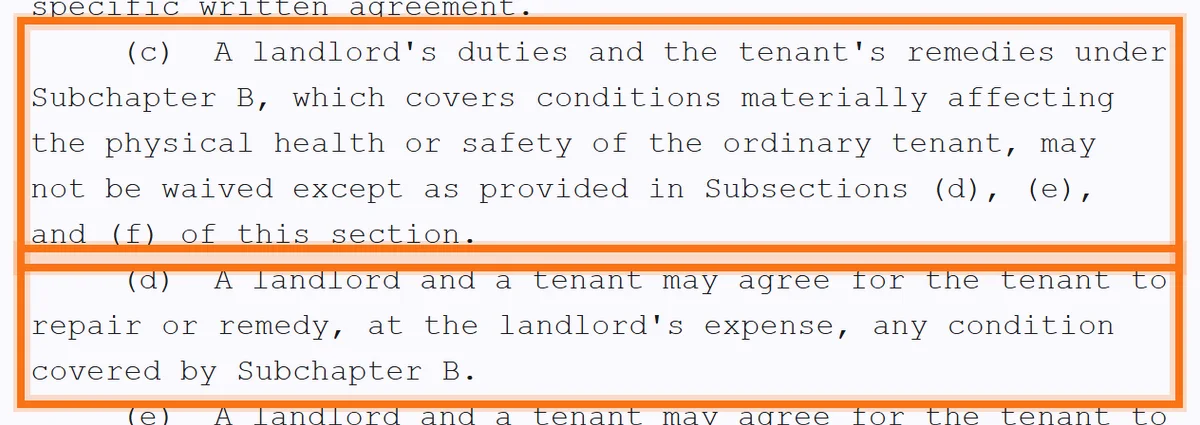
The three exceptions are narrow:
- Tenant repairs at your expense (92.006(d)). Allowed by agreement. This is what a "tenant may fix it and send us the bill" clause does; it does not move the cost.
- Tenant repairs at the tenant's expense (92.006(e)). Only if, at the start of the lease, the landlord owns only one rental dwelling, the home is free of health and safety conditions, the landlord has no reason to expect one, and the agreement is in a written lease, underlined or in bold, specific, clear, and made knowingly, voluntarily and for consideration.
- Tenant pays for three kinds of damage (92.006(f)). Foreign-object stoppages, damage to doors, windows or screens, and damage from windows or doors left open, with the same written-lease requirements.
Repairs by the tenant in lieu of rent, outside these rules, invite disputes over quality and cost. This is general information, not legal advice; a Texas attorney can review your lease wording.
The repair clock: notice, a reasonable time, and the tenant's remedies
The duty in 92.052 starts with notice. The tenant gives it to the person to whom, or the place where, rent is normally paid. Under 92.052(d) it must be in writing only if the lease is in writing and requires written notice. On a managed rental, that is usually the manager's portal or office.
Section 92.056 sets when you become liable to the tenant. In short, the tenant gave notice, the condition materially affects health or safety, a subsequent written notice followed (or the first notice went by certified, registered or tracked mail), you had a reasonable time to repair, you did not make a diligent effort, and the tenant was not delinquent in rent. Under 92.056(d) there is a rebuttable presumption that seven days is a reasonable time, weighed against the severity of the condition and the availability of materials, labor and utilities.
If those conditions are met, 92.056(e) lets the tenant end the lease, have the repair made and deduct the cost from rent under 92.0561, or go to court. Under 92.0561(b), a repair-and-deduct is capped at one month's rent or $500, whichever is greater. After an insured casualty such as hail or fire, 92.054(a) says the repair period does not begin until you receive the insurance proceeds. The full duty list is in Texas landlord repair obligations. This is general information, not legal advice.
Kind 1: emergencies
An emergency is anything that threatens the house or the tenant's safety right now: water coming in, sewage backing up, no heat in a freeze, an electrical hazard, a door that will not lock. It is handled the same hour, at night and on weekends, by whoever holds the emergency phone number you gave the tenant. Texas Property Code 92.020 requires a landlord to give the tenant a phone number for reporting emergencies.
Three guides cover this kind of work: what counts as a maintenance emergency, who handles emergencies at night and on weekends, and a water leak in the middle of the night.
Kind 2: repair requests
Most maintenance is an ordinary request: the dishwasher will not drain, a ceiling fan hums, a gutter is pulling away. The tenant reports it, someone decides how urgent it is and whose cost it is, a vendor goes out, and the job is closed with an invoice. The two decisions that shape this kind of work are your spending limit (what gets fixed without asking you) and the cause (whether the tenant pays under 92.052(b) or the lease).
The guides: what a manager may approve without you, how cause is decided call by call, how a manager keeps its vendor bench, and a tenant who refuses to let a contractor in.
Kind 3: turnover work
Turnover work happens between tenants: the move-out inspection, cleaning, paint, flooring, repairs the last tenancy wore out, and anything you chose to wait on while the house was occupied. It is the one time you can do larger work without working around a tenant's schedule, and every day it takes is a day without rent.
The guides: the move-out inspection, how quickly a manager can get the house ready, and standard paint and finishes for rentals.
Kind 4: preventive work
Preventive work is what you schedule before anything breaks: air conditioning service before the heat, a heating check before the first freeze, the roof and gutters after spring storms, filters, smoke alarm checks, and an inspection that looks for small leaks before they become a ceiling. In Northeast Tarrant County, a roof leak repair or a gutter repair found on a routine visit is a smaller job than the same problem found after the ceiling stains.
The guides: regular HVAC servicing and filter changes, HVAC in Texas rentals, how often a rental is inspected, and foundation and plumbing in North Texas rentals. For an older house, the age of the HVAC, water heater and roof tells you which of these comes first.
The budget line: a reserve you set, not a rule of thumb
Maintenance cost on a rental depends on the house: its age, the age of each major system, the yard, and how the last tenancy went. A percentage borrowed from someone else's portfolio tells you little about yours. A better method is to list the big systems with their ages, ask a vendor or inspector which are near the end of their life, and hold a reserve that covers the next one to fail, plus routine repairs.
Three guides go further: how much a manager keeps in a maintenance reserve, how much to set aside before renting, and whether the rent covers the mortgage, taxes, insurance and management. Repairs and improvements are treated differently for taxes; see rental property taxes in Texas and ask your CPA.
Records: what to keep for every job
Every job should leave four things: the tenant's request with its date, what was found, what was done, and what it cost, with the original invoice. Photos of the finished work matter for large jobs and for anything charged to a tenant or a deposit.
Those records do three jobs. They show you met the repair clock if a tenant says otherwise. They support a deposit deduction for tenant-caused damage. And they show patterns: the same drain three times in a year is a pipe problem, not three clogs. What you should receive after a repair is in repair invoices and photos for owners, and how to keep the books is in rental property bookkeeping basics.
How Perpetual runs maintenance
Perpetual Property Management is broker-owned, with our office in North Richland Hills, and we manage homes in Keller, North Richland Hills, Fort Worth and nearby. What our site states about maintenance:
- Requests. Tenants report issues through their portal with photos, which creates a documented record and lets us triage before dispatching anyone.
- Vendors. Plumbers, electricians, HVAC and general trades we work with repeatedly; you see the invoices, and the original invoice is always in your portal.
- Limits. Routine repairs under your pre-approved limit get fixed fast; anything larger comes to you with a description, photos and a recommendation.
- Emergencies. Anything threatening the property or habitability follows a 24/7 process; 24/7 emergency response is on every plan.
- Prevention and proof. An annual property inspection on every plan, photo reports to your portal, and photo or video proof of every completed repair over $500.
Maintenance coordination is 5% of cost on Full Service and 4.9% on Standard, and make-ready coordination is 3% to 5% of cost on the Investor Special (pricing). The spending limit itself, and how your reserve is held, are confirmed in writing before you sign. See maintenance coordination, or call 682-593-7033.
The takeaway: Maintenance on a Texas rental is one legal rule (92.052, with the narrow exceptions in 92.006) and four kinds of work; an owner who knows which kind each job is, who pays, and where the record lives has a system rather than a string of phone calls.
Questions owners ask
Who pays for what, me or the tenant?
Under Property Code 92.052, you repair conditions that materially affect the tenant's health or safety once the tenant gives notice and is not behind on rent. Under 92.052(b), damage the tenant, an occupant, family or a guest causes, other than normal wear and tear, is not your duty during the lease. Section 92.006(f) lets a lease make the tenant pay for three kinds of damage if it is worded as the statute requires. The lease covers the rest.
Should I let tenants make repairs against rent?
Only within the law. Under 92.006(d), you may agree that the tenant repairs a health or safety condition at your expense. The tenant's own repair-and-deduct remedy under 92.0561 applies only after the 92.056(b) conditions are met and is capped at one month's rent or $500, whichever is greater. Informal repairs in lieu of rent outside those rules invite disputes over quality and cost.
Home warranty companies, worth it for rentals?
A home warranty, called a residential service contract in Texas, can pay for some covered repairs, but it adds a step between the tenant's call and the repair, and the 92.052 duty stays yours either way. If you keep one, give your manager the contract number and the claim steps. Our guide on whether a property manager works with your home warranty company covers the details.
What's a reasonable spending limit to pre-authorize?
There is no standard figure. Set it where routine repairs, such as a disposal or a faucet, get done without waiting for you, and larger jobs still come to you with a description, photos and a recommendation. The rent, the age of the house and your reserve all matter. Emergencies that stop active damage are handled first and reported right away.
How long does a Texas landlord have to make a repair?
Property Code 92.056(d) sets a rebuttable presumption that seven days is a reasonable time to repair after the landlord receives the tenant's notice. The presumption can be rebutted by the date notice was received, the severity and nature of the condition, and the availability of materials, labor and utilities. After an insured casualty such as hail, 92.054(a) starts the repair period only when the landlord receives the insurance proceeds.
Does Texas law require a landlord to provide air conditioning?
No Texas statute names air conditioning. Property Code 92.052 covers conditions that materially affect the health or safety of an ordinary tenant, and whether a broken unit is one depends on the facts. A city may have its own housing rule, so confirm with your city. Our own maintenance page treats "no AC in extreme heat" as an emergency.
Who fixes a roof leak on a rental in Northeast Tarrant County?
The owner, in most cases: a roof leak that lets water into the home is the kind of condition 92.052 covers once the tenant reports it. If a storm caused it and you file an insurance claim, 92.054(a) starts the repair period when you receive the proceeds, but stopping further water damage protects the house either way. Damage the tenant caused is the exception under 92.052(b).
Property management in Keller, North Richland Hills and Fort Worth. How full-service management works in Tarrant County →