Key takeaways
- Property Code 92.052: after notice from a tenant who is current on rent, the landlord must make a diligent effort to repair a condition that materially affects an ordinary tenant's health or safety.
- The owner pays, unless the tenant, an occupant, family or a guest caused it (92.052(b)); then the lease decides how it is billed back.
- Seven days is presumed a reasonable repair time (92.056(d)), but sewage, flooding, no water and failed heating or cooling have faster repair-and-deduct triggers (92.0561(e)).
- A stalled repair can cost a civil penalty of one month's rent plus $500, damages and attorney's fees (92.0563(a)).
- An approval limit handles routine repairs; what your manager may spend in an emergency is a clause to read before you sign.
What does Texas law expect when a rental has a maintenance emergency, and who pays? Once a tenant who is current on rent reports a condition that materially affects health or safety, the landlord must make a diligent effort to repair it, and the owner pays unless the tenant's side caused it. For an owner in Fort Worth, Keller or North Richland Hills, the money risk is not the repair bill; it is the remedies a stalled repair hands the tenant.
This guide covers the statutes section by section, who pays which bill, the arithmetic of a stalled repair, and how approval limits work. What counts as an emergency and how night calls are handled have their own guides, linked below.
The Texas statutes behind a rental emergency
Here is what each section of Property Code chapter 92 says, and what it means for an owner when something breaks at night:
| Section | What it says | What it means in an emergency |
|---|---|---|
| 92.052(a) | After notice from a tenant who is not delinquent in rent, the landlord must make a diligent effort to repair a condition that materially affects the physical health or safety of an ordinary tenant (or a water heater below 120 degrees Fahrenheit) | The duty starts with the tenant's report, not with your approval |
| 92.052(b) | No duty during the lease to repair a condition caused by the tenant, a lawful occupant, family or a guest, unless it is normal wear and tear | Tenant-caused damage is not your repair duty; the lease decides how it is billed |
| 92.052(d) | The notice must be in writing only if the lease is in writing and requires written notice | A phone call can start the clock if the lease does not require writing |
| 92.056(d) | A rebuttable presumption that seven days is a reasonable time to repair, weighed against severity and availability of materials, labor and utilities | Seven days is a ceiling for most repairs, not a target for an emergency |
| 92.0561(b), (e) | Repair-and-deduct capped at one month's rent or $500, whichever is greater; sewage and flooding immediately after the notice of intent, no water or failed heat or cooling after three days, other conditions after seven | The faster triggers match the conditions most likely to be emergencies |
| 92.0563(a) | Court remedies: an order to repair, a rent reduction, a civil penalty of one month's rent plus $500, actual damages, court costs and attorney's fees | A stalled repair costs far more than the repair |
| 92.054(a) | For an insured casualty loss (fire, smoke, hail, explosion or similar), the repair period starts when the landlord receives the insurance proceeds | A covered storm or fire loss runs on the insurance timeline |
| 92.020(d) | A landlord without an on-site office must give the tenant a phone number for reporting emergencies | The tenant must know whom to call |
How to read this table: the first rows set the duty and its limits, the middle rows set the clock and what the tenant may do if it runs out, and the last rows are the special cases. Most of the tenant's remedies also require the conditions in 92.056(b): proper notice, a reasonable time, no diligent effort, and rent paid up. This is general information, not legal advice.
What counts as an emergency, in short
An emergency is a condition that threatens health or safety or will seriously damage the house if it waits until morning: a leak that will not stop at a shutoff, sewage backing up, no water, a gas smell, sparking or a hot panel, no heat in a freeze, no cooling in dangerous heat, a door that will not lock. A running toilet or a slow drain is a repair for the next business day.
The full list, with the borderline cases, is in what counts as a maintenance emergency at a rental. How the night call itself is handled is in how property managers handle after-hours emergencies and who handles rental emergencies at night and on weekends. This guide stays on the law and the money.
The repair clock, and what a stalled repair costs
The clock starts when the tenant gives notice to the person or place where rent is normally paid (92.052(a)(1)). Section 92.056 then sets when the landlord becomes liable: notice given, a condition affecting health or safety, a reasonable time to repair, no diligent effort, and the tenant current on rent. A second written notice is needed unless the first went by certified, registered or tracked mail (92.056(b)(3)). Seven days is presumed reasonable (92.056(d)), but a night-time leak is not a seven-day job.
Repair-and-deduct (92.0561) has faster triggers for the classic emergencies: sewage backup or flooding inside the home can be repaired immediately after the tenant's notice of intent to repair; a total loss of water the landlord agreed to furnish, after three days. Inadequate heating or cooling also has a three-day trigger, but only after a local housing, building or health official has notified the landlord in writing. Repairs must be made by an independent licensed contractor where the city requires one (92.0561(f)).
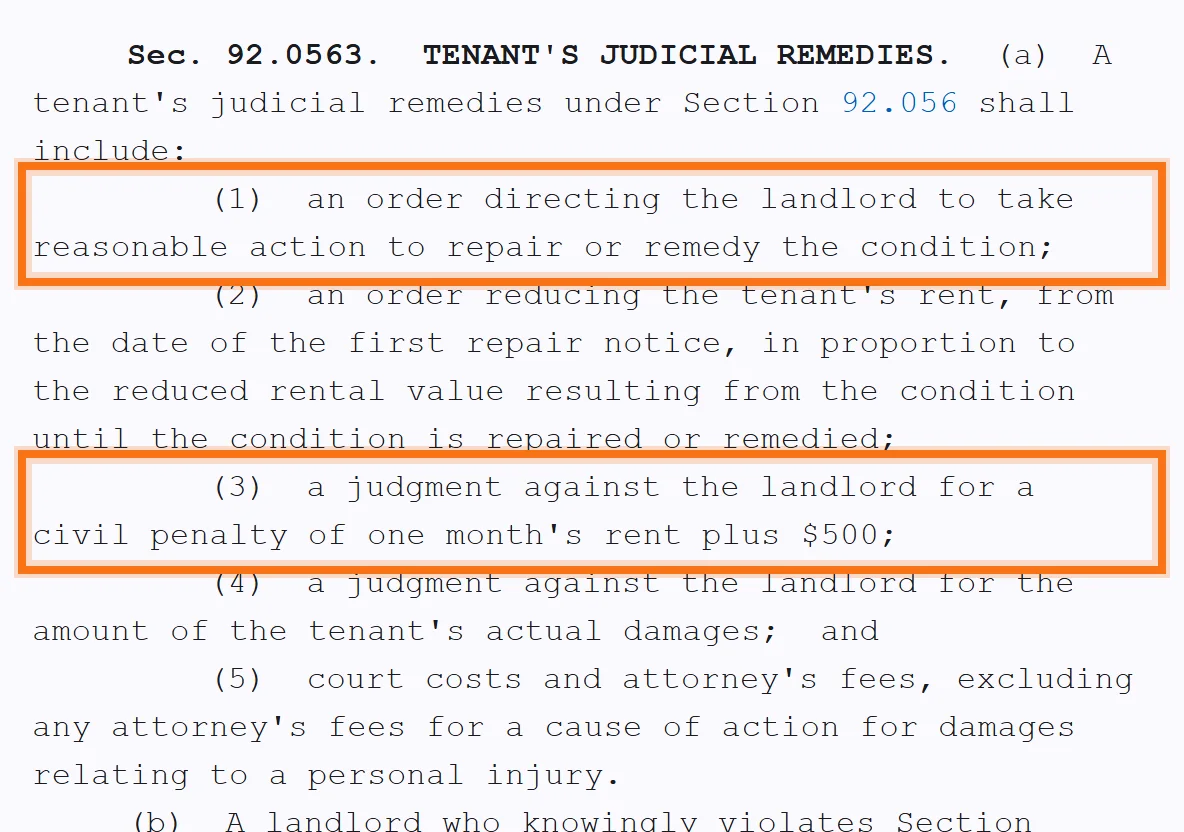
Illustrative only, on a house renting for $1,800: the repair-and-deduct cap is the greater of $1,800 or $500, so $1,800 in a month (92.0561(b), (c)). The civil penalty is $1,800 + $500 = $2,300, before damages, court costs and fees (92.0563(a)(3)). A landlord may delay a tenant's repair with a sworn affidavit only for a parts delay (15 days) or a post-disaster shortage (30 days) under 92.0562; a bad-faith affidavit raises the penalty to one month's rent plus $1,000, here $2,800. Texas landlord repair obligations covers the rest of the subchapter. This is general information, not legal advice.
Who pays which emergency bill
Here is how the usual emergency bills split between the owner, the tenant and the insurer:
| Emergency | Who pays first | Why |
|---|---|---|
| Water heater fails from age and floods the closet | Owner | A condition of the house, not caused by the tenant: 92.052(a) |
| Toilet overflows because a toy was flushed | Tenant, if the lease says so | Caused by the tenant's household: 92.052(b); 92.006(f)(1) allows a lease clause for foreign-object stoppages in lines serving only that home |
| Sewer backs up from roots or a broken line | Owner | 92.006(f) keeps roots, breakage and ground conditions the landlord's duty |
| Burst pipe in a freeze, storm roof leak, fire | Owner, then possibly the landlord insurance policy | Repair period for an insured casualty starts when proceeds arrive: 92.054(a); coverage is the policy's terms |
| Tenant locked out after losing the key | Usually the tenant, per the lease | No statute assigns it; the lease does |
How to read this table: the owner is the default payer for the house and its systems; the tenant pays only where the tenant's side caused the damage and the lease provides for the charge. What the tenant owes and does not pay can be deducted from the deposit at move-out as a charge "for which the tenant is legally liable under the lease" (92.104(a)), with an itemized list.
Deciding cause is where disputes start. The vendor's notes and photos usually settle it; how a manager decides whether a repair is the tenant's responsibility walks through it. For insured losses, see how a manager works with your insurer during a claim.
Approval limits, and why emergencies need their own clause
A management agreement usually sets a dollar limit below which the manager authorizes repairs without calling you, and above which you approve first. That works for a dripping faucet. It cannot work at two in the morning with water coming through a ceiling, which is why the agreement should also say, in plain words, what the manager may spend in an emergency, for what purpose, and how fast you are told.
Read that clause for three things: a purpose limit (make the home safe and stop the damage), a notice promise (when and how you hear about it), and where the money comes from (the reserve, or rent collected). The permanent repair, unlike the night visit, can usually wait for your decision. Whether a manager can approve expensive repairs without your permission covers the clause in more depth.
Remember the law runs underneath it: an owner who is out of reach does not stop the 92.052 clock.
What an emergency repair bill looks like on your statement
On a managed rental, an emergency repair reaches you as the vendor's invoice plus whatever the agreement adds. On our price sheet, maintenance coordination is a percentage of the vendor's invoice: 5% on Full Service and 4.9% on Standard; the Investor Special sheet lists make-ready coordination at 3% to 5% of cost. The original invoice is always in your portal.
Illustrative only, not a quote: a $600 plumbing invoice for a burst supply line becomes $600 + $30.00 = $630.00 at 5%, or $600 + $29.40 = $629.40 at 4.9%. Because it is over $500, our documented work guarantee adds photo or video proof of the completed repair in your portal.
Two lines are worth checking in any agreement: whether a night or weekend call carries its own fee (see whether after-hours calls are billed separately), and how the money is on hand when the bill arrives before rent does (see how much reserve to keep per rental).
How Perpetual handles emergencies and approvals
Here is what our site states:
- Around the clock: every plan on our price sheet includes 24/7 emergency response; the Standard and Full Service lines say 24/7 emergency live response.
- What counts: our maintenance page lists anything threatening the property or habitability: active leaks, no AC in extreme heat, no heat in winter, electrical hazards. Emergencies follow a 24/7 process; routine items follow the standard workflow.
- Approval limits: routine repairs under your pre-approved limit get fixed fast; anything larger comes to you with a description, photos and a recommendation.
- Records: what was reported, what was done and what it cost, in your portal, with the original invoice and photo or video proof of every completed repair over $500.
What we may spend above your limit in an emergency, and the reserve we hold for it, are confirmed in writing before you sign. To set up the limit for your house, request a free rental analysis or call 682-593-7033.
The takeaway: In a Texas rental emergency the law is simple and the money follows it: after notice, repair with diligence; the owner pays unless the tenant's side caused it; and a stalled repair costs more than a fast one. Set the approval limit and the emergency clause in writing before the night it matters.
Questions owners ask
Is no air conditioning an emergency in a Texas rental?
No Texas statute names air conditioning, so the lease and the facts decide. A home without cooling in a North Texas summer can be a condition that materially affects health or safety under 92.052, and many managers, including us, treat no AC in extreme heat as an emergency. Repair-and-deduct for inadequate cooling (92.0561(d)(3)(C)) also requires written notice from a local housing, building or health official. See our broken-AC response time guide.
How quickly does a landlord have to fix something in Texas?
Texas requires a diligent effort within a reasonable time after the tenant's notice, with a rebuttable presumption that seven days is reasonable (Property Code 92.056(d)). Severity counts: a flood or sewage backup can be repaired by the tenant right after a notice of intent if the landlord is liable, and no water allows it after three days (92.0561(e)). This is general information, not legal advice.
Who pays for emergency repairs in a rental?
The owner pays for repairs to the home and its systems unless the tenant, an occupant, family or a guest caused the condition (Property Code 92.052(b)); then the lease decides how it is billed back, and an unpaid charge can come out of the deposit with an itemized list (92.104). Fire, storm and burst-pipe losses may also go to the landlord policy.
Can my property manager spend money without my approval?
Up to the limit your management agreement sets, yes. Above it, only as the agreement says, and that clause matters most in an emergency: it should state the purpose (make it safe, stop the damage), how quickly you are told, and where the money comes from. With us, repairs under your pre-approved limit go ahead; larger ones come to you with a description, photos and a recommendation.
What counts as a maintenance emergency at a rental property?
Anything that threatens health or safety or will seriously damage the house if it waits until morning: an active leak that will not stop at a shutoff, sewage backing up, no water, a gas smell, electrical hazards, no heat in a freeze, no cooling in dangerous heat, a door that will not lock. Our separate guide on what counts as a maintenance emergency covers the borderline cases.
What if an emergency repair is needed and the manager can't reach me?
The agreement answers it before it happens: a dollar limit for routine work, and a separate emergency clause that lets the manager make the home safe and stop the damage, with notice to you. The legal clock under 92.052 does not wait for you, so an owner who is hard to reach should settle the emergency clause and the reserve in writing at signing.
Can a tenant fix an emergency and deduct it from the rent in Texas?
Only if the landlord is liable under Property Code 92.056 and the 92.0561 conditions are met, including a notice of intent to repair. The deduction is capped at one month's rent or $500, whichever is greater, the work must be done by an independent contractor (licensed where the city requires), and the tenant must give the landlord the repair bill and receipt with the rest of the rent.
What can a tenant get in court if a landlord ignores an emergency repair?
Under Property Code 92.0563(a): an order to repair, a rent reduction from the first repair notice until the repair, a civil penalty of one month's rent plus $500, actual damages, and court costs and attorney's fees (excluding fees for a personal-injury damages claim). A justice court may not award more than $20,000 under that section. This is general information, not legal advice.
Related services
Property management in Keller, North Richland Hills and Fort Worth. How full-service management works in Tarrant County →