Key takeaways
- Each repair is decided on its own evidence: what the vendor found and wrote down, photos of the cause, and the condition recorded at move-in.
- Property Code 92.052(b): unless caused by normal wear and tear, a landlord has no duty during the lease to repair a condition caused by the tenant, an occupant, a family member or a guest.
- Normal wear and tear includes breakage or malfunction due to age or deteriorated condition (92.001), so a part that simply wore out stays with the owner.
- A lease may make the tenant pay for drain stoppages from foreign objects, damage to doors, windows or screens, and damage from windows or doors left open, only under the strict terms of 92.006(f); roots, breakage and ground conditions stay the landlord's.
- An unpaid charge can come out of the deposit only if the tenant is legally liable for it, with a written, itemized list (92.104).
A property manager decides it one call at a time, on evidence. If the problem affects health or safety, it is fixed first. Then the vendor's written finding on the cause, photos, and the move-in condition record are compared with the lease and Texas law. For a rental in Fort Worth, Keller or North Richland Hills, the cost shifts to the tenant only when the tenant's household or guests caused it beyond normal wear, or when the lease validly assigns it under Property Code 92.006.
This guide walks through a single repair call from report to decision, the common calls in a table, what the statutes allow, an example of a charge reaching the deposit, and how a fair decision is written up.
Common repair calls at a Fort Worth area rental and how cause is decided
Here is how the cause of common repair calls is usually settled, what evidence decides it, and where the cost lands:
| Repair call | Evidence that decides it | Usually the owner's when | Can be charged to the tenant when |
|---|---|---|---|
| Clogged toilet or drain | Plumber's written note on what was found in the line, with a photo | Roots, breakage, ground conditions, faulty construction or failed equipment | A foreign or improper object in a line serving only that home, and the lease meets 92.006(f) |
| Broken window, door or screen | Photos, the move-in record, the tenant's account | Hail, a storm, age, or the landlord's negligence | The household or a guest broke it, and the lease covers it |
| Water damage from a window or door left open | Photos, weather on the date, the tenant's account | The opening failed on its own | Left open by the household, and the lease meets 92.006(f) |
| Water heater, AC or appliance stops working | Vendor's note on the failed part and why it failed | Breakage or malfunction due to age or deteriorated condition (normal wear) | Vendor documents misuse or damage by the household |
| Hole in a wall, broken fixture, pet damage | Photos against the move-in record | It was there at move-in | Caused by the household, a guest or a pet beyond normal wear |
How to read this table: the middle column is the whole decision. A plumber who writes "cleared stoppage" has not settled who pays; one who writes "recovered a toy from the toilet trap, no roots, line intact" has. Where the evidence is missing or mixed, the honest call is the owner's, because a charge you cannot support will not survive a deposit dispute.
One repair call, from report to decision
- The report. The tenant describes the problem, ideally with a photo. The report itself is evidence: when it came in and what the tenant said happened.
- Triage. Does it affect health or safety, or is the house being damaged? If yes, the repair goes ahead now and the cost question waits.
- The vendor's finding. The vendor is asked in advance to write down the cause, name the failed part and photograph what was found.
- The record. The finding is compared with the move-in condition report and earlier photos of the same spot.
- The lease and the law. Does the lease assign this item, and is the term valid under 92.006? Was the cause the household, or normal wear?
- The decision, in writing, to the tenant and the owner, with the evidence attached.
Most calls are settled at step 3. A worn-out part goes to the owner; a toy in the toilet trap, documented, goes to the tenant if the lease covers it.
The legal line: tenant-caused damage vs normal wear and tear
Two definitions do most of the work. Property Code 92.052(b) says that unless the condition was caused by normal wear and tear, the landlord does not have a duty during the lease term or a renewal or extension to repair or remedy a condition caused by the tenant, a lawful occupant, a member of the tenant's family, or a guest or invitee of the tenant.
Section 92.001 defines normal wear and tear as deterioration from the intended use of a dwelling, including, for the repair subchapter, breakage or malfunction due to age or deteriorated condition. It excludes deterioration from negligence, carelessness, accident or abuse by the tenant, the household, or a guest. So a dishwasher pump that fails after years of use is the owner's; a dishwasher door broken by someone standing on it is not. For room-by-room examples of the line, see what's normal wear and tear, and what can be charged to the tenant.
Note what 92.052(b) does and does not do: it removes the landlord's duty to repair a tenant-caused condition during the lease. Whether the tenant must pay for it is a question for the lease and, at move-out, for the deposit rules.
What a Texas lease can and cannot shift to the tenant
Property Code 92.006(c) says the landlord's duties and the tenant's remedies for conditions that materially affect the physical health or safety of an ordinary tenant may not be waived, except as subsections (d), (e) and (f) allow. Subsection (d) lets the tenant agree to do repairs at the landlord's expense. Subsection (e) allows repairs at the tenant's expense only if, at the start of the lease, the landlord owns only one rental dwelling, the dwelling is free of such conditions, the landlord has no reason to expect one, and the agreement meets subdivision (4): a written lease, the repair term underlined or in bold, specific and clear, and made knowingly, voluntarily and for consideration.
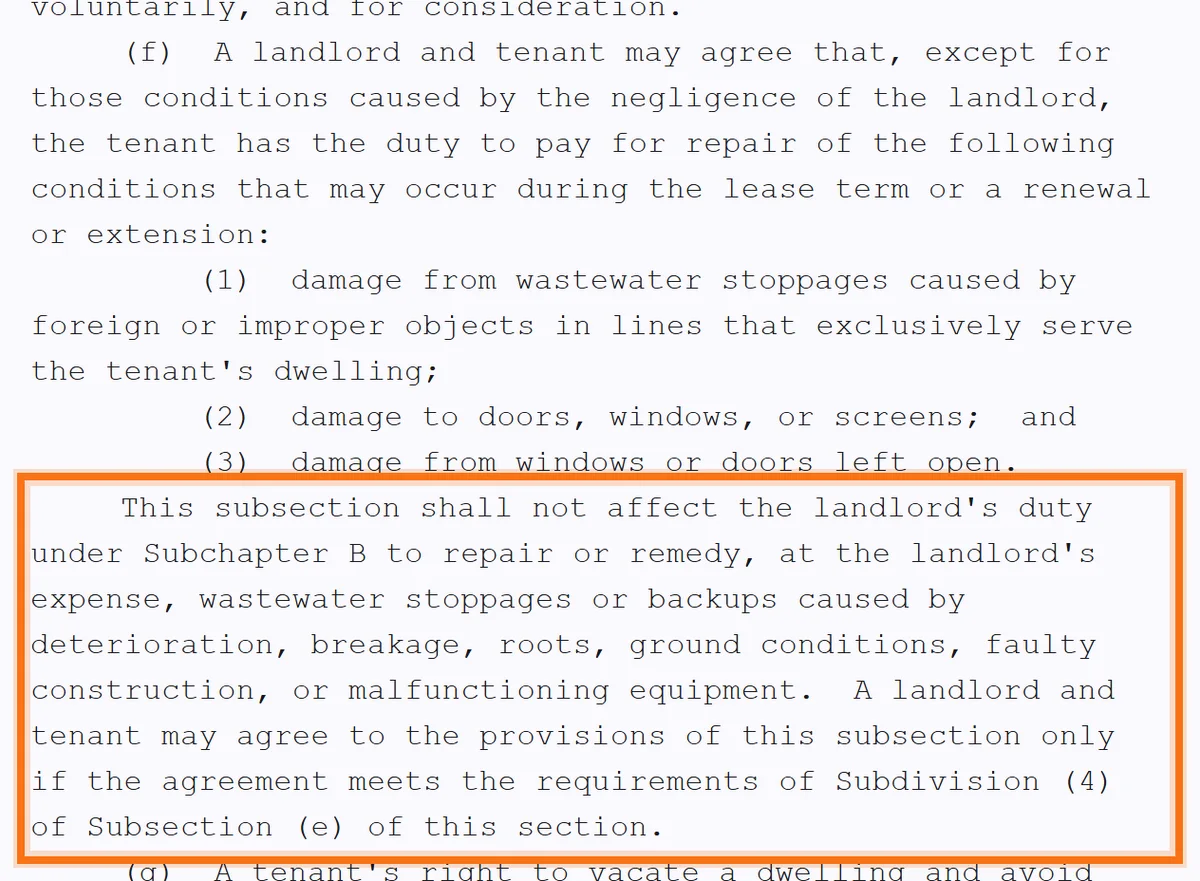
Subsection (f) is narrower and does not depend on how many rentals you own. Except for conditions caused by the landlord's negligence, the tenant may agree to pay for three things: damage from wastewater stoppages caused by foreign or improper objects in lines that exclusively serve the tenant's dwelling, damage to doors, windows or screens, and damage from windows or doors left open. The same subdivision (4) requirements apply. Clogs from roots or ground conditions (on clay soils, see foundation and plumbing in North Texas rentals) stay the landlord's. This is general information, not legal advice.
The evidence that settles the cause
The vendor's written finding is the strongest single piece. Ask vendors, before they go, to write the cause in plain words, name the failed part, and photograph the part or the object they removed. "Cleared line" settles nothing; "removed wipes and a toy from the toilet trap, no roots, line intact" settles a lot.
Photos matter twice: the vendor's photo of the cause, and the move-in photo of the same spot, which shows whether the damage was there before. A dated report from the tenant helps too, especially when it says what happened.
What does not count is a guess. "Probably the tenant" is not a finding. If the evidence is thin, the cost stays with the owner, which is cheaper than a charge you will lose. Our guide on repair invoices and photos explains what each job record should contain.
Illustrative example: a charge that ends up in the deposit
Illustrative only, not a quote: the amounts are assumed for the arithmetic. During the lease, a plumber clears a toilet and writes that a toy was removed from the trap, with a photo. The lease has a 92.006(f) clause for stoppages caused by foreign objects. The owner's funds pay the plumber's $185 invoice so the repair is not delayed, and the tenant is billed $185 under the lease. The tenant does not pay.
At move-out, the inspection against the move-in photos also finds a torn screen, and the lease covers damage to screens. The deposit was $1,800. The deductions are $185 + $120 for the screen = $305, so the refund is $1,800 - $305 = $1,495, sent with the written description and itemized list of deductions that Property Code 92.104(c) requires. Under 92.104(a) and (b), a deduction must be a charge the tenant is legally liable for under the lease or for breaching it, and nothing may be kept for normal wear and tear.
If the charges are larger than the deposit, see when damage or unpaid rent exceeds the deposit.
Fix first, decide second
Fault decides who pays; it does not decide whether the repair happens. A condition that materially affects health or safety still needs prompt action even if the tenant may have caused it, because until the cause is documented you do not know that it was, and a stalled repair can expose the owner to the tenant remedies in Property Code 92.056. Our guide to Texas landlord repair obligations covers that duty and its timing.
The order is always the same: make the home safe, have the vendor document the cause, then decide the bill. Deciding the bill on the phone before anyone has looked is how charges get reversed later. This is general information, not legal advice.
Writing the decision so it holds up
A decision that holds up names the repair and date, quotes the lease paragraph it relies on, attaches the vendor's finding and photos, and states the amount and when it is due under the lease. A decision that charges the owner should be just as clear, so the owner knows why.
Consistency matters as much as wording. The same kind of call should get the same answer for every tenant at every house, which is fair and easier to defend. When a tenant disputes a charge, the answer is the evidence, not a stronger tone; if the evidence does not support the charge, withdraw it.
Keep every decision in the house's file. At move-out, the itemized deposit list should match the charges already decided during the tenancy, which is what makes the move-out inspection straightforward.
How Perpetual handles repair responsibility
Perpetual Property Management manages homes in Keller, North Richland Hills, Fort Worth and nearby. Tenants report maintenance requests through their portal with photos, which creates a documented record and lets us triage before dispatching anyone. Emergencies follow a 24/7 process; routine items follow the standard workflow. Routine repairs under your pre-approved limit get fixed fast, and anything larger comes to you with a description, photos and a recommendation.
Our leasing work includes Texas-compliant leases and move-in documentation, and every move-in and move-out gets a 360-degree condition inspection under the Perpetual Promise, subject to its Guarantee Addendum. The move-out inspection is measured against the move-in baseline, which is what makes fair, defensible deposit decisions possible. Every job is documented in your owner portal with what was reported, what was done and what it cost, and the vendor's original invoice is always there.
How tenant-caused repairs are billed to the tenant and shown on your statement is confirmed in writing before you sign. See maintenance coordination or call 682-593-7033.
The takeaway: Fix first, then decide on evidence: the vendor's written cause, photos and the move-in record, measured against the lease. A charge to the tenant needs tenant-caused damage beyond normal wear, or a lease term that meets Property Code 92.006(f); anything taken from the deposit needs an itemized list under 92.104.
Questions owners ask
Can a landlord charge a tenant for a plumber if the tenant caused the clog?
Yes, when the lease covers it and the plumber documents that the stoppage came from a foreign or improper object. Property Code 92.006(f) lets a lease make the tenant pay for damage from such stoppages in lines serving only that home, if the clause is underlined or bold, specific and clear. Stoppages from roots, breakage or ground conditions stay the landlord's. This is general information, not legal advice.
What repairs can a tenant be charged for in Texas?
Damage caused by the tenant, an occupant, family member or guest beyond normal wear and tear, if the lease makes the tenant liable, and the items Property Code 92.006(f) allows a lease to assign: stoppages from foreign objects, damage to doors, windows or screens, and damage from windows or doors left open. Broader tenant-paid repair clauses are limited by 92.006(e). This is general information, not legal advice.
What is the difference between normal wear and tear and tenant damage?
Texas defines normal wear and tear in Property Code 92.001 as deterioration from the intended use of the dwelling, including, for repairs, breakage or malfunction due to age or deteriorated condition. It excludes deterioration from negligence, carelessness, accident or abuse by the tenant, the household or a guest. A part that wore out is wear; a part someone broke is damage.
Does the tenant have to pay for a repair before it is done?
Usually not. The repair is done first, typically from the owner's funds, so the home is not left broken while cause is decided, and the tenant is billed afterward under the lease if the evidence shows the household caused it. An unpaid charge the tenant is legally liable for can be deducted from the deposit at move-out with an itemized list under Property Code 92.104.
What if the vendor cannot tell what caused the damage?
Then the charge usually stays with the owner. A charge to the tenant needs evidence that the household or a guest caused it beyond normal wear and tear, such as the vendor's written finding, photos of the cause and the move-in record. "Probably the tenant" is not a finding, and an unsupported charge is unlikely to survive a deposit dispute.
Can my lease make the tenant responsible for all repairs in Texas?
Generally not for conditions that materially affect health or safety. Property Code 92.006(c) bars waiving those duties except under (d), (e) and (f). Subsection (e) allows tenant-paid repairs only if the landlord owns just one rental dwelling at the start of the lease, among other conditions, with the term underlined or in bold, specific, and agreed knowingly and for consideration. Ask a Texas attorney before relying on such a clause.
Related services
Property management in Keller, North Richland Hills and Fort Worth. How full-service management works in Tarrant County →