Key takeaways
- ENERGY STAR advises a cooling check-up in spring and a heating check-up in fall, because contractors get busy once summer and winter come.
- The National Weather Service gives November 22 and March 12 as the average first and last freeze dates at Dallas/Fort Worth: plan freeze prep before the first and irrigation start-up after the last.
- Who does each task is set by the lease (tenant duties) and the management agreement (what the manager books); the vendor's work is the owner's cost.
- Texas puts the smoke alarm test at the start of each tenancy on the landlord, and does not require the landlord to supply batteries afterward if the alarm worked at move-in (Property Code 92.258(b), (f)).
- A calendar only works if one person owns it and every visit leaves a record.
A preventive maintenance calendar for a North Texas rental is a dozen tasks tied to the weather: a cooling check-up in spring, a heating check-up in fall, filters on a schedule, irrigation and drainage after the last freeze, and freeze prep before the first one. On a rental in Fort Worth, Keller or North Richland Hills, the lease says which of those the tenant handles, you pay for the vendor visits, and a manager books them and keeps the record.
Below is the month-by-month table with who does each task, then each season in more detail, what to put in the lease so the tenant's share actually happens, and what our published pages say we do.
The month-by-month calendar: the task and who does it
Here is a twelve-month calendar for a single-family rental in Tarrant County. The "who" column is the usual split; your lease and management agreement are what actually decide it:
| When | Task | Who | Why then |
|---|---|---|---|
| January and February | After each hard freeze, ask the tenant to check every faucet runs and report any leak; check hose-bib covers | Tenant reports; manager dispatches; owner pays the repair | The NWS DFW freeze summary shows January with the most freeze days on average (1991-2020) |
| March | After the average last freeze (March 12), restart irrigation and run each zone; look for split hose bibs | Owner or manager arranges; tenant if the lease gives them the yard | A split line shows only when water flows again |
| April | Cooling system check-up: coils, refrigerant, condensate drain, electrical connections | Manager books; owner pays the vendor | ENERGY STAR: cooling in spring, before contractors get busy |
| May | Gutters, downspouts and drainage away from the slab; look at the roof from the ground after storms | Manager or owner | Spring storms; water should leave the foundation |
| June to August | Filter on the schedule the lease sets; condenser kept clear; yard watering per the lease | Tenant if the lease says so; manager checks at visits | ENERGY STAR: inspect, clean or change filters once a month |
| September | Note the age of the water heater, HVAC and roof; plan any replacement for the slow season | Owner decides; manager prices it | A planned replacement gets quotes; a failure does not |
| October | Heating check-up: gas connections, burner, heat exchanger; detectors and dryer vent | Manager books; owner pays | ENERGY STAR: heating in fall |
| November | Freeze prep before the average first freeze (November 22): insulate exposed pipes, cover hose bibs, shut irrigation down at the backflow | Owner pays; manager arranges; tenant disconnects hoses | NWS first-freeze date; Fort Worth Water freeze steps |
| December | Freeze reminder to the tenant; confirm the tenant knows where the main water shut-off valve is | Manager or owner sends it | Fort Worth Water: everyone should know the shut-off |
| Each turnover | Test smoke alarms; rekey within seven days; service per the manuals while the house is empty | Owner or manager | Property Code 92.258(b) and 92.156(a) |
| Once a year | An inspection inside the house with photos | Manager (Perpetual: annual property inspection on every plan) | Catches what no one reports |
How to read this table: the dates come from the National Weather Service, ENERGY STAR and the Property Code, not from a rule that binds you, so adjust them to your house and its age. The "who" column is the one to settle in writing: a task with no name next to it is the one that does not get done. Which of these tasks a management fee covers, and which are billed, is the subject of whether preventive maintenance is included or only repairs.
Every month: filters, leaks and smoke alarms
Three things do not wait for a season. Filters: ENERGY STAR says to inspect, clean or change the filter in a central air conditioner, furnace or heat pump once a month, because a dirty filter can raise energy costs and damage the equipment. In a rental that is usually the tenant's job if the lease says so, with a check at each visit.
Leaks: a slow drip under a sink is cheap when it is reported and expensive when it is found at move-out. The lease should ask the tenant to report leaks promptly; under Property Code 92.052 the landlord's repair duty for conditions affecting health or safety starts when the tenant gives notice.
Smoke alarms: section 92.258 sets the split. The landlord tests the alarm at the start of the tenant's possession (b); during the lease, the duty to inspect or repair arises when the tenant reports a malfunction or asks (c); and the landlord is not obligated to provide batteries after move-in if the alarm worked then (f).
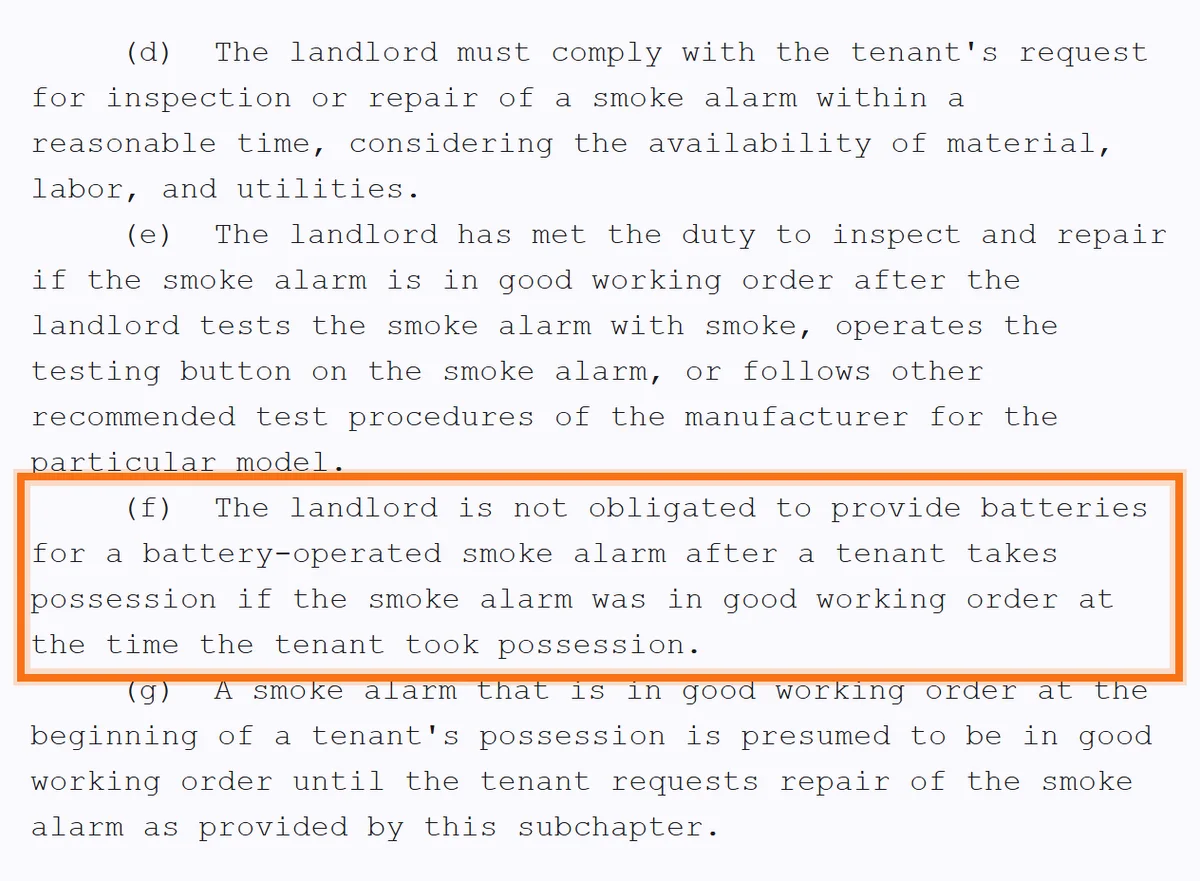
So a battery change mid-lease is normally the tenant's, and a dead alarm reported in writing is the owner's to fix within a reasonable time (92.258(d)). The full rules are in Texas security device and smoke alarm rules. This is general information, not legal advice.
Spring: irrigation, the cooling check-up and drainage
March is the switch-over month. Once the hard freezes are past (the National Weather Service gives March 12 as the average last freeze at Dallas/Fort Worth), turn the irrigation back on and run each zone: broken heads, leaks at the valves and a controller still on its winter setting all show up now. A hose bib that split in a January freeze often leaks only when someone opens it again, so test each one.
April is for the cooling check-up. ENERGY STAR's checklist describes the visit: thermostat settings, electrical connections, lubrication, the condensate drain, coil cleaning, refrigerant level and blower airflow. Its timing advice is the useful part for a landlord: contractors get busy once summer comes, so book the cooling check in spring. More on the system itself is in HVAC in Texas rentals.
May is gutters, downspouts and drainage. Water should run away from the slab, not pool beside it. After a hail or wind storm, a look at the roof from the ground and a call to the tenant is the start; what a proper post-storm check covers is in checking a house after a hailstorm.
Summer: the AC, the condensate line and the yard
Summer is when an AC problem becomes an emergency. Three small things keep it from happening. The filter goes on its schedule. The outdoor condenser stays clear of grass clippings, leaves and stored items so air moves around it. And the condensate drain stays open: ENERGY STAR notes that a plugged drain can cause water damage in the house, which in an attic unit means a ceiling.
The yard is a lease question. In many single-family leases the tenant waters and mows; if you want the soil along the foundation watered on a schedule, say so in the lease, provide the hose or irrigation zone that makes it practical, and follow your city's watering rules. Doors that start to stick and new drywall cracks are worth a photo and a note to the owner; what those signs can mean is in spotting foundation problems early.
Summer visits are also the time to look in the attic on an inspection: insulation, signs of roof leaks, and ductwork that has come loose.
Fall: the heating check-up and the replacement plan
October is the heating check-up. ENERGY STAR advises checking the heating system in the fall, and for gas equipment its checklist includes gas connections, gas pressure, burner combustion and the heat exchanger, because a faulty connection is a fire hazard and a cracked heat exchanger makes the equipment run less safely. Pair the visit with a check of the carbon monoxide and smoke alarms and a cleaning of the dryer vent.
September is the right month for the replacement plan. Note the age of the water heater, the HVAC system and the roof, and ask for prices on anything near the end of its life. A replacement planned for the slow season gets competing quotes; one forced by a failure in July or January gets whoever is free. Flush and service the water heater as its manufacturer's manual says rather than on a rule of thumb.
Late October and November also cover the irrigation: shorten the schedule, and plan the shutdown for the first freeze forecast.
Winter: the freeze season
The National Weather Service gives November 22 as the average first freeze at Dallas/Fort Worth, so the prep belongs in early November: foam sleeves on exposed pipes in the attic and garage, insulated covers on hose bibs, and the irrigation shut down at the controller and the backflow device. Fort Worth Water's freeze page also asks that everyone in the household knows where the main water shut-off valve is and checks that it works, which makes a reminder to the tenant part of the calendar.
January and February are the watch months: after each hard freeze, ask the tenant to confirm the heat runs and every faucet flows, and treat a "no" as urgent. The owner's hands-on checklist is in the Texas rental freeze checklist, and what to agree with a manager before a freeze is in how a property manager handles a Texas freeze.
Put the tenant's share in the lease
About half of this calendar happens inside the tenant's day: filters, hoses, reporting a drip, the yard. Those tasks get done when the lease names them, not when a manager hopes. Write them in plainly:
- Filters: who replaces them and how often, and who supplies them.
- Yard and watering: who mows and waters, including any foundation watering you want.
- Reporting: leaks, a failed smoke alarm and anything that affects heat, cooling or hot water, reported promptly and how (92.052(d) lets a written lease require written notice).
- Freeze duties: hoses disconnected, heat left on when away, and access to the main shut-off.
- Access: how much notice the tenant gets before a scheduled check-up. No Texas statute sets that notice; the lease does.
The owner's side stays with the owner: the vendor visits, the replacements and the repairs under 92.052. How the whole maintenance system fits together is in the owner's maintenance system for a North Texas rental. This is general information, not legal advice.
How Perpetual handles preventive maintenance
What our published pages say about preventive work on the homes we manage in Fort Worth, Keller, North Richland Hills and nearby:
- Inspections. Every plan on our price sheet includes an annual property inspection. Our inspections page says photo reports go to your owner portal, anything found feeds into maintenance coordination with a recommendation, and extra inspections can be arranged when something warrants a look.
- Planned attention. Our maintenance page says planned attention to aging HVAC, water heaters and roofs beats emergency pricing, and that maintenance works hand in hand with scheduled inspections.
- Approvals. Routine repairs under your pre-approved spending limit get fixed fast; anything larger comes to you with a description, photos and a recommendation.
- Billing and records. Maintenance coordination is 5% of cost on Full Service and 4.9% on Standard (make-ready coordination 3% to 5% on Investor Special), as a percentage of the vendor's invoice; the original invoice is always in your portal.
Which calendar tasks we book on your house, and your spending limit for them, are confirmed in writing in the management agreement before you sign. Call 682-593-7033 to talk it through.
The takeaway: Put a dozen dated tasks on one calendar, name who does each one in the lease and the management agreement, and keep a record of every visit.
Questions owners ask
How often should HVAC be serviced on a rental in Texas?
ENERGY STAR advises annual pre-season check-ups by a contractor: the cooling system in the spring and the heating system in the fall, because contractors get busy once summer and winter come. Between visits, it says to inspect, clean or change the filter once a month. In a rental, the lease says who handles the filter.
Should tenants water the foundation in North Texas?
Only if the lease says so. In many single-family leases the tenant handles the yard, and foundation watering can be written in as part of it. If you want it done, put it in the lease, provide a hose or irrigation zone that makes it practical, and follow your city's watering rules.
What maintenance is a tenant responsible for in Texas?
The lease decides most of it: commonly filter changes, lawn care, freeze precautions and prompt reporting of problems. Texas law adds two points: the landlord need not repair conditions the tenant caused unless they are normal wear and tear (Property Code 92.052(b)), and need not provide smoke alarm batteries after move-in if the alarm worked then (92.258(f)). This is general information, not legal advice.
How often should a water heater be flushed in a rental?
Follow the manufacturer's manual for that water heater, since flushing and relief-valve testing differ by model. A fall visit is a convenient time to have it serviced and to note its age, so a replacement can be planned for a slow season instead of forced by a failure.
Is preventive maintenance included or only repairs when something breaks?
It depends on the manager and the agreement, so ask before signing. With us, every plan includes an annual property inspection, and maintenance coordination is a percentage of the vendor's invoice (5% Full Service, 4.9% Standard; make-ready 3% to 5% on Investor Special), with the original invoice in your portal. The vendor's work is billed to you. The full breakdown is in our guide on whether preventive maintenance is included.
When is the first freeze in Dallas-Fort Worth?
The National Weather Service's Fort Worth office gives November 22 as the average date of the first freeze at Dallas/Fort Worth and March 12 as the average last freeze. Early and late freezes happen, so do the freeze prep in early November and wait until after mid-March to restart the irrigation.
Does a tenant have to replace smoke alarm batteries in Texas?
Property Code 92.258(f) says the landlord is not obligated to provide batteries for a battery-operated smoke alarm after the tenant takes possession, if the alarm was in good working order then. The landlord tests it at the start of the tenancy (92.258(b)) and repairs it during the lease when the tenant reports a problem (92.258(c)).
Property management in Keller, North Richland Hills and Fort Worth. How full-service management works in Tarrant County →