Key takeaways
- A manager can spot and document early signs of foundation movement; it cannot tell you whether the foundation is failing or how to fix it.
- Texas's standard for licensed home inspectors lists the visible signs: binding or non-latching doors, framing separations, sloping floors, cracks and masonry movement (22 TAC 535.228).
- Three sets of eyes see a rental: the tenant every day, vendors on service calls and the inspection. Each catches different signs.
- What makes a sign useful is the date: a crack compared with the move-in photos shows change, which is what you act on.
- An engineer's evaluation and any repair are your decisions; the manager arranges access, keeps the record and reports back.
Can a property manager help identify foundation problems before they get worse? Yes, as an early-warning system, not as a diagnosis. On a rental in Fort Worth, Keller or North Richland Hills, the manager sees the house through the tenant's repair requests, vendors' visits and inspections, compares what it sees with dated photos, and tells you when something has changed. Whether the foundation is performing, and what to do about it, is decided by you with a licensed inspector or engineer.
This guide lists the signs, where each shows and who is likely to see it, the order of next steps, and what our own inspection and maintenance pages say we do.
Foundation warning signs in a rental: where they show and who sees them
The first column follows the visible indications in the Texas inspector standard and its grading and drainage items (22 TAC 535.228(a) and (b)); the rest is how they surface in a rented house:
| Sign | Where it shows | Who usually sees it first | Next step |
|---|---|---|---|
| Binding, out-of-square or non-latching doors | Interior doors, exterior doors, the garage entry | The tenant, often as a lock or latch repair request | Fix the latch so the door locks, and photograph the gap and the frame |
| Framing or frieze board separations | Where trim meets the ceiling or the top of the outside walls | The inspection, or a painter or roofer | Dated photos; compare with the move-in record |
| Sloping floors | Rolling objects, tile cracks in a line, gaps under baseboards | The tenant, or a flooring vendor | Note where and how much; ask for an inspector's opinion if new |
| Window, wall, floor or ceiling cracks or separations | Corners of doors and windows, wall-to-ceiling joints, garage slab | The inspection, a vendor, sometimes the tenant | Photograph with something for scale; recheck at the next visit |
| Rotating, buckling, cracking or deflecting masonry | Stair-step cracks in brick mortar, gaps at window frames | The inspection or anyone outside the house | Photograph each side of the house the same way each time |
| Drainage, grade or gutter problems | Water standing by the slab, downspouts emptying at the wall, soil pulled away | Lawn or gutter vendors, the inspection | Repair the drainage item; it is cheaper than the problem it feeds |
| Plumbing clues | Slow drains in several fixtures, a jump in the water bill, sounds of running water | The tenant or the plumber | Plumbing diagnosis first; see the plumbing guide linked below |
How to read this table: no single sign proves a foundation problem, and Texas's own inspector standard says the inspector is not required to provide "an exhaustive list of indicators of possible adverse performance" (535.228(a)(2)(B)). What turns a sign into a reason to act is change over time, so the "Next step" column is mostly about a dated record.
Why a manager can catch what an owner misses
Foundation movement is slow and quiet. A tenant lives with a door that sticks a little more each month and may never mention it, because nothing is broken. An owner who has not been inside for a year has no way to know. A manager who sees the house through repair requests, vendor visits and inspections, with the move-in photos on file, can notice that something has changed.
That is the whole mechanism: a baseline plus later looks at the same spots. A crack that was a hairline in the move-in photos and is wider at the next inspection is a dated change, which is information you can act on. A crack with no earlier photo is only a crack. The soil behind this in North Texas, described in the U.S. Department of Agriculture's own words, is in foundation and plumbing problems in North Texas rentals, so it is not repeated here.
What Texas inspectors look for, and what a manager can do with it
Texas sets out what a licensed home inspector must do with a foundation. Under the Texas Real Estate Commission's standards of practice, the inspector must "render a written opinion as to the performance of the foundation" and report the visible indications used to reach it:
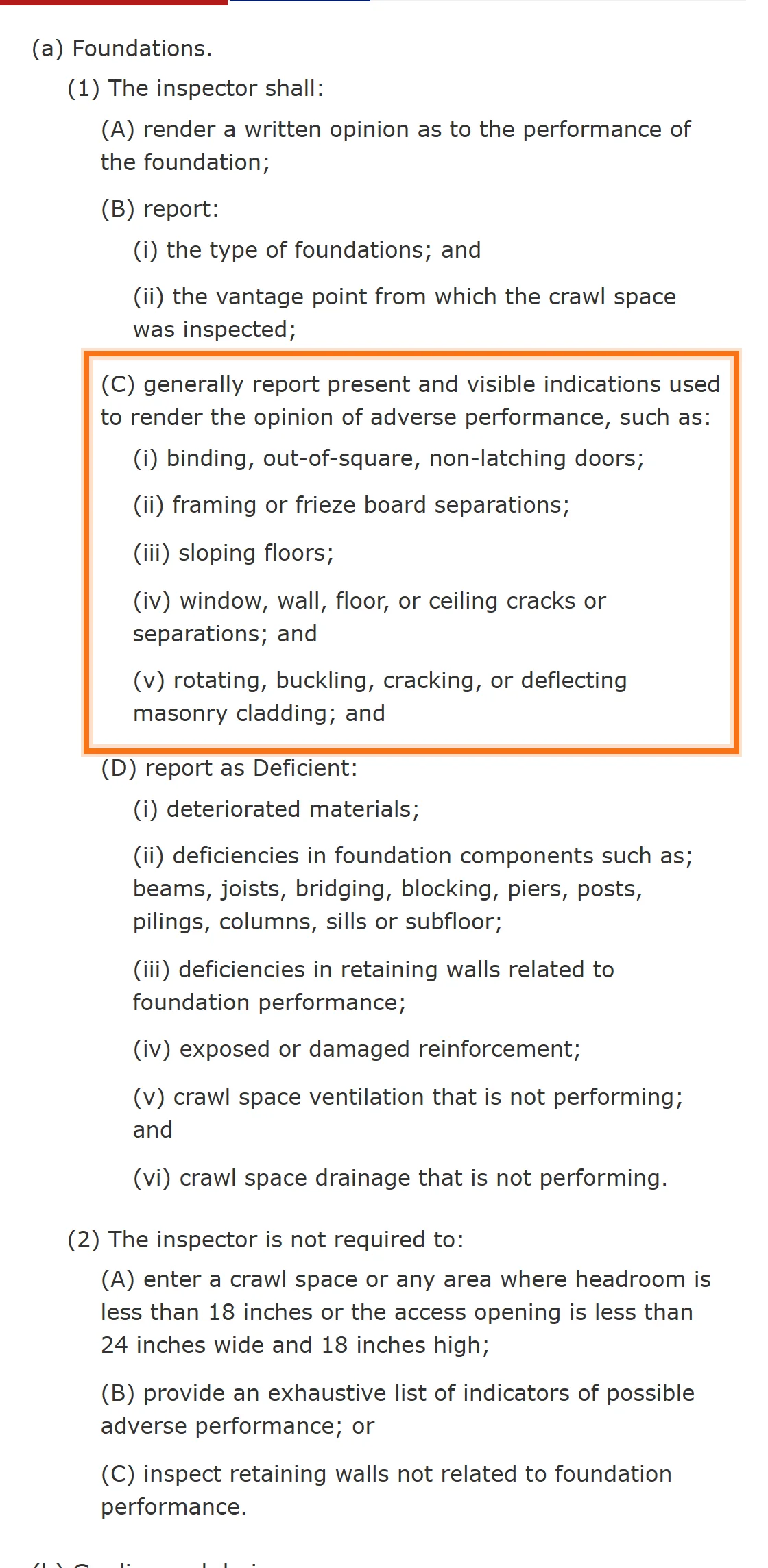
The same rule tells the inspector to report as deficient drainage around the foundation that is not performing, deficiencies in grade levels around the foundation, and deficiencies in installed gutters and downspouts (535.228(b)(1)).
A property manager is not doing that inspection and should not pretend to. What a manager can usefully do is borrow the list: look at the same doors, corners, floors, brick and drainage each time, photograph them, and compare. If your house sits on piers and beams with a crawl space, the rule also covers the crawl space, and that is a job for the inspector, not the manager.
Tenants and vendors as early warning
Between inspections, a manager has two other sources. The first is the tenant. A repair request that says "the back door will not lock" or "the bathroom door scrapes the floor" may be a carpentry job, or the first sign of movement. Asked the right question at move-in, a tenant is more likely to report a door that starts sticking or a new crack.
The second is every vendor who enters the house. A plumber clearing the same drain twice, a painter who sees a ceiling joint opening, a gutter cleaner who sees a downspout emptying against the slab: each sees part of the picture. A manager who asks vendors to mention anything that looks structural, and logs it against the property, turns those visits into a record. How a manager builds and keeps that vendor list is in the vendor bench.
From a sign to a decision: the order of steps
When signs add up, or one sign has clearly changed, the order of steps matters:
- Record it. Dated photos of the sign and the same spot in the move-in record, with something for scale.
- Fix what affects the tenant now. A door that will not lock is a security problem whatever the cause (see the law section below).
- Get an opinion from someone licensed to give it. A TREC-licensed inspector gives a written opinion on foundation performance; a licensed professional engineer can evaluate the structure and say what, if anything, should be repaired. Ask what the evaluation includes, for example whether floor elevations are measured.
- Compare repair bids against the same written scope, and get them in writing.
- Plan access with the tenant under the lease's entry terms; no Texas statute sets a landlord's entry notice period.
Texas engineers are licensed by the Texas Board of Professional Engineers and Land Surveyors, whose site urges people to "verify the legitimacy of the professional engineer" before relying on sealed work. The manager makes sure the decision is informed; you make the decision.
Drainage and watering: the prevention side
The prevention side of foundation care in this area is mostly about water: keeping it from pooling against the slab during storms and avoiding big swings in soil moisture. In a rental, three questions decide who does what. Who maintains the gutters and downspouts? Who waters the yard, and who pays the water bill? Who handles drainage repairs such as regrading or extending a downspout? The lease answers the first two; the third is normally the owner's job.
A sprinkler system soaking one side of the house, a downspout emptying at the wall, or a bed built up against the brick are the kind of items an inspector reports under the grading and drainage rule above, and they are cheap compared with what they can feed. Watering habits and who pays for them are covered in the foundation and plumbing guide; the general repair split is in Texas landlord repair obligations.
What a manager cannot do, and what Texas law adds
A manager can observe, document, ask and coordinate. A manager cannot tell you whether a crack is cosmetic or structural, cannot promise that early detection prevents a repair, and cannot stop clay soil from moving. On an older house some movement is already part of its history; the realistic goal is to notice a change and act on it, not to keep a slab perfectly still.
Texas law adds two points. Under Property Code 92.052(a), the landlord must make a diligent effort to repair a condition that "materially affects the physical health or safety of an ordinary tenant" after the tenant gives notice and is current on rent. And under 92.153(h), a required security device "must be operable throughout the time a tenant is in possession", so a door that no longer latches or locks because the frame has moved is a repair you do not wait on. This is general information, not legal advice.
On insurance, the state's Office of Public Insurance Counsel lists "foundation or slab damage" among extra coverages you may need to add to a residential policy, describing it as help with damage "by water or steam from a plumbing, heating, or A/C system." What your own landlord policy covers is in the policy; ask your agent. This is not insurance advice.
How Perpetual handles foundation warning signs
What our published pages say we do, and what they do not:
- The baseline. Our leasing page describes photo-documented move-in condition reports, room by room and timestamped, and every move-in and move-out gets a 360-degree condition inspection (subject to the Guarantee Addendum).
- Inspections. Every plan includes an annual property inspection, with a photo report in your owner portal; our inspections page says anything found feeds into maintenance coordination or tenant communication with a recommendation, and extra inspections "can be arranged when something warrants a look."
- Repair requests. Tenants report issues through their portal with photos, which creates a documented record. Repairs under your pre-approved spending limit go ahead; anything larger comes to you with a description, photos and a recommendation, and every completed repair over $500 gets photo or video proof in your portal.
Which foundation signs our inspection report covers, and how an engineer's visit is arranged and billed, are confirmed in writing in the management agreement before you sign. Our site does not say we evaluate foundations: that opinion comes from a licensed inspector or engineer you choose. See maintenance coordination, or call 682-593-7033.
The takeaway: Ask your manager for dated photos of the signs that matter, compare them with the move-in record, and bring in an inspector or engineer when something has changed, before anyone sells you a repair.
Questions owners ask
What are the early signs of foundation problems in a Texas house?
The Texas standard for licensed home inspectors lists the visible indications inspectors report: binding, out-of-square or non-latching doors; framing or frieze board separations; sloping floors; window, wall, floor or ceiling cracks or separations; and rotating, buckling, cracking or deflecting masonry (22 TAC 535.228(a)). One sign alone proves little; a sign that has changed since the last dated photo is the reason to get an opinion.
Should I call an engineer or a foundation repair company first?
Start with someone who gives an opinion rather than sells a repair. A TREC-licensed inspector must give a written opinion on foundation performance, and a licensed professional engineer can evaluate the structure and set the repair scope. Get repair bids against that written scope. Texas engineers are licensed by the Texas Board of Professional Engineers and Land Surveyors; verify the license.
Is the tenant responsible for watering the foundation?
Only if the lease says so. Many leases assign yard watering to the tenant, and the tenant may also pay the water bill, which can work against steady watering. Drainage items such as gutters, downspouts and regrading are normally the owner's. Put who waters, who pays and who maintains the gutters in writing.
Does landlord insurance cover foundation repair?
It depends on the policy. Texas's Office of Public Insurance Counsel lists "foundation or slab damage" among extra coverages you may need to add to a residential policy, for damage by water or steam from a plumbing, heating or A/C system. Read your landlord policy's coverage and exclusions and ask your agent. This is general information, not insurance advice.
Is a property manager allowed to inspect a foundation?
A manager can look, photograph and report what it sees, and the lease sets how the house is entered. A written opinion on whether the foundation is performing is a home inspector's or engineer's job; in Texas, home inspectors are licensed by TREC and follow its standards of practice, which include foundations (22 TAC 535.228).
What should I do about an older Fort Worth house on piers and beams?
Treat it the same way: a dated baseline of doors, floors and walls, then an inspector's opinion when something changes. The Texas inspector standard also covers the crawl space under a pier-and-beam house, including its ventilation and drainage, so ask the inspector to report on it. Our guide to managing an older rental home covers the other systems.
Property management in Keller, North Richland Hills and Fort Worth. How full-service management works in Tarrant County →