
Key takeaways
- An older house needs a manager who can talk specifically about the systems that age, and who has a plan for each before it fails.
- For a home built before 1978, federal law requires a lead disclosure, a pamphlet and a lead warning statement before the tenant is bound by the lease (40 CFR 745.107, 745.113).
- A manager hired to lease the house shares the duty: the agent must "ensure compliance" with the lead disclosure rules (42 U.S.C. 4852d(a)(4)).
- Texas smoke alarm and security device rules apply at every move-in; homes occupied before September 1, 2011 have a battery-alarm rule of their own (Property Code 92.255(b)).
- Fees on an older house can differ: our price sheet says an older home that needs permits and repairs at every turn can carry a premium.
What should you look for in a property manager for an older rental home? A manager who can name what tends to go wrong in an older house, has a plan and a vendor for each system, and handles the paperwork that only older homes need. If you own an older rental in Fort Worth, Keller or North Richland Hills, test that in one meeting with specific questions, and compare the answers between companies.
This guide gives the questions system by system with what a good answer sounds like, then the rules that make age matter: Texas smoke alarm and lock requirements and the federal lead-based paint disclosure for homes built before 1978.
The older-house questions for a manager, system by system
Bring this table to each interview. The right-hand column is what a competent answer sounds like, not a script to recite back:
| System | Question for the manager | A good answer sounds like |
|---|---|---|
| Foundation | What do you look at on an older house, and how would I hear about a change? | Doors, cracks, floors and brick photographed and compared with the move-in record; a licensed inspector or engineer for an opinion |
| Drains and supply lines | The same drain backs up twice in a year. What happens on the second call? | A diagnosis of the line (for example a camera inspection), not a third cleaning |
| Water heater | Do you record its age and location, and what if it is in the attic? | Age and location noted at enrollment; replacement discussed before it fails, with your approval |
| Electrical | Who looks at an old panel or ungrounded outlets, and are they licensed? | A licensed electrician's opinion before listing; the license checked |
| HVAC | How do you decide repair versus replace? | Age, repair history and the replacement quote compared before summer |
| Roof | How is roof condition recorded before a tenant moves in? | Dated photos and any storm history in the file |
| Smoke alarms and locks | Who tests the alarms and rekeys at each move-in, and where is the record? | Tested at the start of possession, rekeyed after each turnover, both recorded |
| Lead-based paint (built before 1978) | Show me the lead disclosure and where the signed copy is kept. | The lessor's disclosure, the EPA pamphlet and the lead warning statement before signing; kept at least 3 years |
| Money | What spending limit and reserve fit this house, and why? | Numbers set with you in writing, with an emergency rule |
How to read this table: the first seven rows test knowledge and vendors; the last two test paperwork and money, which is where older houses cost owners most when they are handled loosely. A manager who answers half the rows in specifics usually knows the rest; one who answers "we send our handyman" to most of them is a reason to keep interviewing.
What an older house asks of a manager
Age by itself is not the problem. The problem is several original systems nearing the end of their lives at once, a foundation that has moved through decades of wet and dry years, and tenants who expect the same response they would get in a new subdivision. A manager for an older house has to tell routine calls from early warnings: a drain that needs cleaning from a line that is failing, a door that needs a carpenter from a frame that has moved.
Price follows the work. Our own price sheet says the final fee is set after the rental analysis, and that "an older home that needs permits and repairs at every turn can carry a premium." Whatever the fee, it should come from the house's real repair pattern, in writing, not from a guess.
Drains, supply lines and water heaters
Plumbing is the first thing to test. Ask how the manager handles a repeat drain backup, who is called for a suspected slab leak and how that diagnosis is billed, and whether the water heater's age and location are recorded at the start. A water heater in an attic or interior closet damages the rooms below when it fails, so its age matters more than in a garage.
A manager who answers in specifics has dealt with it; one who says "we send our plumber" and stops has not. The regional background on soils, pipes and who may work on a rental's plumbing is in foundation and plumbing problems in North Texas rentals; use it to check the answers you get.
Foundation: noticing change, not diagnosing it
On an older slab or pier-and-beam house, the manager's job is to notice change, not to diagnose the foundation. That means dated photos of the same doors, corners, floors and brick, compared over time, and a licensed inspector or engineer when something moves. If earlier foundation work was done, the paperwork and any warranty belong in the property file so a covered repair is not paid twice.
The signs to watch, who usually sees each one first and the order of next steps are in can a property manager help spot foundation problems.
Electrical, roof and HVAC before the house is listed
Before an older house is listed, someone should look at it with the systems in mind, not only the paint. Three items most often turn into first-year emergencies. An electrical panel or wiring that worries the person looking at it deserves a licensed electrician's opinion before a tenant moves in. A roof near the end of its life should be photographed and its storm history put in the file. An air conditioner past the age where repairs make sense deserves a repair-or-replace decision before summer, not during it.
Our maintenance page puts the principle plainly: "Planned attention to aging HVAC, water heaters, and roofs beats emergency pricing every time." The HVAC decision itself, including what Texas law does and does not say about air conditioning, is in HVAC in Texas rental property.
Who does the work, and how it is billed
An older house calls plumbers, electricians, HVAC technicians and roofers more often than a new one, sometimes at bad hours, so the manager's vendors are a direct cost to you. Ask, for each trade, whether the vendor holds the license Texas requires, how a trip or diagnostic visit is priced, and how quickly they reach a tenant with no hot water or no cooling. How managers check licenses and insurance is in how property managers verify contractor licenses and insurance.
Ask too how vendor work is billed to you: at cost, with a markup, or with a coordination fee. Whichever it is belongs in writing, and you should see the vendor's own invoice, not a summary line. If you have a trusted plumber or electrician, ask whether the manager will use them; a flat refusal tells you something.
Spending limits and reserves that fit the house
Two numbers matter more on an older house than a new one: the reserve held from rent for repairs, and the amount the manager may spend on one repair without calling you. Too low, and routine repairs wait for your approval while the tenant waits for hot water. Too high, and you learn about a large repair after it is done.
A workable approach is a limit that covers a typical service call plus parts, a quick approval for anything above it, and a written rule that true emergencies such as active leaks, no heat in winter, no cooling in extreme heat and electrical hazards are handled first and reported right away. The general method for sizing the reserve is in how much reserve to keep per rental.
Built before 1978: the federal lead-based paint disclosure
For housing built before 1978, a federal disclosure rule applies to leases as well as sales. The regulation defines "target housing" as housing "constructed prior to 1978", with exceptions such as housing for the elderly or persons with disabilities and 0-bedroom units, unless a child under 6 lives or is expected to live there (40 CFR 745.103). Leases of 100 days or less with no renewal possible, homes found lead-based paint free by a certified inspector, and some renewals where everything was already disclosed are also outside it (745.101).
Before the tenant is obligated under the lease, the lessor must give an EPA-approved lead hazard pamphlet, disclose any known lead-based paint or hazards, and provide available records and reports (745.107(a)). The lease must include, as an attachment or within the contract, a Lead Warning Statement, the lessor's disclosure, a list of records provided, the tenant's acknowledgment and the signatures (745.113(b)), and the lessor and any agent keep a copy for no less than 3 years from the start of the lease (745.113(c)).
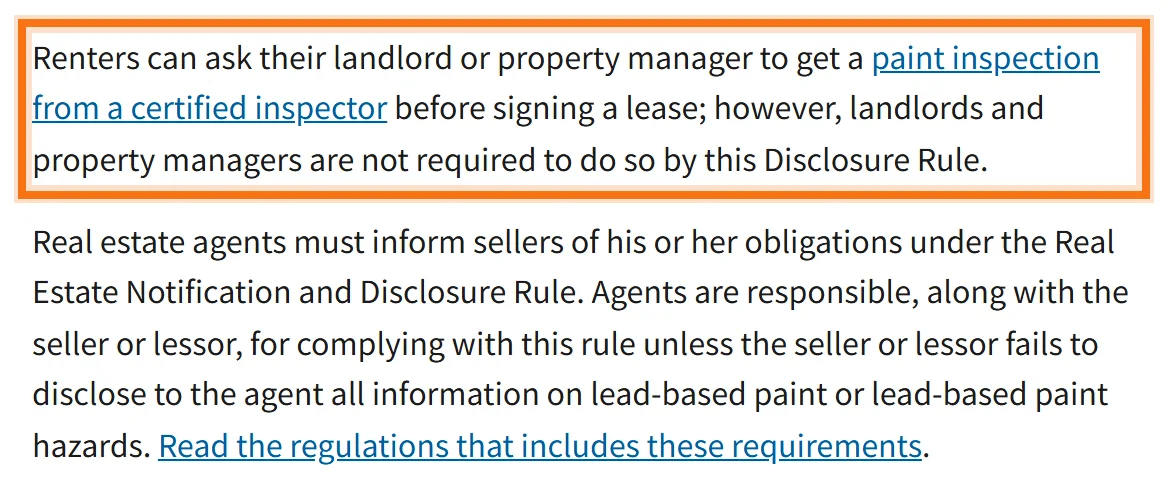
The manager is not a bystander. The statute requires an agent hired to lease target housing to "ensure compliance" on the owner's behalf (42 U.S.C. 4852d(a)(4)), and anyone who knowingly violates it is liable to the tenant for three times the damages (4852d(b)(3)). The rule requires disclosure, not testing. Separately, EPA tells property managers that painting or repair work that could disturb lead-based paint in a pre-1978 home goes to a Lead-Safe Certified firm. This is general information, not legal advice.
Smoke alarms and locks in an older house
Texas safety rules apply to every rental, but older houses fail them more often. Property Code 92.255(a) requires at least one smoke alarm in each separate bedroom, one in the corridor serving several bedrooms, and one on each level. If the home was occupied as a residence before September 1, 2011, the alarms may be battery powered and need not be interconnected, except that replacing an alarm that was there when the home was first occupied must meet the code that applied then or Section 92.252(b) (92.255(b)). Under 92.258(b), the landlord tests each alarm at the beginning of the tenant's possession.
Security devices follow 92.153: a window latch on each exterior window, a keyed dead bolt or doorknob lock on each exterior door, a keyless bolting device and a door viewer on each exterior door, and pin locks and handle latches or bars on sliding glass doors. Locks operated by a key, card or combination are rekeyed no later than the seventh day after each tenant turnover (92.156(a)). Old doors and frames that have moved are where these devices stop working. Where each requirement comes from, and who checks it, is in will a property manager tell you if your house does not meet rental requirements.
How Perpetual handles older rental homes
What our published pages say, for an older house as for any other:
- Price. Plans are 7% (Investor Special, 5 or more units), 9% (Standard) and 10% (Full Service) of monthly rent; the final fee is set after the free rental analysis, and an older home that needs permits and repairs at every turn can carry a premium. The analysis includes make-ready guidance on which improvements raise rent and which just cost money.
- First look and yearly look. The property enrollment inspection is $125 on Investor Special, $49 on Standard and included on Full Service, and every plan includes an annual property inspection.
- Repairs. Repairs under your pre-approved limit go ahead; larger jobs come with a description, photos and a recommendation. Coordination is 5% of cost on Full Service, 4.9% on Standard and 3% to 5% of make-ready cost on Investor Special, the original invoice is always in your portal, and every completed repair over $500 gets photo or video proof (Guarantee Addendum). We can usually work with your own vendor if they are insured and reliable.
- Leases. Our leasing page describes current Texas lease documents with the addenda the property needs, and every applicant is evaluated against the same written criteria.
How the lead disclosure is prepared and filed for a pre-1978 house, what the enrollment inspection records, and your spending limit and reserve are confirmed in writing in the management agreement before you sign. See maintenance coordination, or call 682-593-7033.
The takeaway: Ask every manager the same system-by-system questions, insist on the lead disclosure for a pre-1978 house, and agree the spending limit and reserve in writing before the first tenant.
Questions owners ask
What should I look for in a property manager for an older rental home?
Specific knowledge of the systems that age (foundation signs, drains and water heaters, electrical, HVAC and roof), licensed vendors for each trade with billing in writing, a spending limit and reserve that fit the house, and correct handling of Texas smoke alarm and lock rules and, before 1978, the federal lead disclosure. Ask every company the same questions and compare.
Does an older rental house need a bigger repair reserve?
Usually, because more original systems are near the end of their lives. Agree in writing on a reserve that covers a typical repair without a call to you, a spending limit for anything larger, and an emergency rule for active leaks, loss of heat or cooling and electrical hazards. Size the reserve on your house's own repair history.
Is lead-based paint disclosure required when renting an older house in Texas?
For housing built before 1978, yes, unless an exception applies. Before the tenant is bound by the lease, the landlord gives the EPA pamphlet, discloses known lead-based paint or hazards and available records, and attaches a Lead Warning Statement with signatures (40 CFR 745.107, 745.113). An agent leasing the house must ensure compliance. This is general information, not legal advice.
Should I replace the old air conditioner before renting the house?
Ask the manager for an opinion with numbers: the unit's age, its repair history and a replacement quote against the likely repair bills and the risk of a summer failure with a tenant in place. The point is to decide before the hot months, not during them. The decision and the cost are yours.
Can a property manager use my own plumber or electrician on an older house?
A reasonable manager usually will, as long as the vendor is insured, licensed where Texas requires it and responsive to tenant calls. Our maintenance page says we can usually coordinate with your preferred vendor if they are insured and reliable. Get the arrangement in writing before you sign.
Does the lead disclosure rule require testing an older rental for lead?
No. EPA's disclosure page says renters can ask for a paint inspection by a certified inspector before signing, but landlords and property managers are not required to do so by the disclosure rule. What is required is disclosing what is known, giving the pamphlet and records, and the signed lead warning statement. Repair or painting work that could disturb lead paint goes to a Lead-Safe Certified firm.
Property management in Keller, North Richland Hills and Fort Worth. How full-service management works in Tarrant County →