Key takeaways
- "Rental requirements" is not one rulebook: the Texas Property Code, the federal lead rule, your city, your HOA, your insurer and your lender each set their own.
- The Property Code items are not optional: security devices and rekeying (92.153, 92.156), smoke alarms tested at move-in (92.255, 92.258), and repairs that affect health or safety (92.052).
- When a security device is missing, Texas lets the tenant install it and deduct the cost, or end the lease after a written request is ignored (92.164).
- City registration, HOA leasing rules, insurance conditions and loan terms differ by property: read your own documents and confirm with the city.
- Ask a manager for findings in writing, each tied to its source, before you sign.
Will a property manager tell you if your house doesn't meet rental requirements? A good one will, in writing, before the house is listed, and will tell you where each requirement comes from. For a rental in Fort Worth, Keller or North Richland Hills, that means the Texas Property Code first, then the federal lead rule for older homes, then your city, your HOA, your insurer and your lender. The source decides whether you have a choice.
This guide lists each source with an example of what it actually says, who checks it, what a missed Texas requirement can cost, and how to get a straight answer from any manager.
Where rental requirements come from: six sources and who checks each
Each row is a source of requirements for a single-family rental, an example of what it says (quoted or summarized from the text), and who normally checks it:
| Source | Example requirement, as the source reads | Who checks |
|---|---|---|
| Texas Property Code: security devices (92.153, 92.156) | "A window latch on each exterior window", a keyed dead bolt or doorknob lock, and a keyless bolting device and door viewer on each exterior door; key locks rekeyed "not later than the seventh day after each tenant turnover date" | The owner is responsible; the manager or locksmith checks and records it before move-in |
| Texas Property Code: smoke alarms (92.255, 92.258) | At least one smoke alarm "in each separate bedroom", plus the corridor and each level; tested at the beginning of the tenant's possession | Tested and recorded at move-in |
| Texas Property Code: repairs (92.052) | A diligent effort to repair a condition that "materially affects the physical health or safety of an ordinary tenant", or a hot water device failing to supply 120 degrees Fahrenheit, after the tenant's notice | Found at the walkthrough or reported by the tenant; the owner pays |
| Federal lead rule, homes built before 1978 (40 CFR 745.107) | Before the tenant is obligated under the lease: the EPA pamphlet, disclosure of known lead-based paint or hazards, and available records | Owner and leasing agent |
| City | Some Tarrant County cities run rental registration or inspection programs; this guide does not state each city's rules, so confirm with the city | Owner, often with the manager coordinating |
| HOA (Property Code 209.016) | An association may adopt restrictions "relating to occupancy or leasing" and may request tenant contact information and the lease start date and term; it may not require tenants to be approved by the association | Owner reads the deed restrictions and rules; the manager follows them |
| Insurer | Your policy's terms; Texas's public insurance counsel notes that dwelling insurance usually covers the house and other structures but not liability claims | Owner and insurance agent |
| Lender | Your deed of trust and loan documents | Owner, with the loan servicer |
How to read this table: the first four rows apply to a rental whatever you decide, so a manager should not list the house with them open. The last four depend on your property and your paperwork, so the manager can ask the questions but you hold the documents. City programs are covered in city rental registration and inspections in Tarrant County, and Fort Worth's in do you need to register a rental in Fort Worth.
Why the source of a requirement matters
Owners usually picture a single inspection checklist. In practice the source of a requirement decides three things: whether you have a choice, who checks it, and what happens if it is missed. A Property Code item is the landlord's duty with remedies written into the statute. An HOA rule is enforced by the association under your deed restrictions. An insurance condition is between you and the insurer, and a loan term between you and the lender.
Market items are a separate category: worn carpet or a dated kitchen are not requirements at all, only choices about rent and vacancy. Which repairs to make before listing, sorted into must fix, should fix and can wait, is in what repairs to make before listing your house for rent, and what pays back in the make-ready guide. If the house is not ready yet, when to bring a manager in is covered in when to hire a property manager before the house is rent-ready.
What a straight written answer looks like (illustrative)
Take an illustrative house in North Richland Hills that the owner lived in until last month. The walkthrough finds a smoke alarm in the hallway but none in the bedrooms, two windows with no latch, a stained ceiling under the upstairs bath, bedroom carpet near the end of its life, and a fence that needs staining. The house was built after 1978, and the owner has not yet read the HOA's leasing rules.
A straight written answer ties each finding to its source. Bedroom smoke alarms: Property Code 92.255. Window latches: 92.153. The ceiling stain: find the leak before a tenant moves in, because an active leak is the kind of condition a tenant can give notice about under 92.052. The HOA: read the leasing restrictions and send any tenant information the association may request. Carpet and fence: market choices with no legal source, priced so you can decide.
That is the shape of an honest answer: the finding, the source, the fix, and who decides. Anything vaguer is a sales call.
What a missed Texas requirement can cost the owner
A manager who says nothing at the walkthrough leaves the discovery to the tenant, and the Property Code gives the tenant remedies against the landlord, meaning the owner. Under 92.001 a manager is not the landlord unless it purports to be the owner or lessor in the lease.
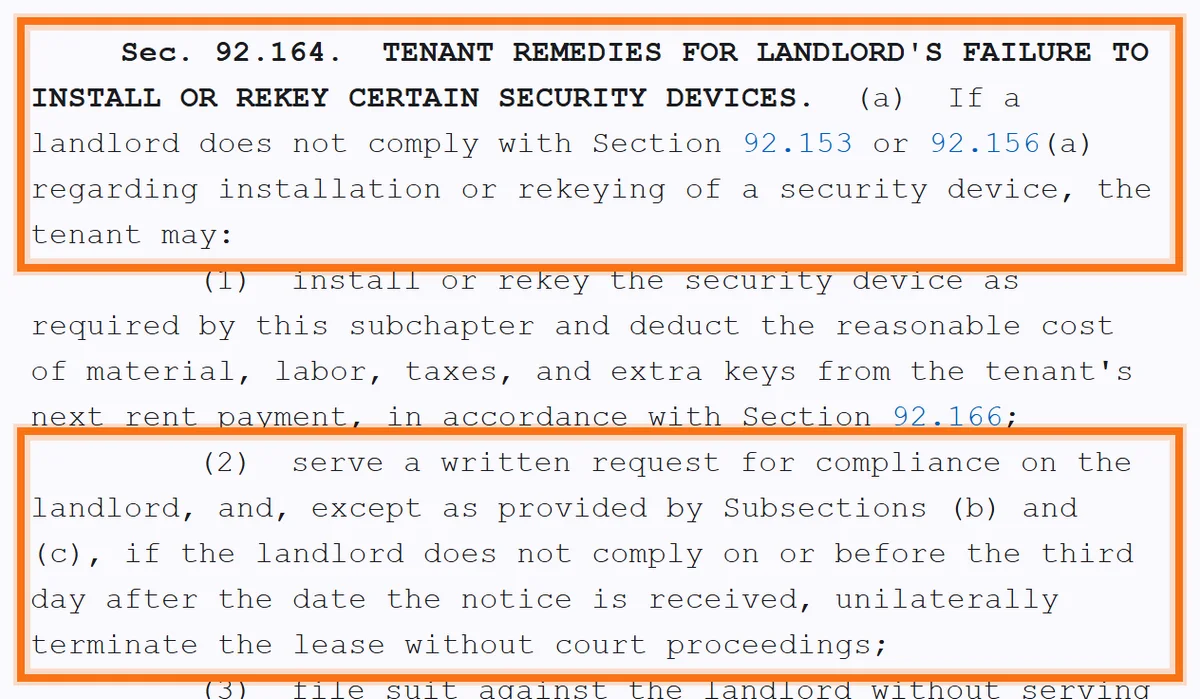
For security devices, 92.164(a) lets the tenant install or rekey and deduct the reasonable cost from rent, terminate the lease if a written request is not met by the third day (seven days if the lease has the required bold or underlined notice), or sue. A suit after an ignored written request can bring a civil penalty of one month's rent plus $500.
For smoke alarms, the landlord is liable under 92.259(a) if no alarm was installed at the tenant's initial occupancy. For repairs, after the notices in 92.056 the tenant may terminate, repair and deduct, or seek a court order, actual damages and a civil penalty of one month's rent plus $500 (92.0563(a)). This is general information, not legal advice; for a specific situation, ask a Texas attorney.
Your options once you have the list
On the Property Code items you have one real choice: who does the work. You can hire your own contractor and have the manager check the result before listing, or approve written quotes from the manager's vendors and have the work coordinated. What you should not do is put a tenant in with those items open.
On the property-specific items, the decision depends on the document. If the HOA restricts leasing, the restriction decides whether and how you can rent. If your insurer needs a landlord policy instead of a homeowner policy, that is a call to your agent before move-in; the differences are in landlord insurance vs homeowners insurance. If your loan documents say anything about occupancy or renting, ask your servicer. And sometimes the honest answer is that a house needs more than you want to spend, and selling or waiting is the better move. A manager should be willing to say that too.
Questions that get you a straight answer
Ask these before the walkthrough, and listen for hesitation:
- Will you walk the house before quoting a rent or asking me to sign, and is that visit billed?
- Will I get the findings in writing, each with its source?
- What would stop you from listing this house as it stands?
- Who tests the smoke alarms and rekeys the locks at move-in, and where is that recorded?
- For a home built before 1978, how is the lead disclosure handled and kept?
- If I decline something you recommend, what happens?
A manager with a real process answers these without notes. "We can work with anything" usually means the problems will be yours to discover.
Requirements keep applying after the first tenant
Requirements do not stop at move-in. The rekey is due after each tenant turnover (92.156(a)) and the smoke alarms are tested at the beginning of each tenant's possession (92.258(b)). During a lease, the duty to inspect and repair a smoke alarm arises when the tenant gives notice of a malfunction or asks for an inspection (92.258(c)). HOA rules change, insurers update their terms at renewal, and cities change their programs.
So the question is not only whether the manager will tell you now, but whether there is a routine that keeps telling you: move-in records, inspections during the lease, and a turnover checklist that repeats the Property Code items every time. Who checks smoke alarms and locks before each move-in, and the record that proves it, is in who checks smoke alarms and locks before a tenant moves in.
How Perpetual handles a house that is not ready
What our published pages say:
- Ready before marketing. Our Hurst, Euless and Bedford page puts it this way: "Before marketing begins, the home needs to be market-ready; unresolved condition issues can affect both tenant interest and the move-in experience."
- The first look. The property enrollment inspection is $125 on Investor Special, $49 on Standard and included on Full Service; every plan includes an annual property inspection.
- What to spend on. Our free rental analysis includes make-ready guidance on which improvements raise rent and which just cost money, before you spend.
- Leases and HOAs. Our leasing page describes current Texas lease documents with the addenda the property needs, such as HOA rules, pool, pets and smart devices.
- The work. Repairs under your pre-approved limit go ahead; larger jobs come with a description, photos and a recommendation; we can usually work with your own insured, reliable vendor; and every completed repair over $500 gets photo or video proof in your portal.
How our findings are written up, and whether a re-check after your repairs is billed, are confirmed in writing in the management agreement before you sign; if a fee is not in the agreement, you do not pay it. Call 682-593-7033, or start with a conversation.
The takeaway: Ask for the findings in writing with the source next to each one; fix the Property Code items before move-in, and read your own city, HOA, insurance and loan documents for the rest.
Questions owners ask
Can a property manager refuse to manage my house?
Yes, and a careful one sometimes will. Common reasons are a house that fails Texas Property Code requirements with an owner unwilling to fix them, an HOA restriction on leasing, an owner who wants to lease over an unresolved condition problem, or an owner who wants the manager to break the law. A refusal with written reasons is more useful than a yes with none.
What happens if I rent out a house that doesn't meet Texas requirements?
The exposure sits with the owner as landlord. For missing security devices, the tenant may install them and deduct the cost, end the lease after an ignored written request, or sue (Property Code 92.164). For smoke alarms not installed at initial occupancy, the landlord is liable under 92.259. For health or safety repairs, 92.056 and 92.0563 give remedies after notice. Ask a Texas attorney about a specific case.
Do I have to make cosmetic upgrades a property manager recommends?
No. Cosmetic and market items are your call, and the manager's job is to tell you what each is likely to do to the rent and the vacant period. Compare the cost with the rent it may add over the time you expect to own the house. Declining an upgrade is reasonable; declining a Property Code requirement is not.
Who checks the house again after I finish the repairs?
Ask the manager to check the house again before it is listed, confirm each required item is done, and photograph it, then ask whether that visit is billed. The photos also become part of the move-in record, so the same visit serves two purposes.
Can my HOA stop me from renting out my house in Texas?
It depends on your deed restrictions. Property Code 209.016 says nothing prohibits an association from adopting or enforcing a restriction relating to occupancy or leasing, lets it request tenant contact information and the lease start date and term, and bars it from requiring tenants to be approved by the association or from requiring a credit report or the rental application. Read your dedicatory instruments.
Does a pre-1978 house need anything extra before it can be rented?
Yes, unless an exception applies: before the tenant is bound by the lease, the landlord gives the EPA lead hazard pamphlet, discloses known lead-based paint or hazards and available records, and attaches a signed Lead Warning Statement (40 CFR 745.107, 745.113). Our guide on choosing a manager for an older rental home covers it in detail.
Related services
Property management in Keller, North Richland Hills and Fort Worth. How full-service management works in Tarrant County →