Key takeaways
- Your statement is where most red flags show first: late, missing invoices, or charges that are not in your agreement.
- Rent and deposits a broker holds are trust money under TREC rule 535.146, with a monthly accounting when the account has activity.
- A payout later than the date in your agreement, or a reserve that keeps growing, needs an answer in writing.
- Under Occupations Code 1101.652, an inaccurate statement of account and an undisclosed profit on your repairs are grounds for license discipline.
- One bad week is not a pattern. Three red flags at once usually is: ask in writing, set a date, then decide.
What are the red flags in a property management company you already have? Statements that arrive late or without the invoices behind them, payouts that slip past the date in your agreement, a security deposit nobody can account for, calls and emails that go unanswered, and repairs over your approval limit done without asking. If you own a rental in Fort Worth, Keller or North Richland Hills and see two or three of these together, it is time to act.
This guide covers the warning signs after you have signed: what each one can mean, what to ask for first, the Texas rule behind it, and how to decide whether to fix it or leave. The warning signs before you hire are in red flags when choosing a property manager.
Red flags in your current manager, and what to do about each
Here are the warning signs owners see most in a manager they already have, what each can mean, the first step and where the rule comes from:
| Red flag | What it can mean | Your first step | Where the rule is |
|---|---|---|---|
| Statement late, or charges with no invoice | Bookkeeping behind, or charges you cannot check | Ask in writing for the invoice behind each charge | Your agreement; TREC rule 535.146 (monthly accounting when there is activity) |
| A charge you never agreed to | A fee that is not in your agreement | Compare the line with the fee schedule and dispute it in writing | Your agreement; Occupations Code 1101.652(b)(24) |
| Payout later than the agreed date | Disorganization, or a cash problem at the company | Ask for the date rent was received and the date it was sent to you | Your agreement; 535.146 (disburse only as the agreement says) |
| Reserve grows with no explanation | Your money held back without a stated reason | Ask for the agreed reserve amount and the current balance | Your agreement |
| Nobody can say where the deposit is | A gap in the deposit records | Ask for the amount, who holds it and in what account | Property Code 92.106; 535.146 |
| Repairs over your limit done without approval | The approval terms are being ignored | Ask for the job records and your limit in writing | Your agreement; 1101.652(b)(13) if someone profits undisclosed |
| Calls and emails unanswered for days | Overload, or your account has stopped mattering | Send one written list with a reply date | Your agreement's service terms, if any |
| Documents you ask for never arrive | Leverage at exit, or missing records | Request them in writing and keep a copy | Occupations Code 1101.652(a)(5) |
How to read this table: the third column is the first move, not the last one. Most of these have an innocent explanation once, and a pattern when they repeat. The fourth column tells you whether the answer is in your agreement, in Texas law or in both, which matters if you later decide to leave or complain.
Red flags in your owner statement
How can you tell whether a property management company is nickel-and-diming you? Read the statement. A monthly owner statement should show rent received, each fee with its basis, each repair with the vendor's invoice behind it, the reserve held and the amount paid to you. Warning signs:
- The statement arrives later each month, or only when you ask.
- Repair lines with a round number, no vendor name and no invoice.
- A fee that is not in your agreement's fee schedule, or a familiar fee calculated differently than the agreement says.
- Balances that do not carry over: last month's ending reserve is not this month's starting reserve.
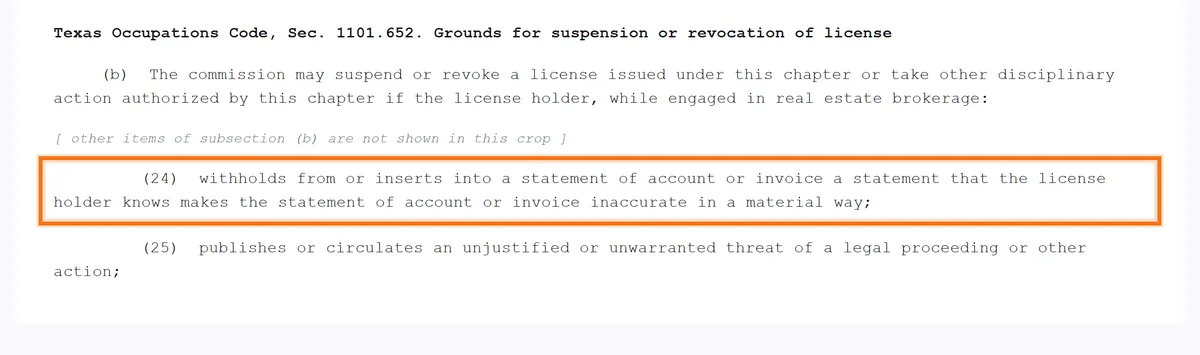
Texas treats an accurate statement as a licensing matter, not a courtesy. Among the grounds on which the Texas Real Estate Commission may discipline a license holder engaged in brokerage is knowingly putting into, or leaving out of, a statement of account or invoice something that makes it inaccurate in a material way.
Most errors are honest and get fixed in one email; the red flag is the same error twice, or no answer. How to read each line is in the owner statement explained.
Red flags in your payouts and the reserve
Your agreement should state when you are paid and how much of your money the manager holds back as a reserve. Measure the manager against those two numbers, not against a feeling.
The Texas rule behind them is TREC rule 535.146. Trust money includes rent and security deposits held on behalf of another person; a broker must keep it in a designated trust account, must not commingle it with the broker's own money, and may disburse it only in accordance with the agreement under which it was received. The rule also requires the broker to provide an accounting to each beneficiary of trust money at least monthly if there has been activity in the account.
So a payout that slips past the agreed date deserves a written question: when was the rent received, and when was it sent? So does a reserve that grows without a repair to explain it. How large a reserve should be in the first place is covered in how much reserve per rental.
Red flags around the security deposit
In Texas the landlord answers for the security deposit, whoever holds it. Under Property Code 92.103, the deposit must be refunded on or before the 30th day after the tenant surrenders the premises, subject to the forwarding-address rule in 92.107. Under 92.109, a landlord who misses that date without refunding or itemizing deductions is presumed to have acted in bad faith, and bad-faith retention costs $100, three times the amount wrongfully withheld and the tenant's attorney's fees. Section 92.106 adds that the landlord shall keep accurate records of all security deposits.
So you should be able to get three answers at any time: how much the deposit is, who holds it, and in what account. If the manager holds it, it is trust money under TREC rule 535.146. A manager who cannot answer, or whose answer changes, is a red flag before the tenant ever moves out. More on where that money should sit is in how to know your rent and deposit money is protected. This is general information, not legal advice.
Red flags in maintenance and repair bills
Maintenance is where a manager can quietly earn more from your house than from the management fee. Warning signs:
- Repairs above your approval limit done first and reported afterward, with no emergency to explain them.
- The opposite: every small item sent to you for approval, so nothing gets fixed.
- Invoices you cannot see, or invoices on the manager's own letterhead instead of the vendor's.
- The same vendor every time, and no answer to whether that vendor is owned by, or pays anything to, the management company.
Texas law draws a line here. Occupations Code 1101.652(b)(13) lists accepting, receiving or charging an undisclosed commission, rebate or direct profit on an expenditure made for a principal as a ground for discipline, and TREC rule 535.148 bars a license holder from taking a fee or rebate from someone other than the client without disclosing it and getting the client's consent. A disclosed coordination charge written into your agreement is a different thing. The difference is explained in maintenance markups explained, and what a complete repair record looks like is in repair invoices and photos for owners.
Unanswered calls, and a vacant house with no updates
No Texas statute sets how fast a property manager must return your call. Your agreement may, and if it does, that is the standard. If it does not, use a plain test: did you get a real answer, from someone who knows your house, within a reasonable time, more than once?
Warning signs that tend to come together:
- Each email gets a reply from a different person, or none for days.
- Your tenant tells you their calls go unanswered.
- The house sits vacant with no regular update on inquiries, showings and applications.
- The asking rent is cut without a conversation about showing feedback.
- You learn about a repair from the statement rather than from the manager.
For owners with houses spread across a metro, add one more: nobody can tell you when a person was last inside your particular house. If calls are the main problem, what to do when your property manager won't respond walks through the steps.
A bad month or a pattern? How to check in one afternoon
Before you decide anything, separate a bad month from a pattern. Set aside an afternoon and pull together the management agreement and its fee schedule, the last twelve statements, the tenant's ledger, the invoices behind each repair, the lease, and the deposit record. Then check:
- Every fee on the statements against the fee schedule.
- Every repair over your approval limit against an approval from you, or an emergency.
- Every payout date against the date in the agreement.
- The reserve balance against the amount the agreement states.
- The deposit amount on the lease against the deposit record.
If documents you request do not arrive, put the request in writing. Under Occupations Code 1101.652(a)(5), failing to surrender to the owner, without just cause, a document or instrument the owner requests and the license holder has is a ground for discipline. Three or more mismatches, or documents that never come, is a pattern.
What to do about it: fix it in writing, then leave
Is it time to fire your property management company? Give it one clear chance in writing, then use the agreement:
- Write it down. One email listing each problem with dates and the statement lines involved, and what you want: the invoices, the corrected statement, the deposit record.
- Set a reply date. A reasonable, specific date. Keep the reply.
- Read the termination clause before you give notice: the notice period, any fee, and what happens to a tenant the manager placed. How much notice you need to give and what canceling can cost cover both.
- Line up the next manager before the notice goes out, so the lease, deposit, keys, ledger and records have somewhere to go. The full handover is in how to switch property managers.
- Complain if the license law was broken. TREC accepts written, signed complaints within four years of the incident. Its own page says it cannot order a license holder to pay you damages and that contractual disputes generally are not matters it can address; for money, talk to a private attorney.
If the old manager will not hand over keys or records, see when your old manager won't release keys or records.
How Perpetual handles this
Perpetual Property Management is broker-owned, based in North Richland Hills, and manages homes in Keller, North Richland Hills, Fort Worth and nearby. Our written commitments answer the red flags above directly. The Perpetual Promise is part of every management agreement, subject to its Guarantee Addendum:
- Calls and emails answered within one business day, and a written activity report every week while your home is vacant, or that month's management fee is credited.
- Payouts. Rent we collect is disbursed to you by the 10th of each month, or that month's management fee is waived.
- Repairs. The original vendor invoice is always in your portal, and every completed repair over $500 gets photo or video proof.
- Fees. Every fee you pay is listed in your written agreement. If a fee is not in the agreement, you do not pay it.
Monthly statements, documents and disbursement history are in our AppFolio owner portal. When you switch to us, we request the lease, security deposit, keys, tenant ledger, property records and open work orders, and if your current agreement makes waiting the better decision, we will tell you. The reserve amount for your house and how the deposit is held are confirmed in writing before you sign. To talk through a switch, contact us or call 682-593-7033.
The takeaway: The red flags in a current manager are on paper: statements, payout dates, the deposit record and the repair file, so ask for them in writing, give a reply date, and let the answer decide whether you fix the relationship or leave it.
Questions owners ask
What is the biggest red flag in a property manager you already have?
Money you cannot trace. A payout later than the date in your agreement, a reserve that grows without a reason, or a deposit nobody can account for. Rent and deposits a broker holds are trust money under TREC rule 535.146, and you should be able to get a clear answer about any of them in writing.
How do I know if my property manager is overcharging me?
Compare every line on your statements with the fee schedule in your agreement, and ask for the vendor's invoice behind every repair. Charges that appear in neither place, invoices that cannot be produced, and repairs over your approval limit with no emergency behind them are the clearest signs. Under Occupations Code 1101.652(b)(13), an undisclosed profit on an expenditure made for you is a ground for license discipline.
Is it a bad sign if a property manager has negative reviews?
Not by itself. Tenants who lost part of a deposit for damage sometimes leave angry reviews of a manager who did the job correctly. Read for patterns: repeated owner complaints about statements, payouts, communication or surprise fees matter far more than one angry tenant. Your own statements are better evidence than anyone's review.
Is it time to fire my property management company?
If the same problem repeats after you have raised it in writing, yes. Send one email listing each problem with dates, set a reply date, and read your termination clause for the notice period and any fee. Line up the next manager before you give notice so the lease, deposit, keys and records have somewhere to go.
What are the red flags when choosing a property manager?
Before you hire, the warning signs are a rent number quoted before anyone sees the house, pressure to sign, no fee list until the agreement arrives, and terms in the agreement that do not match what you were told. After you hire, they move to your statements, payouts, the deposit record, repair approvals and unanswered calls. Our separate guide covers the before-you-hire list in detail.
How can I tell if a property management company won't nickel-and-dime me?
Read the fee schedule before you sign and look for a sentence that no fee outside it may be charged. After you sign, check each monthly statement against that schedule and ask for the vendor's invoice behind every repair. Charges that appear in neither place are the nickel-and-dime pattern, and they show up in the statement first.
Can I report a property manager in Texas?
Yes. Anyone can file a complaint with the Texas Real Estate Commission against a license holder. TREC says the complaint must be in writing and signed, and filed within four years of the incident. It can discipline a license holder but cannot order one to pay you damages; money claims go to a private attorney.
Related services
Property management in Keller, North Richland Hills and Fort Worth. How full-service management works in Tarrant County →