Key takeaways
- A markup is any amount a manager adds to a vendor's invoice before you pay it; a disclosed coordination fee is a markup you agreed to in writing.
- Texas Occupations Code 1101.652(b)(13) lists accepting or charging an undisclosed commission, rebate or direct profit on an expenditure made for a principal as grounds for license discipline.
- The hidden versions cost more: retyped invoices, an in-house crew billing at retail, vendor rebates, and a trip fee on every visit.
- Any percentage of the invoice, disclosed or not, pays the manager more when repairs cost more; approval limits and original invoices are the counterweight.
- The test takes two minutes: lay the vendor's original invoice next to your statement line. Anything not on the vendor's paperwork was added.
A maintenance markup is money a property manager adds to a vendor's invoice before it reaches your statement. If it is written into your agreement as a stated coordination percentage, it is a fee you can see, compare and negotiate. If it is hidden, it is the opposite. For an owner in Fort Worth, Keller or North Richland Hills, the question that matters is not whether a manager earns something on repairs, but whether you can see exactly what and why.
This guide covers where markups hide, what Texas license law says about undisclosed profit on your repair spend, how a percentage changes a manager's decisions, illustrative numbers, and the questions and checks that expose a markup.
Maintenance markups on a Fort Worth rental: how each one shows up
Here are the ways a manager can earn on your repairs, how each one reaches your statement, whether you can see it, and how to check it:
| Type | How it reaches your statement | Visible to you? | How to check |
|---|---|---|---|
| Stated coordination percentage | A separate line calculated on the vendor's invoice, as the agreement states | Yes, if it is in the agreement | Recalculate it from the original invoice |
| Markup on a retyped invoice | The vendor's bill is redone on the manager's letterhead with a higher total | No | Ask for the vendor's own invoice with its name and itemized pricing |
| In-house maintenance company | The manager's own crew bills at its own rates | Only if ownership is disclosed | Ask who owns the crew and get an outside quote on larger jobs |
| Vendor rebate or referral fee | Nothing on your statement; the vendor pays the manager | No | Ask in writing whether any vendor pays the manager anything |
| Trip or dispatch fee per visit | A flat charge on each visit, whatever was done | Yes, if it is listed | Count the visits per problem and check the fee schedule |
| Rounded or estimated costs | A round number on the statement instead of the invoice amount | Partly | Match the statement line to the invoice to the cent |
How to read this table: the first row is a fee you can see and negotiate. The rows marked "No" are the costly ones, because you cannot compare what you cannot see, and an undisclosed profit on your repair spend is exactly what Texas license law targets.
Where maintenance markups hide
The plain version is a stated percentage on every invoice, written into the fee schedule. It is at least visible, and you can weigh it against what the manager does for it: finding the vendor, scheduling around the tenant, checking the work and paying the bill. The versions that cost owners more are the ones they do not recognize as markups, laid out in the table above.
None of them carry the word markup. A retyped invoice looks like a normal bill, and a vendor rebate leaves no trace on your statement at all, because the vendor recovers it in the price you pay. They all do the same thing to your net income.
The difference between a fair charge and a hidden one is not the percentage. It is whether the charge is written down, shows up as its own line, and can be checked against the vendor's own paperwork.
What Texas license law says about maintenance markups
In Texas, managing a rental for someone else is usually licensed work. Occupations Code 1101.002 defines a broker to include a person who, for a commission or other valuable consideration, does this for another person: "controls the acceptance or deposit of rent from a resident of a single-family residential real property unit." A manager who collects your rent for a fee generally needs a real estate license and answers to the Texas Real Estate Commission.
That license comes with a disclosure rule. Occupations Code 1101.652(b)(13) lists, among the grounds for suspending or revoking a license, a license holder who "accepts, receives, or charges an undisclosed commission, rebate, or direct profit on an expenditure made for a principal." A repair paid from your money is an expenditure made for you. TREC rule 535.148(a) adds that a license holder may not take a commission, rebate or fee from anyone other than the client without first disclosing it and getting the client's consent.
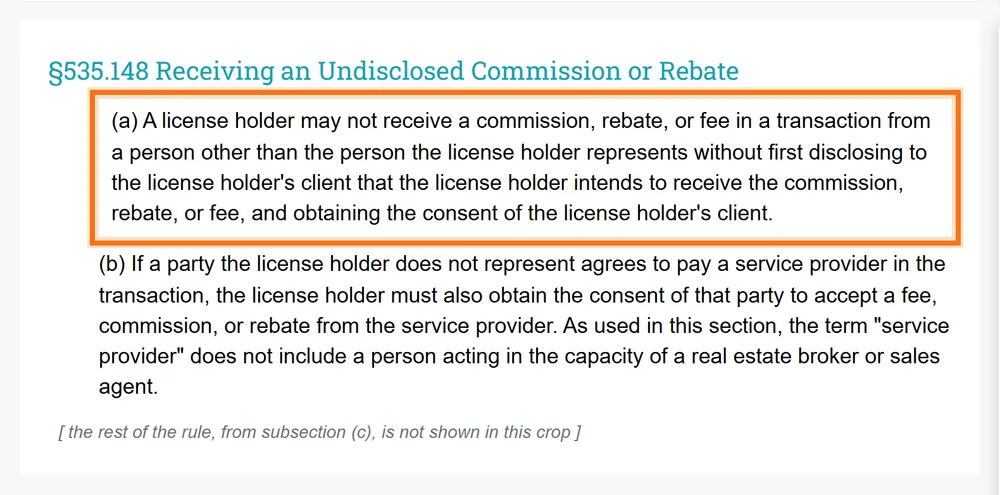
The practical reading: a coordination fee written into your agreement is disclosed; a markup buried in a retyped invoice, or a rebate you never heard about, is not. You can check a manager's license on the TREC site, as our guide on verifying a property manager's Texas license shows. This is general information, not legal advice; for a specific dispute, ask a Texas attorney.
The in-house vendor conflict
A manager who owns the repair company has a conflict that is hard to manage. The repair side makes money when work is done; the management side is supposed to decide whether work is needed. When both answer to the same owner, the house tends to get more repairs, bigger repairs and fewer second opinions.
In-house crews are not always a bad deal. For small, frequent jobs they can be fast. The problem is when there is no alternative and no benchmark. If the manager's own crew is the only option for a water heater, a roof patch or an HVAC compressor, you have no way to know whether the price is fair. Ask how often outside quotes are obtained, and whether you can request one on any job above a set size.
How any percentage on repairs changes a manager's decisions
A manager paid a percentage of each invoice earns more when your house spends more. That is true of a hidden markup and of a disclosed coordination fee alike, including ours. It does not make anyone dishonest. It tilts judgment calls in one direction: replace instead of repair, send a vendor instead of walking the tenant through a breaker reset, approve the higher bid.
Three things push back against that tilt, and they matter more than the percentage itself. A written approval limit, so anything significant comes to you first. The vendor's original invoice on every job, so the cost is visible. And photos of the problem and the finished work, so you can see that the repair was needed and done. A manager who offers all three without being asked has nothing to hide in the percentage.
The percentage is the price; the controls are the protection. Judge a manager on both.
Approval limits: the number that protects you
Every management agreement should state a dollar limit above which the manager must get your approval before spending. Below it, routine repairs proceed without a call. Above it, you get a description, photos and an estimate, and a chance to ask for a second quote.
The limit should be low enough that you see anything meaningful and high enough that a running toilet does not need a phone call. Emergencies are the exception: a burst pipe gets handled first and reported right away. For conditions that materially affect a tenant's health or safety, Property Code 92.056 presumes seven days is a reasonable time to repair after notice, so an owner who sits on an approval can create a legal problem as well as a bigger bill.
Watch for an agreement with no limit, or a phrase like "reasonable repairs" instead of a number. How to set the number and what happens when a manager exceeds it is in can a property manager approve expensive repairs without my permission.
Questions that expose a markup
Ask these in the first conversation, and ask for the answers in writing:
- Do you add any percentage, fee or charge to vendor invoices? If yes, how much, and where is it in the agreement?
- Do you own, or have a financial interest in, any maintenance company you use?
- Do vendors pay you anything for referrals or volume?
- Will I see each vendor's original invoice, with the vendor's name and itemized pricing?
- What is my approval limit, and can I get a second quote above it?
- Is there a trip, dispatch or after-hours fee of your own?
A clean answer is short and specific: the exact coordination rate if there is one, no undisclosed vendor payments, original invoices in the portal, approval above a stated amount. A long answer built around "industry standard" usually means the specifics are worse than you want them to be. The night-and-weekend version of these charges is covered in after-hours maintenance fees.
What a clean maintenance line looks like
On a properly run account, every repair on your statement traces back to a document you can open. The vendor's name is on it. The work is itemized. The statement line equals the invoice amount, plus any coordination charge your agreement states, shown separately and recalculable to the cent. Where it makes sense, there are photos of the problem and the finished work.
If your current manager's statements show repairs as single lines with no backup, ask for the invoices. What a complete repair record should contain is in will you see the original repair invoices and photos, and how to read the rest of the statement is in how to read your monthly owner statement.
The silent tax, with illustrative numbers
Illustrative only, not a quote and not real vendor prices. Assume a rental needs three repairs in a year, with vendor invoices of $250, $400 and $1,350, so $2,000 in total. Here is what different charging methods add:
- A disclosed 5% coordination charge on each invoice: $12.50 + $20.00 + $67.50 = $100.00, the same as $2,000 x 5%. You pay $2,100, and the $100 is a line you can see and recalculate.
- A hidden 10% markup on retyped invoices: $25 + $40 + $135 = $200, the same as $2,000 x 10%. You pay $2,200 and never see a separate line.
- A $75 trip fee on each of the three visits: 3 x $75 = $225. You pay $2,225, and the fee does not depend on the work at all.
The disclosed charge is the smallest here only because of the numbers assumed; the real point is that it is the only one you can audit. Small on one statement, the hidden versions add up over years of ownership. Our own fee structure is on the pricing and fees page.
How Perpetual handles this
Perpetual Property Management is broker-owned, and we manage homes in Keller, North Richland Hills, Fort Worth and nearby. We do charge for coordinating repairs, and our price sheet says exactly what:
- Maintenance coordination is 4.9% of cost on Standard and 5% of cost on Full Service. On the Investor Special, for portfolios of 5 or more units, the price sheet lists make-ready coordination at 3% to 5% of cost.
- It is a percentage of the vendor's invoice, and the original invoice is always in your portal, so you can recalculate any coordination line yourself.
- Your spending limit. Routine repairs under your pre-approved limit get fixed fast; anything larger comes to you with a description, photos and a recommendation.
- Vendors. Plumbers, electricians, HVAC and general trades we work with repeatedly, accountable for their work. You can usually use your own handyman or vendor if they are insured and reliable.
- Proof. Under the Perpetual Promise, subject to its Guarantee Addendum, every completed repair over $500 gets photo or video proof in your portal, and if a fee is not in the agreement, you do not pay it.
How maintenance billing works for your plan, including the questions in this guide about vendor payments and in-house work, is confirmed in writing before you sign. See our maintenance coordination page or call 682-593-7033.
The takeaway: A disclosed coordination fee is a price you agreed to; an undisclosed markup is a problem under Texas license law. Ask for the vendor's original invoice on every repair, set a written approval limit, and get every maintenance charge stated in the agreement before you sign.
Questions owners ask
Do property managers add a markup to repair bills?
Many do, in some form, though it is not universal. The visible version is a stated coordination percentage in the agreement; the costlier versions hide as an in-house repair company billing at its own rates, trip fees, retyped invoices or vendor rebates. Ask plainly whether anything is added to vendor invoices and get the answer in the agreement. At Perpetual, maintenance coordination is 4.9% of cost on Standard and 5% on Full Service, and the original invoice is always in your portal.
What is a reasonable maintenance approval limit?
Low enough that you see anything significant and high enough that the manager can handle routine fixes without a call. The right number depends on your rent and your comfort level. What matters most is that it is a specific dollar amount in the agreement, with an exception only for genuine emergencies.
Can I use my own handyman or contractor with a property manager?
Often yes, if the contractor is insured and willing to work through the manager's process. Some managers decline because of liability or scheduling. Ask before signing. Even if you keep your own vendor, the manager should still document the work and the invoice on your statement.
How can I tell if the repair prices I'm being charged are reasonable?
Start with the vendor's original invoice, with the vendor's name and itemized pricing, and compare it to the line on your statement; if you cannot get the original, that is the first warning. On any job above your approval limit, ask for a second quote before approving. Then look at the pattern over a year: replacements where repairs would do, a trip charge on every visit and round-number invoices all deserve questions.
Is it legal for a Texas property manager to mark up repairs?
A charge disclosed in your agreement is a fee you agreed to. What Texas license law targets is the undisclosed version: Occupations Code 1101.652(b)(13) lists accepting or charging an undisclosed commission, rebate or direct profit on an expenditure made for a principal as grounds for license discipline, and TREC rule 535.148 requires disclosure and consent before taking a fee from anyone other than the client. This is general information, not legal advice.
Is a maintenance coordination fee the same as a markup?
It is money added to a repair, so in effect yes, but a disclosed one. A coordination fee is a stated percentage in the agreement, shown as its own line and calculated on the vendor's original invoice, so you can check it. A hidden markup is built into the invoice total. The useful comparison between managers is the rate, what it covers and whether you see the original invoice.
Related services
Property management in Keller, North Richland Hills and Fort Worth. How full-service management works in Tarrant County →