Key takeaways
- Walk away from fees that are not all in writing, unwritten screening, a vague answer about where rent and deposits are held, and pressure to sign today.
- Pricing red flags hide in the parts of the fee sheet that are not the monthly percentage: leasing, renewal, markups and the cost of leaving.
- Texas already names some red flags: managing rentals for others for pay generally requires a license, and commingling or an undisclosed profit on repairs can cost a broker that license.
- A leasing fee, a repair approval limit and firm screening criteria are normal, not warning signs.
- Ask your questions by email, so the answers are on record before you sign.
What are the red flags when choosing a property manager? The ones that should end the conversation are fees you cannot get on one written page, no written screening criteria, a vague answer about where your rent and deposits are held, and pressure to sign today. For an owner in Fort Worth, Keller or North Richland Hills, most other warning signs are questions worth asking, and a few are normal practices that only look alarming the first time.
The red flags guide lists warning signs by where they appear. This one sorts them by what to do, walk, ask or relax, with a closer look at pricing and the Texas rules behind them.
Red flags at a glance: walk, ask or relax
Here are the signs owners meet most often when comparing managers, what each one means and what to do about it:
| What you see | Verdict | Why it matters | What to check |
|---|---|---|---|
| Fees only "in the agreement", no written list first | Walk | You cannot compare a company whose costs you find later | A one-page fee list before the contract arrives |
| No written screening criteria | Walk | Unwritten screening is inconsistent screening | Published criteria applied to every applicant |
| Vague answer on where rent and deposits are held | Walk | TREC Rule 535.146 requires a broker's trust money in a trust account | The account type, in writing |
| No license you can look up | Walk | Managing rentals for others for pay is brokerage under Occupations Code 1101.002 | The company and broker on TREC's license search |
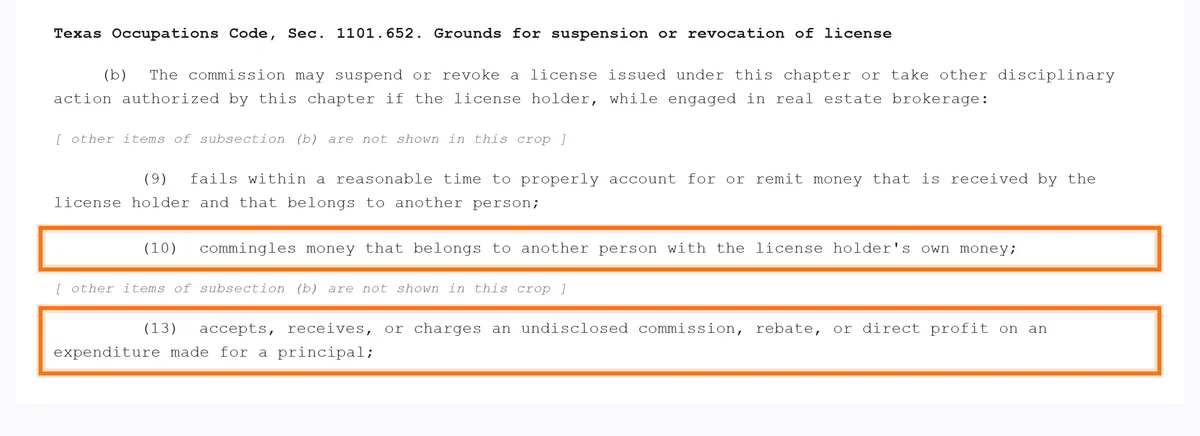
| A repair markup with no number | Ask | An undisclosed profit on an expenditure is grounds for discipline under 1101.652(b)(13) | The percentage, and whether you see the vendor's invoice |
| A termination fee or a long term | Ask | It decides what leaving costs if the service falls short | The notice period and every exit charge, in writing |
| A leasing fee on top of the monthly fee | Normal | Placing a tenant is separate work | What it includes and whether any of it is refunded |
| A repair approval limit | Normal | It lets small repairs happen without a phone call | That you set the limit |
How to read this table: one "walk" row is enough to move on, because each one hides a cost or a risk you will only meet later. "Ask" rows are settled by a clear written answer. "Normal" rows should not scare you off a well-run company.
Deal-breakers: walk away
These signs mean the company either cannot run your house properly or does not intend to be straight with you about how it does:
- No fee list until the agreement. A company that cannot hand you every fee on one page before the contract is planning for you to find them later.
- A rent number with no support. A figure that beats every other quote, with no leased comparables behind it, is a sales number. If the house does not lease at it, the price drop comes out of your vacancy.
- No written screening criteria. Screening from instinct produces bad placements and inconsistent treatment of applicants, and you share the risk of both.
- A vague answer about where rent and deposits are held. A licensed broker has a clear one: a trust account.
- An exit cost nobody will put in writing. If the company will not tell you on paper what leaving costs, assume it is a lot.
- Pressure to sign today. There is no reason a management agreement cannot wait a week while you read it.
Yellow flags: ask a direct question first
These signs often have a reasonable explanation, and the explanation is what you are after. Ask, listen, decide:
- In-house maintenance. It can be efficient or a profit center. Ask whether you can use your own vendor for a major repair and whether you see the original invoice.
- A markup on repairs. A disclosed, fixed charge that pays for coordination is defensible. An undisclosed one is the thing 1101.652(b)(13) names. Ask for the number.
- A long term or automatic renewal. Ask what the notice period is and whether you can leave without a penalty if the service falls short.
- Slow replies during the sales process. Sometimes a busy week; sometimes a preview. Ask who your contact will be and what response time the company commits to in writing.
- Few or mixed reviews. A newer company may be excellent. Ask about the broker's experience and for an owner reference; reading property management reviews shows what to look for.
A good company answers all of these without getting defensive. Defensiveness is itself an answer.
Red flags when evaluating a property management company's pricing
Is it a red flag when a company's pricing looks cheap? Not by itself. The red flag is a price you cannot total. Our own pricing page describes Dallas-Fort Worth pricing as usually built from a few standard parts: a monthly fee, a leasing fee, sometimes a renewal fee, maintenance handling and occasional extras. A low monthly percentage can be paid back through the other parts.
Illustrative only, not a quote. Two companies manage a $2,000-a-month house for a year, with rent collected all 12 months, one new tenant placed and $1,500 of repairs:
- Company A charges 6% a month, a leasing fee of one full month and a 10% repair markup: $2,000 x 6% = $120 x 12 = $1,440, plus $2,000, plus $1,500 x 10% = $150. Total: $3,590.
- Company B charges 8% a month, a leasing fee of half a month and a 5% coordination charge: $2,000 x 8% = $160 x 12 = $1,920, plus $1,000, plus $1,500 x 5% = $75. Total: $2,995.
The company with the lower monthly fee costs $595 more in this year. Run the same test on every quote, and add the renewal fee and any charge for leaving. How to compare two property management quotes fairly sets up the comparison.
Red flags Texas law already names
Some warning signs are more than bad practice. In Texas, a person who, for pay and for another person, controls the acceptance or deposit of rent from a resident of a single-family rental is acting as a broker (Occupations Code 1101.002), and section 1101.351 says a person may not act as a broker without a license. Section 1101.005 lists exceptions, such as an owner or the owner's employee leasing the owner's own property.
Under section 1101.652(b), TREC may suspend or revoke a license holder who fails to account for or remit other people's money within a reasonable time, commingles that money with its own, or takes an undisclosed commission, rebate or direct profit on an expenditure made for a client.
TREC Rule 535.146 adds that trust money, which includes rent and security deposits, must be kept in a designated trust account, never in a personal or operating account. TREC rules 531.18 and 531.20 also require a license holder's business website to link to the TREC Consumer Protection Notice and to Information About Brokerage Services from its homepage. A management website without those two links is worth a question. How to verify a property manager's license in Texas shows the lookup. This is general information, not legal advice.
Things that look like red flags but are normal
Owners comparing companies for the first time sometimes walk away from good ones for the wrong reasons. These are standard practices:
- A leasing fee on top of the monthly fee. Placing a tenant is separate work, and it is one of the standard parts of a management price.
- A required owner reserve. A set amount held for repairs is how a manager fixes a leak on a Saturday without calling you first. The red flag is a large reserve with no explanation.
- No firm rent number on the first call. A rent built from leased comparables near your house takes a little time, and that is a good sign.
- A repair approval limit. Being told the manager can spend up to a set amount without calling you is normal. You choose the limit.
- Firm screening criteria that exclude some applicants. That is what criteria are for.
If a company has these and nothing from the walk-away list, you are probably looking at a well-run operation.
Red flags that only show up in the agreement
Some warning signs are invisible until you read the contract, which is why you read it before signing. Look for fees that were not on the quote, an automatic renewal with a short window to cancel, a clause requiring you to list the house for sale with the company, an indemnification clause that runs only one way, and language letting the company change fees on notice.
None of these is unusual, and some are negotiable. The red flag is a company that will not discuss changing them. The agreement guide goes clause by clause, and whether hiring a manager means you must use them to sell covers the listing clause.
What to do when you see a red flag
For a deal-breaker, thank them and move on. There is no version of "we will fix it once you sign" that holds up. For a yellow flag, ask the direct question by email, so you have the answer on record. A good company replies with specifics; a phone call with no written follow-up is a second yellow flag.
If you have already signed and now see red flags in practice, read your agreement for the notice period and start documenting: unanswered emails, missing statements, invoices you cannot match. Leaving a manager is a process, not an argument, and the paperwork you keep now makes it clean later. How to switch property managers walks through it.
How Perpetual handles this
Perpetual Property Management is broker-owned, with our office at 5755 Rufe Snow Dr in North Richland Hills, managing homes in Keller, North Richland Hills, Fort Worth and nearby. Our license numbers are in the footer of every page of our site: Perpetual Realty Group, LLC, TREC 9008702-BB, and Justin Brown, Broker, TREC 549418-B. What our site commits to on the flags above:
- Every fee on one page. Our price sheet lists three plans: Full Service 10%, Standard 9% and Investor Special 7% of monthly rent, with placement, renewal, inspection and coordination fees. The final fee is set after the rental analysis, and every number is confirmed in writing before you sign. If a fee is not in the agreement, you do not pay it.
- A stated coordination charge. Maintenance coordination is a percentage of the vendor's invoice (5% Full Service, 4.9% Standard; make-ready 3% to 5% on Investor Special), and the original invoice is always in your owner portal.
- Written criteria. Every adult applicant is screened against published rental criteria, applied the same way to everyone.
- Five written guarantees, each with a remedy, on our guarantees page, subject to the Guarantee Addendum.
Our pricing page lists the questions to ask any manager, including what it costs to leave, and we answer them in writing for your property before you sign. The agreement term, notice period, any termination charge and how owner funds are held are confirmed in writing before you sign. Call 682-593-7033 to get them on paper.
The takeaway: Walk away from fees that are not all in writing, unwritten screening or vague answers about your money; ask by email about everything else; and do not mistake a leasing fee, an approval limit or firm criteria for a warning sign.
Questions owners ask
Is a low property management fee a red flag?
Not by itself, but it is a reason to look harder at the rest of the fee sheet. A low monthly percentage can be recovered through leasing, renewal, markup or termination charges. Ask for every fee in writing and total a full year with the same assumptions for each company. If the low-fee company cannot produce that list, the low fee is the bait.
Is it a red flag if a property manager will not give me references?
It is a yellow flag worth a direct question. Some companies protect their owners' privacy and only connect you after asking permission, which can take a few days. A flat refusal with no alternative, such as reviews that describe specific events or a sample statement, is a stronger warning. Judge the refusal by whether the company offers another way to check its work.
What is the most common red flag owners miss?
Comparing the monthly percentage instead of the year. Owners pick the lowest monthly fee and meet the leasing fee, the renewal fee, the repair markup and the exit charge later. Total each quote for a full year with the same rent, the same repairs and one tenant placement, and the cheapest headline is often not the cheapest company.
Can I leave a property manager after I notice red flags?
Usually yes, by following the notice period in your agreement, which also says whether a termination charge applies. Document the problems in writing first, because a record of unanswered emails or missing statements supports you if the company disputes the exit. A new manager can take over mid-lease, and the deposit, keys and records move with the house.
Is it a red flag when evaluating a property management company's pricing if not every fee is written down?
Yes, and it is the clearest pricing red flag there is. You cannot compare a price you cannot total. Ask for a written list of every fee before the agreement arrives, then check that the agreement matches it. A company that answers "it is all in the contract" is asking you to find the costs after you sign.
Is a maintenance markup a red flag?
Not when it is disclosed and fixed. A stated percentage for coordinating a repair, with the vendor's original invoice in front of you, is a price you can judge. The red flag is a markup nobody will state. Texas Occupations Code 1101.652(b)(13) makes an undisclosed commission, rebate or direct profit on an expenditure made for a client grounds for license discipline.
Does a property manager in Texas need a license?
A person who, for pay and for another person, controls the acceptance or deposit of rent from a resident of a single-family rental is acting as a broker under Occupations Code 1101.002, and section 1101.351 says a person may not act as a broker without a license. Section 1101.005 lists exceptions, such as an owner leasing the owner's own property. Look up the company and its broker on TREC's license search before you sign. This is general information, not legal advice.
Related services
Property management in Keller, North Richland Hills and Fort Worth. How full-service management works in Tarrant County →