Key takeaways
- The duty is the landlord's (the owner's); a property manager does the work as the owner's agent and the owner pays for it (Property Code 92.162(e)).
- Locks operated by a key, card or combination are rekeyed at the landlord's expense no later than the seventh day after each tenant turnover date (92.156(a)).
- Each smoke alarm is tested at the beginning of the tenant's possession, by smoke, the test button or the maker's procedure (92.258(b)).
- The proof is one dated file: the locksmith invoice, door-by-door photos, the alarm test log and a move-in form the tenant signs.
- A smoke alarm that worked at the start of possession is presumed to keep working until the tenant asks for a repair (92.258(g)).
Who checks smoke alarms, locks and the other safety requirements before move-in? Texas law puts the duty on the landlord, and when you hire a property manager, the manager runs the check for you as your agent, at your cost. On a rental in Fort Worth, Keller or North Richland Hills, that means rekeying the locks, confirming the required security devices and testing every smoke alarm before the keys change hands, then keeping a dated record the tenant signs.
This guide covers the pre-move-in check as a record: what it should show, who tests what and when, how it is signed, and who pays for each item. The full list of statutory devices and the tenant's remedies are in our guide to Texas security device and smoke alarm rules.
The pre-move-in safety record: what it should show
A safety check that leaves no record is hard to prove later. Here is what a complete pre-move-in record contains, item by item, with the Property Code section behind each line:
| Item | What the record shows | When | Who pays |
|---|---|---|---|
| Rekey of every lock operated by a key, card or combination | Locksmith or vendor invoice listing the doors, dated between move-out and move-in | No later than the 7th day after the tenant turnover date (92.156(a)) | Landlord (92.156(a)) |
| Required security devices: window latches, a doorknob lock or keyed dead bolt, a keyless bolting device and door viewer on each exterior door, pin lock plus handle latch or bar on sliding glass doors | A door-by-door and window-by-window checklist with a dated photo of each device | Before possession; they must work while the tenant is in possession (92.153(d), (h)) | Landlord (92.153(c)) |
| Smoke alarms: each bedroom, the hallway serving the bedrooms, each level | Room-by-room test log: date, method (button, smoke or maker's procedure), result | At the beginning of the tenant's possession (92.258(b)) | Landlord installs (92.255) |
| Tenant acknowledgment | The move-in condition form, signed by the tenant, noting the devices present and the alarms tested | At the move-in walk | No cost |
| Lease clauses | The underlined or bold clauses for tenant-caused device damage and the smoke alarm notice | Signed before move-in | No cost |
How to read this table: the first three rows are duties the statute puts on the landlord, and the last two are the paperwork that lets you prove they were done. If a row has no dated document behind it, treat that item as not done until someone checks it again.
The duty is the landlord's; the manager carries it out
The Property Code puts the security device and smoke alarm duties on the landlord. A management company acts as the owner's agent: under 92.169 and 92.262, a managing agent is the landlord's agent for the notices these subchapters require, so a tenant's request sent to the manager counts as sent to you. When a manager rekeys the house and tests the alarms, it is your duty being carried out with your money.
The statute says so directly about the money:
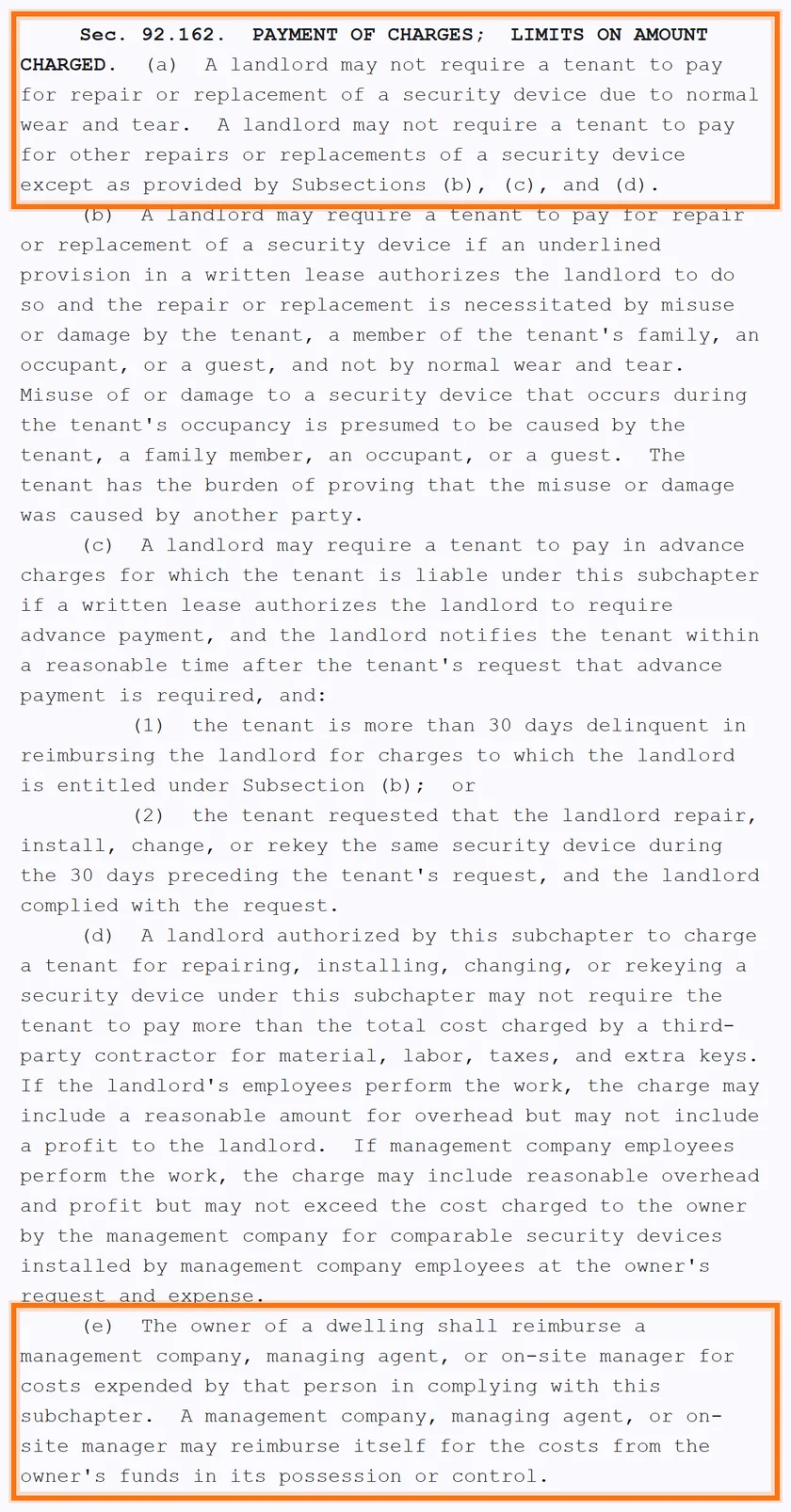
That is why "who checks" has a second half: who keeps the proof. A manager that does the work and keeps no record has done half the job, because you cannot show a tenant, an insurer or a court what happened on move-in day.
Who tests what, and in what order
The order matters, because each step depends on the one before it:
- After the prior tenant surrenders the house: collect every key, remote and code, and schedule the rekey. The clock in 92.156(a) runs from the tenant turnover date.
- During make-ready: walk every exterior door, window and sliding door against the device list, fix or install what is missing, and photograph each device. Test every smoke alarm, replace any that fail, and note which rooms each one serves.
- At the move-in walk: test the alarms again with the tenant present, note the result on the condition form, and hand over the new keys.
- Same day: file the invoice, photos, test log and signed form together.
A vendor or the manager's own staff can do the physical work. What matters is that a named person signs each step with a date, and that the person who signs actually pressed the test button.
The timing: turnover date, make-ready and the move-in walk
The rekey. Section 92.156(a) requires a security device operated by a key, card or combination to be rekeyed by the landlord, at the landlord's expense, no later than the seventh day after each tenant turnover date. Interior and closet door locks are excluded (92.156(d)). Seven days is a deadline, not a target: rekeying before the new tenant gets a key is the only way to be sure no former tenant can open the door.
The devices. The required devices apply when a tenant is in possession and must be operable throughout that time (92.153(d), (h)). Check them during make-ready, when a missing latch can be fixed with the rest of the make-ready work, not on move-in morning.
The alarms. Section 92.258(b) requires the landlord to determine that each smoke alarm is in good working order at the beginning of the tenant's possession. Testing during make-ready is good practice; the test that counts is the one on the day possession starts.
How the check is dated and signed
Four documents make up the proof, and they belong in one file:
- The rekey invoice, dated after the prior tenant left and before the new tenant got a key, listing each door.
- Dated photos of each exterior door's devices, each window latch, each sliding door device and each smoke alarm.
- The alarm test log: room, date, method and result, signed by the person who tested.
- The move-in condition form, signed by the tenant, noting that the devices were present and the alarms sounded.
The lease completes the file. Several rules only work if the lease says so in a particular way: charging a tenant for device damage needs an underlined lease provision (92.162(b)); requiring device requests in writing needs an underlined or bold clause (92.159); and the landlord's remedies against a tenant who disables an alarm need an underlined or bold notice in the lease (92.2611(d)). A move-out inspection later compares against this same file.
Items outside these two subchapters: ask the city and your insurer
The security device subchapter (92.151 to 92.170) and the smoke alarm subchapter (92.251 to 92.264) do not mention carbon monoxide alarms, outlet protection, water heater valves or garage door openers. That does not mean nothing applies. Section 92.252(a)(2) says the smoke alarm subchapter does not limit a local ordinance on fire safety that is part of a building, fire or housing code, so a city can add requirements.
Before a first tenant in a Fort Worth, Keller or North Richland Hills house, ask the city's code office whether any fire or housing code item applies to a single-family rental at your address, and ask your insurance agent what the landlord policy expects. Then add those items to the same checklist so they are tested, photographed and signed on the same day. A pool needs its own check; see whether a manager will take a house with a pool.
Who pays for each item under Texas law
Most of the cost is the owner's, and the statute is specific about the exceptions:
- Rekey between tenants: landlord's expense (92.156(a)). Extra rekeys the tenant asks for during the lease: tenant's expense (92.156(b)).
- Required devices: installed at the landlord's expense (92.153(c)).
- Device repairs from normal wear and tear: the landlord pays (92.162(a)). The tenant pays only for misuse or damage, and only with an underlined lease provision (92.162(b)), and within the cost limits in 92.162(d), which start from what a third-party contractor would charge.
- Smoke alarm batteries: the landlord does not have to provide batteries after the tenant takes possession if the alarm worked at move-in (92.258(f)).
- An alarm the tenant damaged: the landlord repairs it if the tenant pays the reasonable cost in advance (92.258(c)).
With a manager, the bill reaches you through the statement, and the manager may pay itself from your funds it holds (92.162(e)). This is general information, not legal advice.
What happens if the check is skipped
If a required device is missing or the locks were not rekeyed, the tenant has statutory remedies against the landlord, and the same is true for a smoke alarm that was not installed or tested. Those remedies, including the civil penalties in 92.164 and 92.260, are set out in our security device and smoke alarm guide, so we do not repeat them here.
The practical point is simpler. Owners who get caught by this are rarely careless; they assumed a previous tenant, a cleaner or a handyman had covered it. Nobody covers it unless it is on a checklist with a name and a date next to it. This is general information, not legal advice; the statute and your lease control any specific case.
How Perpetual handles this
Perpetual Property Management is broker-owned and manages rentals in Fort Worth, Keller and North Richland Hills from our office in North Richland Hills. What our published pages say about this part of the work:
- Move-in record: every move-in and move-out gets a 360-degree condition inspection under the Perpetual Promise, and our leasing service produces a photo-documented move-in condition report, room by room, timestamped and acknowledged by the tenant.
- Lease: Texas-compliant lease documents with the addenda the property needs.
- Repairs: work under your pre-approved spending limit goes ahead; larger jobs come to you with a description, photos and a recommendation; the original vendor invoice is in your owner portal, and every completed repair over $500 gets photo or video proof.
- Inspections: an enrollment inspection ($125 Investor Special, $49 Standard, included on Full Service) and an annual property inspection on every plan, as listed on our pricing page.
Who performs the rekey and the alarm test on your house, and how that line appears in the move-in file, is confirmed in writing before you sign. See our leasing and move-in service, or call 682-593-7033.
The takeaway: The duty is the landlord's, the work is the manager's, the cost is the owner's, and the proof is one dated file the tenant signs before the first night in the house.
Questions owners ask
Do the locks have to be rekeyed before a new tenant moves in?
Yes. Under Property Code 92.156(a), a security device operated by a key, card or combination must be rekeyed by the landlord, at the landlord's expense, no later than the seventh day after each tenant turnover date. Interior and closet door locks are excluded. A tenant may also ask for extra rekeys during the lease at the tenant's expense (92.156(b)).
Does a carbon monoxide alarm belong on the pre-move-in check?
The Property Code subchapters on security devices (92.151 to 92.170) and smoke alarms (92.251 to 92.264) do not mention carbon monoxide alarms. Section 92.252 leaves room for local fire, building and housing codes, so ask your city's code office what applies to a single-family rental at your address, and ask your insurance agent what the landlord policy expects.
Can the tenant be charged for a smoke alarm that stops working?
Not for an alarm that simply fails. The landlord inspects and repairs a smoke alarm during the lease when the tenant reports a malfunction (92.258(c)). Batteries are different: the landlord does not have to provide batteries after move-in if the alarm worked when the tenant took possession (92.258(f)). If the tenant damaged the alarm, the landlord repairs it once the tenant pays the reasonable cost in advance.
What does a move-in condition form have to do with safety devices?
It is the document that proves the devices were present and the alarms worked on the day the tenant took possession. A form that lists each exterior door, window and alarm, notes the test method and result, and carries the tenant's signature and date closes most arguments before they start. Pair it with dated photos and the rekey invoice in one file.
Who is responsible for replacing smoke alarms in rented properties in Texas?
The landlord installs the required smoke alarms: at least one in each bedroom, one in the hallway serving the bedrooms, and one on each level (92.255). The landlord tests them at the start of the tenant's possession and repairs or replaces them during the lease when the tenant reports a problem (92.258). With a property manager, the manager arranges the work and the owner pays for it.
What are the door lock rules for a Texas rental?
Property Code 92.153 lists the devices required without the tenant asking: a window latch on each exterior window, a doorknob lock or keyed dead bolt and a keyless bolting device and door viewer on each exterior door, and a pin lock plus a handle latch or security bar on each sliding glass door. Locks are rekeyed within seven days after each turnover (92.156). Device heights and the exceptions are covered in our security device guide.
Related services
Property management in Keller, North Richland Hills and Fort Worth. How full-service management works in Tarrant County →