Key takeaways
- Most managers take pool houses once the barrier, the pool service, the insurer and the lease are settled.
- The Texas pool-yard law (Health and Safety Code chapter 757) covers multiunit rental complexes and HOAs, not a single-family house.
- For your house, the city's pool fence ordinance applies; cities adopt one under Local Government Code 214.101.
- Chapter 757's numbers (48-inch enclosure, self-closing and self-latching gates) are still a useful benchmark for the walk-through.
- Settle four things before listing: the barrier, who pays for the pool service, the insurer and the lease's pool addendum.
Will a property manager take a rental house with a pool? Most will, after an acceptance check. For a house in Fort Worth, Keller or North Richland Hills, the manager wants four things settled before the first showing: a fence, gates and house doors that meet the city's pool rules, a pool service someone pays for, an insurer who knows about the pool, and a lease with a pool addendum. Get those right and a pool house rents and runs like any other.
Below: the acceptance checklist, which Texas rule applies to your backyard, and how the pool service, insurance and lease fit together.
The acceptance check: what a manager looks at before taking a pool house
Here is the checklist, item by item, with the standard each item is measured against:
| Item | What the manager looks at | The standard to measure against |
|---|---|---|
| Fence or wall around the pool yard | A complete enclosure, its height, gaps under and through it, nothing climbable placed against it | Your city's ordinance; chapter 757 as a benchmark (48 inches, 4-inch gaps, no climbable equipment) |
| Gates | Close and latch on their own every time, open away from the pool, latch out of a child's reach | Your city's ordinance; chapter 757.004 as a benchmark (latch at least 60 inches, with exceptions) |
| House doors and windows into the pool yard | Doors that close and latch on their own, alarms or locks where the city requires them | Your city's ordinance |
| Pool and equipment | Pump, filter, drain covers, leaks, the surface, any heater or spa | A pool professional's written report |
| Pool service | Who hires it, who pays, how often, how the service gets into the yard | The management agreement and the lease |
| Insurance | The insurer knows the house is rented and has a pool; the liability limit | Your insurer |
| Lease | A pool addendum with rules and the tenant's daily duties | The lease |
| HOA | Any rules on pools, fences or rentals | The HOA's documents |
How to read this table: the first three rows are about keeping a child out of the water, so they come first and they are pass or fail. The middle rows are about money and records. A manager who walks the yard, photographs each item and writes down the standard used gives you a baseline for every later inspection and for the move-out.
Why some managers say no
Three concerns drive the refusals, and each one is settled by a condition, not by luck. Safety: a manager who cannot confirm the fence and gates are right should not rent the house. Upkeep: a pool left entirely to a tenant often turns green, and the argument over who pays to recover it lands on the manager. Equipment: pumps, filters and heaters fail, and an owner with no budget for them turns every failure into a crisis.
A manager who takes pool houses answers all three before listing. The liability and lease side in depth is in renting out a house with a pool.
Which Texas pool rule applies to your backyard
Owners often hear that Texas requires a 48-inch pool fence at every rental. Read who that law covers. Health and Safety Code chapter 757 applies to pools of multiunit rental complexes and property owners associations (757.002), and its definition of a multiunit rental complex excludes a single-family home that is not part of a condominium project (757.001(7)). A rented house with its own backyard pool is outside it.
What does reach your backyard is the city. Local Government Code 214.101 lets a city set minimum standards for pool fences and enclosures by ordinance, and lets it require the owner to repair, replace or secure a fence that violates them, after notice and a hearing.
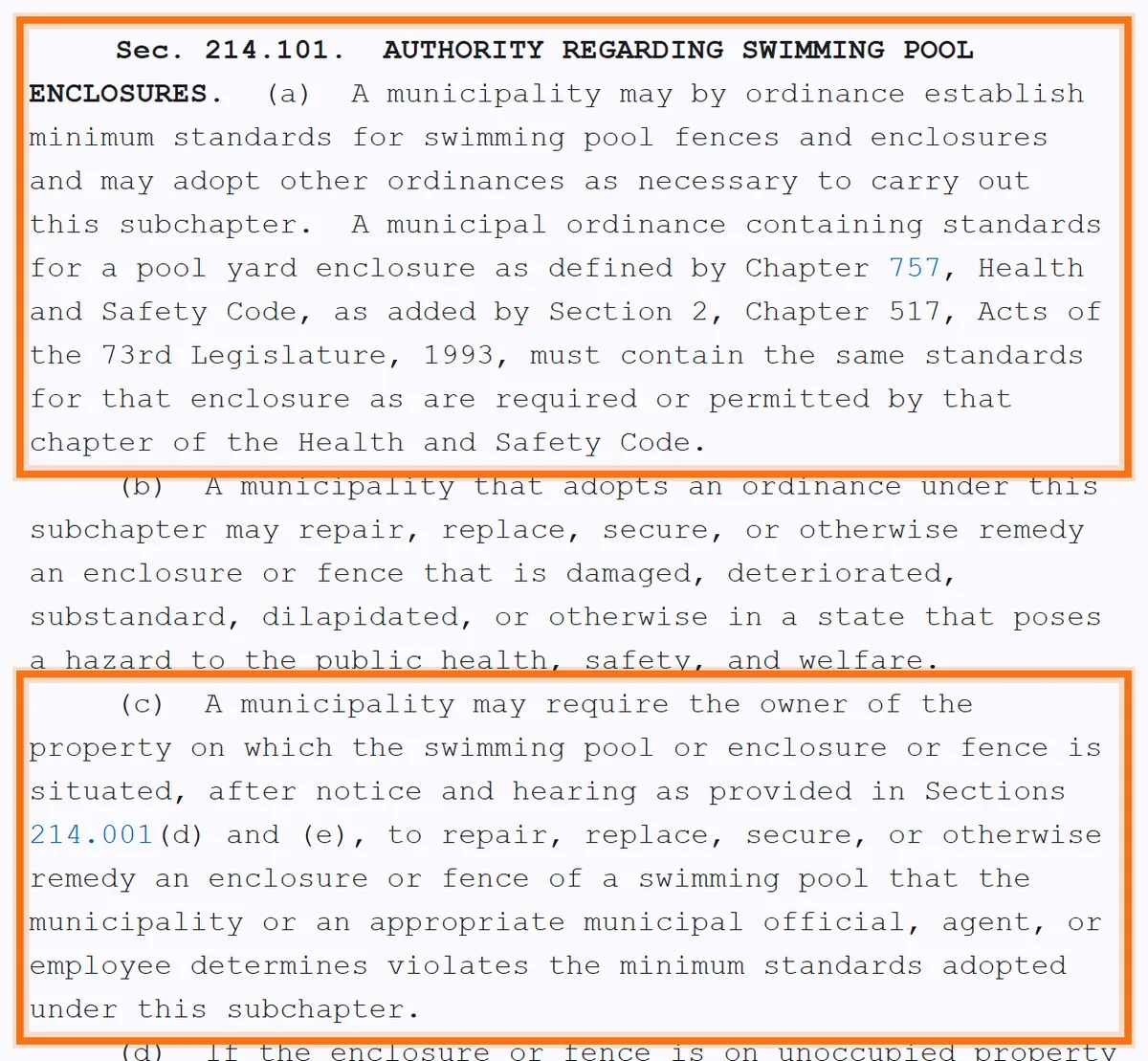
The same section lets the ordinance set a penalty of up to $1,000 for a violation and count each day as a separate offense (214.101(f)), and gives the city a lien for its repair costs (214.101(e)). So call the building or code department in Fort Worth, Keller or North Richland Hills and ask what applies to an existing residential pool at a rented house. Two exceptions: a rented condo or townhome in a project with a shared pool, and a duplex with a pool, can fall under chapter 757; see who handles lawn care and pool maintenance. This is general information, not legal advice.
Who pays for the pool service
The common arrangement in managed pool homes is a professional pool service the owner pays for, with the cost considered when the rent is set. The reason is practical: chemistry, the pump and the surface are easy to damage and expensive to recover. The tenant keeps the parts anyone can do: skimming leaves between visits, keeping the water level up, keeping gates shut, leaving the equipment alone and reporting problems at once.
Settle three details in writing: who hires the service, how its invoices are paid, and how the service gets into the yard (a gate code or key, and the days it comes). If you already use a pool company you trust, ask whether the manager will work with it. The full split of yard and pool jobs, and what the lease should say, is in who handles lawn care and pool maintenance at a rental house?
The insurer and the pool addendum
Tell your insurance agent the house is rented and has a pool, and ask whether the carrier sets conditions for a rented pool home. Texas's Office of Public Insurance Counsel notes that dwelling insurance, a common policy type for rentals, does not pay for someone else's injuries, and lists extra liability coverage for accidents involving a pool among the coverages you can add. Ask your agent which applies to your policy. See also umbrella insurance for landlords. This is general information, not insurance advice.
The lease needs a pool addendum: the maintenance split, the rules (no glass, supervision of children, no diving where the depth does not allow it, no changes to the equipment, fence or gates), the duty to keep gates closed and latched, prompt reporting, and the pool service's access. Requiring renters insurance is covered in should I require my tenants to have renters insurance?
Keeping the pool acceptable during the tenancy
Acceptance is not a one-time event. A gate that stops latching in month five turns a compliant yard into a hazard, so treat a broken gate latch or a damaged fence as an urgent repair, not a routine one, and say so in the lease and in your instructions to the manager.
For apartment complexes and HOAs, chapter 757 sets a useful benchmark: the owner must inspect pool yard enclosures, gates and their self-closing and self-latching devices at least once every 31 days (757.009(c)). It does not bind a single-family rental, but it shows how often the gate deserves a look. In practice, the pool service is in the yard most often; ask it to report a gate or fence problem the day it sees one, and ask that the pool yard appear in every inspection report with photos.
Plan for the equipment too: a spending limit high enough for a pump or filter repair, and a decision on who calls the pool company after hours. Freeze care and leaks are covered in renting out a house with a pool.
Does a pool raise the rent?
Sometimes, and not always by as much as the pool costs to run. Some applicants see a pool as the reason to choose the house; others see a chore or a risk with small children. How that plays out depends on the house, the street and what else is listed, so price from comparable leased homes rather than from the cost of the pool. A free rental analysis is a sensible start. Including the pool service in the rent, rather than handing the pool to the tenant, usually makes the listing easier to explain.
An acceptance walk-through in Keller, step by step
Illustrative only. You own a four-bedroom house in Keller with a pool and you are moving out of state. The acceptance walk-through goes like this:
- Barrier. The gate no longer latches on its own, and a patio door opens straight into the pool yard. You confirm with the city what applies to an existing pool and fix both before listing.
- Equipment. A pool company checks the pump, filter and drain covers and puts its findings in writing.
- Service. You choose a weekly service, decide that you pay for it, and give it a gate code.
- Insurer. Your agent confirms the policy covers a rented pool home and what liability limit applies.
- Lease. The lease carries a pool addendum; the move-in report photographs the pool, deck, fence and gates.
Months later the service reports a failing pump. The estimate is above your spending limit, so it comes to you first, and the move-out is compared with the move-in photos.
How Perpetual handles this
Perpetual Property Management is broker-owned, with our office at 5755 Rufe Snow Dr in North Richland Hills. What our site states that applies to a pool house:
- The lease: current Texas-compliant lease documents with the addenda your property actually needs, and our leasing page names a pool addendum among them (leasing and move-in).
- Inspections: every plan includes an annual property inspection, the enrollment inspection when management starts is $125, $49 or included by plan, and every move-in and move-out gets a 360-degree condition inspection under our written guarantees, subject to the Guarantee Addendum.
- Repairs and vendors: routine repairs under your pre-approved limit get fixed fast, larger items come to you with a description, photos and a recommendation, and you can usually use your own vendor, such as a pool company you trust, if it is insured and reliable (maintenance coordination).
How a pool service is set up and billed on your house, and what we record about the pool yard at enrollment, are confirmed in writing before you sign. To talk through a pool house, call 682-593-7033.
The takeaway: A manager takes a pool house once four things are settled: a barrier that meets your city's rules, a paid pool service, an insurer who knows about the pool, and a pool addendum in the lease. Check the city's rules, not the state apartment-complex law.
Questions owners ask
Should the tenant or the owner pay for pool maintenance?
Usually the owner, through a professional pool service, with the cost considered when the rent is set. Pool chemistry and equipment are easy to damage and costly to recover. The tenant handles what anyone can do: skimming leaves, keeping the water level up, keeping gates shut and reporting problems. Put the split in the lease's pool addendum.
Is a pool fence required for a rental house in Texas?
Not under the state pool-yard law: Health and Safety Code chapter 757 applies to multiunit rental complexes and property owners associations, and excludes a single-family home that is not part of a condominium project. Your city's ordinance applies instead (Local Government Code 214.101). Confirm the rules with Fort Worth, Keller or North Richland Hills, and treat chapter 757's 48-inch standard as a benchmark. This is general information, not legal advice.
Does a pool increase my liability as a landlord?
Yes, a pool adds risk, which is why the barrier, the insurer and the lease addendum matter. Tell your insurer the house is rented and has a pool, ask about the liability limit and whether extra liability coverage applies, and consider requiring renters insurance. A sound fence, latching gates and a written record of both are what you control. This is general information, not insurance advice.
Can I close the pool or keep it empty instead of maintaining it?
Draining a pool is usually not the answer: an empty pool can be damaged and is still a fall hazard. A pool professional can tell you what reduces cost in the off season, but it stays behind a sound barrier either way. Whatever you choose, tell the manager so the lease and the pool addendum match it.
Can the tenant maintain the pool instead of a pool service?
It is possible, but it is where most pool disputes start: chemistry and equipment are easy to get wrong and the cost of recovery lands on you. If you do it, the lease should spell out exactly what the tenant does, how often, and what happens if the pool is not kept. Many owners pay for the service and keep the tenant's part simple.
What does a manager check before agreeing to take a pool house?
The fence or wall around the pool yard, gates that close and latch on their own, house doors that open into the pool area, the equipment's condition, who pays for the pool service, whether the insurer knows about the pool, any HOA rules, and a pool addendum for the lease. Each item is measured against your city's rules, your insurer and your lease.
Property management in Keller, North Richland Hills and Fort Worth. How full-service management works in Tarrant County →