Key takeaways
- The first inspection decides whether the house can be leased as it stands, what work comes first, and the condition record everything later is measured against.
- Texas security device rules apply when a tenant is in possession (Property Code 92.153(d)), so locks, latches and door viewers are fixed before move-in, not after.
- Smoke alarms: one in each bedroom, plus the corridor and each level as 92.255 requires, tested at the beginning of the tenant's possession under 92.258(b).
- Homes built before 1978 need the federal lead-based paint disclosure before the lease is signed.
- Perpetual's price sheet lists the property enrollment inspection at $125 (Investor Special), $49 (Standard) or included with onboarding (Full Service).
A property manager should inspect your house before the first tenant moves in, and a careful one will not take a house it has never seen. Some managers walk the house before you sign; others do it as part of enrollment. Either way, for a rental in Fort Worth, Keller or North Richland Hills, the inspection should tell you three things in writing: whether the house meets the Texas items a tenant is entitled to on move-in day, what you need to fix first, and what can wait.
This guide covers when the first inspection happens, the Texas rules it checks against, older-home and city and HOA items, how findings are sorted into what to fix first, who does the work, and what our enrollment inspection costs on each plan.
Before the first tenant in a Fort Worth area rental: what gets checked and why
Here are the items a first inspection checks on a single-family rental, the rule behind each one, and when it has to be done:
| Item | What the rule says | Source | When |
|---|---|---|---|
| Exterior doors | A doorknob lock or keyed dead bolt, plus a keyless bolting device and a door viewer, on each exterior door | Property Code 92.153(a) | Before a tenant is in possession |
| Windows and sliding doors | A latch on each exterior window; a pin lock and a handle latch or security bar on each sliding glass door | Property Code 92.153(a) | Before a tenant is in possession |
| Rekeying | Key, card or combination devices rekeyed at the landlord's expense | Property Code 92.156(a) | By the 7th day after each tenant turnover |
| Smoke alarms | At least one in each bedroom, in the corridor serving bedrooms, and on each level | Property Code 92.255(a) | Installed before move-in |
| Smoke alarm test | Landlord determines each alarm is in good working order by testing it | Property Code 92.258(b) | At the beginning of the tenant's possession |
| Health and safety conditions | Diligent effort to repair conditions that materially affect health or safety, after tenant notice | Property Code 92.052 | Best fixed before anyone moves in |
| Lead-based paint (homes built before 1978) | Pamphlet, known information and records, Lead Warning Statement | EPA disclosure rule | Before the lease is signed |
| City and HOA rules | Registration where the city requires it; HOA leasing restrictions | City and HOA documents | Before listing |
How to read this table: the first five rows are fixed by statute and are the true must-fix list, because they attach to the day a tenant takes possession. The last rows depend on the age of the house, the city and the HOA, so they are checked address by address. This is general information, not legal advice.
Before you sign or at enrollment: when the first inspection happens
Managers handle the first look at a house in one of two ways. Some walk it before the management agreement is signed, as part of the rent estimate. Others sign first and inspect at enrollment, before any marketing starts. Both can work, as long as the inspection happens before a tenant is chosen and before you commit money to a make-ready.
What a manager should not do is lease a house nobody has looked at. The first inspection answers three questions: can this house be leased as it stands, what it will rent for in its current condition, and what work would change that. It also sets the condition record, the reference point when a later inspection or a move-out shows something different.
Ask any manager two things before you sign: does someone walk the house before the agreement or at enrollment, and is there a charge for it. If the answer to the second is yes, the amount belongs in the agreement. For what onboarding covers beyond the inspection, see setup and onboarding fees in property management.
The Texas safety items to fix before a tenant moves in
Texas puts specific duties on the day a tenant takes possession, so the first inspection checks them before that day. Property Code 92.153(a) lists the security devices a dwelling must have without the tenant asking: a window latch on each exterior window, a doorknob lock or keyed dead bolt and a keyless bolting device and door viewer on each exterior door, and a pin lock plus a handle latch or security bar on each sliding glass door, with limited exceptions in the statute. Subsection (d) says these apply when a tenant is in possession, and (c) puts the cost on the landlord. Section 92.156 then requires rekeying by the seventh day after each tenant turnover.
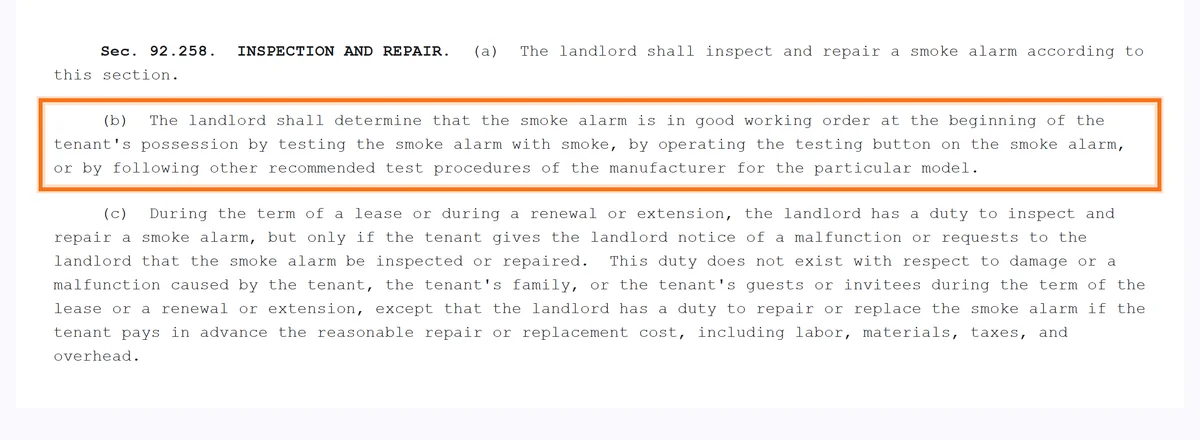
Smoke alarms come next. Section 92.255 requires at least one in each separate bedroom, one in the corridor serving multiple bedrooms, and one on each level. Section 92.258(b) requires the landlord to test each one at the start of the tenancy:
Beyond those, the inspection looks for conditions that materially affect health or safety, which 92.052 obliges a landlord to repair once a tenant gives notice: active leaks, exposed wiring, a heater that does not run, broken steps or railings. The statute also names hot water, a device supplying it at a minimum of 120 degrees Fahrenheit. The detail is in Texas security device and smoke alarm rules. A manager is not a licensed home inspector; if something structural or electrical turns up, the right professional comes first.
Older homes: the lead-based paint disclosure
If your house was built before 1978, the federal Lead-Based Paint Disclosure Rule applies before a renter signs a lease. As the EPA describes it, landlords and property managers must give the renter the Protect Your Family From Lead in Your Home pamphlet, disclose any known information about lead-based paint and hazards in the home, provide the available records and reports, and include a Lead Warning Statement in or attached to the lease. A signed copy is kept for three years after the lease begins.
The first inspection is where this gets flagged, because the build year decides it and the owner holds whatever records exist. The rule does not require you to test for lead; the EPA notes that renters can ask for an inspection, but landlords and property managers are not required to provide one under the disclosure rule. It does not apply to housing built after 1977, to leases of 100 days or less, or to housing tested and found free of lead-based paint by a certified inspector. Peeling or chipping paint on an older house is a should-fix item at minimum, since the EPA calls deteriorating lead-based paint a hazard that needs prompt attention.
City registration and HOA leasing rules
Rental rules vary by city, so the first inspection checks your address against the right one. In Fort Worth, the city's rental registration page says registration is voluntary for one- and two-family rentals with no violations, and mandatory, at $200 a year for each unit, for one- and two-family rentals with fire safety or public health and sanitation code violations, and that registration requires out-of-state owners to designate a local agent to accept legal service and a contact for local emergencies. For Keller, North Richland Hills and other cities, confirm the current rules with the city before you list. More detail is in do I need to register my rental or arrange a city inspection in Fort Worth.
The HOA gets the same check. Ask for the covenants and leasing rules before the inspection, because a leasing restriction, a minimum lease term or a tenant registration form changes the plan. Finding that out after the listing is live is expensive. See how to check whether your HOA allows you to rent out your house.
What the owner fixes first: must-fix, should-fix, can-wait
The findings should come back in writing, sorted so you can act on them:
- Must fix before leasing. The statutory items in the table above and anything that affects health or safety: missing or broken locks, missing or dead smoke alarms, an active leak, no hot water, a heater that does not run. These are not negotiable.
- Should fix to rent well. Condition items that affect the rent or how long the house sits: worn carpet, scuffed paint, mismatched appliances, an overgrown yard, peeling paint on an older house. You decide each one with its likely effect in front of you.
- Can wait, with a plan. Items to budget for over the next year or two, such as an aging roof or a water heater near the end of its life, so the money is ready before the call comes.
Each item should come with a rough scope so you can get a price, not a surprise invoice. How much to keep aside for the can-wait list is covered in how much to set aside for repairs and vacant months before renting.
Who pays for the work, and who does it
The owner pays for pre-leasing work; it is your house. What a manager changes is who coordinates it and how it is documented. You usually have three options: do the work yourself or with your own contractor and have the house checked again when it is finished; have the manager's vendors do it, with approval before anything starts and the invoice on your statement; or split it, painting and yard yourself and a licensed trade for the electrical item.
Before you choose, ask how coordination is billed. A percentage of the vendor's invoice, a trip fee or a minimum should all be in the agreement, not found on the first statement. And whoever does the work, the must-fix list has to be finished and photographed before the first showing.
How to prepare so the inspection takes one visit
A little preparation makes the inspection faster and the findings more accurate:
- Utilities on. Nobody can test a heater, a water heater or a hardwired smoke alarm with the power and gas off.
- Paperwork. HOA documents, prior inspection reports, roof or HVAC warranties, the build year, and any lead-based paint records for an older house.
- A known-issues list. Everything you already know is wrong, so the inspection confirms it rather than rediscovers it.
- Your timing and budget. When the house will be empty, when you want rent to start, and what you are willing to spend on make-ready, so the should-fix list becomes a decision rather than a debate.
If the house needs more work than the budget allows, it may be worth bringing a manager in before it is rent-ready; see when to hire a property manager before the house is rent-ready.
How Perpetual handles this
Perpetual Property Management is broker-owned and based in North Richland Hills, with Keller, North Richland Hills and Fort Worth as our main cities. What our site states about the start of management:
- The enrollment inspection. It establishes a condition record as we begin management and helps connect the records we receive with the property we are taking over. It is separate from the 360-degree condition inspection at every move-in and move-out under the Perpetual Promise, subject to its Guarantee Addendum.
- What it costs. Our price sheet lists the property enrollment inspection at $125 on the Investor Special (portfolios of 5 or more units), $49 on Standard, and onboarding and enrollment inspection included on Full Service. Plans are negotiable case by case, and every number is confirmed in writing before you sign.
- Make-ready advice. Our free rental analysis includes make-ready guidance on which improvements raise rent and which just cost money, so you hear it before you spend.
- Who does the work. You can usually use your own handyman or vendor if they are insured and reliable. Repairs under your pre-approved limit get fixed fast; anything larger comes to you with a description, photos and a recommendation, and the original vendor invoice is always in your portal.
Whether anyone walks the house before you sign, and the exact checklist the enrollment inspection covers for your house, are confirmed in writing before you sign. Start with the free rental analysis, see pricing and fees, or call 682-593-7033.
The takeaway: Get the first inspection in writing before the first tenant: Texas lock and smoke alarm items fixed, the lead paint disclosure ready if the house is pre-1978, city and HOA rules checked, and every repair sorted into must-fix, should-fix and can-wait.
Questions owners ask
Will a property manager inspect my house before agreeing to manage it?
A careful one will, either before you sign or at enrollment, and you should expect it before the first tenant moves in. The inspection checks the Texas items that apply when a tenant takes possession, conditions affecting health or safety, lead paint disclosure for pre-1978 homes, and city and HOA rules. Ask whether there is a charge; at Perpetual, the enrollment inspection is $125, $49 or included, depending on the plan.
Will a property manager tell me if my house doesn't meet rental requirements?
A good one will, in writing. Findings are usually sorted into must-fix items, such as missing locks or door viewers, smoke alarms that are missing or not working, an active leak or no hot water; should-fix items that affect rent; and can-wait items to budget for. Each should come with a rough scope so you can get a price before deciding.
Does the pre-management walkthrough replace a licensed home inspection?
No. A manager checks the items a tenant, a city inspector or Texas law would focus on, plus the condition items that affect rent. A manager is not a licensed home inspector. If the inspection raises a structural, foundation or electrical concern, the right licensed professional should look at it before anything else happens.
Do I have to use the manager's contractors for the pre-leasing repairs?
Usually not. Many managers let you use your own contractor, then check the house again before listing. At Perpetual you can usually use your own handyman or vendor if they are insured and reliable. If you use the manager's vendors, ask how coordination is billed and make sure the original invoice reaches you.
What should I have ready for the walkthrough?
Utilities on so systems and smoke alarms can be tested, the HOA documents, prior inspection or warranty paperwork, the build year and any lead-based paint records, a list of known repairs, and your timing and make-ready budget.
What does a pre-management inspection cost?
It depends on the manager; some include it, some charge separately. Perpetual's price sheet lists the property enrollment inspection at $125 on the Investor Special, $49 on Standard, and onboarding and enrollment inspection included on Full Service. Plans are negotiable case by case, and the final numbers are confirmed in writing before you sign.
Do smoke alarms have to be tested before a tenant moves in?
Yes. Texas Property Code 92.258(b) requires the landlord to determine that each smoke alarm is in good working order at the beginning of the tenant's possession, by testing it with smoke, the test button or the manufacturer's recommended procedure. Section 92.255 sets where alarms go: each bedroom, the corridor serving bedrooms, and each level. This is general information, not legal advice.
Property management in Keller, North Richland Hills and Fort Worth. How full-service management works in Tarrant County →