Key takeaways
- The National Weather Service gives November 22 as the average first freeze at Dallas/Fort Worth: do the prep in early November.
- The owner's items are one-time and cheap: pipe insulation, hose-bib covers, the irrigation shutdown and a tested main shut-off valve.
- Fort Worth Water's irrigation steps: turn off the controller and the water at the backflow, then run the zone closest to the backflow to depressurize the main line.
- The tenant's part goes out in writing before each freeze: hoses off, cabinet doors open, faucets dripping, heat on.
- TDI warns that a policy might not pay for frozen-pipe damage if steps were not taken to protect the pipes, such as keeping the heat on.
To prepare a Texas rental for a hard freeze, insulate exposed pipes in the attic, garage and outside, cover the hose bibs, shut the irrigation off at the controller and the backflow, check the heat, and make sure the tenant knows where the main water shut-off is. On a rental in Fort Worth, Keller or North Richland Hills, those owner items are done once in the fall; before each freeze the tenant gets short written instructions; and an empty house gets its own plan.
This guide is the hands-on checklist: the item table, the owner's prep, the sprinkler shutdown, the tenant message, what to do during the freeze and an outage, the vacant house, and who pays if a pipe bursts anyway.
The freeze checklist: each item, the prep step and who does it
Here is the checklist for a single-family rental in Tarrant County, item by item, with the usual split between owner, tenant and manager (your lease and management agreement decide the final split):
| Item | Prep step | Who does it |
|---|---|---|
| Exposed pipes in the attic, garage and crawl space | Foam pipe insulation, including the water heater lines | Owner pays; manager or vendor installs |
| Outdoor faucets (hose bibs) | Disconnect hoses; check the faucet washers; fit insulated covers | Tenant disconnects hoses; owner supplies covers |
| Irrigation system | Controller off; water off at the backflow; run the zone nearest the backflow to depressurize | Owner or manager; tenant only if the lease gives them the system |
| Backflow preventer | Insulated cover or wrap | Owner pays |
| Main water shut-off | Find it, test that it turns, tag it, tell the tenant | Owner or manager; tenant knows where it is |
| Water meter box | Keep the lid on | Tenant or owner |
| Heating system | Fall check-up; fresh filter | Owner pays; tenant changes filters if the lease says so |
| Washer in an unheated garage | Turn off its water supply before a freeze | Tenant |
| Vacant house | Water off at the shut-off and heat left on, or a plumber prepares the pipes | Owner decides; manager carries it out |
How to read this table: the pipe, faucet-cover, irrigation, backflow and shut-off items are one-time owner work, best finished before the National Weather Service's average first freeze of November 22. The rest repeat before every hard freeze and depend on the tenant, which is why they go into a written message. The prep steps come from Fort Worth Water's and TDI's freeze pages; what to agree with a manager in advance is in how a property manager handles a Texas freeze.
Why North Texas houses freeze where they do
Freeze damage follows the construction. Supply lines run through attics and garages that track the outdoor temperature, hose bibs come straight through the wall, and the sprinkler backflow preventer stands outside above ground. Fort Worth Water's freeze page tells customers that a frozen line is probably frozen where the pipe goes under the house or through an attic, if it is not insulated, so those are the places to start.
The other half is heat. When a winter storm cuts power, the house cools, and full water lines in a cold house are the risk. Fort Worth Water also warns that a frozen pipe may be cracked and will burst when thawed, which is why the leak often appears after the cold has passed.
Preparation is cheap and mostly a matter of knowing which few spots matter. If it fails, the response follows the water leak and mold guide.
The owner's prep before the first freeze
Do this once, in early November, and it holds for the season:
- Insulate every exposed supply line in the attic, garage and any crawl space with foam sleeves, including the lines at the water heater. Fort Worth Water's list starts with pipes outside the house and pipes in unheated parts of the home.
- Check that outdoor faucet washers are secure, and fit insulated covers on every hose bib.
- Shut down the irrigation and cover the backflow preventer (next section but one).
- Have the heating system checked and the filter changed, so the heat that protects the pipes actually runs.
- Find the main water shut-off valve, test that it turns, and tag it. Fort Worth Water asks that everyone in the household knows where it is and that the valve is checked now.
- Make sure the meter box lid is on, so the meter does not freeze.
These items sit on the November line of the preventive maintenance calendar. They are owner costs, and they are the cheapest line on this page.
The message to send the tenant before each freeze
A day or two before a forecast hard freeze, every tenant should get the same short message, by text and email so it is seen and on record. A version built from TDI's and Fort Worth Water's tips:
A hard freeze is forecast from [date]. Please disconnect garden hoses from outdoor faucets and leave the covers on. Open the cabinet doors under sinks so the house's heat reaches the pipes, and move cleaning products out of reach of children and pets. Let the faucets drip, cold and hot, overnight, following any water-use instructions from the city. Keep the heat on day and night, even if you are away. Turn off the water to the washer if it is in an unheated garage. The main water shut-off is at [location]; if a pipe bursts, turn it off first and call [number]. Keep some water drawn in case your supply is cut off.
Tenants act on instructions they can follow in five minutes. Put the shut-off location and the emergency number in the move-in papers too, so the freeze message is a reminder, not news.
The irrigation shutdown, step by step
An irrigation system has two freeze problems. A schedule that keeps running sprays water that freezes on sidewalks and streets; Fort Worth Water names irrigation systems as a common cause of icy roadways and sidewalks in freezing weather. And the backflow device holds water outdoors, where it can freeze and crack.
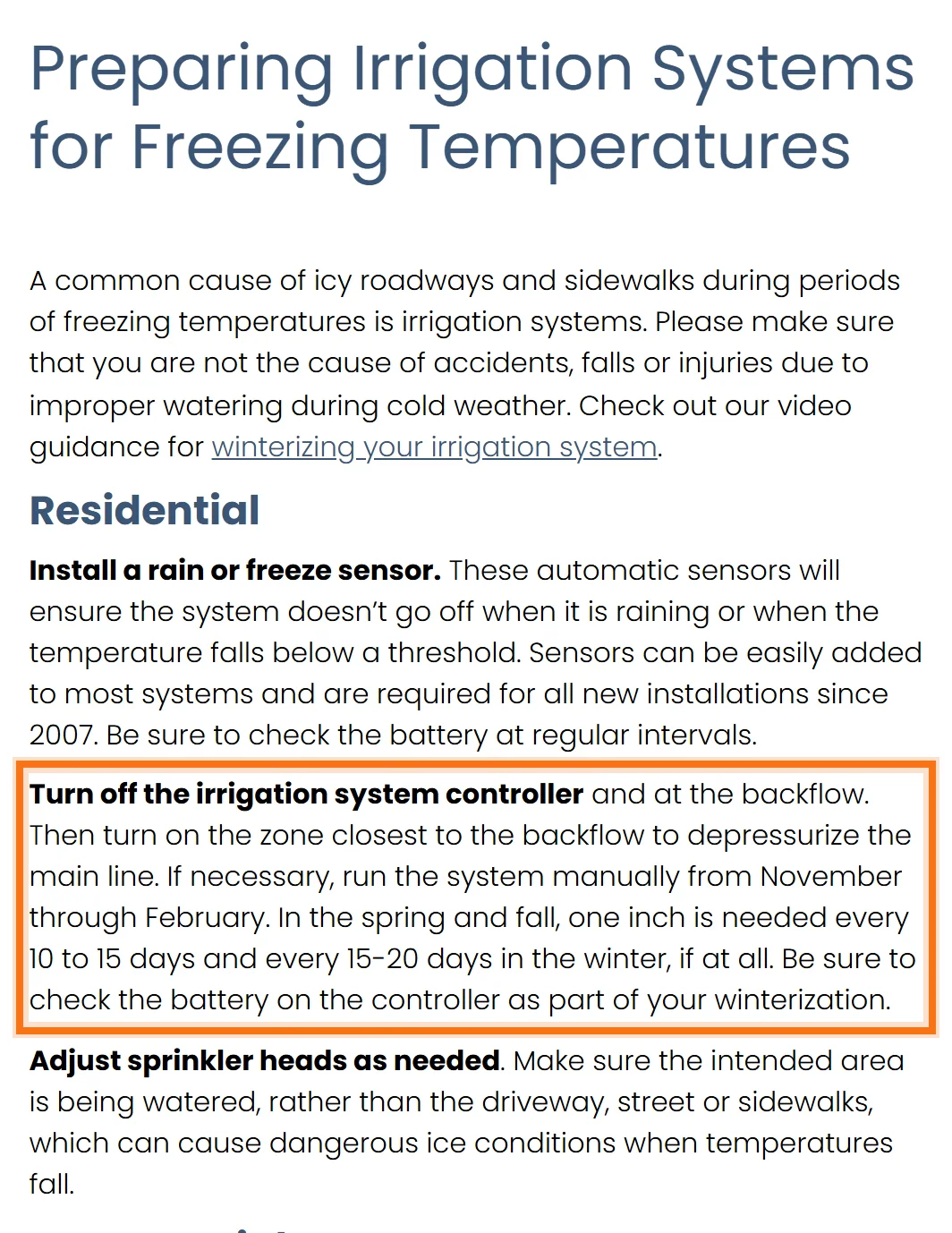
Fort Worth Water's residential steps: install a rain or freeze sensor (required on new installations since 2007, with the battery checked regularly); turn off the controller and the water at the backflow, then turn on the zone closest to the backflow to depressurize the main line; check the controller's battery; and adjust heads so water lands on the yard, not the street. Cover the backflow device once it is shut down. If the yard needs water in winter, the same page says to run the system manually if necessary from November through February, at every 15 to 20 days in winter, if at all.
Whoever the lease gives the yard to, the shutdown is usually easiest as an owner or manager task, because the backflow device is the owner's to repair if it cracks.
During the freeze: no water, or no power
On the first morning below freezing, ask the tenant one question: is the heat running and does water flow at every faucet? A "no water at one faucet" answer means a line has probably frozen. Fort Worth Water's guidance is that it is safest to call a plumber, because the pipe may be cracked and burst when thawed, and that using an electrical appliance to heat the pipe risks electrocution if the pipe sprays. Turn the main off if water starts to leak and call the plumber; do not ask a tenant to thaw pipes with a heater or a flame.
If the power goes out, the heat goes with it. The tenant should keep cabinet doors open and the faucets dripping, and stay safe: TDI's resources warn about carbon monoxide from generators and space heater fires. If an outage looks likely to last, decide early whether a plumber should shut the water off and drain the lines, and where the tenant can stay warm. A plan made in November is calmer than one made at midnight.
When a pipe bursts anyway
A burst usually shows itself on the thaw: water running in a wall or through a ceiling. The response is the leak response: main off at once, a plumber, drying started the same day, dated photos before anything is moved. After a regional freeze, plumbers and drying crews are booked for days, so having names on your list before the storm matters more than for any other repair.
Where to look first: the hose bib stem inside the wall, a sink line on an outside wall, an attic line, the water heater lines in the garage and the sprinkler backflow. If you see a city water main break in the street, Fort Worth Water's 24-hour line is 817-392-4477, option 1; its page says not to assume a neighbor called.
Keep the tenant informed in writing and record the timeline. How the claim works with a manager involved is in property managers and insurance claims.
The vacant house: the highest-risk case
An empty house in a freeze has no one dripping faucets, no one noticing the heat failed and no one hearing a pipe burst. Give it its own plan before the forecast, choosing one of the two approaches the official pages describe:
- Short absence: TDI's tip for leaving a house before a freeze is to turn off the water at the shut-off valve and leave the heat on.
- Long vacancy: Fort Worth Water says to turn off the water at the valve on the resident's side of the meter box and have a plumber do the work needed to prepare the pipes.
Either way, keep the utilities on, and decide who checks the house during a long cold spell and how often. Put a note on the main valve and the water heater so no one turns the water back on without knowing what was done. A leak sensor with its own alert helps when there is no tenant to call; the options are in rental technology worth installing, and the rest of vacant-house care is in looking after an empty house.
Who pays for freeze damage
The plumbing is the owner's to repair. Property Code 92.052 requires a landlord to make a diligent effort to repair a condition that materially affects the physical health or safety of an ordinary tenant after the tenant gives notice, and section 92.052(b) removes that duty for conditions the tenant caused, unless caused by normal wear and tear. So the tenant's share depends on the cause: heat turned off against the lease, a hose left connected after the message, a frozen faucet not reported.
Bill a tenant only where the cause is plain and documented, ideally by the plumber. A tenant who followed the message and still had an attic line burst did nothing wrong; the attic line was the owner's to insulate. On insurance, TDI says to ask your agent whether the policy covers sudden and accidental water damage, warns that policies might not pay if steps were not taken to protect the pipes, such as keeping the heat on, and notes that flood insurance does not pay for burst pipes. The tenant's own belongings are a renters insurance question; see requiring renters insurance. This is general information, not legal or insurance advice.
How Perpetual handles freezes on managed homes
What our published pages say, for homes we manage in Fort Worth, Keller, North Richland Hills and nearby:
- Emergencies. Every plan on our price sheet includes 24/7 emergency response, and our maintenance page lists active leaks and no heat in winter among emergencies.
- Prep and repairs. Work under your pre-approved spending limit goes ahead; larger jobs come to you with a description, photos and a recommendation. Maintenance coordination is a percentage of the vendor's invoice, and the original invoice is always in your owner portal.
- Inspections. Every plan includes an annual property inspection, with a photo report in the portal.
- Vacant homes. While your home is vacant you get a written activity report every week (subject to our Guarantee Addendum).

Which freeze steps we take on your house, how a vacant home is handled and your spending limit are confirmed in writing in the management agreement before you sign. Self-managing? Call 682-593-7033 and we will talk through the list for your house.
The takeaway: Do the owner items once in early November, send the tenant the same short message before every hard freeze, give an empty house its own plan, and keep the photos and messages in case of a claim.
Questions owners ask
How cold does it have to get for pipes to freeze in Texas?
There is no single temperature. Fort Worth Water says a frozen line is most likely where a pipe runs under the house or through an uninsulated attic, and the National Weather Service's DFW records show freezes lasting days, such as 139 hours below freezing in February 2021. Treat any hard-freeze forecast as the signal to run the checklist.
Should tenants drip faucets during a freeze?
Yes. TDI's winter tips say to let faucets drip from the cold and hot taps, or run water through indoor faucets before going to sleep, and to follow your local government's instructions, which may limit water use. Open cabinet doors under sinks so the house's heat reaches the pipes, and keep the heat on.
Who is responsible for frozen pipes in a rental in Texas?
The owner repairs the plumbing; Property Code 92.052 puts repairs of conditions affecting health or safety on the landlord after notice. The tenant can be responsible under the lease where they caused the damage, for example by turning the heat off against the lease's freeze terms or leaving a hose connected. The cause and the lease decide it. This is general information, not legal advice.
Should I winterize a vacant rental in Texas?
Yes, with a plan chosen in advance. For a short absence, TDI's tip is to turn off the water at the shut-off valve and leave the heat on. For a long vacancy, Fort Worth Water says to turn off the water at the valve on the resident's side of the meter box and have a plumber prepare the pipes. Keep utilities on either way.
What should a tenant do if the power goes out during a freeze?
Keep cabinet doors open and faucets dripping, dress warmly and avoid unsafe heat sources; TDI warns about carbon monoxide from generators and space heater fires. Do not thaw pipes with an electrical appliance or a flame. If the outage looks long, the owner or manager should decide early whether a plumber shuts off and drains the water.
Can a property manager handle the freeze prep for me?
It can, if the agreement covers it. Agree in the fall what the tenant is told before a freeze, what happens to a vacant house and how much the manager may spend on an emergency without reaching you. With us, every plan includes 24/7 emergency response and no heat in winter is on our emergency list; the details for your house are confirmed in writing before you sign.
How do I winterize a sprinkler system in Fort Worth?
Fort Worth Water's residential steps: turn off the irrigation controller and the water at the backflow, then turn on the zone closest to the backflow to depressurize the main line; check the controller battery; adjust heads so water stays off streets and sidewalks. It also recommends a rain or freeze sensor, required on new installations since 2007.
Related services
Property management in Keller, North Richland Hills and Fort Worth. How full-service management works in Tarrant County →