Key takeaways
- After a tenant's notice, Property Code 92.052 requires a diligent effort to repair; 92.056(d) presumes seven days is a reasonable time.
- If repairs stall, the tenant may have remedies, including repair and deduct under 92.0561.
- Mold assessment and remediation are licensed in Texas (Occupations Code 1958.101), with exemptions such as areas under 25 contiguous square feet.
- Per the Texas Department of Insurance, most home policies cover sudden and accidental water damage, not gradual leaks or floods.
- The notice date, photos, the plumber's stated cause and any mold certificate are the file that protects you.
A water leak in a Texas rental starts three clocks: the house drying before mold starts, the owner's legal duty to repair after the tenant's notice, and the insurer's deadline to hear about the loss. On a rental in Fort Worth, Keller or North Richland Hills, the owner who stops the water, dries the house and documents each step the same day keeps a leak a plumbing bill instead of a mold job and a dispute.
This guide covers the owner's side of the whole episode: the repair duty, the tenant's remedies, an unusable house, mold licensing, insurance and records. The night of the call itself is in what happens if there's a water leak in my rental in the middle of the night.
A leak in a Fort Worth area rental: who owes what under Texas law
Here is the sequence of a leak from the owner's side, with the Texas rule that applies at each step and where it comes from:
| Step | What Texas law or the official source says | Source |
|---|---|---|
| Tenant reports the leak | The repair duty applies once the tenant gives notice to the place rent is normally paid; notice must be in writing only if a written lease requires it | Property Code 92.052(a), (d) |
| Your agent receives the notice | Notice counts as received when the landlord or the landlord's agent or employee actually receives it | Property Code 92.056(c) |
| Time to repair | A rebuttable presumption that seven days is a reasonable time; severity and availability of materials and labor are considered | Property Code 92.056(d) |
| Tenant caused the leak | No repair duty during the lease for a condition the tenant, an occupant, family or a guest caused, unless it is normal wear and tear | Property Code 92.052(b) |
| Owner does not act | The tenant may terminate, repair and deduct, or go to court, if every condition in the statute is met | Property Code 92.056(e), 92.0561 |
| Mold is found | Mold assessment and remediation require a license, with exemptions | Occupations Code 1958.101, 1958.102 |
| Insurance | Most home and renters policies cover sudden and accidental water damage, not gradual leaks, seepage or floods | Texas Department of Insurance |
How to read this table: the clock starts with the tenant's report, not with the plumber's visit, and a report to your manager counts as a report to you. Everything below explains one row. This is general information, not legal advice.
The first day: stop the water, dry the house, start the file
The Texas Department of Insurance puts the urgency plainly: dry the area as soon as you can, because mold can start growing within a day after a leak. Its own steps are the right order: stop the water at the main valve or the valve near the fixture, remove standing water and start drying, move wet items to a dry room, pull up wet carpets and rugs, and use a water damage cleanup service if you cannot dry the area yourself.
Waiting for a plumber's diagnosis before anyone starts drying usually costs flooring and drywall; the diagnosis can happen while fans run. Start the file the same hour: note when and how the tenant reported the leak, photograph the source and the wet area before anything is moved, and keep every message.
Your repair duty and the seven-day presumption
Property Code 92.052(a) requires a landlord to make a diligent effort to repair or remedy a condition when the tenant has given notice to the person or place where rent is normally paid, the tenant is not delinquent in rent when the notice is given, and the condition materially affects the physical health or safety of an ordinary tenant. A ceiling leak over a bedroom or water across the kitchen floor can meet that test; a dripping outdoor spigot might not.
Section 92.056(d) adds the timing: a rebuttable presumption that seven days is a reasonable time to repair, which the severity of the condition and the availability of materials and labor can move. An active leak is not a seven-day job in practice, because the damage grows every hour, but the presumption is the legal yardstick.
The duty has a limit. Under 92.052(b) there is no duty during the lease to repair a condition caused by the tenant, a lawful occupant, a family member or a guest, unless it came from normal wear and tear. That is why the plumber's written cause matters. The wider framework is in Texas landlord repair obligations.
What the tenant may do if the repair stalls
If the landlord is liable under 92.056(b), which requires notice, a reasonable time, no diligent effort and a tenant current on rent, the tenant may terminate the lease, repair and deduct, or seek court remedies. A second written notice is required unless the first went by certified, registered or tracked mail.
Repair and deduct under 92.0561 has tight conditions, and one of the listed events is the landlord's failure to remedy "the flooding from broken pipes or natural drainage inside the dwelling." For that case the tenant may have the repair made immediately after a notice of intent to repair, if the other requirements are met. The repair must be done by an independent contractor, licensed where the city requires it, and in compliance with building codes.
The deduction is capped at one month's rent or $500, whichever is greater, per month. Illustrative only, not a quote: on a lease at $1,900 a month the cap is $1,900, because one month's rent is more than $500; at a rent of $450 the cap would be $500. The practical lesson is simpler than the statute: an owner who responds the same day never reaches this section.
When the house cannot be lived in
Most leaks leave the house usable. When the damage is bigger, Property Code 92.054 applies to a casualty loss, its examples being fire, smoke, hail, explosion "or a similar cause"; whether a particular water loss counts is a question for your attorney.
- Insured casualty: under 92.054(a), the period for repair does not begin until the landlord receives the insurance proceeds.
- Totally unusable: if the house is, as a practical matter, totally unusable for residential purposes and the tenant's side did not cause the loss, either party may end the lease by written notice before repairs are complete. The tenant is then entitled to a pro rata refund of rent from the move-out date and the deposit as the law requires.
- Partly unusable: the tenant may get a proportionate rent reduction, but only on judgment of a county or district court, unless a written lease says otherwise.
Read your lease before you answer a tenant who asks about rent or a hotel. This is general information, not legal advice.
Mold in a Texas rental: who may assess and remove it
Occupations Code 1958.101 says a person may not engage in mold assessment without a mold assessment license, or in mold remediation without a mold remediation license. The Texas Department of Licensing and Regulation (TDLR) runs the program, and its FAQ for renters spells out the practical limits:
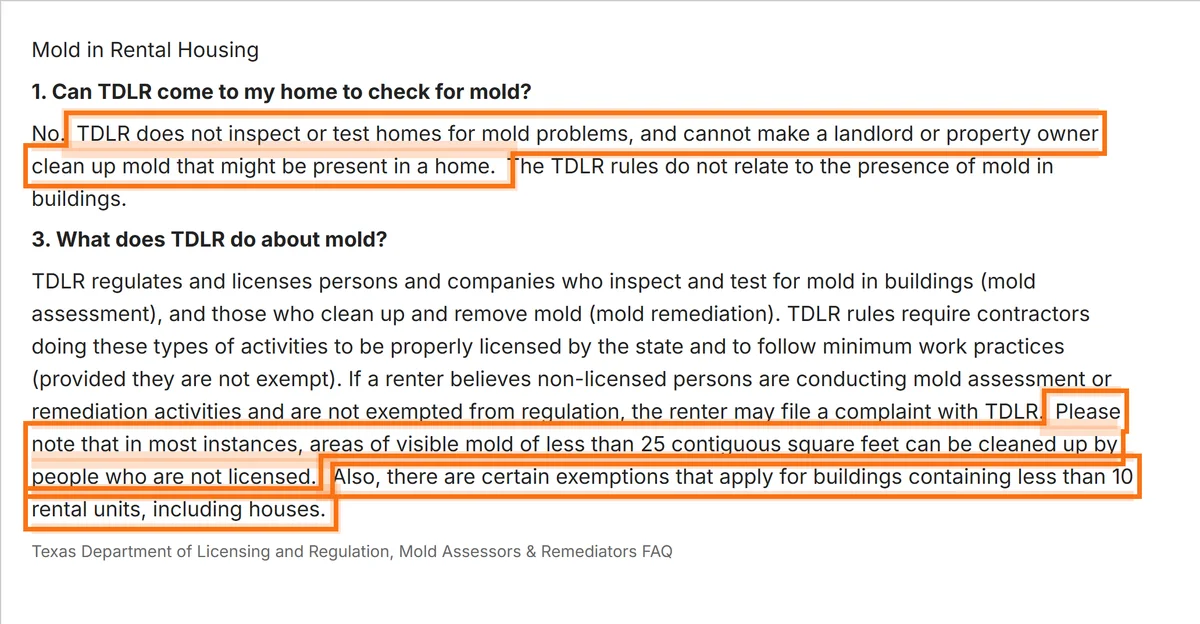
The exemptions are in 1958.102: remediation of less than 25 contiguous square feet, and an owner, or the owner's managing agent or employee, working on residential property the owner owns with fewer than 10 dwelling units, unless that agent or employee is in the mold business for the public. Being allowed is not the same as doing it well: TDLR notes that painting over mold is not effective and that moldy drywall, carpet and insulation should be removed.
When a licensed company does the work, three rules help you. The assessor and the remediator cannot be the same license holder on one project (1958.155). Within 10 days of finishing, the license holder must give you a certificate of mold remediation (1958.154) and the remediator the before and after photos (1958.156). And if you sell, you must give the buyer a copy of each certificate issued in the five years before the sale. This is general information, not legal advice.
Keeping the tenant informed while the house dries
A tenant living with fans running is deciding whether to renew. Send written updates when the leak is reported, when drying is done and when the repair is scheduled. Silence is what turns a leak into a complaint. Damage to the tenant's own belongings is a renters insurance question, not a claim on your policy; see should you require tenants to carry renters insurance.
What insurance usually covers, per the Texas Department of Insurance
The Texas Department of Insurance summarizes how most home and renters policies treat water. Sudden and accidental water damage is usually covered, such as a burst pipe, a toilet overflow or a broken washer hose, and mold that develops on a damaged item is covered too. Gradual leaks or seepage, and the mold that comes with them, usually are not, and flood damage needs a separate flood policy.
A rental is usually insured on a landlord or dwelling policy, not a homeowners policy, so read your own declarations and exclusions; the difference is in landlord insurance vs homeowners insurance. TDI's claim tips apply either way: report hidden water damage within days of first seeing it, photograph before repairs, keep damaged items until the adjuster sees them, make temporary repairs and keep the receipts.
Compare the repair to your deductible before filing. Illustrative only, not a quote: with a $2,500 deductible, a $1,800 repair is paid entirely by you, while a $9,000 covered repair leaves $6,500 for the insurer, before any limits or exclusions. This is general information, not insurance advice.
The records that protect you
Keep one file per leak: the tenant's original report with its date and time, every message, photos before and after drying, the plumber's invoice stating the cause, the drying company's moisture readings, any mold assessment, certificate and photos, the repair invoices, and the insurance correspondence.
That file shows the insurer the loss was sudden and that you acted promptly. It shows the tenant, or a court, that you made a diligent effort after notice, the test in 92.052. And it tells a future buyer what was done, which is when a mold certificate has to be handed over under 1958.154(b). How a manager should involve you in a claim is in property managers and insurance claims.
Where leaks start, and how to make them rarer
Most rental leaks come from a short list: washing machine hoses, water heaters, ice maker lines, toilet supply lines and wax rings, AC condensate lines that clog in summer, shower pans and grout, roof flashing after hail, and window and door seals. Small, scheduled work removes much of it: replace worn hoses and plastic ice maker lines at turnover, plan the water heater's replacement before it fails, keep the condensate line clear, re-caulk tubs at turnover, and tag the main shutoff and show it to every tenant at move-in.
Battery leak sensors under sinks and in the water heater pan are an inexpensive extra. Scheduled interior inspections that open sink cabinets and look at ceilings below bathrooms catch what tenants do not report.
How Perpetual handles this
Perpetual Property Management manages homes in Keller, North Richland Hills, Fort Worth and nearby. Here is what our site states about leaks and repairs:
- Emergencies. Every plan on our price sheet includes 24/7 emergency response. Active leaks are on our list of emergencies, which follow a 24/7 process; burst pipes do not wait for business hours, and neither does our process.
- Reporting. Tenants report issues through their portal with photos, which creates a documented record and lets us triage before dispatching anyone.
- Your spending limit. Routine repairs under your pre-approved limit get fixed fast; anything larger comes to you with a description, photos and a recommendation.
- Records. Documentation on every job, what was reported, what was done, what it cost, is visible in your portal, and the original vendor invoice is always there. Every completed repair over $500 gets photo or video proof, under the Perpetual Promise and subject to its Guarantee Addendum.
- Inspections. As our inspections page puts it, a slow water stain caught at inspection is caulk and paint; caught a year later, it is drywall, flooring and a mold conversation.
Who contacts your insurer or meets the adjuster, which drying and mold companies are used, and how emergency spending above your limit is approved are confirmed in writing before you sign. See maintenance coordination or call 682-593-7033.
The takeaway: Stop the water and start drying the same day, treat the tenant's report as the start of a legal clock, use licensed mold professionals for anything beyond a small area, read your own policy, and keep one file per leak.
Questions owners ask
How fast does a landlord have to fix a water leak in Texas?
After the tenant's notice, Property Code 92.052 requires a diligent effort to repair a condition that materially affects health or safety, and 92.056(d) presumes seven days is a reasonable time. An active leak is an emergency in practice: stop the water and start drying the same day. This is general information, not legal advice.
Who is responsible for mold in a rental in Texas?
It depends on the cause. The owner's repair duty covers conditions that materially affect health or safety after the tenant's notice, such as mold from a roof or plumbing leak. Under Property Code 92.052(b), there is no duty during the lease to repair a condition the tenant, an occupant, family member or guest caused, unless it is normal wear and tear. The plumber's written cause is the evidence. Confirm with your lease or an attorney.
Does landlord insurance cover water damage?
According to the Texas Department of Insurance, most home and renters policies cover sudden and accidental water damage, such as a burst pipe, but not gradual leaks, seepage or floods. A rental is usually on a landlord or dwelling policy, so read your own exclusions and compare the repair to the deductible before filing. This is general information, not insurance advice.
Can a tenant withhold rent for a water leak in Texas?
The remedy Property Code 92.0561 gives tenants is repair and deduct, not simply holding back rent, and it applies only when the landlord is liable under 92.056(b) and specific conditions are met, such as flooding from broken pipes inside the dwelling, and the deduction is capped at one month's rent or $500, whichever is greater. Responding the same day and keeping the tenant informed in writing avoids the question. This is not legal advice.
Should I put leak sensors in my rental?
They are an inexpensive extra. Battery sensors in the water heater pan, under sinks and behind the washer alert a phone when they get wet, which can turn a weekend leak into a same-day shutoff. They do not replace interior inspections.
Can a renter get a free mold inspection from the state of Texas?
No. The Texas Department of Licensing and Regulation says it does not inspect or test homes for mold and cannot make a landlord clean up mold. It licenses the people who assess and remove mold. A renter who sees mold or smells mustiness should report it to the landlord promptly, first verbally and then in writing, as TDLR's own guidance suggests.
Does a mold remediation company need a license in Texas?
Yes. Occupations Code 1958.101 requires a license for mold assessment and for mold remediation, issued through TDLR. There are exemptions, including remediation of less than 25 contiguous square feet and an owner or the owner's managing agent working on a residential property with fewer than 10 units. The assessor and the remediator on one project must be different license holders, and the remediator issues a certificate of mold remediation.
Related services
Property management in Keller, North Richland Hills and Fort Worth. How full-service management works in Tarrant County →