Key takeaways
- Yes: a manager can schedule a cooling check-up in spring and a heating check-up in fall with a licensed contractor, which is the timing ENERGY STAR recommends.
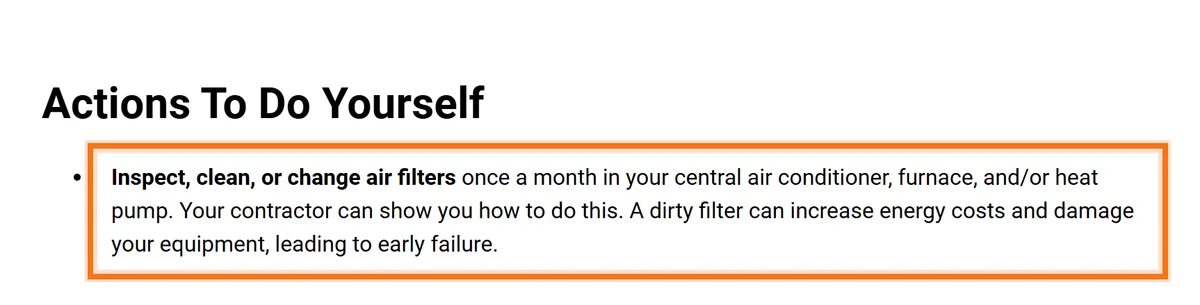
- ENERGY STAR advises inspecting, cleaning or changing the air filter once a month; how often to replace it depends on the filter maker's instructions.
- In Texas, contractors who install, repair or maintain air conditioning or heating systems must hold a license from TDLR.
- The lease decides who changes filters. A filter clause only works if someone checks it, which is what inspections are for.
- No Texas statute names air conditioning as a landlord duty, but a failed system can be a condition that materially affects health or safety under Property Code 92.052.
Can a property manager arrange regular HVAC servicing and filter changes? Yes. A manager can put your house on a schedule with a licensed HVAC contractor, a cooling check-up in spring and a heating check-up in fall, and can make filter checks a written tenant duty that is verified at inspections. On a rental in Fort Worth, Keller or North Richland Hills, where cooling runs for much of the year, that routine is what keeps a small problem from becoming a July breakdown.
This guide covers what to set up and how you check it happened, what a check-up includes, who handles the filter, what it costs you and what it saves, and what Texas law does and does not require.
HVAC servicing in a Fort Worth rental: what to set up and how you check it
Here is each piece of an HVAC routine on a rental house, how often it happens, who normally arranges and pays for it, and the proof that tells you it was done:
| Item | How often | Who arranges and pays | Proof it happened |
|---|---|---|---|
| Cooling check-up | Once a year, in spring, before contractors get busy (ENERGY STAR) | The manager books a TDLR-licensed contractor; the owner pays | The contractor's invoice and service report |
| Heating check-up | Once a year, in fall (ENERGY STAR) | The manager books the contractor; the owner pays | The contractor's invoice and service report |
| Filter inspected, cleaned or changed | Once a month (ENERGY STAR); replacement interval per the filter maker | The tenant, if the lease assigns it; the filter cost depends on the lease | The filter's condition at each scheduled inspection |
| Condensate drain checked | At each check-up (on the ENERGY STAR checklist) | The contractor | A line on the service report |
| Repair found during a check-up | When the contractor reports it | The manager, within your pre-approved spending limit; above it, you decide | An estimate before work above the limit, then the invoice |
How to read this table: the first two rows are your cost and your equipment, the third row is the tenant's job only if the lease says so, and the last column is the part most owners never ask for. If you cannot point to the proof for a row, assume it is not happening.
What a spring or fall check-up actually includes
A check-up is preventive work, not a repair call. ENERGY STAR's maintenance checklist recommends a contractor visit before each season, cooling in spring and heating in fall, because contractors get busy once summer and winter arrive. The checklist for a typical visit includes:
- Checking thermostat settings and the system's controls, including that it starts, runs and shuts off properly.
- Tightening electrical connections and measuring voltage and current on motors.
- Lubricating moving parts.
- Checking the condensate drain, since a plugged drain can cause water damage in the house.
- For cooling: cleaning the evaporator and condenser coils, checking the refrigerant level and adjusting blower components for proper airflow.
- For heating: checking gas connections, gas pressure, burner combustion and the heat exchanger.
The value is in what gets caught early. A weak part or a half-blocked drain found on a spring visit is fixed on a weekday, on a schedule. The same problem in July is a tenant without cooling and an urgent call during the busiest weeks of the HVAC year.
Texas licenses this work. TDLR states that contractors who install, repair or maintain systems related to air conditioning, refrigeration or heating must have a TDLR license, so ask for the license number of whoever services your system.
How a manager puts your house on a schedule
Once a manager decides to put a house on a schedule, the mechanics are simple:
- Record the system. Make, age, filter size and the date of the last service go into the property file, usually from the first inspection.
- Book the season early. The cooling check goes on the calendar for spring and the heating check for fall, with a licensed contractor the manager already works with.
- Tell the tenant. Entry follows the access clause in the lease, and a short note explains that this is routine, not a sign of a problem.
- File the report. The technician's findings and the invoice go into the property's maintenance history, where you can see them.
- Approve what goes beyond the visit. Anything the technician recommends is handled under the spending limit you set; above it, you get an estimate and decide.
Some contractors sell an annual plan covering both visits. That can be convenient, but read what it includes, since some plans are mostly a discount on repairs. Where the HVAC visits sit among the other seasonal jobs is in a preventive maintenance calendar for a North Texas rental.
Who changes the filter, and how to know it happens
Many residential leases assign filter changes to the tenant, because the tenant lives there, the filter is easy to reach and it is a small cost. The clause should state the filter size and location and how often it is checked. ENERGY STAR's guidance is to inspect, clean or change the filter once a month; how long a given filter lasts is in its maker's instructions, so the lease can point to those rather than invent a number.
A clause on paper does not change a filter. Three things turn it into a habit: the correct size and location written into the move-in paperwork, filters of that size delivered to the house on a schedule so the only step left is swapping them, and a look at the filter during each scheduled inspection.
If a tenant's neglect damages the system, Property Code 92.052(b) says the landlord has no duty to repair a condition the tenant caused, unless it was normal wear and tear. Whether the repair can be charged to the tenant depends on the lease, and any deposit deduction needs the written description and itemized list section 92.104 requires. Inspection photos of a clogged filter are what make that charge stick. This is general information, not legal advice.
What Texas law requires, and where the city comes in
No Texas statute requires a landlord to provide air conditioning statewide, and the Property Code does not name it in the landlord's duty to repair. Section 92.052 requires a diligent effort to repair a condition the tenant has reported, if the tenant is current on rent and the condition materially affects the physical health or safety of an ordinary tenant. A house with no cooling in a North Texas summer can meet that test, which is why a failed system is treated as urgent.
Section 92.056(d) presumes seven days is a reasonable time to repair, weighed against the severity of the condition and the availability of materials and labor. Cooling appears in one place: under section 92.0561, if the lease provides cooling equipment, it produces inadequate cooled air, and a local housing, building or health official has notified the landlord in writing that this materially affects health or safety, the tenant may repair and deduct if the landlord has not repaired it within three days after the tenant's notice of intent.
Whether Fort Worth, Keller or North Richland Hills has its own cooling rule for rentals is a question to confirm with the city. Regular servicing does not change these duties, but it makes a breakdown less likely to happen in the first place. More on the law and the repair clock is in HVAC in Texas rentals. This is general information, not legal advice.
What servicing costs you and what it saves
Two contractor visits a year are a known, planned expense, billed at the contractor's own price. Set that against what they prevent: an urgent repair in peak season, with the wait and the cost that come with it, and an early replacement, which is one of the largest single bills a rental owner pays.
There is a paperwork benefit too. If your system's warranty requires proof of regular professional maintenance, check its terms; the dated service reports in your property file are that proof.
An illustrative scenario, not a real case. Two similar houses in North Richland Hills have systems of the same age. One gets its spring check-up, and the technician finds a weak part and a slow condensate drain in April. The other skips it, and in July the same part fails on a Saturday while the drain backs up and stains the ceiling under the air handler. The second owner pays for an urgent call, the part, the drain and a ceiling repair, and the tenant spends a weekend in the heat. Same failure, very different month.
What servicing does not fix
Maintenance extends a system's life; it does not make an old system new. If your equipment is near the end of its life, check-ups keep it running and give you warning, but the replacement decision is still coming. A useful service report says so, with a repair-or-replace view, rather than just booking the next visit. How to plan that decision is in HVAC in Texas rentals.
Servicing also does not change how fast a failure must be handled when it happens. A tenant without cooling in dangerous heat is a priority whenever the system was last checked; how fast a broken AC should be fixed in a Texas rental covers that side.
How Perpetual handles this
Perpetual Property Management is broker-owned and manages homes in Keller, North Richland Hills, Fort Worth and nearby. What our site states about HVAC and maintenance:
- Trades we know. We use plumbers, electricians, HVAC companies and general trades we work with repeatedly, accountable for their work.
- Planned attention to older systems. Much of Northeast Tarrant's housing is 30 to 50 years old, and planned attention to aging HVAC, water heaters and roofs beats emergency pricing.
- Your spending limit. Routine repairs under your pre-approved limit get fixed fast; anything larger comes to you with a description, photos and a recommendation.
- Emergencies. No AC in extreme heat and no heat in winter are on our published list of emergencies and follow our 24/7 process.
- Inspections. Every plan includes an annual property inspection, and inspection photo reports go to your owner portal with recommended actions.
- Invoices. Maintenance coordination is a percentage of the vendor's invoice (4.9% on Standard, 5% on Full Service), the original invoice is always in your portal, and every completed repair over $500 gets photo or video proof under the Perpetual Promise, subject to its Guarantee Addendum.
Whether seasonal check-ups and filter deliveries are set up for your house, and what the lease says about filters, is confirmed in writing before you sign. The maintenance service page and the inspections page explain both halves. To talk about your system, call 682-593-7033.
The takeaway: Ask your manager for two things in writing: a spring and fall check-up with a licensed contractor whose report lands in your portal, and a lease clause on filters that someone actually checks. Those two habits prevent most avoidable HVAC failures in a North Texas rental.
Questions owners ask
How often should the HVAC be serviced in a Texas rental?
ENERGY STAR recommends a contractor check-up before each season: the cooling system in spring and the heating system in fall, since contractors get busy once summer and winter arrive. In North Texas the spring cooling check matters most, because the system cools for much of the year and a summer failure is the costly one. Filters are a separate, monthly check.
Can the tenant be charged for HVAC damage caused by not changing filters?
Possibly. Property Code 92.052(b) says a landlord has no duty to repair a condition the tenant caused, unless it was normal wear and tear. If the lease assigns filter changes to the tenant and the damage can be tied to neglect, such as a frozen coil behind a clogged filter, the lease may allow the repair to be charged to the tenant. A deposit deduction needs the written description and itemized list section 92.104 requires. Inspection photos are the evidence. This is general information, not legal advice.
Is an HVAC maintenance plan from the contractor worth it?
It can be, if the plan covers both seasonal check-ups and spells out what else is included. Some plans are mostly a discount on repairs. Read the terms, compare the plan price with two separate visits, and make sure the invoice shows the contractor's own price.
Who pays for HVAC servicing, the owner or the tenant?
Check-ups maintain the owner's equipment, so they are normally the owner's cost. The lease decides who buys and changes filters, and many leases give that job to the tenant. Some owners pay for a filter delivery so the right size arrives on schedule, which removes the usual excuse for skipping it.
Does Texas law require a landlord to provide air conditioning?
No Texas statute requires air conditioning statewide, and the Property Code does not name it in the repair duty. Section 92.052 requires a diligent effort to repair a condition that materially affects the physical health or safety of an ordinary tenant, which a failed system in North Texas heat can be. Section 92.0561 adds a repair-and-deduct remedy for inadequate cooling after written notice from a local official. City rules: confirm with the city. This is general information, not legal advice.
Does an HVAC contractor need a license in Texas?
Yes. TDLR states that contractors who install, repair or maintain systems related to air conditioning, refrigeration or heating must have a TDLR license, and that air conditioning and refrigeration companies must employ a licensed contractor at each permanent location. You can search a license on TDLR's website before the contractor is booked.
How does property management handle HVAC repair in Texas?
The tenant reports the problem, the manager triages it and sends a licensed contractor, and the repair goes ahead within the spending limit you pre-approved; larger work comes to you first with an estimate. A system that has stopped cooling in hot weather is treated as urgent. Check-ups and filter checks are what keep those calls rare.
Related services
Property management in Keller, North Richland Hills and Fort Worth. How full-service management works in Tarrant County →