Key takeaways
- No Texas statute sets how much notice a landlord must give before entering; the lease's access clause decides.
- Most refusals are practical: a work shift, a dog, an embarrassed tenant or a missed message. One phone call fixes them.
- Repeated refusal of a properly noticed visit is a lease issue: written notice, a dated record of each attempt, then a violation notice with time to cure.
- Property Code 92.0081 and 92.008 bar lockouts and utility shutoffs outside narrow exceptions, with penalties of one month's rent plus $1,000, actual damages and attorney's fees.
- A tenant who reported the repair is protected from retaliation under Property Code 92.331, so ending the tenancy over a refusal is a question for a Texas attorney.
What happens if a tenant refuses to let a contractor in? The manager finds out why, reschedules once with written notice, and then escalates in writing under the lease. On a rental in Fort Worth, Keller or North Richland Hills, that sequence settles most refusals, and the rest end with a lease-violation notice and a documented record, never with a forced door, a lock change or a utility shutoff.
This guide covers the steps in order, why the lease is the authority in Texas, the difference between a repair the tenant asked for and a visit you scheduled, when an emergency changes the rules, who pays for damage that grows while access is refused, and what a manager must not do.
When a Fort Worth tenant refuses a contractor: the steps in order
Here are the steps a manager takes when a tenant refuses access for a repair, when each one applies, what happens and what goes on file:
| Step | When | What happens | What goes on file |
|---|---|---|---|
| 1. Ask why | The first refusal or missed visit | A call: another time window, a crated pet, a clear reason for the visit | A note of the call and the new time |
| 2. Written notice of a new visit | If the call does not settle it | Notice citing the lease's access clause, with the date, window and purpose | The notice and how it was delivered |
| 3. Record the second refusal | If the vendor is turned away again | Date, time, the vendor's trip note and any reason given | Vendor trip record, photos of anything visible |
| 4. Lease-violation notice | Repeated refusal of a properly noticed visit | States the clause, the refusals and a period to allow access, with the lease consequences | The notice and proof of delivery |
| 5. Owner decision | If access is still refused | Charges under the lease, non-renewal or termination, weighed with a Texas attorney | The full file from steps 1 to 4 |
| Emergency | Active leak, gas smell, sewage backup, electrical hazard | Entry under the lease's emergency terms with a vendor, after trying to reach the tenant | Call attempts, arrival photos, the invoice |
How to read this table: most refusals end at step 1 or step 2. Steps 3 and 4 exist so that, if it goes further, you can show you acted reasonably and on time; skipping straight to step 5 is what weakens an owner's position.
Step one: find out why the tenant said no
A refusal is rarely about the contractor. The usual reasons: the tenant works a shift and cannot be home in the window offered; a dog needs to be crated; the home is untidy and the tenant is embarrassed; the tenant is behind on rent and assumes the visit is about that; a bad experience with an earlier contractor; or the message simply never arrived.
Each of those has a quick fix: a different window, a note that the vendor is fine with a crated dog, a plain statement that the visit is about the water heater and nothing else. Treating the first refusal as a conversation, not a violation, keeps the tenant and gets the repair done. The written steps exist for the second refusal, not the first.
One more question to ask early: does the tenant think they will be charged? A tenant who fears a bill for the repair may stall. Explaining that the repair happens either way, and who pays is decided afterward from the vendor's findings and the lease, often opens the door.
In Texas, the lease is the authority on entry
Texas has no statute that tells a landlord how much notice to give before entering or what hours are acceptable. The lease fills that gap, which is why its access clause matters. A good one says the owner, the owner's agents and contractors may enter at reasonable times for repairs, inspections and showings, with advance notice, and may enter without notice in an emergency. Our guide to landlord entry rights in Texas explains what a good clause includes and what happens when the lease is silent.
With that clause in place, a tenant who refuses a properly noticed repair visit is declining something they already agreed to. Without it, the manager is negotiating, and your position is weaker. If your current lease has no clear access clause, the fix is the next lease or renewal, and your manager should flag it.
A repair the tenant asked for vs. a visit you scheduled
It matters who asked for the visit. When the tenant reported the problem, Property Code 92.052(a) puts a duty on the landlord to make a diligent effort to repair a condition that materially affects the physical health or safety of an ordinary tenant, once the tenant gives notice and is not behind on rent. Section 92.056 makes the landlord liable only after a reasonable time to repair, with a presumption that seven days is reasonable, and that presumption can be rebutted by the severity of the condition and the availability of labor and materials.
A tenant who reports a leak and then turns the plumber away has made that repair harder to finish on time. Your dated record of each offered visit is how you show the diligent effort the statute asks for. Keep every notice, every vendor trip note and every message.
A visit you scheduled is different: preventive maintenance inspections, an HVAC tune-up, a filter change, pest treatment or a routine inspection. No statute compels access for these; the lease's access clause does. Refusals happen most often here, because the tenant sees no problem to fix. Explaining what the visit prevents, and offering a time that suits the tenant, usually ends it. How to schedule those visits respectfully is in arranging inspections without violating tenant privacy.
When an emergency changes the rules
An active water leak, a gas smell, a sewage backup, no heat in a freeze, an electrical hazard: these are the situations a lease's emergency terms are written for, because waiting means damage to the property or danger to the people inside. The manager still tries to reach the tenant, records each attempt, and enters with the vendor, not alone, photographing the condition on arrival.
The line between emergency and inconvenience matters, and a manager should not stretch it. A dripping faucet is not an emergency. A supply line spraying into a cabinet is. What qualifies is laid out in what counts as a maintenance emergency, and how fast each kind of repair is due under Texas law is in Texas landlord repair obligations.
Who pays for damage that gets worse while access is refused
Property Code 92.052(b) says that, unless the condition was caused by normal wear and tear, a landlord has no duty during the lease to repair a condition caused by the tenant, a lawful occupant, a family member or a guest. Whether damage that grew while access was refused counts as tenant-caused depends on the facts and on your lease, which is why a lease can make the tenant responsible for damage that results from denying access. The dated record from the steps above is what makes such a charge defensible.
Illustrative only, not a real case. A tenant in North Richland Hills reports a slow leak under the kitchen sink, then turns the plumber away twice. By the time the plumber gets in, the cabinet floor has to be replaced. The leak repair is the owner's. The cabinet floor may be chargeable to the tenant under a lease that covers damage from denied access, backed by the two dated notices and the vendor's trip records. If it is taken from the deposit at move-out, Property Code 92.104 requires a written description and itemized list of the deductions.
What a manager must not do, however frustrated you are
Owners sometimes ask the manager to change the locks, shut off a utility, or simply let the contractor in after a refusal. Texas law draws hard lines here. Property Code 92.0081(b) bars a landlord from intentionally keeping a tenant out except by judicial process or in narrow cases: bona fide repairs, construction or an emergency; removing an abandoned tenant's contents; or a lock change for unpaid rent under strict conditions the lease must allow. A refused contractor is none of those. Section 92.008(a) bars interrupting utilities the tenant pays for directly, unless the interruption results from bona fide repairs, construction or an emergency.
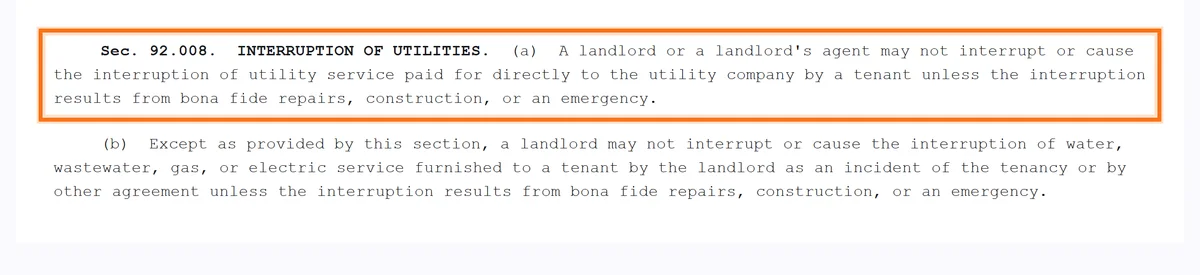
The penalties are real. A tenant may recover one month's rent plus $1,000, actual damages, court costs and reasonable attorney's fees under 92.008(f) and 92.0081(h). Entering over an express refusal outside an emergency has no statute behind it either way; it is a lease question, and a careful manager does not do it without legal advice.
The slow path is the safe one: notice, documentation, a violation notice and, if needed, an attorney. If the tenant reported the repair, Property Code 92.331 also bars a landlord from retaliating within six months, including by terminating the lease. If ending the tenancy is on the table, Property Code 24.005(a) requires at least three days' written notice to vacate before an eviction suit, unless the lease sets a different period. This is general information, not legal advice; ask a Texas attorney before acting.
How Perpetual handles this
Perpetual Property Management is broker-owned, and we manage homes in Keller, North Richland Hills, Fort Worth and nearby. What our site states that bears on a refused repair visit:
- The lease. Current Texas-compliant lease documentation with property-specific addenda, and you receive a copy of everything through the owner portal.
- The request. Tenants report issues through their portal with photos, which creates a documented record and lets us triage before dispatching anyone.
- The record. Documentation on every job, what was reported, what was done and what it cost, visible in your portal.
- Emergencies. 24/7 emergency response on every plan; our published list is active leaks, no AC in extreme heat, no heat in winter and electrical hazards.
- Inspections. Our inspection program exists partly to catch lease violations early, and anything found feeds into tenant communication with a recommendation.
- If a tenancy fails. Proper notices, properly served, and coordination with an attorney experienced in landlord-tenant law; we are not a law firm. Eviction service is included on Full Service and optional at $7.95 per month on the other plans.
What our lease's access clause says, and the steps we take before a refusal becomes a violation notice, are confirmed in writing before you sign. See maintenance coordination and our leasing process, or call 682-593-7033.
The takeaway: Ask why, reschedule once in writing, then escalate under the lease with a dated record of every attempt. That record protects you on repair duties, damage charges and any later dispute; a lock change, a utility shutoff or a forced entry undoes it.
Questions owners ask
Can a tenant refuse entry to a landlord in Texas?
A tenant can decline a visit that the lease does not authorize, and Texas has no statute that overrides the lease on notice or hours. If the lease includes an entry clause for repairs and inspections with reasonable notice, refusing a properly noticed visit is a lease violation. Emergencies are usually treated separately in the lease. This is general information, not legal advice.
How much notice does a landlord have to give a tenant for repairs in Texas?
Texas law does not set a notice period for landlord entry, so the lease governs. A well-drafted lease provides for advance notice at reasonable hours and allows entry without notice in an emergency. Whatever the lease says, a manager gives written notice with a date, a time window and the reason for the visit, and keeps a copy. This is general information, not legal advice.
Can a landlord enter without permission for repairs if the tenant is not home?
If the lease allows entry for repairs and proper notice was given, entry while the tenant is out is generally what the lease permits, and the manager enters with the vendor and documents the visit. Entering over an express refusal is different: outside an emergency, a careful manager does not do it without legal advice.
What if the tenant refuses access because they think the repair is their fault and they will be charged?
That fear is common and worth addressing directly. The manager should explain that the repair will be made regardless, that who pays is decided afterward from the vendor's findings, and that refusing access makes any damage worse and more clearly chargeable to the tenant. Most tenants allow access once they understand that the visit is not a trap.
Can I change the locks or shut off the water if my tenant keeps refusing repairs?
No. Property Code 92.0081 bars keeping a tenant out except by judicial process or in narrow cases, and a refused repair is not one of them. Section 92.008 bars interrupting utilities except for bona fide repairs, construction or an emergency. A tenant can recover one month's rent plus $1,000, actual damages and attorney's fees. Use the lease's notice and violation steps instead. This is general information, not legal advice.
Does the landlord still have to make the repair if the tenant keeps refusing access?
The duty under Property Code 92.052 is to make a diligent effort to repair once the tenant gives notice. A dated record of each offered visit and each refusal is how you show that effort, and 92.056 makes a landlord liable only after a reasonable time to repair. Keep offering access in writing, document every attempt, and ask a Texas attorney if the tenant later claims the repair was never made.
Related services
Property management in Keller, North Richland Hills and Fort Worth. How full-service management works in Tarrant County →