Key takeaways
- A new kitchen, flooring through the house, a roof, an HVAC replacement or water damage between leases is a project: it needs a written scope, a contract, often a permit, and a payment schedule.
- Three roles share it: you decide and pay, the contractor builds and pulls the permit, the manager coordinates and keeps the record.
- Fort Worth requires permits for work that changes, moves or repairs walls, floors, electrical, mechanical or plumbing; cosmetic remodels are exempt. For Keller and North Richland Hills, confirm with the city.
- Texas Property Code 53.101 requires the owner, which includes the owner's agent, to reserve 10% of the contract price during the work and for 30 days after it is completed.
- Set the re-listing date from the contractor's written completion date plus the final inspection and the clean, not from the old tenant's move-out.
Who can supervise a major make-ready or renovation between tenants? Three people share it: you decide the scope and approve each payment, a licensed contractor does the work and pulls the permit, and a property manager can coordinate the trades, check the work against the scope and keep the paper trail. In Fort Worth, Keller, North Richland Hills and the nearby Mid-Cities, Perpetual coordinates make-ready work with vetted, insured vendors and posts every original invoice in your owner portal.
This guide covers the stages of a big job between two leases, who decides at each one, the Fort Worth permit line and the Texas license rules, how to pay a contractor in draws, the re-listing date, and how the IRS sorts repairs from improvements.
A major make-ready between leases, stage by stage
Each stage of a big job between two tenants has one person who decides and one record that proves it was done:
| Stage | Who decides | The record you get |
|---|---|---|
| Move-out inspection | The manager documents; you read it | Dated photos measured against the move-in condition record |
| Scope of work | You approve, line by line | A written scope: rooms, materials, quantities, what is excluded |
| Bids and contractor check | You choose; the manager collects and compares | Two or more written bids on the same scope, license numbers, insurance certificates |
| Permit | The contractor applies; the city issues | The permit number and the inspection results |
| Contract and draws | You sign or authorize in writing | A contract with a payment schedule tied to finished stages and a 10% reserve |
| Work in progress | The manager tracks; you approve any change | Progress photos and written change orders with prices |
| Completion | The manager walks it against the scope | Final inspection, punch list, final invoice, bills-paid affidavit on request |
| Re-listing | You approve the rent; the manager markets | Listing photos of finished rooms and the market-ready date |
| Filing | Your CPA classifies the costs | Invoices kept apart: repairs vs improvements |
How to read this table: the middle column is where projects go wrong: when nobody is named, change orders get approved by phone. Name the decider for each stage in writing before demolition starts, and ask for the record in the right column before you release the next payment.
When a make-ready turns into a renovation project
Most turnovers are cleaning, paint and small repairs, covered in arranging cleaning, painting and yard work before listing and how fast a manager makes a house rent-ready. A job becomes a project when any one of these is true:
- It needs a permit: electrical, plumbing, an HVAC replacement, a roof.
- Several trades follow each other: demolition, rough-in, drywall, cabinets, flooring, paint.
- The cost is far above your pre-approved repair limit, so each payment needs your decision.
- The cause is a loss, such as a leak or a storm, where an insurance claim may set the scope and timing; see who does what in an insurance claim.
Whether a project is worth doing at all is a separate question: see what pays and what doesn't when preparing a rental and avoiding overspending between tenants.
Who supervises: you, the contractor and the manager
You own the decisions: the scope, the budget, the contractor, every change order and every payment. Nobody should enlarge the job without your written yes.
The contractor supervises the workers: schedules the trades, answers for their work, applies for the permit and calls for inspections. On a single-trade job, such as an HVAC replacement, the licensed trade contractor plays that role.
The property manager supervises from the owner's side: walks the house before and after, collects bids on one scope, checks licenses and insurance, lets the trades in, tracks progress, confirms each stage before a draw is paid, keeps the invoices and photos, and plans the listing. A manager who coordinates is not the builder; ask in writing which role the manager takes and what it costs.
Prefer your own contractor? Say so before the scope is written; see using your own contractor with a property manager.
The scope of work: the document every other step depends on
A one-line description such as "remodel kitchen" cannot be priced, compared or checked. A scope a manager can supervise against lists:
- each room and item, with quantities (square feet of flooring, linear feet of cabinets);
- materials by type and model or color, and who supplies them;
- whether a permit is needed and who applies;
- what is excluded, so it does not return as a change order;
- the start and completion dates;
- the contractor's written warranty on labor.
Write it after the move-out inspection, with dated photos, and send the same scope to every bidder; how to line up two quotes is in asking for a second quote before a major repair.
Permits in Fort Worth, Keller and North Richland Hills
The City of Fort Worth's residential permitting page sets the line plainly. Permits are required for "work that changes, moves or repairs walls, floors, ceiling, windows, doors, electrical, mechanical or plumbing." They are not required for "cosmetic" remodels, which the page lists as "floor or wall covering, cabinets, counter tops, shelving, etc.", or for plumbing fixture replacement.
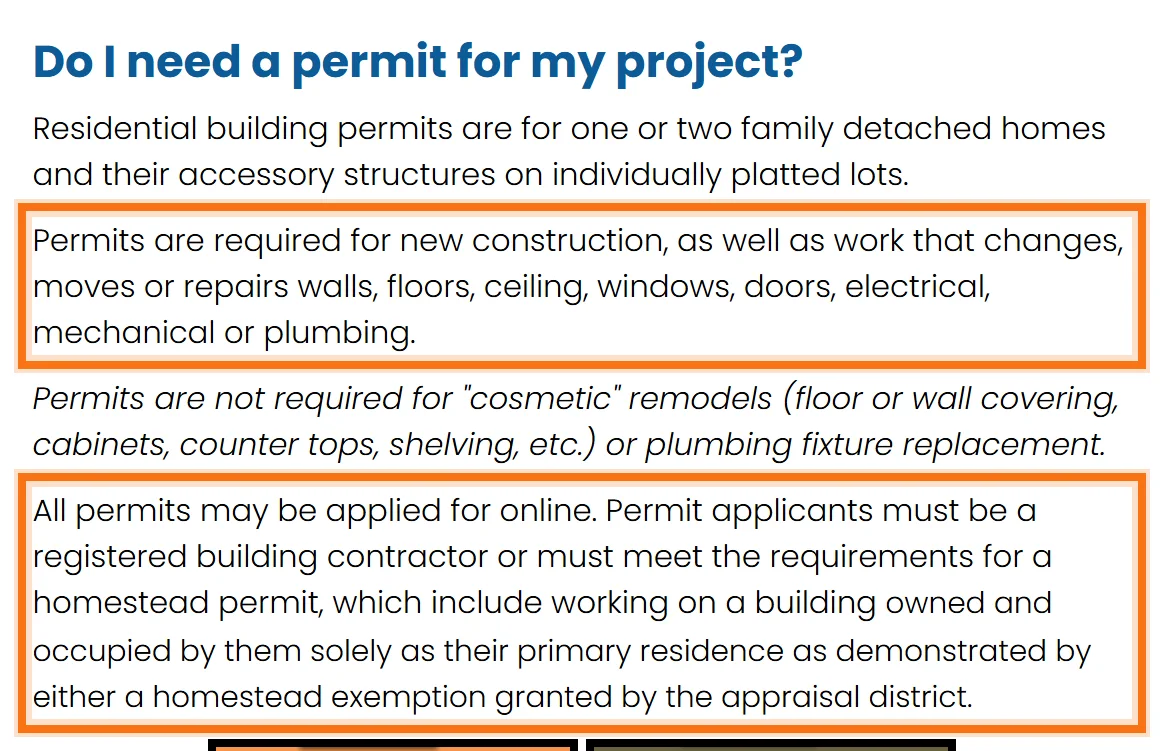
The same page says permit applicants "must be a registered building contractor" or meet the requirements for a homestead permit, which include working on a building the owner occupies "solely as their primary residence." For a rental, plan on the contractor applying. The city's Residential Permit Guide shows which permits a project needs and their estimated cost.
This guide does not state Keller's or North Richland Hills' permit rules; confirm with the city before work starts. Where a job sits on the line between cosmetic and permitted, ask first: a missed inspection costs far more once the drywall is closed.
The trades Texas licenses, and why the homeowner exemptions do not cover a rental
Three trades in a typical renovation need a state license, each under its own chapter of the Occupations Code:
- Electrical. Section 1305.151: a person "may not perform or offer to perform electrical work" without an appropriate license, except as section 1305.003 provides.
- Plumbing. Section 1301.351(a): a person other than a responsible master plumber may not engage in plumbing unless licensed, registered or endorsed under the chapter and supervised by a license holder.
- Heating and air conditioning. Section 1302.251(a): a person may not engage in air conditioning and refrigeration contracting without a license under the chapter.
The homeowner exemptions are written for a home the owner lives in. Section 1305.003(a)(6) exempts work "performed in or on a dwelling by a person who owns and resides in the dwelling", and section 1302.053 covers a building "owned solely by the person as the person's home." An owner doing their own wiring or AC on a rental is outside both texts.
How a manager looks up licenses and checks insurance certificates is in how property managers verify contractor licenses and insurance. This is general information, not legal advice.
Paying the contractor: draws, the 10% reserve and the bills-paid affidavit
Pay for finished stages, never ahead of the work. Texas law adds a rule many owners miss.
Property Code section 53.101 says that while work under an original contract for which a mechanic's lien may be claimed is in progress, and for 30 days after it is completed, "the owner shall reserve" 10 percent of the contract price (or of the value of the work done); "owner" includes the owner's agent. Under section 53.105, if the owner does not, unpaid workers and suppliers who follow the chapter's steps have a lien at least to the extent of the amount that should have been reserved. Section 53.085 lets you require, as a condition of payment, an affidavit that the contractor has paid its subcontractors and suppliers, or a list of who is still owed.
Illustrative only, not a quote: a contract price of $18,000 paid in four parts:
| Payment | When it is released | Share | Amount |
|---|---|---|---|
| Draw 1 | Demolition done, rough-in passed inspection | 30% | $5,400 |
| Draw 2 | Cabinets, flooring and fixtures installed | 40% | $7,200 |
| Draw 3 | Final inspection passed, punch list done | 20% | $3,600 |
| Reserve | 30 days after completion, with a bills-paid affidavit | 10% | $1,800 |
| Total | 100% | $18,000 |
How to read this table: the amounts add to $18,000 ($5,400 + $7,200 = $12,600; + $3,600 = $16,200; + $1,800 = $18,000), and the shares to 100%. Until the 30 days pass, no more than 90% has been paid. Ask your attorney how these rules apply to your contract; this is general information, not legal advice.
Setting the re-listing date
Every week the house sits empty costs a week of rent. Set the re-listing date from the contractor's written completion date, then add the final inspection, the punch list, the cleaning and the photos. A date set from the old tenant's move-out ignores permits and materials on order, and a new tenant promised a date the work misses is a bad start.
Two ways to win back time: order long-lead materials (cabinets, flooring, HVAC equipment) as soon as the scope is approved, and market before the last trade leaves, with photos of finished rooms only; see advertising before the repairs are finished. The whole turnover clock, with its costs, is in rental turnover cost and timeline.
Repair or improvement: how IRS Publication 527 sorts the bill
IRS Publication 527 says an expense for repairing or maintaining a rental may generally be deducted if you are not required to capitalize it, but you must capitalize an improvement: an expense that "results in a betterment to your property, restores your property, or adapts your property to a new or different use." Its Table 1-1 lists examples of improvements that include a new roof, a heating system, central air conditioning, a water heater, kitchen modernization, flooring and wall-to-wall carpeting.
So many major projects land on the improvement side. The publication's practical instruction: "Separate the costs of repairs and improvements, and keep accurate records." Ask for invoices by scope item rather than one lump sum, and let your CPA sort them; which upgrades earn their cost is in which upgrades are worth doing before renting. This is general information, not tax advice.
How Perpetual coordinates a major make-ready in Fort Worth, Keller and North Richland Hills
Perpetual Property Management is broker-owned, with our office in North Richland Hills. We manage homes in Keller, North Richland Hills and Fort Worth, and also serve Watauga, Hurst, Bedford, Euless, Haltom City, Southlake, Colleyville and Saginaw (areas we serve). What our site states about make-ready and repair work:
- Vendors and approvals. Vetted, insured plumbers, electricians, HVAC and general trades we work with repeatedly; anything above your pre-approved limit comes to you with a description, photos and a recommendation. Before you spend, we tell you which make-ready items actually raise rent and which don't.
- Coordination fees. Make-ready coordination is 3% to 5% of cost on the Investor Special (portfolios of 5 or more units); maintenance coordination is 4.9% of cost on Standard and 5% on Full Service. Coordination is a percentage of the vendor's invoice, and the original invoice is always in your portal (price sheet).
- Proof. A 360-degree condition inspection at every move-out and move-in, and photo or video proof in your portal for every completed repair over $500, subject to the Guarantee Addendum in the Perpetual Promise.
- Re-listing. Once market-ready, the home is live on every major rental platform within 5 business days, or the first month's management fee is waived.
Illustrative only, not a quote: on an $18,000 project, coordination at 3% is $540 and at 5% is $900 ($18,000 x 0.03 = $540; $18,000 x 0.05 = $900); at 4.9% it is $882. Our site does not state which coordination line applies to a renovation on each plan, whether we hold the 10% reserve as your agent, or how often we visit during the work, so those terms are confirmed in writing before you sign. Start with a free rental analysis or call 682-593-7033.
The takeaway: Treat a big make-ready as a project: written scope, licensed trades, the permit, draws tied to finished stages with 10% held back, and a re-listing date set from the contractor's written completion date. Approve the scope and the money yourself; let the manager run the sequence and keep the record.
Questions owners ask
Who can supervise a major make-ready or renovation between tenants?
The contractor who holds the contract and the permit supervises the work. You, or a property manager acting for you, supervise the project: written scope, bids, license checks, progress, payment only for finished stages, and the records. In Fort Worth, Keller and North Richland Hills, Perpetual coordinates make-ready work with vetted, insured vendors, with the original invoice in your owner portal.
Who can coordinate a large make-ready project before listing a Mid-Cities rental?
A property manager who serves the area, or a general contractor you hire directly. Perpetual serves Hurst, Euless and Bedford, which our site describes as commonly considered part of the Mid-Cities, plus North Richland Hills next door. Make-ready coordination on the Investor Special is 3% to 5% of cost; the other plans list maintenance coordination at 4.9% or 5% of cost.
Which Keller manager coordinates make-ready work quickly between tenants?
Speed comes from the sequence more than the manager: a scope written right after move-out, long-lead materials ordered at once, the permit applied for early, and marketing that starts before the last trade leaves. Perpetual manages homes in Keller from our North Richland Hills office about ten minutes away, and the Perpetual Promise commits us to listing a home on every major rental platform within 5 business days of it being market-ready, or the first month's fee is waived.
Which Fort Worth manager coordinates make-ready work between tenants?
Choose one that works your part of the city and can show you the scope, the bids, the license checks and the invoices for a past job. Perpetual coordinates make-ready and repair work in north Fort Worth neighborhoods such as the Alliance corridor, Heritage, Park Glen, Summerfields, Fossil Creek and Basswood, and posts every original vendor invoice in the owner portal.
Do I need a permit to redo a rental kitchen in Fort Worth?
It depends on the work. The City of Fort Worth lists cabinets, counter tops and floor or wall covering as cosmetic remodels that do not need a permit, while work that changes, moves or repairs walls, floors, electrical, mechanical or plumbing does. By that wording, a kitchen that moves plumbing or changes wiring needs one, and on a rental the applicant is a registered building contractor, since the homestead permit is for an owner's primary residence.
How much does a property manager charge to coordinate a renovation?
It varies by company, so get it in writing with the invoices it applies to. Perpetual's price sheet lists make-ready coordination at 3% to 5% of cost on the Investor Special and maintenance coordination at 4.9% (Standard) or 5% (Full Service) of cost, charged on the vendor's invoice. Illustratively, 5% of an $18,000 project is $900.
Property management in Keller, North Richland Hills and Fort Worth. How full-service management works in Tarrant County →