
Key takeaways
- Any repair above your pre-approved spending limit is your decision, and asking for a second quote is part of making it.
- A second quote pays on large, non-urgent jobs where the diagnosis or the scope is debatable: replacing an aging system, a roof, a sewer line, foundation work.
- Compare quotes line by line: diagnosis, scope, materials, permit, disposal, warranty, start date and exclusions. The lower total is often a smaller job.
- For a condition that materially affects a tenant's health or safety, Property Code 92.056(d) presumes seven days is a reasonable time to repair after notice; collecting bids does not stop that clock.
- Give your manager a standing rule (for example, two quotes above a set amount, act first on emergencies) so you are not deciding job by job.
Yes. Above the spending limit in your management agreement, the repair waits for your decision, and you can ask for a second quote before you make it. On a rental in Fort Worth, Keller or North Richland Hills, a second quote is worth it on large, non-urgent jobs where a different contractor might diagnose the problem differently. It is not worth it in an emergency, or on a health or safety repair where the Texas repair clock is already running.
This guide covers when the wait pays, how to compare two quotes so you are not choosing a smaller job by accident, and what Property Code 92.056 says about how long a repair can take.
Comparing two repair quotes like for like on a Fort Worth rental
Before comparing totals, line the two quotes up on these points. Each one changes what you are actually buying:
| Line up | What to check on each quote | Why it changes the comparison |
|---|---|---|
| Diagnosis | What each contractor says is wrong, in writing | Two quotes for different problems are not two prices for one job |
| Scope | Exactly what is replaced or repaired, and what is left as is | A partial repair priced against a full replacement looks cheaper and is not the same work |
| Materials and equipment | Brand or grade, size or capacity, matched components | A smaller or lower-grade unit lowers the price and may shorten its life |
| Permit | Whether the quote includes pulling the city permit and the inspection | A quote without it may add it later, or skip it |
| Disposal and cleanup | Haul-away of old equipment or debris | Often an add-on line on the cheaper quote |
| Warranty | Parts and labor, how long each lasts, and who honors it | A shorter labor warranty moves the risk of a callback to you |
| Timing | Earliest start and how long the tenant is affected | Matters most when the house is occupied |
| Exclusions and allowances | "If needed" items, extra-charge clauses, assumed conditions | Where the final bill grows past the quote |
How to read this table: if the two quotes differ on any of the first six rows, adjust before comparing totals, by asking each contractor to price the missing item or by adding it from their own quote. Only then is the difference in price a real difference.
Your spending limit is where a second quote fits
Your management agreement sets a spending limit. Below it, the manager has the repair done and reports it; above it, the job comes to you first. That pause is where a second quote fits: you can approve, ask for a second quote, ask for a different scope, or ask whether a repair would do instead of a replacement.
How to choose the number, and what the emergency clause allows above it, is covered in can a property manager approve expensive repairs without my permission. This guide starts where that one ends: the quote is on your screen, and you have to decide whether to ask for another.
When a second quote is worth the wait
A second quote earns its delay when three things are true: the job is large, the house is not being damaged while you wait, and the first contractor's diagnosis or scope could reasonably be different. Typical cases on rentals in Keller, North Richland Hills and Fort Worth:
- Replacing an HVAC system that still runs. Whether the whole system or one component needs replacing is a judgment call. HVAC in Texas rentals explains the repair-or-replace decision.
- A roof after hail, where the contractor's scope and the insurance adjuster's scope need to match.
- Foundation work, where one company proposes piers and another proposes drainage changes and monitoring.
- A sewer line, where the method changes both price and disruption.
- Any "replace" recommendation on equipment you expected to last longer.
In each case the second contractor is not only pricing the job. They are checking the first one's diagnosis, and that is usually where the money is.
When a second quote costs more than it saves
Emergencies. Water coming through a ceiling, a sewage backup or a gas smell needs the first qualified contractor who can get there. The emergency clause in your agreement exists so the manager can stop the damage; quotes come afterward for the permanent repair. What you and the tenant should hear from the first report to the invoice is in communicating with owners during major repairs.
Small jobs just over the limit. A second visit can carry its own trip charge and adds days. If the first quote is reasonable and the scope is not in doubt, the second one rarely pays for itself.
Health or safety conditions with the tenant waiting. The next section explains why: once the tenant gives notice, Texas law measures how long the repair takes, and collecting bids is not one of the reasons the law accepts for taking longer.
The Texas repair clock: what Property Code 92.056 means for a second quote
Some repairs cannot wait for bids. Under Property Code 92.052(a), a landlord must make a diligent effort to repair or remedy a condition that materially affects the physical health or safety of an ordinary tenant once the tenant gives notice to the person or place where rent is normally paid and is not behind on rent. If your manager collects the rent, notice to the manager counts, and section 92.056(c) treats the landlord as having received notice when the landlord's agent or employee actually received it.
Section 92.056(d) adds a rebuttable presumption that seven days is a reasonable time to repair. The factors that can rebut it are the date the landlord received the notice, the severity and nature of the condition, and the reasonable availability of materials and labor and of utilities. Waiting for a second quote is not on that list.
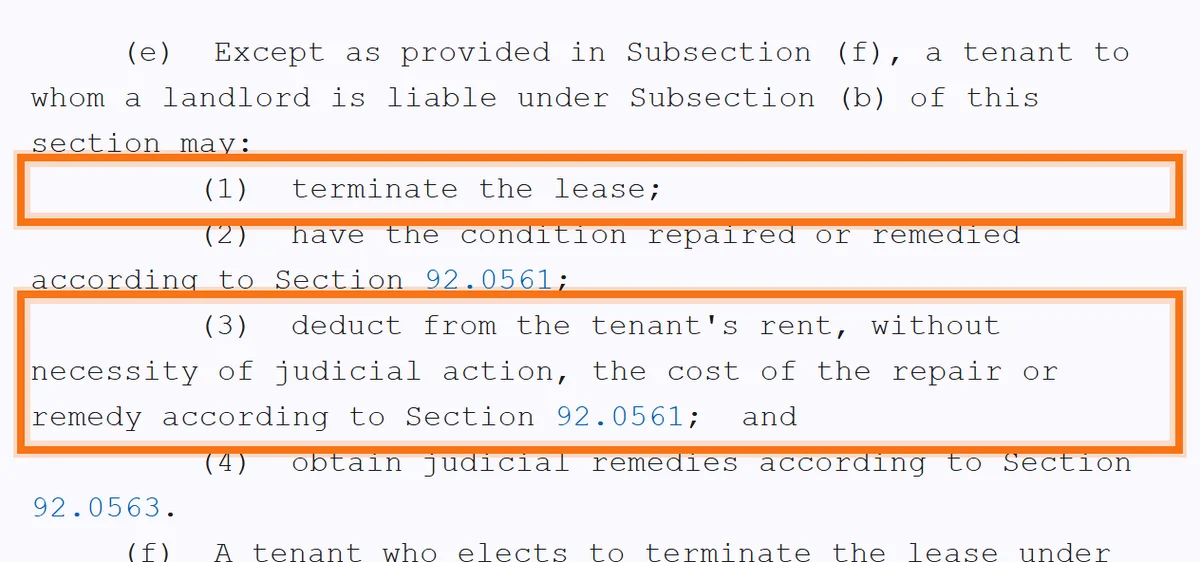
If the landlord becomes liable under 92.056(b), which also requires a subsequent written notice or a first notice sent by certified, registered or another tracked mail, the tenant may terminate the lease, repair and deduct under 92.0561, or go to court. The repair-and-deduct amount is capped by 92.0561 at one month's rent or $500, whichever is greater. So on a health or safety condition, get the first qualified contractor moving and save the second opinion for the permanent fix, if there is one. Our guide to Texas landlord repair obligations covers the full duty. This is general information, not legal advice.
Adjusting two quotes before you compare totals
Use the table at the top as a checklist, then adjust:
- Confirm the diagnosis matches. If it does not, ask each contractor to explain the other's finding. A third opinion is sometimes cheaper than the wrong repair.
- Fill the gaps. If one quote excludes the permit or disposal, ask that contractor to price it, or use the add-on price already in its quote.
- Match the equipment. Ask for the same capacity and grade, or note the difference in plain words.
- Compare warranties side by side, parts and labor separately.
- Then compare totals.
A lower price with a shorter labor warranty, a smaller unit, or an "additional work may be required" line is often not lower at all. Ask your manager to send both quotes with these points filled in, and keep them with the job record; our guide on repair invoices and photos explains what that record should hold.
Illustrative example: two quotes for an aging AC
Illustrative only, not a quote: the prices and terms are assumed to show the arithmetic. In April, the AC at a North Richland Hills rental still cools, but the first company finds a failing compressor on an older outdoor unit and quotes a full system replacement at $7,800, including permit and haul-away, with a 10-year parts and 1-year labor warranty.
Because the house is cooling and the weather is mild, you ask for a second quote. The second company agrees on the compressor but finds the indoor equipment in good condition and quotes replacing the outdoor unit only, with a matched unit, at $4,900. Its quote excludes the permit and haul-away, which it prices as add-ons at $250 and $150. Adjusted, the second quote is $4,900 + $250 + $150 = $5,300, or $2,500 less than the first ($7,800 - $5,300).
Before you choose, check the warranties and whether the matched unit keeps the manufacturer's warranty. The saving here came from a different diagnosis, not from haggling. The same request in July, with the tenant in a hot house, would be a different decision.
How to ask without slowing every repair down
Set a standing rule once, in writing, instead of deciding job by job: for example, two quotes on anything above a set amount, one quote below it, and act first on emergencies and on health or safety repairs. Ask your manager to keep it with your file so it applies automatically.
When a quote reaches you, answer the same day, even if the answer is "please get a second quote." The expensive delay is rarely the second contractor's visit; it is a quote sitting unread while the tenant waits and the clock in 92.056 runs.
If you want to see how the person doing the work affects the price you are quoted, our guide on whether managers use in-house maintenance staff or outside contractors explains what each means for your bill.
How Perpetual handles large repairs
Perpetual Property Management manages homes in Keller, North Richland Hills, Fort Worth and nearby. Spending limits are agreed with you in advance: routine repairs under your pre-approved limit get fixed fast, and anything larger comes to you with a description, photos and a recommendation. That is the point where you can approve the job or ask for another quote.
Our city pages describe maintenance coordination with vetted, insured vendors and owner-approved spending limits. Emergencies follow a 24/7 process, and 24/7 emergency response is part of every plan on our price sheet. Every job is documented in your owner portal with what was reported, what was done and what it cost, and the vendor's original invoice is always there. Under the Perpetual Promise, subject to its Guarantee Addendum, every completed repair over $500 gets photo or video proof in your portal.
Whether we gather more than one quote on a given kind of job, and the standing rule you want on file, is confirmed in writing before you sign. See maintenance coordination or call 682-593-7033.
The takeaway: Ask for a second quote on large, non-urgent jobs, compare the quotes line by line rather than by total, and do not hold a health or safety repair for bids: under Property Code 92.056 the tenant's notice starts a clock, with seven days presumed reasonable.
Questions owners ask
What is a reasonable maintenance approval limit for a rental?
There is no standard figure. Pick the amount you would be comfortable seeing on a statement without a call first, and write it into the agreement as a dollar amount. Owners of older houses or tight budgets often choose lower; owners who prefer fewer calls choose higher. You can change it in writing later. Our guide on managers approving expensive repairs covers how to choose it.
Can I use my own contractor for the second quote?
Usually, if your contractor is licensed for the trade where Texas requires it, carries insurance, and gives a written quote the manager can compare line by line. If your contractor then does the work, expect the manager to ask for proof of insurance and to document the job like any other, so the house's repair history stays complete.
Does getting a second quote delay the repair for the tenant?
On a large, non-urgent job, usually by a few days, which is fine for a roof or a planned replacement. It is not fine for a condition that materially affects the tenant's health or safety: under Property Code 92.056(d), seven days is presumed a reasonable time to repair after notice, and gathering bids is not one of the factors that can rebut it.
Should I choose the cheapest estimate?
Only when scope, materials, permit, disposal and warranty are the same, which is rarer than it sounds. The cheaper quote often leaves out a permit, disposal or a matched component, or carries a shorter labor warranty. Adjust both quotes to the same job first, then compare totals.
How long can a repair wait while I get a second quote in Texas?
For a condition that materially affects an ordinary tenant's health or safety, not long. Once the tenant gives notice, Property Code 92.056(d) presumes seven days is a reasonable time to repair; the factors that can rebut it are the notice date, the severity and nature of the condition, and the availability of materials, labor and utilities. For other repairs, the lease and your agreement govern. This is general information, not legal advice.
Does a tenant's repair request to my property manager count as notice to me?
It can. Section 92.052(a) refers to notice given to the person to whom or the place where rent is normally paid, and section 92.056(c) treats the landlord as having received notice when the landlord's agent or employee actually received it. If your manager collects the rent, assume the clock starts when the manager hears about the problem. This is general information, not legal advice.
Related services
Property management in Keller, North Richland Hills and Fort Worth. How full-service management works in Tarrant County →