Key takeaways
- There are three staffing models: outside vendors only, an in-house crew, or a hybrid with staff for small jobs and trades for the rest.
- With outside vendors your bill is a third party's invoice you can check; with in-house staff it is the manager's own hourly rate, parts and trip charge, so those rates must be written down before you sign.
- Plumbing, electrical work and air conditioning contracting need a Texas license (Occupations Code 1301.351, 1305.151, 1302.251), whoever employs the worker.
- The maintenance-person exemptions in 1301.053 and 1305.003 are narrow: they require that the person does not do the work for the public.
- Ask who will actually work on your house, how each kind of charge is calculated, and what happens when a repair fails.
Both models exist, and many companies mix them. A manager either sends work to outside vendors, employs its own maintenance staff, or uses staff for small jobs and licensed trades for the rest. For an owner in Fort Worth, Keller or North Richland Hills, the model itself is not the risk. What matters is what your bill is built from, whether licensed work goes to a licensed trade, and who answers to you when a repair fails.
This guide compares the three models side by side, shows how the same repair reads on your statement under each one, explains which Texas trades require a license and the narrow exemptions, and lists the questions that tell you who will actually be at your house.
Who fixes a Fort Worth area rental: the three models side by side
Here is what changes for you as the owner under each staffing model, from the bill to the person who answers for the work:
| What you care about | Outside vendors only | In-house staff | Hybrid |
|---|---|---|---|
| Who comes to the house | A plumber, electrician, HVAC company or handyman the manager hires for the job | A technician on the manager's payroll | Staff for small jobs; outside trades for licensed or specialized work |
| What your bill is built from | The vendor's invoice, plus any coordination fee the agreement names | The manager's hourly rate, minimum charge, trip charge and parts | Both, depending on who did each job |
| How you check the price | Compare the original invoice with the statement line | Check hours and rates against the agreement; ask how time is logged | Know which jobs were staff and which were vendors |
| Licensed trade work | Goes to a licensed trade if the manager dispatches one | Only if the employee holds the license, or a licensed trade is called in | Depends on which jobs staff take: ask where the line is drawn |
| Who answers when it fails | The vendor is called back; the manager presses the vendor | The manager judges its own employee's work | Depends on who did the job |
How to read this table: no column is the right one for every owner. The rows show where to look. With outside vendors, the check is the invoice; with in-house staff, the check is the agreement's rates and the time logged; with a hybrid, you need to know which applies to each line on your statement.

Outside vendors, in-house staff or both: how each works
Outside vendors only. The manager keeps a list of plumbers, electricians, HVAC companies and general trades, sends the right one, reviews the invoice and pays it from your funds. The manager's own pay for that work, if any, is a coordination fee the agreement names.
In-house staff. The company employs technicians, stocks parts and bills you at its own rates. It controls scheduling directly, and it also earns from every hour its staff spend at your house.
Hybrid. An employee handles small, frequent items such as a running toilet, a loose cabinet door or a sticking lock, and outside trades take anything that needs a license, a permit or special equipment. This is a common middle ground, and it is the one where you most need to know which jobs went where.
The same repair on your statement under each model
Illustrative only, not a quote, and the rates are assumed for the arithmetic, not market rates. A kitchen faucet needs a new cartridge.
Outside vendor: the vendor's invoice is $260, and the agreement has a 4.9% coordination charge. The fee is $260 x 4.9% = $12.74, so the statement shows $260.00 for the repair and $12.74 as its own line, $272.74 in total. You can check both lines against the vendor's paperwork.
In-house staff: the agreement sets $70 an hour with a one-hour minimum, a $35 trip charge, and parts at cost. The technician logs 1.5 hours ($105) and an $85 cartridge, so the statement shows $105 + $85 + $35 = $225.
The in-house figure is lower here, but it only means something if the rates were disclosed before you signed and the 1.5 hours were reasonable. With in-house staff, the same company sets the rate and logs the time, so ask how time is recorded and whether parts are billed at cost. Our guide to checking whether repair bills carry a markup walks through the vendor-invoice test line by line.
Who answers to you when a repair goes wrong
With an outside vendor, the manager stands between you and the vendor. If the repair fails, the manager calls the vendor back, holds the invoice, and can stop using a vendor who keeps getting it wrong. The vendor's own warranty on labor, if it offers one, is a document you can read.
With in-house staff, the manager is grading its own employee's work. That does not make it dishonest, but it removes the outside check. If a staff repair fails, ask before you sign who pays for the second visit: you, at the hourly rate again, or the company. The answer belongs in the agreement, not in a phone call.
Photos help in both models. A picture of the failed part and the finished work tells you what was done without a site visit, which is why original repair invoices and photos should be part of every job record you receive.
Which repairs need a licensed trade in Texas, whoever employs the worker
The staffing model does not change the license rules. Under Occupations Code 1301.351, a person other than a responsible master plumber "may not engage in plumbing" unless the person holds the proper license, registration or endorsement and the work is supervised and controlled by a person licensed under that chapter.
Section 1305.151 says a person or business "may not perform or offer to perform electrical work" without an appropriate license, and section 1302.251 requires an air conditioning and refrigeration contractor license to engage in that contracting. Plumbers are licensed by the Texas State Board of Plumbing Examiners; electricians and air conditioning contractors by the Texas Department of Licensing and Regulation.
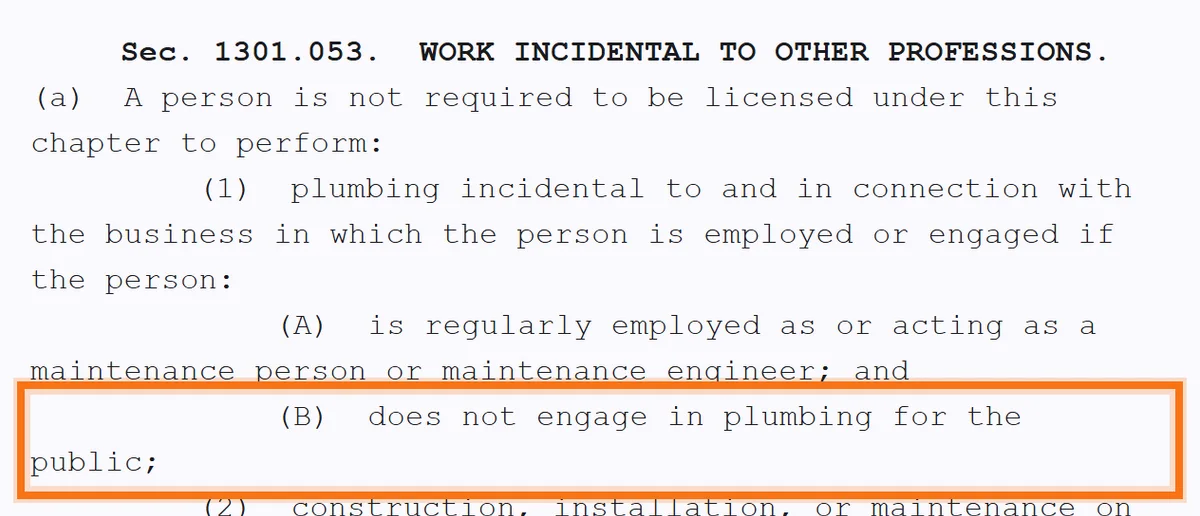
There are exemptions, and they are narrow. Section 1301.053(a)(1) excuses plumbing incidental to the business where a person is employed if the person is regularly employed as or acting as a maintenance person or maintenance engineer and does not engage in plumbing for the public. Section 1305.003(a)(8) has a similar electrical exemption for a person regularly employed as a maintenance person for a business who does not do electrical work for the public, excluding installation during new construction.
Whether a management company's crew working at many owners' houses fits that wording is a question to put to the manager in writing, not to assume. Our guide on how a manager checks contractors' licenses and insurance shows how to look a license up. This is general information, not legal advice.
Five questions about who will work on your house
Put these to any manager, and ask for the answers in writing:
- "Who will actually work on my house?" Outside vendors, your own staff, or both, and for which kinds of jobs.
- "How is each kind of work billed?" For vendors: any coordination fee and its rate. For staff: hourly rate, minimum, trip charge, and whether parts are at cost.
- "Does anyone you own or are related to do work on my house?" An in-house or affiliated crew is not wrong in itself; an undisclosed one is. Maintenance markups explained covers why this conflict matters.
- "Who does plumbing, electrical and HVAC work, and are they licensed?" If an exemption is claimed, ask which one.
- "Who pays when a repair has to be redone?"
A manager who answers all five in a few lines has a model you can check. Vague answers built around "we handle it" are the signal to ask again.
When one model suits your house better
An older house with original plumbing, an aging HVAC system and a roof near the end of its life produces jobs that need licensed specialists, so a deep list of outside trades matters most. A newer house produces mostly small items, where quick turnaround matters and a handyman-level visit is often enough, whether that is a staff member or a vendor.
If you own several rentals, consistency counts: the same standard for small jobs, licensed trades for the rest, and the same paperwork on every statement, so you can compare houses month by month.
Above a certain size, the model matters less than your approval limit. A large repair should come to you first whoever would do it; see can a property manager approve expensive repairs without my permission. When a big job does reach you, a second quote is how you test the first one.
How Perpetual handles maintenance work
Perpetual Property Management is broker-owned and manages homes in Keller, North Richland Hills, Fort Worth and nearby. Our maintenance page describes the work this way: qualified vendors at real prices, plumbers, electricians, HVAC and general trades we work with repeatedly, accountable for their work. Our city pages describe maintenance coordination with vetted, insured vendors and owner-approved spending limits.
Routine repairs under your pre-approved limit get fixed fast; anything larger comes to you with a description, photos and a recommendation. Every job is documented (what was reported, what was done, what it cost) in your owner portal, and the vendor's original invoice is always there. Maintenance coordination is a percentage of the vendor's invoice: 4.9% of cost on Standard and 5% of cost on Full Service, and make-ready coordination is 3% to 5% of cost on the Investor Special (portfolios of 5 or more units). Under the Perpetual Promise, subject to its Guarantee Addendum, every completed repair over $500 gets photo or video proof in your portal.
You can usually use your own handyman or vendor if they are insured and reliable. Who will work on your particular house, and how any work not done by an outside vendor would be billed, is confirmed in writing before you sign. See maintenance coordination and pricing, or call 682-593-7033.
The takeaway: Ask who will do the work on your house. Outside vendors give you an invoice from someone else to check; an in-house crew bills at the manager's own rate, which must be in the agreement. Either way, plumbing, electrical and HVAC work should go to licensed trades, and you should know who redoes a failed repair.
Questions owners ask
Is in-house maintenance cheaper than contractors?
Sometimes, for small jobs, because a staff visit can avoid a vendor's minimum service call. But the price is the manager's own rate and logged time, so you can only judge it if the hourly rate, minimum, trip charge and parts policy are written into the agreement. For licensed trade work and large repairs, the price depends on the specific job and vendor, not the model.
Can I ask a property manager to use my own contractor?
Often yes, if the agreement allows it. Expect the manager to ask for proof of insurance and to keep the job documented like any other. Emergencies are the usual exception, because someone has to answer at night. At Perpetual, you can usually use your own handyman or vendor if they are insured and reliable, and we will tell you honestly if one is causing problems.
Does a property manager make money on repairs?
Some do, through a coordination fee on vendor invoices, an in-house hourly rate, or both. Neither is wrong when the agreement names it. The problem is money you cannot see: a retyped invoice with a higher total, or a payment from a vendor that never reaches your statement. Texas license law lists an undisclosed profit on an expenditure made for a principal as grounds for discipline (Occupations Code 1101.652(b)(13)).
Who is liable if a contractor damages my rental?
Start with the contractor and the contractor's insurance, which is why a manager should confirm coverage before sending a vendor. If the manager's own employee caused the damage, the management agreement and the facts decide who pays. Read the agreement's maintenance and liability clauses before you sign. This is general information, not legal advice; a Texas attorney can review a specific case.
Does a property manager's maintenance employee need a plumbing license in Texas?
Generally a person may not engage in plumbing without a license under Occupations Code 1301.351. Section 1301.053(a)(1) exempts plumbing incidental to the employer's business by a person regularly employed as a maintenance person who does not engage in plumbing for the public. Whether a crew working at many owners' houses fits that wording is worth asking in writing. This is general information, not legal advice.
How do I tell from my statement who did a repair?
An outside vendor's job should come with the vendor's own invoice, with its name and the work described, plus any coordination fee as a separate line. A staff job should show hours, the rate, parts and any trip charge from your agreement. If a line shows neither, ask your manager who did the work and for the paperwork behind it.
Related services
Property management in Keller, North Richland Hills and Fort Worth. How full-service management works in Tarrant County →