Key takeaways
- Your own bills answer the question: put the vendor's original invoice next to the statement line, and anything that is not on the vendor's paperwork was added.
- A disclosed coordination fee appears as a separate line you can recalculate from the invoice; an undisclosed markup is built into the total and leaves no line.
- Three questions settle the rest: is anything added to vendor invoices, does anyone else pay you in connection with my repairs, and will I see every original invoice?
- Occupations Code 1101.652(b)(13) lists an undisclosed commission, rebate or direct profit on an expenditure made for a principal as grounds for license discipline.
- The agreement should name any repair charge, its rate, what it is calculated on and your approval limit; if it is not there, ask before you sign.
Some property managers add something to repair bills and some do not, and you can find out which kind you have from your own paperwork. Put the vendor's original invoice next to the repair line on your owner statement. If the numbers match, nothing was added; if they differ, the difference should be a fee your agreement names. For an owner in Fort Worth, Keller or North Richland Hills, that five-minute comparison beats any promise on a website.
This guide walks through that test, what a gap means, the three questions to ask your manager, and what the agreement has to say.
Checking a Fort Worth repair bill: the statement line against the invoice
Here is what to compare between your owner statement and the vendor's original invoice, where to find it, and what a match or a gap tells you:
| What you compare | Where to find it | If it matches | If there is a gap |
|---|---|---|---|
| The amount | Invoice total vs the repair line on the statement | Nothing was added to the vendor's price | The difference is a fee, a markup or an error; find which in the agreement |
| Separate fee lines | Statement lines next to the repair (coordination, trip, admin) | Each recalculates from the invoice at the agreement's rate | A fee with no rate in the agreement, or a rate that does not recalculate |
| The vendor | Name and address on the invoice | An outside business you can look up | A company tied to the manager: ask who owns it |
| The work | Description and date on the invoice | Says what was wrong and what was done | "Service call" with no detail: ask for the itemized invoice |
| The paperwork itself | The vendor's letterhead, not the manager's | An original you can open | A retyped or summarized bill: ask for the vendor's own copy |
How to read this table: a full row of matches means you are paying the vendor's price plus only what your agreement names. One gap is a question for your manager, not proof of anything; a pattern of gaps across several repairs is the point to ask for every invoice in writing.
Test one repair bill in five minutes
- Pick one repair from a recent statement, ideally one over a couple of hundred dollars.
- Get the vendor's original invoice. If your manager posts invoices in the owner portal, it is there; if not, request it in writing.
- Compare the totals. Write down the invoice total and the statement total for that repair, including any fee lines beside it.
- Recalculate any fee using the rate in your agreement.
- Explain the difference, if any is left, from the agreement. If you cannot, ask.
Illustrative only, not a quote. Say the plumber's invoice is $480 and your agreement has a 4.9% coordination charge. The fee is $480 x 4.9% = $23.52, so the statement should show $480.00 for the repair and $23.52 as a separate line, $503.52 in total. Now say the statement instead shows one line of $540 and no fee line: the $60 gap is 12.5% of the invoice ($60 / $480), and nothing in your paperwork explains it. The first case is a disclosed fee; the second needs an answer.
What counts as a markup on your bill, and what does not
Not every dollar between the invoice and your payout is a hidden markup. A coordination fee written into your agreement, shown as its own line and calculated on the vendor's invoice, is a disclosed charge: you can see it, recalculate it and compare it between managers. So is a trip or after-hours fee, if the agreement lists it.
A markup in the sense owners worry about is money you cannot see: a higher total on a retyped invoice, an in-house crew billing at its own rates without disclosure, or a payment from the vendor to the manager that never touches your statement. The types, and how a percentage of the invoice changes a manager's incentives, are covered in maintenance markups explained, so this guide stays with your own bills.
The test is disclosure, not the word "markup." A charge in the agreement is a price; a charge that is not there is a problem.
When you cannot get the invoice, or the year looks wrong
If the manager will not produce the vendor's invoice, that is your answer to whether the bill can be checked. Ask in writing, name the repair and the date, and keep the reply. A missing invoice for one small job can be an oversight; a policy of not sharing invoices is a reason to change managers, as our guide to seeing original repair invoices and photos explains.
Once a year, look at the pattern instead of single bills. Sort the year's repairs by vendor and by amount. Watch for round-number totals that never match an itemized invoice, the same small vendor on every job, a trip charge on every visit, or repairs that are replaced rather than fixed. None of these proves a markup, but each is worth one question. Your approval limit matters here too: see can a property manager approve expensive repairs without my permission.
What the agreement must say about repair charges
Read the compensation section, the maintenance section and the definitions together. Before you sign, the agreement should answer these in plain words:
- The charge: whether any fee is added to vendor invoices, what it is called and the rate.
- The base: what the rate is calculated on (the vendor's invoice total) and whether it also applies to make-ready, improvements or large projects.
- Affiliates: whether the manager or its owners have an interest in any vendor it uses.
- Payments from others: whether any vendor pays the manager for referrals or volume.
- Your limit: the dollar amount above which work needs your approval.
- Your paperwork: that you receive the vendor's original invoice for each repair.
Names vary: "coordination fee," "oversight fee," "project management fee," "administrative fee on vendor invoices." A percentage that applies to "all repairs, improvements and capital projects" deserves a dollar example in the quote before a roof replacement makes it real.
What Texas license law says about money added to your repairs
A manager who collects rent for others in Texas is generally doing licensed broker work, and the license law speaks to repair money directly. Occupations Code 1101.652(b)(13) lists, among the grounds for suspending or revoking a license, a license holder who "accepts, receives, or charges an undisclosed commission, rebate, or direct profit on an expenditure made for a principal." A repair paid from your rent is an expenditure made for you.
TREC rule 535.148 adds that a license holder may not receive a commission, rebate or fee from anyone other than the client without first disclosing it and getting the client's consent. And TREC rule 535.146 requires the broker to keep a documentary record of each deposit to and withdrawal from the trust account, and to keep trust account documentation for four years, which is why asking for the invoice behind a payment from your money is a normal request. The full background is in maintenance markups explained. This is general information, not legal advice.
The three questions to ask your manager
Ask these in writing and keep the answers with the agreement:
- "Do you add any percentage or fee to vendor invoices, for repairs of any size? Where is it in the agreement?" A clean answer names the rate and the clause.
- "Does anyone other than me pay you, or a company you own, in connection with my repairs?" This covers vendor rebates, referral fees and in-house crews in one question. The answer should be no, or a disclosure you can read.
- "Will I see the vendor's original invoice for every repair?" Yes, in a portal or by email, is the only answer that lets you check anything.
A manager with nothing to hide answers all three in a few lines. Long answers built around "industry standard" can mean the specifics are worse. Compare the answers with the written fee schedule, as our pricing and fees page lays ours out.
How Perpetual handles repair invoices
Perpetual Property Management is broker-owned and manages homes in Keller, North Richland Hills, Fort Worth and nearby. We charge for coordinating repairs, and our price sheet says what: maintenance coordination is 4.9% of cost on Standard and 5% of cost on Full Service, and make-ready coordination is 3% to 5% of cost on the Investor Special (portfolios of 5 or more units). Maintenance coordination is a percentage of the vendor's invoice, and the original invoice is always in your portal.
If you searched for a Perpetual invoice: the vendor's original invoice for a repair we coordinate is in your owner portal, where monthly statements, invoices and documents sit in one place, so you can run the five-minute test above on any line. Routine repairs under your pre-approved limit get fixed fast; anything larger comes to you with a description, photos and a recommendation. Under the Perpetual Promise, subject to its Guarantee Addendum, every completed repair over $500 gets photo or video proof in your portal, and if a fee is not in the agreement, you do not pay it.
Our answers to the three questions above for your house, including whether a coordination charge applies when your own vendor does the work, are confirmed in writing before you sign. See our maintenance coordination page or call 682-593-7033.
The takeaway: Compare every repair line with the vendor's original invoice, recalculate any coordination charge from it, ask the three questions in writing, and make sure the agreement names every repair charge before you sign.
Questions owners ask
Is it legal for a property manager to mark up repairs in Texas?
A charge disclosed in your management agreement is a fee you agreed to. What Texas license law targets is the undisclosed version: Occupations Code 1101.652(b)(13) lists accepting or charging an undisclosed commission, rebate or direct profit on an expenditure made for a principal as grounds for license discipline, and TREC rule 535.148 requires disclosure and the client's consent before a license holder takes a fee from anyone else. This is general information, not legal advice.
How do I know if the repair vendor is owned by the management company?
Ask in writing whether the manager or its owners have any interest in the vendors it uses, and read the name and address on each original invoice. The same company on nearly every job, or an invoice on the manager's own letterhead, is worth a direct question. An in-house crew is not wrong in itself; an undisclosed one is the problem.
Can I use my own contractor to avoid a markup?
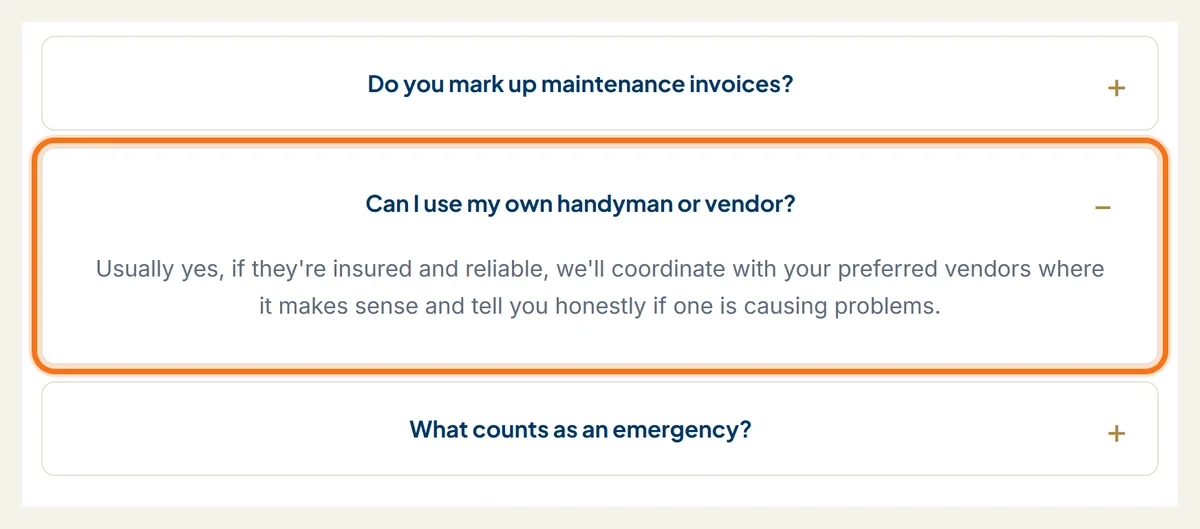
Often, if the agreement allows it and your contractor is insured and can work around the tenant's schedule. Ask whether a coordination charge still applies when your own vendor does the work, and get the answer in writing. At Perpetual, you can usually use your own handyman or vendor if they are insured and reliable, and we will tell you honestly if one is causing problems.
What is a reasonable approval limit for repairs?
There is no set number. It should be high enough that routine repairs do not stall waiting for you and low enough that you see anything that changes the house or its budget. Put the figure in the agreement as a dollar amount, not "reasonable repairs," and ask how emergencies are handled above it. Our guide on managers approving expensive repairs covers how to choose the number.
Where do I find the Perpetual invoice for a repair?
In your owner portal. For a repair we coordinate, the vendor's original invoice is always there, alongside your monthly statements and documents, so you can compare it with the statement line. Maintenance coordination is a percentage of that invoice: 4.9% of cost on Standard and 5% of cost on Full Service, as the price sheet states.
How do I check a coordination fee on my statement?
Multiply the vendor's invoice total by the rate in your agreement and compare the result with the fee line. Illustrative only: a $480 invoice at 4.9% gives $23.52, so the repair plus fee should total $503.52. If the fee line differs, or there is no fee line but the repair line is higher than the invoice, ask your manager to explain it in writing.
Related services
Property management in Keller, North Richland Hills and Fort Worth. How full-service management works in Tarrant County →