Key takeaways
- Most managers will work with your contractor if they meet the same bar as the manager's own vendors; our maintenance page says "usually yes, if they're insured and reliable."
- Texas licensing exemptions for owners are tied to the owner's own home: plumbing in the owner's homestead, A/C work in a building owned as the owner's home, electrical work by a person who owns and resides in the dwelling.
- Emergencies and work inside an occupied house are where splitting the work causes trouble, because the landlord's repair duty runs from the tenant's notice (Property Code 92.052).
- Every repair, whoever did it, belongs in one record with the invoice, or deposit deductions and your CPA's numbers suffer.
- Settle it in writing before you sign: trades, emergencies, invoices, any fee.
Can you use your own contractor, or do some repairs yourself, once a property manager runs your rental? Usually yes to the contractor, if they are insured and reliable, and often yes to your own work on a vacant house. On a rental in Fort Worth, Keller or North Richland Hills, the arrangement works when it is written down: which trades your people cover, who takes emergencies, how invoices reach the record, and which licensed work stays with license holders.
This guide goes situation by situation: what worries a manager in each, what Texas licensing law says about an owner working on a rental, and the written rule that settles it.
Your contractor or your own hands: situation by situation
Here are the usual requests owners make, what a manager worries about in each, and the rule worth writing into the management agreement or an addendum:
| Situation | The manager's concern | What the written rule should say |
|---|---|---|
| Your long-time handyman for small repairs in an occupied house | Insurance, response time, tenant contact going around the manager | Named person and trades, insurance on file, scheduling through the manager, a fallback vendor if they cannot come in time |
| Your licensed plumber, electrician or A/C company | Mostly logistics: invoices, access, warranty on the work | They are first call for that trade; invoices go into the property record; the manager may dispatch its own vendor for emergencies |
| You paint, clean or do yard work on a vacant house | The finish date and the rent-ready standard before listing | Scope, a completion date, and a walk-through before the listing goes live |
| You do plumbing, electrical or A/C work on the rental | Texas licensing: owner exemptions cover the owner's own home | Licensed trades go to license holders, whoever pays them |
| A burst pipe or no heat at night | The repair duty and the tenant's safety cannot wait for an owner's schedule | Emergencies go to whoever answers first under the agreement's emergency terms |
| A relative or friend does the work for free | No insurance, no invoice, no warranty, no record | Same bar as any vendor, plus a written receipt of what was done for the file |
How to read this table: the middle column is why a manager asks questions, not a refusal. Every "what the rule should say" item is something you can agree before signing, and the agreement you sign is what settles it later. The licensing row is the one that does not bend, and the next section shows why.
Why owners ask, and why managers are careful
Owners ask for two reasons. One is cost: a handyman you have used for years may charge less than a manager's vendor, and you may want to avoid a coordination charge on top (how those charges work is in maintenance markups explained). The other is trust: you know how your contractor works, and you do not know the manager's vendors yet.
Managers are careful for one reason: when a repair goes wrong in an occupied rental, the manager is the one the tenant calls back. A contractor who misses two appointments with a tenant who has no hot water is the manager's problem to solve. An uninsured helper injured at your house is a claim that can reach your policy. The caution is about who answers for the result, and a good manager will say so plainly rather than refuse.
When a manager will use your contractor
Most managers put every vendor, theirs or yours, through the same check. If your contractor passes, there is little reason to refuse. The usual items:
- Liability insurance, with a certificate on file and a renewal date someone tracks.
- A Texas license where the trade needs one (next section), checked on the state's license search.
- Availability that fits a rental: a reply the same day and service within the windows the manager promises tenants.
- Invoices to the record, itemized, so the repair history and your statement match.
Workers' compensation is a question to ask, not a legal requirement: Texas Labor Code 406.002 makes coverage elective for most private employers. What a real insurance and license check looks like is in how a manager checks that contractors are licensed and insured, and how a manager keeps its vendor list is in the vendor bench.
Texas licensing: what an owner may do on a rental
Texas licenses plumbing, electrical work and air conditioning contracting, and the owner exemptions in each statute are written around the owner's own home:
- Plumbing: a property owner does not need a license "to perform plumbing in the property owner's homestead" (Occupations Code 1301.051); otherwise plumbing requires the proper license and supervision (1301.351(a)).
- Air conditioning: the chapter does not apply to a person doing A/C work "in a building owned solely by the person as the person's home" (1302.053); otherwise a contractor license is required (1302.251(a)).
- Electrical: the exemption covers work "performed in or on a dwelling by a person who owns and resides in the dwelling" (1305.003(a)(6)); otherwise a license is required (1305.151).
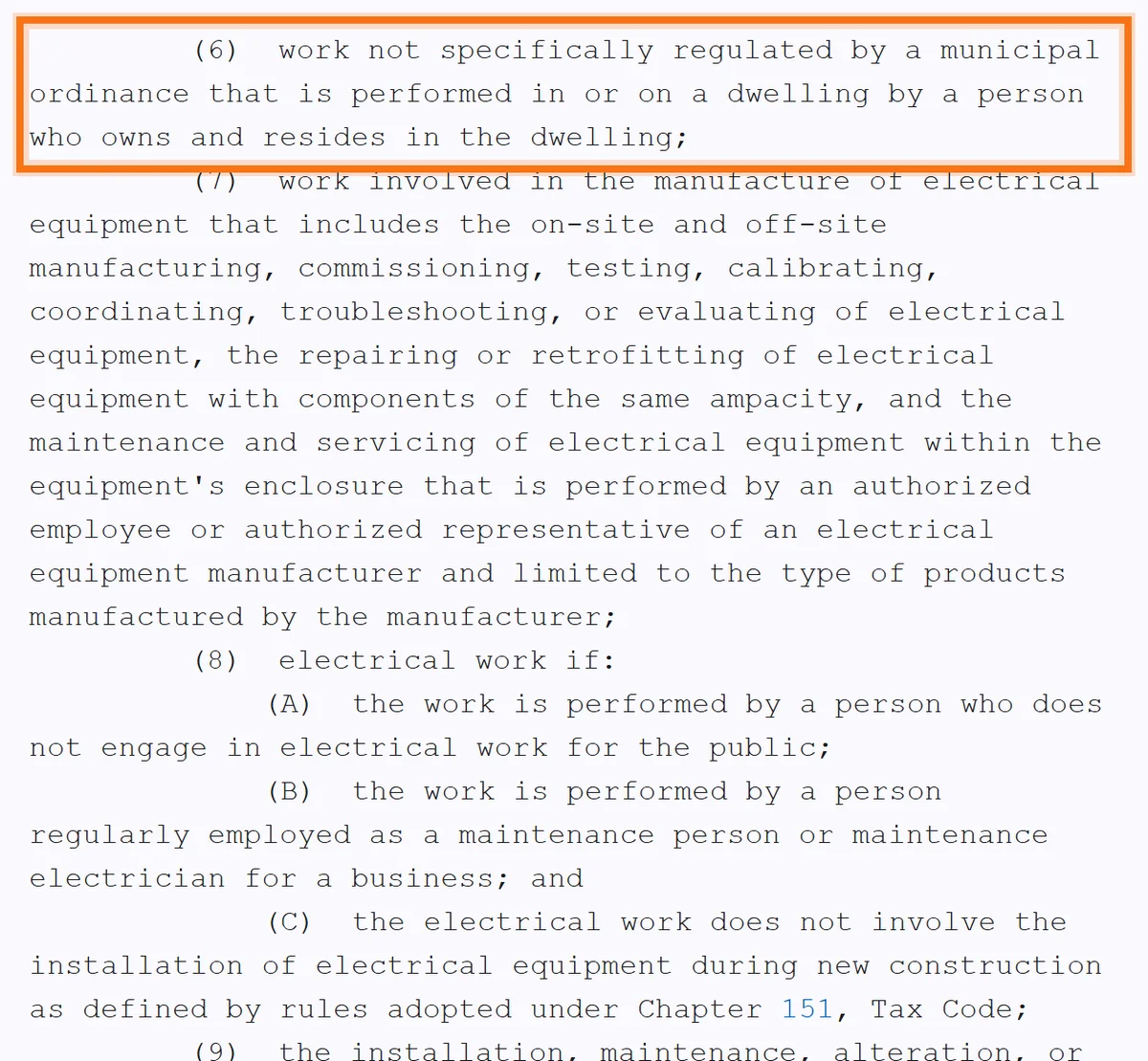
A rental you do not live in is not your homestead or your home, so on a plain reading those exemptions do not cover your work on it. Maintenance-employee exemptions in the same chapters cover a business's regular staff, not an owner. If your cousin is "basically an electrician," a manager will still send a licensed one. Ask a Texas attorney or the licensing agency if your case is unusual; this is general information, not legal advice.
Doing the work yourself: where it works
The clean case for your own work is a vacant house between tenants. No one is living there, no tenant repair request is pending, and no entry has to be arranged. Paint, cleaning, landscaping, minor carpentry and swapping fixtures (not wiring) are the usual owner jobs during a make-ready. What the rent-ready standard includes is in the make-ready guide.
The thing to manage is the date. Every day the house is not ready is a day it is not listed, and a tenant approved to move in on the first cannot move into a house still being painted on the third. Agree a scope and a finish date, and a walk-through before the listing goes live.
Some owners also keep exterior items on an occupied house, such as lawn service or fence repair. That works when the tenant is told through the manager and the lease supports the access.
Where owner work causes trouble
Inside an occupied house, owner work runs into three problems at once:
- Tenant contact. Once a manager is in place, the tenant's calls go to one number. An owner texting the tenant to arrange a visit undoes that, and the tenant soon calls the owner about everything.
- Access. No Texas statute sets a notice period for a landlord's entry; the lease does. The manager knows what the lease says and schedules to it.
- Insurance and warranty. If your own work causes a leak or a fire, ask your agent before, not after, how your landlord policy treats it. Work by a licensed, insured contractor comes with someone to answer for it.
None of this is about skill. A manager cannot promise a tenant a repair process it does not control.
Emergencies and the tenant's repair clock
The repair duty in Texas runs from the tenant's notice. Property Code 92.052(a) requires a landlord to make a diligent effort to repair a condition that materially affects the physical health or safety of an ordinary tenant, once the tenant has given notice and is not delinquent in rent. Section 92.056 then gives the landlord a reasonable time to repair, with a rebuttable presumption that seven days is reasonable, before the tenant's remedies apply.
That clock does not care whose contractor was supposed to come. If dispatch belongs to the owner and the owner is away, the tenant's notice still started the clock. That is why the workable middle is category-based: your contractor is first call for named trades on routine work, while emergencies go to whoever can come now. What counts as an emergency is in what counts as a maintenance emergency, and what Texas requires generally is in Texas landlord repair obligations.
Invoices, fees and your records
If cost is your reason, ask two questions before signing: is there a coordination charge on work by your own vendor, and who pays the vendor, the manager from your funds or you directly? Either answer can be fine, but it should be in the fee schedule, not discovered on a statement.
Then insist that every repair, including ones you paid for yourself, is in the property's record with the invoice. Three things depend on it: a deposit deduction for tenant damage needs the repair invoice behind it, your CPA needs the full year of expenses, and the next owner or manager needs the history of the house. Owner-paid work that never reached the record is a common reason an owner's numbers and the manager's numbers disagree at year end.
What to put in the management agreement
Decide this at signing and write it into the agreement or an addendum:
- Your contractors by name, the trades they cover, and proof of insurance and any required license.
- Which jobs you keep for yourself, limited to work that needs no license, mostly on a vacant house, with a finish date.
- The fallback: if your contractor cannot respond in time, the manager may send its own vendor without waiting for you.
- That emergencies go to whoever can respond first under the agreement's emergency terms.
- How invoices reach the record and the statement, and any fee on your vendor's work.
A manager who agrees to all this out loud but will not put it in writing is telling you how it will go later. The rest of the maintenance service questions are the same ones: who is responsible, how fast, and what gets documented.
How Perpetual works with your contractor
What our published pages say:
- Your vendor. Our maintenance page answers "Can I use my own handyman or vendor?" with: usually yes, if they are insured and reliable; we coordinate with your preferred vendors where it makes sense and tell you honestly if one is causing problems.
- Our vendors. Our city pages describe maintenance coordination with vetted, insured vendors and owner-approved spending limits.
- Approvals. Routine repairs under your pre-approved limit get fixed fast; anything larger comes to you with a description, photos and a recommendation. Emergencies follow a 24/7 process.
- Invoices. Maintenance coordination is a percentage of the vendor's invoice (5% Full Service, 4.9% Standard; make-ready 3% to 5% on Investor Special, per our price sheet), and the original invoice is always in your portal.
How work by your own contractor or your own hands is handled on your house, including any charge on it, is confirmed in writing in the management agreement before you sign. Call 682-593-7033 and tell us who your contractor is.
The takeaway: Bring your contractor if they are insured and reliable, keep your own hands to work that needs no license and no tenant coordination, and write the trades, emergencies, invoices and fees into the agreement.
Questions owners ask
Can I use my own contractors with a property management company?
Usually, if the contractor is insured, holds any license Texas requires for the trade, can respond within the times the manager promises tenants, and sends invoices into the property record. Our own maintenance page says usually yes, if they're insured and reliable. Put the arrangement and the fallback for slow response in the management agreement.
Can I do some of the maintenance myself and let the manager handle the rest?
Often, for work that needs no license and no tenant coordination, mostly on a vacant house between tenants: paint, cleaning, yard work, minor carpentry. Inside an occupied house it is harder, because tenant contact, access under the lease and the repair clock under Property Code 92.052 all run through the manager. Agree the split in writing.
What insurance does my contractor need to work on my rental?
Liability insurance with a certificate on file is the usual baseline. Workers' compensation is worth asking about if they have employees, though Texas Labor Code 406.002 makes it elective for most private employers. Plumbing, electrical and A/C work also need the Texas license the trade requires.
Does a property manager charge a fee when I use my own contractor?
Some managers charge their coordination fee on all vendor work, some do not on an owner's own vendor. Either is fine if it is in the fee schedule before you sign. Ask whether your vendor's invoices carry any charge and who pays the vendor. With us, that is confirmed in writing in the management agreement.
Can I do my own make-ready between tenants under management?
Generally yes. Agree the scope and a finish date, have the manager walk the house against the rent-ready standard before it is listed, and keep receipts so the work is in the property's record. The risk is timing: an approved tenant waiting on a house that is not ready.
Can I do plumbing or electrical work on my own rental house in Texas?
The owner exemptions in the Occupations Code are tied to the owner's own home: plumbing in the owner's homestead (1301.051), A/C work in a building owned as the owner's home (1302.053), and electrical work by a person who owns and resides in the dwelling (1305.003(a)(6)). A rental you do not live in does not fit them, so use a license holder. This is general information, not legal advice.
Who handles emergencies if I use my own contractor?
Write it down. The workable rule is that your contractor is first call for routine work in their trade, and emergencies go to whoever can respond first under the agreement's emergency terms. The tenant's notice starts the landlord's repair duty under Property Code 92.052 whether or not your contractor is free.
Related services
Property management in Keller, North Richland Hills and Fort Worth. How full-service management works in Tarrant County →