
Key takeaways
- A split arrangement (you collect rent, the manager leases and repairs) exists, but few managers offer it.
- Under Texas Property Code 92.052, the tenant's repair notice counts when it is given to the person or place where rent is normally paid.
- The repair duty also depends on the tenant not being behind on rent when the notice is given: a fact only the rent collector knows.
- Under TREC rule 535.146, rent a broker accepts is trust money, kept in a designated trust account with at least a monthly accounting if there is activity.
- If what you want is control of the money, get it through the payout date, the statements, the invoices and the spending limit.
Can a manager lease your house and handle repairs while you collect the rent yourself? A few will, most will not, and the reason is not stubbornness. In Texas the rent and the repairs run through one channel: repairs are paid from rent, and the tenant's repair notice legally goes to where rent is paid. For a rental in Fort Worth, Keller or North Richland Hills, the practical choices are placement only, full management, or a split arrangement written very carefully.
This guide covers why the two jobs are tied, who does what when they are split, and what to do if your real goal is control of the money.
Who does what when you collect the rent and the manager leases and repairs
Here is how the main jobs fall under full management and under a split arrangement where you collect the rent, with the rule or document that decides each one:
| Job | Full management | Split: you collect, manager leases and repairs | What decides it |
|---|---|---|---|
| Collecting rent | Manager, into the broker's trust account | You, into your own account | The management agreement |
| Paying repair invoices | Paid from the rent, shown on the statement | You pay each invoice, or fund money the manager holds | The agreement; TREC rule 535.4(h) |
| Where the tenant sends a repair request | One place for rent and repairs | Must be spelled out, or it can come to you | Property Code 92.052(a)(1); the lease |
| Knowing whether the tenant is current | Same ledger as the work orders | Only you know; the manager must be told | Property Code 92.052(a)(2) |
| Late notices and notice to vacate | Manager, as the lease and agreement set | You, unless the agreement says otherwise | The lease; Property Code 24.005 |
| Holding and refunding the deposit | Manager, with the move-out itemization | Whoever holds it; often you | Property Code 92.103, 92.104 |
| Year-end records | One statement with income and expenses | Your books plus the manager's invoices | Your agreement; your CPA |
How to read this table: under full management every row has one owner. In the split column, three rows (repair requests, knowing who is current, and the deposit) need a written answer before the lease is signed, because Texas law ties them to whoever collects the rent. If a company will not put those answers in writing, the split will fail on the first late month.
Why few managers lease and repair without collecting the rent
A manager who leases and repairs but never touches the rent takes on the two jobs that cost money and gives up the one that pays for them. Every repair is paid from somewhere. Under full management it is paid from the rent the broker holds. Under a split, the manager has to invoice you and wait, or hold money you send ahead and chase you when it runs low.
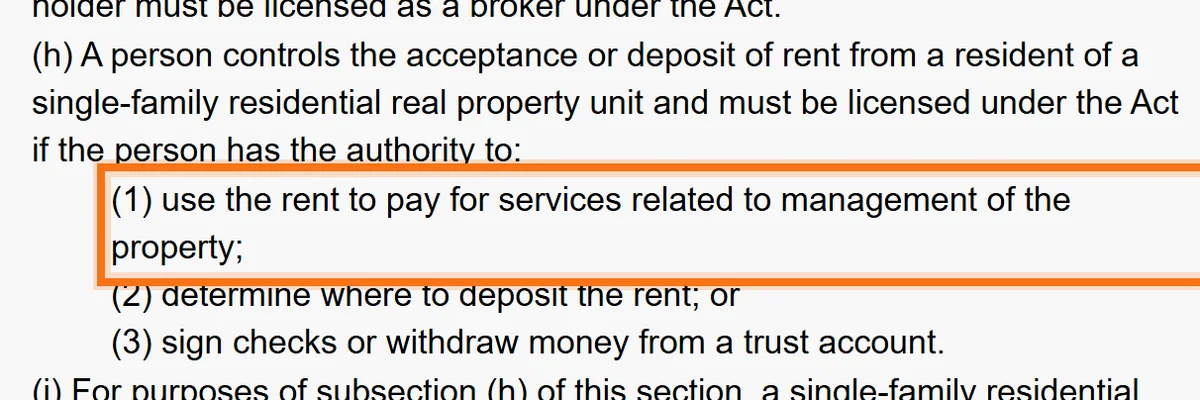
Texas real estate rules treat paying for repairs out of rent as part of controlling the rent. TREC rule 535.4(h) says a person controls the acceptance or deposit of rent from a single-family home, and must be licensed, if the person has the authority to use the rent to pay for services related to management of the property, decide where to deposit it, or sign checks or withdraw money from a trust account.
When the broker does hold your rent, TREC rule 535.146 calls it trust money: it goes into a designated trust account, by the close of business of the second working day unless the parties agree otherwise in writing, never mixed with the broker's own money, with an accounting to you at least monthly if there was activity. That structure is what makes paying a plumber from rent routine. A split takes it away. This is general information, not legal advice.
The Texas repair rule that ties repairs to rent
Texas repair law is the bigger reason. Property Code 92.052(a) says a landlord must make a diligent effort to repair a condition when three things are true: the tenant specifies the condition in a notice "to the person to whom or to the place where rent is normally paid", the tenant is not delinquent in rent at the time the notice is given, and the condition materially affects the physical health or safety of an ordinary tenant. Under 92.052(d), the notice must be in writing only if a written lease requires it.
Read that against a split arrangement:
- The notice can go to you. If the tenant pays rent to you, a repair notice given to you can start the landlord's duty, even though the manager is supposed to handle repairs.
- The rent status sits with you. Whether the tenant was current when the notice was given is in your ledger, not the manager's.
- Tenant-caused damage is a judgment call. Under 92.052(b) the duty does not cover damage the tenant or their guests caused, apart from normal wear and tear; whoever sees the work and whoever sees the money need to compare notes.
None of this makes a split illegal. It means the lease and the management agreement must say exactly where repair requests go and how you and the manager share rent status. Texas landlord repair obligations covers the deadlines. This is general information, not legal advice.
One late month under a split arrangement
Picture a house in North Richland Hills, illustrative only. The manager leased it, the tenant pays you, and the manager handles repairs. In month three the tenant pays half the rent and emails the manager that the dishwasher is broken. The manager sends a technician, because that is the job. You see the short payment and send a late notice. The tenant tells the manager you are harassing them over a broken dishwasher, and the technician's invoice reaches you for a tenant who has not paid you.
Nobody did anything wrong; the structure did. Under full management the same month is one record: the short payment, the late process and the repair, reported to you together.
The service shapes that actually exist
Rather than hunting for a company that carves out exactly the piece you want, choose from the shapes that are commonly offered and priced:
- Tenant placement only. The manager prices, markets, shows, screens and delivers a signed lease and a move-in report. Then rent, repairs, renewals and the move-out are yours. See can I hire someone just to find a tenant?
- Full management. Rent collection, repairs, inspections, renewals and move-outs for a monthly fee.
- A split arrangement, where a company offers it. The manager places the tenant and stays the repair contact while you collect rent. It needs the written answers in the last section of this guide.
What each of the first two leaves with you after move-in, duty by duty, is in full-service management vs. tenant placement only.
If the goal is control of the money
Many owners who ask for the split are not trying to save a fee. They want to see the rent and not wonder what happens to it. That control can be written into a full-management agreement instead:
- A payout date. Ask which day of the month you are paid and what happens if it is missed.
- A spending limit you set. Repairs under it go ahead; anything above it comes to you first.
- The original invoices. Ask to see the vendor's own invoice for every repair, not a summary line.
- Your own vendor. Ask whether you can use a contractor you already trust.
- The statement and the ledger. Ask what the monthly statement shows and where you can see it between statements.
- Where the money sits. Ask which account holds rent and deposits; a broker holds them as trust money.
How the reserve and the payout work together is in owner reserves and disbursements, and how to check that the money is protected in how do I know my rent and security deposit money are protected?
What our site states, and what to ask for
If you are asking us "can I pay only for the property management services I need?", here is what our site states. The plans on our price sheet are management plans at 7% (Investor Special, portfolios of 5 or more units), 9% (Standard) or 10% (Full Service) of monthly rent, with tenant placement at 50%, 75% or 50% of one month's rent. Our leasing page says it plainly: our core service is full-service management, and the placement work inside it is the same work a placement-only service sells; tell us about the house and we will say which one fits.
The same sheet says plans are negotiable case by case, with the final fee set after the free rental analysis. Ask, and get the answers to the questions below in the written quote.
If the goal is a lower fee: the illustrative math
If the goal is cost, run the numbers honestly. Illustrative only, not a quote: on a $2,000 rent, a 10% management fee is $200 a month. If a company priced a split arrangement at 6%, that is $120, a saving of $80 a month, or $960 a year.
For that $960 you take on rent collection, late notices, the deposit and the books. The deposit has a deadline: under Property Code 92.103 the refund is due within 30 days after the tenant surrenders the house (once the tenant has given a written forwarding address, 92.107), with an itemized list of any deductions (92.104(c)). Missing it creates a presumption of bad faith under 92.109(d), and a landlord who withholds in bad faith owes $100 plus three times the amount wrongfully withheld plus attorney's fees (92.109(a)).
On a $600 deduction withheld in bad faith, that is $100 + $1,800 = $1,900 before fees. Is property management worth it? runs the full comparison. This is general information, not legal advice.
Questions to ask any company that offers the split
If a company says yes to a split, the yes is only as good as the written answers to these:
- Where does the tenant send repair requests, and does the lease say so?
- How will the manager learn, the same day, that rent is late or short?
- Who sends late notices and any notice to vacate?
- Who holds the security deposit, and who prepares the move-out itemization?
- How are repair invoices paid: by you per invoice, or from money the manager holds in trust?
- Who keeps the year-end records?
- What does the arrangement cost, compared with full management, in writing?
If any answer is "we'll figure it out," you have found the handoff that will fail first.
How Perpetual handles this
Our core service is full-service management, and our site does not publish a leasing-and-repairs-only plan. What it states about the money and the repairs:
- Rent: tenants pay online through their portal; owner disbursements go out on a predictable monthly schedule, direct to your bank (rent collection).
- The payout date: rent we collect is disbursed to you by the 10th of each month, or that month's management fee is waived, one of the written guarantees in the Perpetual Promise, subject to the Guarantee Addendum.
- Repairs: routine repairs under your pre-approved limit get fixed fast; anything larger comes to you with a description, photos and a recommendation. You see the invoices, and every completed repair over $500 gets photo or video proof in your portal.
- Your own vendor: usually yes, if they are insured and reliable (maintenance coordination).
- The portal: statements, documents and disbursement history in our AppFolio owner portal.
Whether any split of the work fits your house, and its price, is confirmed in writing before you sign. To talk it through, request a free rental analysis or call 682-593-7033.
The takeaway: Rent and repairs run on one ledger and, under Property Code 92.052, one notice address. Choose placement only or full management, and if you want control, get it in writing: payout date, statements, original invoices and a spending limit you set.
Questions owners ask
Can a company handle leasing and maintenance while I collect the rent myself?
A few companies offer it, most do not. Under Texas Property Code 92.052, the tenant's repair notice goes to the person or place where rent is normally paid, and the repair duty depends on the tenant not being behind on rent when notice is given, so splitting rent from repairs splits the information the repair duty depends on. The common alternatives are placement only or full management with a payout date, statements and a spending limit you control.
What is the difference between tenant placement and full-service management?
Tenant placement ends when the lease is signed and the move-in report is done; then you collect rent and handle repairs, renewals and the move-out yourself. Full management continues for the life of the tenancy for a monthly fee. Placement is a one-time fee; management is ongoing.
Can I see the rent before the property manager pays me?
You should be able to follow it. Ask where rent is held, which day you are paid and where you can see statements and invoices. A Texas broker holds rent as trust money in a designated trust account and must give you an accounting at least monthly if there was activity (TREC rule 535.146). We disburse rent we collect by the 10th of each month under our written guarantee.
Who pays for repairs if the tenant has not paid rent?
Under Property Code 92.052(a), the landlord's duty to make a diligent effort to repair a condition that materially affects health or safety applies when the tenant gave notice and was not delinquent in rent at the time. So rent status and repair duty are linked. Urgent items still need judgment, and the owner funds the repair either way. This is general information, not legal advice.
Can I switch from tenant placement to full service later?
Usually yes. A manager taking over needs the lease, the deposit record, the move-in report, the tenant ledger and the keys, and the tenant gets new payment and maintenance instructions. We take over occupied properties this way. Ask before you choose placement only whether any part of the placement fee counts toward management later.
Can I pay only for the property management services I need?
Sometimes. Many companies offer placement only or full management, and some will price a narrower arrangement. Ask for the exact list of what is and is not included, and the price, in the written quote. Our plans are management plans at 7%, 9% or 10% of monthly rent, negotiable case by case, with the final fee set after a free rental analysis.
Does someone handling my rent need a Texas real estate license?
If they control it for you, yes. TREC rule 535.4(h) says a person who has the authority to use a single-family home's rent to pay for management services, decide where to deposit it, or sign checks or withdraw money from a trust account controls the rent and must be licensed. You can collect your own rent as the owner.
Property management in Keller, North Richland Hills and Fort Worth. How full-service management works in Tarrant County →