Key takeaways
- An owner disbursement is the money sent to you after the month's fees and approved bills are paid from the rent collected for your house.
- The owner reserve is your own money that the manager keeps back so a repair between payouts can be paid without waiting for you; the agreement sets the amount.
- In Texas, a broker who holds rent holds trust money: TREC rule 535.146 requires a designated trust account, no commingling and an accounting at least monthly when there is activity.
- A repair made after one payout shows up in the next one, as the invoice plus any coordination charge, because the reserve is refilled from the next rent.
- Every line of a payout should match the agreement or an invoice you can open; a balance you cannot trace is a question, not a cost.
When a manager collects your rent, it goes into a trust account, the month's management fee and any approved repair bills come out, the owner reserve is brought back to the amount your agreement sets, and what is left is your owner disbursement. For an owner in Fort Worth, Keller or North Richland Hills, the reserve and the payout are two halves of one system: the reserve pays the plumber on the 18th, and the next payout shows it.
This guide reads the payout line by line, works through four illustrative months, explains the Texas trust-money rules, and lists what to check each month.
The payout line on a Fort Worth rental statement, line by line
Here is what each line between the rent and your owner disbursement means, where its number comes from, and what to check:
| Line | What it is | Where the number comes from | What to check |
|---|---|---|---|
| Rent collected | The tenant's payment for the month, once it has cleared | The lease and the tenant ledger | Same as the lease amount; partial payments shown as partial |
| Management fee | The manager's monthly charge | The percentage or amount in your agreement | Recalculate it from the rent line |
| Vendor invoice | A repair paid for your house | The vendor's own invoice | Open the invoice; the amount should match to the cent |
| Coordination charge | A fee for arranging the repair, if your agreement has one | The rate in the agreement times the invoice | Recalculate it from the invoice |
| Leasing or renewal fee | A one-time charge in the month a tenant is placed or renews | The fee schedule in your agreement | Appears only in that month |
| Reserve draw or refill | Your own money moving into or out of the reserve | The reserve amount in your agreement | Balance back at the stated amount after the refill |
| Owner disbursement | What is sent to your bank | Rent minus every line above | Arrives by the date the agreement states |
How to read this table: only the first and last lines are about the tenant and you; everything in between is either a charge from your agreement or your own money moving into the reserve. If a line cannot be traced to one of those two sources, ask about it before the next payout.
Where your rent sits before the payout: the trust account
Rent collected for you is your money, not the manager's. In Texas, a broker who manages for others and accepts rent holds it as trust money: TREC rule 535.146 defines trust money to include rent, security deposits and "any money held on behalf of another person," and says it is held "in a fiduciary capacity" in a designated trust account. The rule's main points:
- Trust money must be deposited by the close of business of the second working day after the broker receives it, unless the principals agree otherwise in writing.
- The broker may not commingle it with personal or operating money. A broker may keep a separate trust account for each client, but is not required to.
- The broker must give each beneficiary an accounting at least monthly when there has been activity, and may disburse trust money only as the agreement under which it was received allows.
- If the account earns interest, the interest goes to the people the money is paid to, unless an agreement you signed says otherwise.
Occupations Code 1101.652(b)(9) and (10) list failing to account for or remit another person's money within a reasonable time, and commingling it, as grounds for license discipline. This is general information, not legal advice.
What the owner reserve does between payouts
The owner reserve is a set amount of your money the manager keeps back in the trust account so a repair between payouts can be paid without waiting for next month's rent or a transfer from you. It is not a fee. When a repair draws it down, the next rent refills it before you are paid, which is why a mid-month repair always shows up in the following payout.
It is also not your whole safety net. Owners searching for an "operating reserve bank account for rentals" usually mean their own account for vacancy months and large replacements, which sits with you, not with the manager. How to size both is in how much reserve to keep per rental, and how managers size theirs is in how much money a property manager keeps in a maintenance reserve.
Watch for a reserve balance that sits above the stated amount, or a refill line in a month with no repair.
When the owner disbursement reaches you
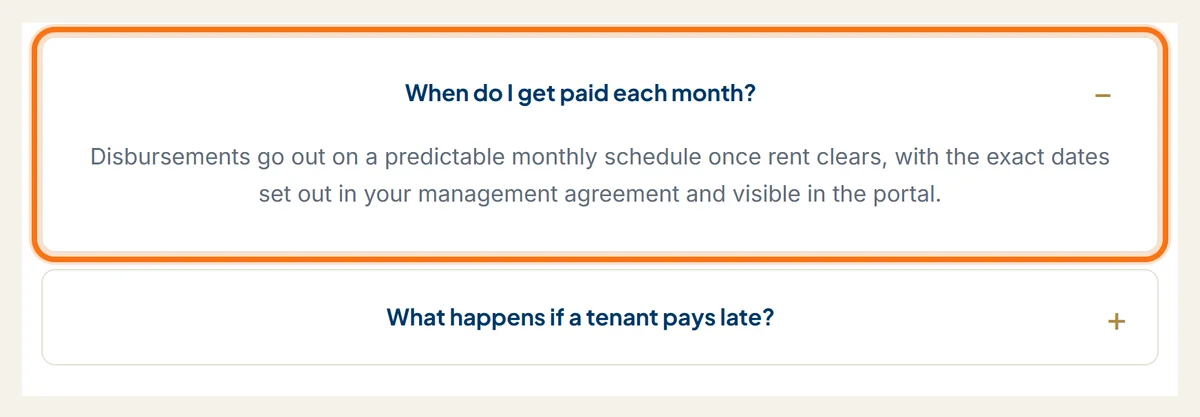
A payout can only go out after the rent has actually cleared, so the date depends on two things: when the tenant pays and what your agreement says about the disbursement date. Ask whether the date is fixed or moves with the rent, and what happens to a payout when the tenant pays late. A manager should not be advancing you the tenant's rent from someone else's money; the trust rules above limit disbursements to what the agreement allows.
How late rent is chased, and how late fees work under the lease, is covered on our rent collection page and in who sets late fees and makes sure they are collected.
Four illustrative months: how the reserve and the payout move together
Illustrative only, not a quote. Assume a house rents for $1,900 a month on a plan priced like our Full Service plan on the price sheet (10% of monthly rent, maintenance coordination 5% of cost), and assume a reserve of $300; your agreement sets the real reserve. Here is the payout in four different months:
| Line on the statement | Quiet month | $260 plumber call | $1,100 approved repair | $2,400 approved replacement |
|---|---|---|---|---|
| Rent collected | $1,900.00 | $1,900.00 | $1,900.00 | $1,900.00 |
| Management fee (10%) | -$190.00 | -$190.00 | -$190.00 | -$190.00 |
| Vendor invoice | $0.00 | -$260.00 | -$1,100.00 | -$2,400.00 |
| Coordination (5% of the invoice) | $0.00 | -$13.00 | -$55.00 | -$120.00 |
| Owner disbursement | $1,710.00 | $1,437.00 | $555.00 | -$810.00 (balance owed) |
How to read this table: the fee stays the same and the payout moves with the repairs. In the plumber month the invoice was paid from the reserve on the 18th, and the next rent refilled the reserve before the payout, so the payout is $273 lower ($260 + $13). In the last column the bills exceed the rent by $810, so the agreement decides whether the reserve, the next rent or a transfer from you covers it.
The arithmetic, checked: $1,900 - $190 = $1,710. $1,710 - $260 - $13 = $1,437. $1,710 - $1,100 - $55 = $555. $1,710 - $2,400 - $120 = -$810. A month with a leasing or renewal fee works the same way: the fee is one more line between the rent and the payout.
A five-minute check of each payout
Five minutes a month catches nearly everything:
- Rent collected equals the lease amount, or the statement says why not.
- The management fee recalculates from the rent line to the cent.
- Each repair line has the vendor's own invoice behind it, at the same amount, and any coordination charge recalculates from that invoice at your agreement's rate.
- The reserve ends the month at the amount your agreement states.
- The payout equals rent minus every line above and reached your bank by the stated date.
If you cannot do that in five minutes, the statement is the problem. The full walkthrough is in how to read your monthly owner statement.
The security deposit is never part of the payout
The tenant's security deposit is the tenant's money. Property Code 92.102 describes it as money "intended primarily to secure performance under a lease," and TREC rule 535.146 counts security deposits as trust money. It does not belong in your reserve, it should never fund a repair during the tenancy, and it never appears in your payout.
Deductions happen at the end: Property Code 92.104(a) lets the landlord deduct, before returning the deposit, damages and charges the tenant is legally liable for under the lease, and 92.103 sets the refund deadline at 30 days after the tenant surrenders the premises. The rules are summarized in Texas security deposit rules. This is general information, not legal advice.
How Perpetual handles the reserve and your payout
Perpetual Property Management is broker-owned, with our office in North Richland Hills, and we manage homes in Keller, North Richland Hills, Fort Worth and nearby. What our site commits to on payouts:
- On-time owner payout guarantee: rent we collect is disbursed to you by the 10th of each month. If it is not, that month's management fee is waived. It is part of the Perpetual Promise, subject to the terms and exclusions in our Guarantee Addendum.
- Schedule: owner disbursements go out on a predictable monthly schedule, direct to your bank, once rent clears, with the exact dates set out in your management agreement and visible in the portal.
- Statements: monthly statements in the Owner Portal show income, expenses, invoices and documents in one place, and the AppFolio portal keeps your disbursement history.
- Repairs: maintenance coordination is a percentage of the vendor's invoice (4.9% on Standard, 5% on Full Service; make-ready coordination 3% to 5% of cost on the Investor Special), and the original invoice is always in your portal. Routine repairs under your pre-approved limit get fixed fast; anything larger comes to you with a description, photos and a recommendation.
The reserve amount for your house, how the trust account is handled, and what happens to a payout when rent arrives late are confirmed in writing before you sign. To see the numbers for your house, request a free rental analysis or call 682-593-7033.
The takeaway: Your payout is rent collected minus the fee, approved invoices and any agreed charges, with the reserve refilled first. Read it against the agreement and the invoices every month, and know from the agreement when the money is due and how much reserve is held.
Questions owners ask
What is an owner reserve in property management?
It is a set amount of the owner's own money the manager keeps in the trust account so repairs between payouts can be paid without waiting for the next rent or a transfer from the owner. The agreement sets the amount. When a repair uses it, the next rent refills it before the owner is paid, and it should show on every statement as a balance. It is separate from the owner's own operating reserve for vacancies and big replacements.
When will the property manager send me the rent each month?
Once a month, after the tenant's rent has cleared and that month's fee and approved bills are paid. The exact date belongs in the management agreement, so ask whether it is fixed and what happens when rent is late. At Perpetual, rent we collect is disbursed to you by the 10th of each month, or that month's management fee is waived, subject to the Guarantee Addendum.
Does a property manager have to keep my rent in a separate account?
For a licensed broker, yes. TREC rule 535.146 says trust money, which includes rent and security deposits, must be kept in a designated trust account, and the broker may not commingle it with personal or operating money or keep it in a business account. A broker may keep one trust account for many clients; a separate account per client is allowed but not required.
Can the property manager use the security deposit for repairs during the lease?
It should not. The deposit secures the tenant's performance under the lease, and Property Code 92.104 lets the landlord make deductions before returning it, at the end of the tenancy. Repairs during the lease are paid from rent or the owner reserve. Using the deposit mid-lease leaves nothing to apply at move-out and muddles the accounting the law expects.
How much money does a property manager keep in a maintenance reserve?
Whatever the management agreement states. TREC's trust-money rule, 535.146, does not set one; it is a business term between you and the manager. A sensible reserve covers an ordinary service call, so that only large jobs wait for your approval and funds. Question a balance that sits above the stated amount, or a refill in a month with no repair. Perpetual does not publish a reserve figure on its site.
How do I know my rent and security deposit money are protected?
Ask three questions: is my money in a designated trust account, is it kept apart from your operating money, and how often do I get an accounting? TREC rule 535.146 requires all three of a broker: a trust account, no commingling, and an accounting at least monthly when there is activity. You can also look up the broker's license on the TREC website before you sign.
Do tenants pay rent to me or to the property management company?
To the management company, as the lease directs, and the rent is held for you in trust until the payout. That is what lets the manager enforce the lease's late-fee terms and keep a clean ledger. At Perpetual, tenants pay online through the tenant portal by bank transfer or card, and you see the statement and disbursement history in the owner portal.
What does owner disbursement mean?
An owner disbursement is the payment a property manager sends the owner from the rent collected for the property, after the management fee, approved repair invoices and any other charges the agreement allows have been paid, and after the reserve is refilled. It is usually monthly. The statement that comes with it should show every line between the rent and the amount you received.
Related services
Property management in Keller, North Richland Hills and Fort Worth. How full-service management works in Tarrant County →