Key takeaways
- Self-managing works for a local, organized owner who will enforce the lease. Distance, time and Texas rules are what tip the decision the other way.
- You need no license to lease your own house in Texas (Occupations Code 1101.005). Anyone who leases it or collects the rent for you for pay generally must be licensed.
- The Texas rules self-managers trip on: late fees only as a written lease allows (92.019), deposit refunds within 30 days (92.103) and repairs to conditions affecting health or safety (92.052).
- Price the fee against your own year: vacancy, repairs at retail, waived late fees and your hours. Lost rent is income not received, not cash paid out.
- The answer is not permanent. Revisit it when you move, buy a second home or meet your first difficult tenant.
Should you self-manage your rental or hire a property manager? Self-manage if you live near the house, have vendors who answer, apply written screening criteria without exceptions and can take a call at any hour. Hire a manager if you are remote, short on time, building a portfolio or unsure of Texas deposit, repair and late-fee rules. For owners in Fort Worth, Keller and North Richland Hills, that is the honest answer, from a company paid on one side of it.
This guide sets the two side by side job by job, lists the Texas rules that apply either way, shows the fee math with an illustrative example, and ends with an eight-question worksheet. If your question is only whether the fee pays for itself on one house, see is property management worth it.
Self-manage vs property manager: who does each job
Here is each part of running a rental, who does it in each case, and the Texas rule that applies no matter who does it:
| Job | If you self-manage | With a property manager | Rule that applies either way |
|---|---|---|---|
| Licensing | None needed to lease your own house | Leasing or collecting rent for you for pay generally requires a license | Occupations Code 1101.005(8), 1101.002, 1101.351 |
| Screening | You write the criteria and apply them to every applicant | The manager applies its written criteria | Printed notice of selection criteria when an applicant gets the application (Property Code 92.3515) |
| Lease and late fees | You choose the lease form and enforce it | The manager prepares the lease and applies the late process | A late fee needs notice in a written lease, must be reasonable and starts after rent is unpaid two full days (92.019) |
| Repairs | You take the calls and find the vendors | The manager coordinates, within a spending limit you set | Diligent effort to repair a condition that materially affects health or safety after the tenant gives notice and is not delinquent (92.052) |
| Security deposit | You hold it and do the move-out accounting | A broker holds it as trust money in a trust account | Refund within 30 days with deductions itemized (92.103, 92.104); TREC rule 535.146 for brokers |
| Renewals and rent increases | You decide and send the offer | The manager recommends; you decide | No rent increase or lease termination within six months to retaliate for a tenant's good-faith repair notice or other protected act (92.331) |
How to read this table: the right-hand column does not change with your choice. Hiring a manager moves the work in the middle columns, not your duties as the owner, so the question is who will do each job correctly and on time.
The frame: this is a job decision, not just a money decision
Hiring management is not buying a product. It is deciding whether a part-time job you already own should be done by you or by someone you pay. So the comparison has three columns: workload, money and risk. Most owners price only the middle one.
The real workload of self-managing a rental
In a calm year with a stable tenant, self-managing one house is light: a few calls, a repair or two, a renewal conversation. The workload is not the calm year. It is the bursts:
- Turnover: make-ready, listing, photos, showings with strangers on your calendar, applications, screening done properly, reference calls, income checks, the approval decision, then the lease and the move-in report. All of it lands while every vacant week costs you rent.
- Crises: the burst pipe while you are away, the AC that dies in July, the rent that stops arriving with a story attached. Each is rare; owning rentals for years makes a few of them likely.
- Being reachable: not the late-night call itself, but carrying the phone every night in between.
How many hours a manager would actually take off your plate depends on how many of those bursts you face in a year, not on the calm months.
The money comparison, with an illustrative example
Management costs real money, and how fees are built is covered in what property management costs. The honest comparison sets that fee against your own year, not against zero.
Illustrative only, not a quote. Assume a $2,000 monthly rent, a 10% management fee on 12 months of rent and one new tenant placed at 50% of one month's rent. Fees for the year: 10% x $2,000 x 12 = $2,400, plus $1,000 for placement, for $3,400. On the other side, our marketing page notes that at $2,000 a month, every week of avoidable vacancy costs about $460 ($2,000 x 12 / 52 = $461.54).
Do not add those two numbers together. The fee is cash you pay; a vacant week is rent you never receive. Put them side by side, then add what a self-managed year really cost you: repairs at one-off prices, late fees you waived, a stretched turnover and your hours. The full one-house math is in what a vacant month really costs a rental owner.
The Texas rules self-managers meet mid-dispute
Texas landlording is regulated in specific ways, and self-managers usually meet the rules for the first time in the middle of a dispute:
- Deposits. Refund on or before the 30th day after the tenant surrenders the house (92.103), with a written, itemized list of deductions (92.104). A landlord who in bad faith keeps a deposit is liable for $100, three times the amount wrongfully withheld and the tenant's reasonable attorney's fees (92.109). The detail is in Texas security deposit rules.
- Late fees. Only with notice in a written lease, only if reasonable, and only after rent is unpaid two full days after it was due (92.019).
- Repairs. A diligent effort to repair a condition that materially affects the physical health or safety of an ordinary tenant, once the tenant gives notice and is not delinquent in rent (92.052). See Texas landlord repair obligations.
- Screening. Printed notice of your selection criteria when you hand out an application (92.3515), and the same criteria for every applicant, which is also what fair housing law expects.
This is general information, not legal advice.
Who should self-manage a rental
- You are local, within a practical drive of the house.
- You have, or will build, a plumber, an electrician and an HVAC company who answer your calls.
- You are organized about paperwork and will apply written screening criteria without exceptions.
- You are reachable, and fine with being reachable, indefinitely.
- You can enforce a lease with a sympathetic person on the other side. This is the underrated qualification.
Texas does not require a license to do it. Occupations Code 1101.005 lists who the real estate license law does not apply to, and item (8) is the owner:
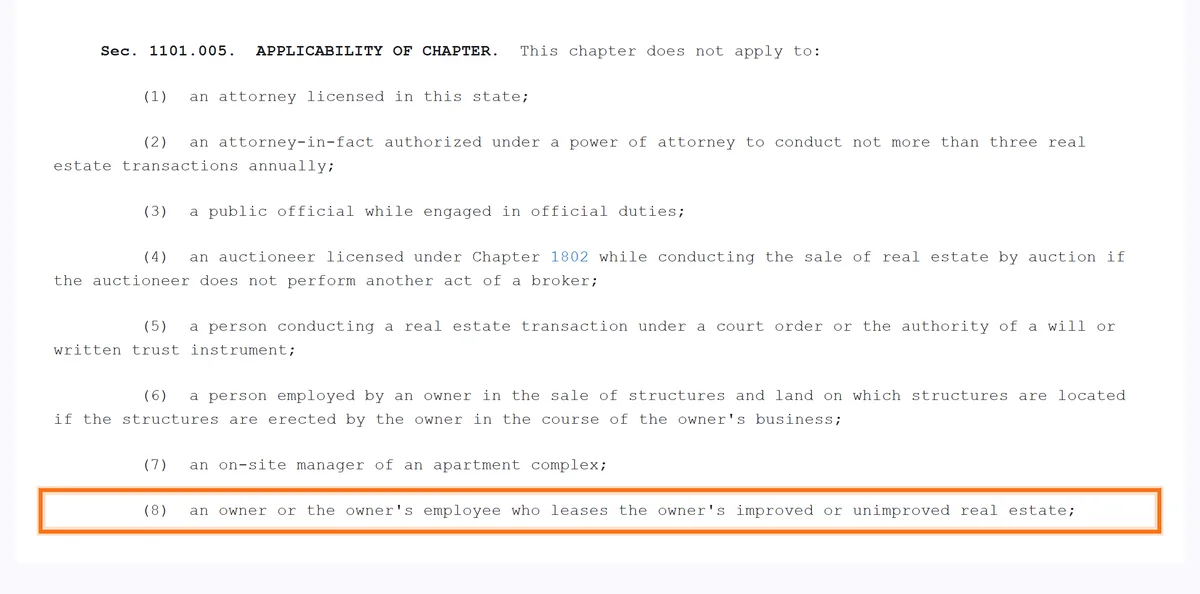
If that list describes you, self-manage, and do it to a standard. The checklist in renting out your house for the first time covers the systems you need.
Who should hire a property manager
- Remote owners. Distance breaks most do-it-yourself systems, because every repair and every showing needs someone at the house.
- Owners whose time is the scarce asset: busy careers, businesses, families.
- Portfolio builders. Self-managing does not scale well past a few homes; systems do.
- Owners burned once by a placement or a dispute that went badly, who recognize the pattern.
- Honest non-enforcers. If you already know you will waive the late fee three months running, hire the consistency.
The middle paths: placement only, or switching later
Two middle paths are worth knowing. Placement only: a professional finds, screens and leases the tenant, and you manage the tenancy after move-in. It suits local owners who fear the placement mistake most, and the trade-offs are in can I hire someone just to find a tenant. Our own core service is full-service management; our leasing page says we will tell you plainly which one fits your house.
Switching later: many owners self-manage for years and hire a manager at a life event, such as a move, a second house or a bad tenant. The file you build while self-managing, meaning the lease, the ledger and the move-in report, is what makes that handover clean.
Self-manage or hire? Answer these eight questions
Score yourself honestly. The pattern in your answers usually makes the decision before the math does:
- Can I be at the house within an hour, most days?
- Do I have a plumber, an electrician and an HVAC company who answer my calls today, not "I would find someone"?
- Will I verify income and call previous landlords on every application, even in week six of a vacancy?
- Will I send a late notice on schedule, in writing, to a tenant with a sympathetic story?
- Do I know the Texas deposit, late-fee and repair rules well enough to bet the bad-faith penalties on my compliance?
- Is my time available in bursts, such as turnover weeks and crisis days, not just on calm evenings?
- Do I want this job, not just tolerate it?
- What did my last 12 months of self-managing actually cost: vacant days, retail repairs, waived fees and hours?
Seven or eight confident yeses: self-manage. Four to six: consider placement only, or management on the house that is farthest or hardest. Three or fewer: the fee is not the expensive option for you; the job is. Revisit the answer when your life changes. It is a function of your circumstances, not a permanent verdict.
How Perpetual handles this
Perpetual Property Management is broker-owned, with our office at 5755 Rufe Snow Dr in North Richland Hills, and we manage homes in Keller, North Richland Hills, Fort Worth and nearby. What our site states that helps you decide:
- A free analysis either way. Our free rental analysis gives a rent range from leased comparables and a written management quote, and whether you hire us, self-manage or go elsewhere, the analysis is yours to keep.
- Published prices. Our pricing page lists three plans: Investor Special at 7% of monthly rent (portfolios of 5 or more units), Standard at 9% and Full Service at 10%, with every fee on the sheet. The final fee is set after the rental analysis, whatever we agree goes into the management agreement, and if a fee is not in the agreement you do not pay it.
- Taking over from self-management. We take over occupied properties: the lease, deposit and records transfer to us, and tenants get new payment and maintenance instructions.
- What changes for you. Repairs under the spending limit you pre-approve go ahead without waiting; anything larger comes to you with a description, photos and a recommendation. Under our written guarantees, rent we collect is disbursed to you by the 10th of each month, or that month's management fee is waived.
The contract term and what it costs to end the agreement are confirmed in writing before you sign. If you are leaning toward self-managing, the free analysis is still worth having. Call 682-593-7033.
The takeaway: Self-manage when you are local, organized and willing to enforce the lease; hire a manager when distance, time or Texas rules make the job the expensive option; and price the fee against your own year, not against zero.
Questions owners ask
Can I start self-managing and switch later?
Yes. The file you build while self-managing, meaning the lease, the ledger, the deposit record and the move-in report, transfers to the new manager. We take over occupied properties: the lease, deposit and records transfer to us, and tenants get new payment and maintenance instructions. The reverse also works: some owners use a manager for a placement and then self-manage a settled tenancy.
Is placement-only a good compromise?
For local, organized owners, often yes. The placement mistake is the expensive one, and professional marketing and screening reduce that risk while you keep the ongoing work. Be honest about whether the ongoing work will happen to a standard: rent tracked, late fees applied per the lease, repairs handled and the deposit returned on time.
What should I try to negotiate if I hire?
Clarity before discounts. Ask whether the management fee is charged on collected rent or billed even during vacancy, what the leasing fee includes, how maintenance is billed and whether you see the original invoice, and what it costs to leave. Get every answer in a written quote. On our pricing page, plans are negotiable case by case, and whatever we agree goes into the management agreement.
How do I test a manager before committing?
Request the free rental analysis and grade the process itself: how fast it arrives, whether the rent range rests on leased comparables, and how straight the answers to your questions are. How a company treats a prospect is a fair preview of how it treats a client.
Is it cheaper to manage my rental myself?
In a calm year with a stable tenant, yes: there is no fee and the work is light. The comparison changes in the years that are not calm: a stretched turnover, a bad placement, a retail-priced emergency, or a deposit or late-fee mistake under Texas rules. Price those against your own rent and time, not against zero. Self-managing is cheaper for a local, organized owner with vendors who answer.
Should I hire a property manager or self-manage my rental property?
Self-manage if you are local, organized, reachable and willing to enforce the lease on schedule. Hire a manager if you are remote, short on time, growing a portfolio or unsure of the Texas deposit, late-fee and repair rules. The eight-question worksheet in this guide turns that into a score; three or fewer confident yeses usually means the job, not the fee, is the expensive option.
Do I need a license to manage my own rental in Texas?
No. Occupations Code 1101.005(8) says the real estate license law does not apply to an owner, or the owner's employee, who leases the owner's own real estate. Someone who leases your house or controls the acceptance of rent for you, for a fee, generally falls within the broker definition in 1101.002 and must be licensed under 1101.351. This is general information, not legal advice.
Related services
Property management in Keller, North Richland Hills and Fort Worth. How full-service management works in Tarrant County →