Key takeaways
- Texas law needs a local point of contact: the tenant's repair notice goes to the person or place where rent is normally paid (Property Code 92.052), and a landlord with no on-site office must give the tenant an emergency number (92.020).
- A tenant or official can ask for the record owner's name and address and the off-site manager's name and street address; the answer is due within seven days, or it can be in the lease from the start (92.201).
- A managing agent is the landlord's agent for city notices and service of process (92.207), so agree how anything served on your manager reaches you.
- Reports replace your eyes: inspection photos, statements, invoices and the payout record, read on a schedule.
- Taxes and insurance stay yours: the Texas Constitution bars a state tax on individuals' net incomes, but your home state, the appraisal district and your insurer still need you.
Can you manage a rental property in Texas from out of state? Yes, if someone local covers what Texas law and the house need every week. For a rental in Fort Worth, Keller or North Richland Hills, that means a place where the tenant's repair notices and rent go, an emergency number, a key holder, inspections with photos and statements you can read from anywhere. You keep the decisions, the taxes and the insurance.
Below: what has to be local, the distance problems, the reports, the money, taxes and insurance, choosing a manager remotely, a checklist and the common mistakes.
Owning a Texas rental from another state: what has to be local
Here is what a Texas rental needs on the ground, the rule or reason behind it, and how a remote owner usually covers it:
| What is needed | The rule or reason | How a remote owner covers it |
|---|---|---|
| A place for repair notices | Property Code 92.052(a): notice goes to the person or place where rent is normally paid | Rent and repair requests both go to your manager |
| An emergency phone number | Property Code 92.020(d), for a landlord with no on-site office | The manager's emergency line, written into the lease |
| Owner and manager disclosure | Property Code 92.201: record owner's name and street or PO box address, off-site manager's name and street address | Put both in the lease from day one |
| Someone to receive city notices and legal papers | Property Code 92.207: a managing agent is the landlord's agent for them | Agree in writing how and how fast they are forwarded to you |
| Keys and access | The lease sets entry; no Texas statute sets an entry notice period | A local key holder: your manager |
| Rent money held for you | TREC rule 535.146: a broker holds it in a trust account and accounts at least monthly if there is activity | A monthly statement and a payout to your bank |
| Property tax notices | The Tarrant Appraisal District mails the Notice of Appraised Value | Keep your mailing address current with the district |
How to read this table: the middle column is why each item cannot wait for your next flight. A repair notice or a disclosure request starts a clock the day it arrives, whether or not you are in the state. If the third column names someone local for every row, distance stops being the problem.
What distance actually breaks
Remote ownership fails in a few predictable ways:
- You cannot see the house. Condition drifts, a lease violation settles in, a slow leak becomes a ceiling, because nobody looks.
- Clocks run while you are away. A repair notice, a written demand for an explanation of a delay, a disclosure request or a city notice can arrive at a mailbox nobody checks.
- Time zones slow approvals. A morning emergency in Fort Worth can arrive before you are awake, and a tenant waiting on a decision loses patience.
- You cannot check what you are told. A remote owner who cannot verify depends on invoices and photos being there.
Each part of the setup below closes one of these gaps.
The local team: a manager, the keys and an emergency number
Remote self-management with a handyman you trust works until the first real vacancy or emergency. You cannot show a house from Seattle, and you cannot meet a plumber at 7 a.m. from Boston. The working version has a local, accountable team: someone to market and show the house, screen applicants against written criteria, hold the keys, dispatch vendors and answer the emergency line.
Texas law expects that local presence. A tenant's repair notice goes to the person or place where rent is normally paid under 92.052(a), and under 92.020(d) a landlord with no on-site office must give the tenant an emergency phone number. Under 92.201, a tenant can ask for your name and address and the management company's, and the answer is due within seven days; a landlord who still fails after a further written notice faces remedies under 92.205, including one month's rent plus $100. Put the details in the lease and the question never comes up.
Reports and photos that replace your eyes
The remote owner's core need is information you can trust without being there. The standard to ask for:
- Inspection reports with photos on a schedule written into your agreement, so you see the condition, not just the rent (how inspections work).
- A portal with statements, documents and the payout history, open whenever you are (owner portal).
- The vendor's original invoices, not summary lines, and photo proof of larger repairs.
- Notice of anything material: lease violations, larger repairs with a recommendation, the renewal with comparables.
Ask any manager for a sample inspection report and a sample owner statement before you sign. What a good inspection report contains shows what to look for in them.
Controlling repair costs from another state without delaying urgent work
Who can help an out-of-state owner control repair costs without delaying urgent work? A local manager working under three written rules: a spending limit for routine repairs, an emergency rule that lets work start before you are reached, and paperwork (photos and the original invoice) for everything else. The limit keeps small jobs moving, the emergency rule keeps a leak from waiting on your time zone, and the paperwork is how you check the cost afterward.
Here is how each kind of repair should move when you live in another state:
| Kind of repair | What happens | What you see |
|---|---|---|
| Emergency: an active leak, no AC in extreme heat, no heat in winter, an electrical hazard | Work starts on the manager's 24/7 process to stop the damage and make the home safe; what may be spent above your limit is set in the agreement | What was done and the invoice, afterward |
| Routine and under your limit | Fixed without waiting for your approval | The vendor's original invoice and the job record |
| Above your limit and not urgent | Comes to you with a description, photos and a recommendation; you decide, and you can ask for a second quote | Photos, the recommendation and the price before work starts |
| The same system again | Treated as a replace-or-repair decision, not another service call | The repair history for that house |
How to read this table: the first row is the one that must never wait for you, and Texas law is the reason. Once a tenant who is current on rent reports a condition that materially affects health or safety, the landlord must make a diligent effort to repair it (Property Code 92.052), and seven days is presumed a reasonable time for most repairs (92.056(d)). The other rows are where your money is controlled: by the limit you set and the paper you read.
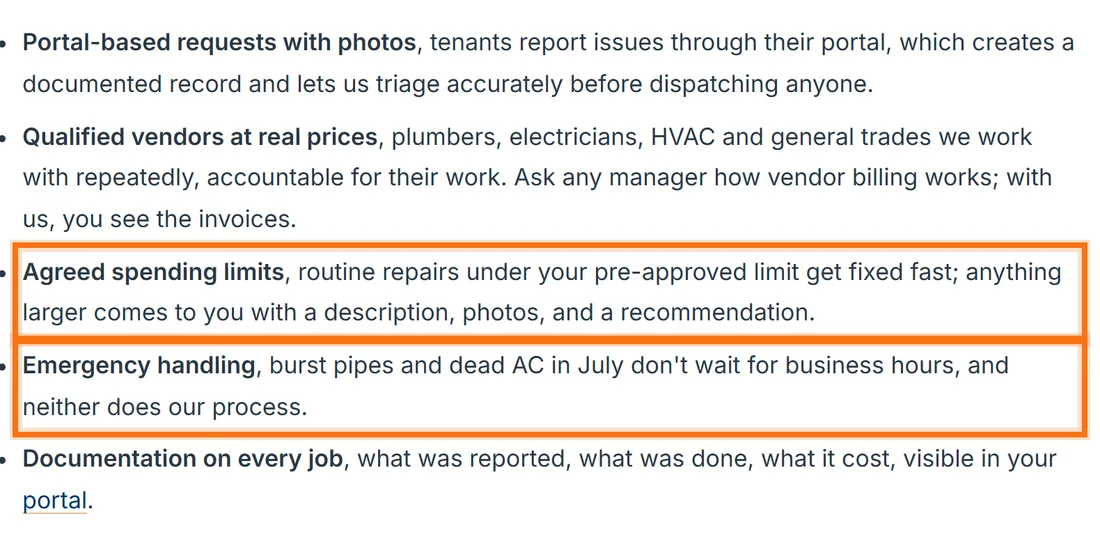
Set the limit high enough that a routine plumbing call does not wait a day for your reply, and low enough that a large job always comes to you. Keep a reserve with the manager so an approved repair is not held up by a wire transfer. For a large job that can wait, such as a roof or a full HVAC replacement, asking for a second quote before you approve is reasonable; the photos and the recommendation are what let you judge it from far away.
Then compare each vendor invoice with your statement every month. Rental maintenance emergencies in Texas covers who pays and how the approval limit works, and our 24/7 emergency maintenance page shows how emergencies are handled at the homes we manage in Keller, North Richland Hills and Fort Worth.
How the money gets from Texas to your bank
Rent moves from the tenant to the manager, from the manager to you. If your manager is a Texas broker, TREC rule 535.146 says trust money such as rent and security deposits is held in a fiduciary capacity in a designated trust account, in a banking institution authorized to do business in Texas, and the broker provides an accounting to each beneficiary at least monthly if there was activity.
- Use one bank account for the house. Payouts land there, and your records stay clean from another state.
- Read the statement each month. Rent in, fees and repairs out, the payout. How to read your owner statement walks through each line.
- Know the reserve. Money held back for repairs lets a repair over your limit go ahead without waiting on a wire. Owner reserves and disbursements explains how the two work together.
Taxes, insurance and your LLC from another state
Income tax. Article VIII, section 24-a of the Texas Constitution says the legislature may not impose a tax on the net incomes of individuals. Your home state and the IRS are separate questions: ask a CPA how your home state treats Texas rent. Rental property taxes in Texas covers the federal side.
Property tax. The Tarrant Appraisal District appraises the property, and each taxing unit, such as the county, the city and the school district, sets its own rate. The district mails a Notice of Appraised Value and lets owners provide evidence and file a protest online. From another state, calendar it. The homestead exemption is for your residence homestead, so if the Texas house was your home, read converting your home to a rental.
Insurance. The Texas Department of Insurance describes landlord insurance as mainly for traditional, long-term leases, and says to ask your agent whether to add it to a homeowner policy or get a separate one. TDI's home insurance guide also notes that most companies stop coverage if a house is vacant for 60 days or more, so tell your insurer before a long vacancy. Landlord vs homeowners insurance goes further.
Your LLC. The Texas Secretary of State lists Form 304, the Limited Liability Company Application for Registration. Whether yours must register is a question for a Texas attorney. This is general information, not legal, tax or insurance advice.
Choosing a manager you cannot visit
Vet harder because you cannot drop by:
- Video-call the person who will manage your house, not only the salesperson.
- Look up the broker on the TREC license holder search by name or license number.
- Ask for a sample inspection report and a sample owner statement.
- Ask, in writing, how they forward city notices and legal papers, and how fast.
- Ask how they handled their last after-hours emergency: the story, not the policy.
Questions to ask a property manager turns this into a full interview list. Then start with a free rental analysis: a rent range from leased comparables, demand notes, make-ready guidance and a written management quote, delivered within one business day. It doubles as a sample of how the company communicates.
The remote owner's checklist
- A local manager who collects the rent and receives repair notices
- An emergency number and the owner and manager details in the lease
- A written rule for forwarding city notices and legal papers
- A spending limit and emergency authority, so a night problem does not wait for your time zone
- Inspections with photos on a set schedule; original invoices in the portal
- One bank account for the house; a CPA who knows your home state
- Landlord insurance, and your insurer told before any long vacancy
- Your mailing address current with the appraisal district, and the protest window on your calendar
- A rule on renters insurance in the lease, if you want one (should you require it)
Four remote-owner mistakes
- 1. The friend-or-relative manager. A friend in Plano "keeping an eye on it" works until the first real decision: a repair in the thousands, a screening call, a notice to vacate. Goodwill is not a system, and the broker definition in Occupations Code 1101.002 includes a person who, for another person and for a commission or other valuable consideration, controls the acceptance or deposit of rent from a single-family rental.
- 2. Pricing from your home market's instincts. Rents differ block by block. Use leased comparables near the house, not asking prices or what homes cost where you live.
- 3. Approving repairs blind. Without photos and invoices, remote owners approve everything or nothing, and both cost money. Set a limit, require the paper, decide the rest.
- 4. Treating the visit as the audit. A yearly trip shows what is visible that Tuesday. The statements, inspection photos, invoices and response times are the audit; the visit becomes a strategy day.
How Perpetual handles this
Perpetual Property Management is broker-owned, with our office at 5755 Rufe Snow Dr, Suite 155, North Richland Hills. Our site names out-of-state owners as owners we help every week: you need eyes, hands and honest reporting on the ground. What it states:
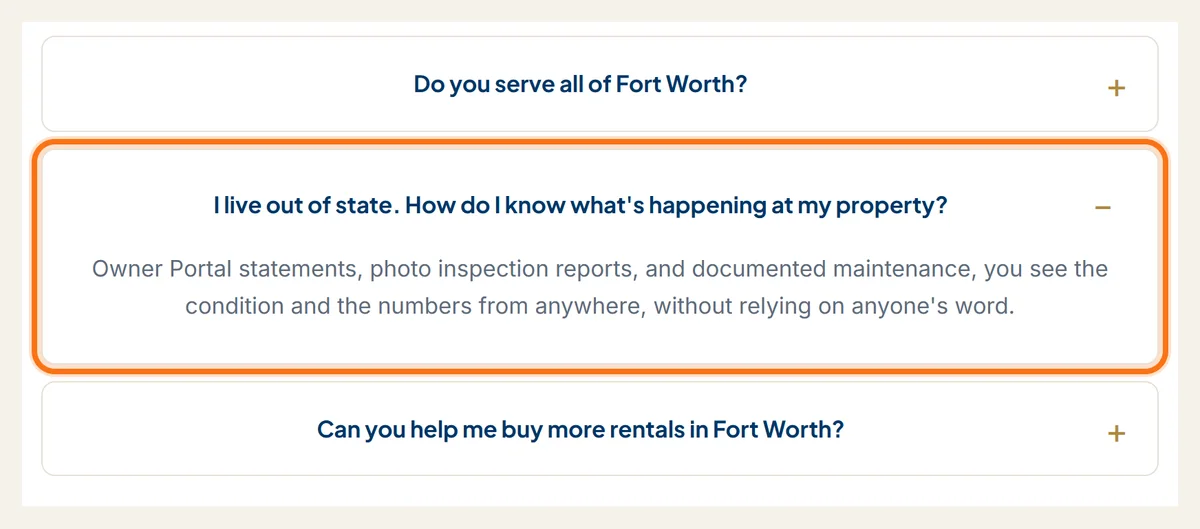
- What you see. Owner Portal statements, photo inspection reports and documented maintenance, so you see the condition and the numbers from anywhere. The portal holds your statements, documents and disbursement history.
- Repairs. Work under your pre-approved limit gets fixed fast; anything larger comes to you with a description, photos and a recommendation. Every plan includes 24/7 emergency response.
- Payouts. Rent we collect is disbursed to you by the 10th of each month, or that month's management fee is waived.
- Answers. We respond to your calls and emails within one business day, and while the home is vacant you get a written activity report every week, or we credit that month's fee.
- Buying more. Perpetual Realty Group, our affiliated brokerage, represents investors on acquisitions, with management from day one.
The guarantees are subject to our Guarantee Addendum. How notices served on us reach you, and your spending limit and reserve, are confirmed in writing before you sign. To set up your Texas rental from where you live, call 682-593-7033.
The takeaway: From another state, cover the local pieces Texas law and the house need, read the reports on a schedule, keep the money and tax paper organized, and let the paper trail, not an annual visit, tell you how the house is doing.
Questions owners ask
How often should an out-of-state owner visit the rental in person?
There is no required number. With inspection photos, original invoices and monthly statements, many owners visit rarely, and the visit becomes a strategy day rather than a check. If you feel you must visit to know what is true, the reporting needs fixing, not your travel schedule.
What time-zone issues actually matter?
Emergencies and approvals. A spending limit you set in advance, an emergency number in the lease and a manager with 24/7 emergency response mean a burst pipe is handled before you are awake. Larger repairs wait for you, so answer approvals promptly and keep a reserve so funding is not the delay.
Can I use my out-of-state LLC for a Texas rental?
Possibly, but check first. The Texas Secretary of State lists Form 304, the Limited Liability Company Application for Registration, and whether your LLC needs it depends on what it does in Texas. Spend an hour with a Texas attorney before closing or transferring the deed, and ask your insurer and lender too.
What is the biggest mistake remote owners make?
Choosing a manager on the fee percentage alone instead of on reporting. From another state you can only judge the house by its paper: statements, invoices, inspection photos and how fast questions are answered. Ask for samples before you sign and compare those, not just the rate.
How do I manage rental property in Texas from out of state?
Put someone local where Texas law expects one: the person who collects rent receives repair notices under Property Code 92.052, a landlord with no on-site office gives the tenant an emergency number under 92.020, and the owner and manager details go in the lease under 92.201. Then read photo inspection reports and monthly statements on a schedule, and keep taxes and insurance current with a CPA and an agent.
Do I have to tell my Texas tenant my address if I live out of state?
If asked, yes in substance. Property Code 92.201 requires the name and either a street or post office box address of the holder of record title, plus the off-site management company's name and street address, given in writing within seven days of the request, or included in the lease beforehand. A post office box is allowed for the owner.
Who can help an out-of-state owner control repair costs without delaying urgent work?
A local manager with written rules: a spending limit for routine repairs, an emergency process that starts work before you are reached, and the original invoice and photos for everything else. At Perpetual, repairs under your pre-approved limit get fixed fast, larger ones come to you with a description, photos and a recommendation, and every plan includes 24/7 emergency response.
Related services
Property management in Keller, North Richland Hills and Fort Worth. How full-service management works in Tarrant County →