Key takeaways
- From another state you cannot judge a manager by the office or the handshake; judge by what you can verify.
- Managing a single-family rental for others, including controlling the rent, is a broker activity under Occupations Code 1101.002.
- TREC's license holder search shows the license type and status of the company and its broker.
- TREC rule 535.146: rent and deposits a broker accepts are trust money, held in a designated trust account with at least a monthly accounting if there was activity.
- Test the communication before you sign: send a written question and time the answer.
Out of state landlord property management in DFW comes down to one question: how do you choose a manager you cannot visit? For a rental in Fort Worth, Keller or North Richland Hills, choose on evidence you can check from your own desk: the broker's license on the TREC search, where your rent and the tenant's deposit will sit, a written fee list, sample reports, and how quickly and clearly the company answers in writing.
Below is a scorecard you can fill in for each company, then each check explained. If you live overseas rather than in another state, also read managing a DFW rental while you live overseas.
The remote owner's scorecard: what to ask and how to check it from home
Here are the nine checks that matter most when you hire from another state, the question to ask, how to verify the answer without visiting, and the answer that should worry you:
| Check | Ask | Verify from home | Worrying answer |
|---|---|---|---|
| License | Which company and broker are responsible for my house? | TREC license holder search by name or number | "Rentals don't need a license" |
| Trust account | Where are my rent and the deposit held? | The agreement names a trust account | "In our business account" |
| IABS notice | Did you send the Information About Brokerage Services notice? | Your first emails and their homepage link | Never mentioned |
| Fees | Can I have every fee in a written quote? | Compare the quote with the agreement | "We'll cover that on the phone" |
| Statements | Can I see a sample owner statement? | Read it: rent in, fees and repairs out, payout | "You'll see it after you sign" |
| Inspections | How often, and can I see a sample report? | Photos, dates, notes, recommendations | "As needed" |
| Communication | What is your written response standard? | Email a question and time the reply | No standard, or a voicemail |
| Distance | How far is my house from your office? | A map and the service-area page | Vague, or "we cover all of Texas" |
| Exit | What notice ends the agreement, and what transfers? | The termination clause | Will not say before you sign |
How to read this table: the first three rows are facts you can check on public records and in your own inbox, so a wrong answer there ends the conversation. The other six are judgment calls; score them side by side for each company. If you want weights and a 1-to-5 scale, use the weighted scorecard for interviewing property managers.
Why choosing from another state is different
An owner who lives in Keller can visit the office, drive past the house and notice a problem on the way to work. You cannot, so the manager has to stand in for your eyes, your signature and your judgment, and you have to choose that manager without the usual signals: the office, the handshake, the neighbor's recommendation.
That changes what you weigh. Reviews and a friendly sales call matter less. Public records, written answers and sample documents matter more, because they are what you can check from home and what you will rely on for years. The scorecard above turns that into nine checks. The day-to-day system after you hire, from keys to the money flow, is in owning Texas rentals from out of state.
Check the license on TREC before the first call
In Texas, managing a rental for someone else is real estate brokerage. Occupations Code 1101.002 defines a broker to include a person who, for a fee or other valuable consideration, leases real estate for another person, or "controls the acceptance or deposit of rent from a resident of a single-family residential real property unit." Section 1101.351 says a person may not act as a broker without a license.
The Texas Real Estate Commission's License Holder Search lets you search by name or license number, choose the license type (for a manager, Broker or Sales Agent), and see the status: active, inactive, expired, suspended, surrendered or revoked. Look up the company and the broker by name, and match the numbers to the ones on the company's website and in your agreement. The full walk-through is in how do I verify a property manager's Texas license?
The first email should carry the IABS notice
When you hire from another state, your first real contact with a Texas manager is usually an email. TREC rule 531.20 makes that email a useful test. It requires every license holder to put a link to a completed Information About Brokerage Services notice in a readily noticeable place on the homepage of each business website, and to provide the completed notice at the first substantive communication, as Occupations Code 1101.558 requires.
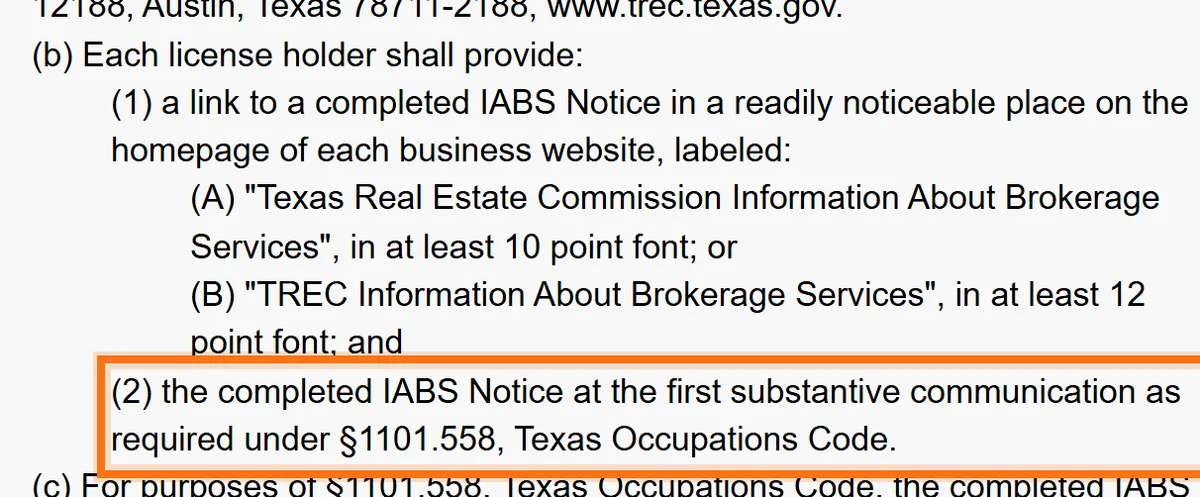
Subsection (c) of the rule allows the notice to be delivered in the body of an email, or as an attachment or link with a specific reference to it in the body, but not tucked into a footnote or signature block. A company that gets this right with an owner in another state is showing you how it handles paperwork. A company that never mentions it is showing you that too.
Ask where your rent and the deposit will sit
From another state you will never see the bank account, so ask about it by name. TREC rule 535.146 says rent, security deposits and other money a broker holds for someone else is trust money, held in a fiduciary capacity in a designated trust account at a bank authorized to do business in Texas.
The broker must deposit it no later than the close of business of the second working day after receiving it, unless the parties agree otherwise in writing, may not commingle it with the broker's own money, must give each beneficiary an accounting at least monthly if there was activity, may disburse it only under the agreement it was received under, and must keep the trust-account records for four years.
So the questions are simple: which account holds my rent, which holds the deposit, and what does my monthly accounting show? How do I know my rent and security deposit money are protected? covers the warning signs. This is general information, not legal advice.
Test the communication before you sign
Everything you will ever know about your house will come to you in writing, so test the writing before you sign. Send each company the same short email with two questions: "How will I hear about a repair that costs more than my limit, and how long will you wait for my answer?" and "What happens if the house has a water leak at 2 a.m. and you cannot reach me?" Then note three things: how long the reply took, whether it answered both questions, and whether it was written by someone who could manage your house.
The right answers are a written estimate with photos and a recommendation, a deadline for your reply, and a standing emergency rule that lets the manager protect the property first. A long voicemail instead of an email is an answer too. What good communication looks like after you hire is in what owner communication should look like.
Write the approval rules into the agreement
Standing rules replace your availability with your judgment, written down once. Ask each company which of these its agreement covers and how:
- Repair spending limit. The amount under which the manager fixes without asking. From another state, set it high enough that routine work never waits on you.
- Emergencies. What the manager may do first for water, heat, cooling, security or anything threatening the structure.
- Renewals. Whether the manager brings every renewal to you, and how early.
- Rent price. Who decides the asking rent and any change while the house is listed.
- Late rent. Which steps the manager takes without asking you first.
A manager used to remote owners will raise these before you do. How the repair limit works in practice is in can a property manager approve expensive repairs without my permission?
See a sample statement and inspection report first
The portal and the reports are your only view of the house, so do not hire on a promise of them. Ask for a sample owner statement and a sample inspection report with identifying details removed, and read them as if they were yours. The statement should show rent received, each fee, each repair with its invoice, and the payout. The inspection report should have photos, condition notes and recommended actions you could act on from another state.
Ask also how often the house is inspected during the tenancy and whether the frequency is written into the agreement. Will I receive inspection reports with photos? shows what a useful report contains, and how to read your monthly owner statement walks through each line.
The payout date, the reserve and the deposit deadline
Ask three questions about money and get the answers in writing. First, on which day of the month are you paid, and what happens if that day is missed? Second, what reserve does the company keep from your rent, and when is it topped up? Third, who holds the tenant's security deposit and who prepares the move-out itemization?
The deposit question matters more from a distance. Texas Property Code 92.103(a) says the landlord must refund the deposit on or before the 30th day after the tenant surrenders the premises (subject to 92.107, which ties the obligation to the tenant's written forwarding address). You cannot walk the house at move-out yourself, and the deadline does not move for your schedule, so the manager should hold the deposit and do the itemization. When will the property manager send me the rent each month? covers the payout calendar.
How close is the manager to your house?
Distance between the manager and your house decides how real the "eyes on the house" promise is. Ask how far your address is from the office, who goes to the house for showings, inspections and move-outs, and whether that person works for the company. Then check the company's own service-area page: a manager that lists the city your house is in, and describes it in detail, is more likely to know the leases and vendors around it than one that claims all of Texas.
Red flags that only show up once you are far away
Some problems are invisible at the first meeting and obvious six months later. Screen for them now:
- No license numbers anywhere, or numbers that do not match the TREC search.
- No clear answer about which account holds your rent and the deposit.
- A fee list that arrives only after a phone call, or never in writing.
- No sample statement or inspection report "until you sign."
- Routine repairs that must each be approved by you, which will make you the bottleneck from another state.
- An emergency plan that is a voicemail box.
One of these can be a misunderstanding. Two or more means the company is built for owners who can drop by. What are the red flags when choosing a property manager? lists more, and 15 questions to ask a property manager turns this into a full interview.
How Perpetual handles this
Here is how our own card reads, using only what our site states. Perpetual Property Management is the registered assumed name of Perpetual Realty Group, LLC, TREC Broker Company License 9008702-BB, at 5755 Rufe Snow Dr, Suite 155, North Richland Hills; Justin Brown is the Broker/Owner, TREC Broker License 549418-B, licensed since 2006 (our disclosures page links the IABS notice). For out-of-state owners, our site says portal access, photo inspections and statements mean you see everything from anywhere.
- Written replies: we respond to your calls and emails within one business day, with a written activity report every week while the home is vacant, or that month's fee is credited (the Perpetual Promise, subject to the Guarantee Addendum).
- The payout: rent we collect is disbursed by the 10th of each month, or that month's fee is waived.
- Fees: every plan and fee is on our price sheet; plans are negotiable case by case, and every number is confirmed in writing before you sign. If a fee is not in the agreement, you do not pay it.
- Reports: an annual property inspection on every plan, photo reports in the portal, the original vendor invoice always in your portal, and statements, documents and disbursement history in our AppFolio owner portal.
Which account holds your rent and deposit, the in-tenancy inspection schedule and the exit terms are confirmed in writing before you sign. Our free rental analysis arrives within one business day with a written management quote, and it doubles as a test of how we communicate. Or call 682-593-7033.
The takeaway: From another state, hire the manager whose answers you can verify: an active TREC license, a named trust account, every fee in writing, sample reports you have actually seen, and written replies that arrive when promised.
Questions owners ask
Which DFW property managers work well with out-of-state owners?
There is no list to trust from a distance, only checks. Pick the companies whose broker shows an active license on TREC's license holder search, who tell you which trust account holds your rent and deposit, who put every fee in a written quote, who send a sample statement and inspection report, and who answer a written question promptly and completely. Then score them side by side.
Can a local company manage my DFW rental while I live overseas?
Yes. The tenant, rent and repairs stay local, so the management itself does not change. What changes is your side: a bigger time difference, signatures and a power of attorney, the payout account, and IRS rules that depend on your residency. Our guide to managing a DFW rental while you live overseas covers each one.
What approval limit should a remote owner set for repairs?
High enough that routine work never waits on you, and low enough that anything which changes your year gets a conversation. Set a separate, higher emergency authorization for water, heat, cooling and security so the manager can protect the house without reaching you. Review the limit after the first year once you have seen the actual repair pattern.
How often should a rental be inspected if the owner never visits?
Ask each company how often it inspects during the tenancy, whether that frequency is written into the agreement, and to see a sample report with photos. Every Perpetual plan includes an annual property inspection, and our in-tenancy schedule is set in your management agreement, with extra inspections arranged when something warrants a look.
Do overseas owners pay tax on U.S. rental income?
It depends on your status. IRS Publication 519 says a nonresident alien's U.S. rent is taxed at 30% (or a lower treaty rate) of the gross unless the owner chooses to treat it as effectively connected and be taxed on net income. A U.S. citizen living in another state files as usual. This is general information, not tax advice; ask a CPA.
How do I check a DFW property manager's license from another state?
Use the Texas Real Estate Commission's License Holder Search online. Search the company and the broker by name or license number, choose Broker or Sales Agent as the license type, and read the status, which can show as active, inactive, expired, suspended, surrendered or revoked. Then match the numbers to the company's website and your agreement.
What are the best options in Fort Worth for full-service property management for out-of-state owners?
The ones that pass the checks you can run from home: an active TREC license, rent and deposits in a named trust account, every fee in a written quote, sample statements and inspection reports you have seen, and written replies that arrive when promised. Compare at least two companies on the same scorecard before you sign.
Property management in Keller, North Richland Hills and Fort Worth. How full-service management works in Tarrant County →