Key takeaways
- Six criteria with weights that add up to 100: license, money and agreement 25; leasing 20; maintenance and inspections 20; communication 15; fees in full 10; local knowledge 10.
- Score each answer 1 to 5, then multiply by the weight and divide by 5.
- A 4 or 5 needs a document or a check you made yourself, not a confident answer.
- The license row starts with the TREC License Holder Search, by name or license number.
- In the filled-in example, the winner leads by 4 points, so the decision comes down to the heaviest row.
A property manager interview scorecard is a one-page grid you fill in after each interview with a company that would manage your rental in Fort Worth, Keller or North Richland Hills. Each company gets a 1 to 5 score on the same six weighted criteria, and the weighted total out of 100 replaces the vague feeling that one office was nicer. It works because you ask everyone the same questions and grade every answer against the same written standard.
Below: the card, how to score, a filled-in example, what a 5 looks like and the answers that end an interview. The question list is in 15 questions to ask a property manager; this guide is about grading the answers.
The scorecard: six criteria, weights and the proof for a 5
Here is the card. Copy the first three columns onto paper or a spreadsheet, one column of scores per company:
| Criterion | Weight | What earns a 5 | Proof to ask for |
|---|---|---|---|
| License, money handling and agreement | 25 | Broker license you checked; clear answer on where owner funds and deposits are held; agreement sent before you commit | TREC license search result, IABS notice, the agreement |
| Leasing | 20 | Rent set from leased comparables; listing, showings and approval explained step by step | A rental analysis for your house, the written rental criteria |
| Maintenance and inspections | 20 | Spending limit, emergency process and billing stated plainly; a real inspection report | Sample invoice and inspection report |
| Communication and reporting | 15 | Named contact, a stated response standard, a statement you can read | Sample owner statement, a look at the portal |
| Fees in full | 10 | Every fee on one written page that matches what was said | The fee schedule |
| Local knowledge | 10 | Specifics about your city, its HOAs and its housing stock | Their answer, checked against official pages |
How to read this table: the weights add up to 100 and put the most points where mistakes cost the most, your money and your agreement. Points for a row = score x weight / 5, so a 5 on license earns 25 and a 3 earns 15. Change a weight if your situation calls for it, but before the first interview, not after.
Why a weighted score beats a good impression
Interviews reward the best talker, not the best operator. A polished presenter can describe a maintenance process that does not exist, and a quiet broker who has run the same process for years can describe it badly. A scorecard slows the conversation down to specifics and makes you ask everyone the same follow-up.
It also leaves a record you can check a year later against what the winner delivered. If you are still deciding what "good" looks like, start with how to tell if a property management company is good.
Why the weights fall where they do
The criteria are not equal, and the weights say so. Whether your rent and the tenant's deposit are handled properly matters more than whether the portal has a mobile app. Score everything equally and a company that is strong on the cosmetic rows and weak on the structural ones can win on points.
The weights encode what can actually hurt you. The top row carries 25 because mishandled money or a trap in the agreement costs more than any other mistake. Leasing and maintenance carry 20 each because they decide vacancy and repair bills. Fees score on completeness, not size. An owner of an older home might move 5 points to maintenance; decide that before you meet anyone.
How to score an answer from 1 to 5
The scale only works if each number means the same thing for every company:
- 5: a specific answer with an example, backed by a document you saw or a check you made (a license search, a sample statement, the agreement).
- 4: specific and credible, with the process described in detail, but not yet verified.
- 3: a reasonable general answer with no specifics. "We have a great vendor network" is a 3.
- 2: vague, evasive or inconsistent with something else said in the same interview.
- 1: the answer revealed a practice that would cost you money or add risk, short of a deal breaker.
The discipline is refusing a 4 or 5 for confidence alone. If you cannot write down the example the company gave, the score is a 3. That one rule keeps the best talker from winning by default.
A filled-in example: three companies, one card
Illustrative only: three made-up companies, A, B and C, scored by one owner after three interviews in the same week. Each cell shows the 1 to 5 score and the weighted points:
| Criterion (weight) | Company A | Company B | Company C |
|---|---|---|---|
| License, money, agreement (25) | 5 = 25 | 4 = 20 | 3 = 15 |
| Leasing (20) | 4 = 16 | 5 = 20 | 4 = 16 |
| Maintenance and inspections (20) | 3 = 12 | 4 = 16 | 4 = 16 |
| Communication and reporting (15) | 4 = 12 | 3 = 9 | 4 = 12 |
| Fees in full (10) | 5 = 10 | 2 = 4 | 3 = 6 |
| Local knowledge (10) | 4 = 8 | 5 = 10 | 3 = 6 |
| Total (out of 100) | 83 | 79 | 71 |
How to read this table: A leads B by only 4 points (83 against 79), so the totals alone do not settle it. A won the heaviest row and showed every fee on one page; B was the stronger leasing operation but scored 2 on fees because its list kept growing. C trails by 12 and is out. The next step is a pointed follow-up to A about its 3 on maintenance before signing.
What a 5 looks like: license, money handling and the agreement
In Texas, a person who, for a fee and for someone else, leases real estate or controls the acceptance or deposit of rent from a resident of a single-family home is acting as a broker (Occupations Code 1101.002). So the first check is the license. The TREC License Holder Search takes a name or license number, and its status filter lists statuses such as active, inactive, un-sponsored, expired and suspended. How to verify a property manager's Texas license walks through it.
Money handling is the second half of the row. Under TREC rule 535.2 a broker is responsible for the proper handling of trust funds, and rule 535.146 says trust money a broker accepts is held in a fiduciary capacity in a designated trust account or delivered to an authorized escrow agent. A 5 means the company told you where owner funds and deposits are held and when disbursements go out. The agreement earns its part of the row when you were sent the full document before committing, with a termination clause you understand.
What a 5 looks like: leasing, maintenance and inspections
Leasing earns a 5 when the company explains how it sets the asking rent (homes that leased, not listings), where the listing appears, how showings work, and that applicants are judged against written criteria you can read. Ask for a rental analysis on your own house: it is the best evidence of how they price.
Maintenance and inspections earn a 5 when the company states its spending limit, its emergency process and how repairs are billed, in plain terms, and shows you a real inspection report with photos and a real invoice. "We have vendors we trust" is a 3. A billing practice the company cannot state is a 2. How maintenance markups work lists what to ask.
What a 5 looks like: communication, fees and local knowledge
Communication scores on evidence you collect during the interview itself. Did the company answer your first inquiry quickly and send what it promised? A 5 is a named contact, a stated response standard, a statement you could read without help, and a portal you saw. If a company cannot find time to talk for two weeks, score that.
Fees score on completeness, not size. A 5 means every fee is on one page (management, placement, renewal, inspection, maintenance coordination, setup, termination) and the page matches the conversation. If the list grows as you ask, score down. What moves in a fee negotiation covers the next step.
Local knowledge is a 5 when the company talks specifically about your city: HOAs it already deals with, the age of the housing, what the city asks of rentals. Check any city rule it mentions on the city's own website.
Deal breakers that zero the card
Some answers end the evaluation whatever the other scores say. Do not add them up; write "DB" on the card and move on:
- No Texas broker license you can verify, or a license whose status is not active.
- No clear answer on where owner funds and security deposits are held.
- A fee the company will not put in writing, or a billing practice it will not state.
- Refusal to send the management agreement before you sign.
- A termination clause that locks you in with no way out short of a large fee.
Each is a structural risk, not a preference. More signs to watch for are in red flags when choosing a property manager.
Running the interviews so the scores compare
Scores are only comparable if the interviews were:
- Same questions, same order, same week. Your memory of the first company fades by the third.
- Score within an hour of each conversation, before the next one.
- Ask everyone for the same documents: agreement, fee schedule, sample statement, rental criteria, sample inspection report. Give the verified score only when the document arrives.
- Write down two sentences from each interview: the one that impressed you most and the one that concerned you most.
- Read the reviews first, so you can ask about the themes; see how to read property management reviews.
Reading the totals and making the call
Look at the spread before the ranking. If the top two are within a few points, as A and B are in the example, the decision comes down to the heaviest row and the sentence that concerned you most. If one company leads by 15 or more, the card has made the decision and you are confirming it.
Then go back to the leader with the concern you wrote down and ask about it directly. The answer to a pointed follow-up, after the sales conversation is over, is the most honest exchange you will have before signing. Read the agreement once more against your notes, and sign only when the documents match the scores.
How Perpetual fills in its own card
If we are on your card, here is what our site states that you can check before the interview:
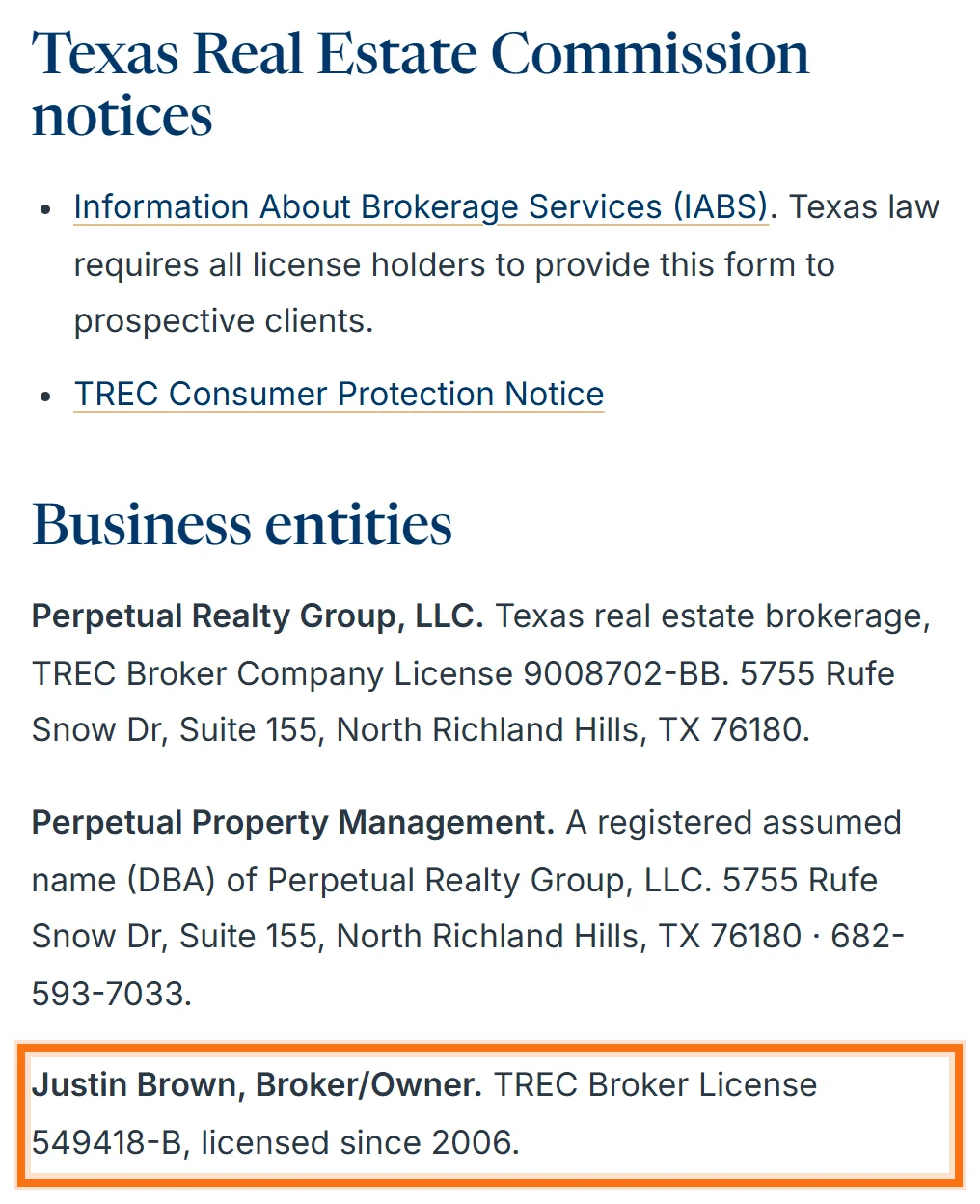
- License. Perpetual Property Management is a registered DBA of Perpetual Realty Group, LLC, TREC Broker Company License 9008702-BB; Justin Brown, Broker/Owner, holds TREC Broker License 549418-B and has been licensed since 2006. Our disclosures page links our IABS form.
- Fees in full. Our price sheet lists three plans and every fee; the final fee is set after the rental analysis, and if a fee is not in the agreement, you do not pay it.
- Written promises. The five guarantees in the Perpetual Promise are part of the management agreement, each with a stated remedy, subject to the Guarantee Addendum. One is a reply to calls and emails within one business day.
- Leasing. A free rental analysis with a rent range from leased comparables, and the same written rental criteria for every applicant.
- Reporting. Statements, documents and disbursement history in the Owner Portal.
- Local. Keller, North Richland Hills, Fort Worth and the surrounding Northeast Tarrant County communities. Our reviews are excerpts from our public Zillow profile, where you can read them all.

Anything your card asks that the site does not state, such as the term and notice in the agreement, is confirmed in writing before you sign. Request a free rental analysis or call 682-593-7033.
The takeaway: Write the weights down before the first interview, score every company on the same six rows with a written 1 to 5 standard, give a 4 or 5 only for what you verified, zero the card on a deal breaker, and let the spread between totals decide.
Questions owners ask
What criteria matter most when choosing a property manager?
License and money handling, the management agreement, leasing practice and the maintenance process carry the most weight, because failures there cost real money. Communication, a complete fee schedule and local knowledge come next. On the card in this guide they weigh 25, 20, 20, 15, 10 and 10 out of 100. Score each with a written standard rather than an impression.
How many property managers should I interview?
Three is enough to see the spread and few enough to finish within one week with the same questions. Interview more and the conversations spread out, your memory of the first one fades, and the scores stop being comparable.
What is an automatic deal breaker when interviewing a property manager?
A Texas broker license you cannot verify or that is not active, no clear answer on where owner funds and deposits are held, a fee or billing practice the company will not put in writing, refusal to send the agreement before you sign, and a termination clause that locks you in. Any one of these ends the evaluation regardless of the total.
Should the lowest management fee win?
No. Score fees on whether every charge is on one written page and matches what was said, not on the headline percentage. A low management fee with renewal, inspection and coordination charges you learn about later can cost more than a complete, slightly higher quote. Compare the whole year, not the first line.
How do I verify what a property manager tells me in an interview?
Ask for documents: the management agreement, the fee schedule, a sample owner statement, the written rental criteria and a sample inspection report. Look up the license yourself in the TREC License Holder Search by name or license number. Give a 4 or 5 only when the document matches the answer.
How can I tell if a property management company is actually good?
Grade it on specifics instead of impressions: check the broker license yourself, ask where owner funds and deposits are held, and score each answer on whether it is specific, documented and verifiable. A license you cannot verify or a fee the company will not write down ends the conversation.
How do I calculate the weighted score?
Multiply each 1 to 5 score by the row's weight and divide by 5, then add the rows. With weights of 25, 20, 20, 15, 10 and 10, scores of 5, 4, 3, 4, 5 and 4 give 25 + 16 + 12 + 12 + 10 + 8 = 83 out of 100. A deal breaker sets the card aside whatever the total.
What are the criteria for screening a property manager?
Use the same six rows for every company: license, money handling and agreement; leasing; maintenance and inspections; communication and reporting; fees in full; and local knowledge. For each, decide in advance what a 5 looks like and which document proves it, so the criteria are explained before the first interview, not invented after it.
Related services
Property management in Keller, North Richland Hills and Fort Worth. How full-service management works in Tarrant County →