
Key takeaways
- Read your loan documents and ask your lender or servicer before you sign a lease; no general rule replaces what your loan says.
- TDI says most homeowners insurance won't cover damage to a rental property, or might limit what it pays: talk to your agent before the tenant moves in.
- The homestead exemption is for your principal residence; Tax Code 11.43(g) requires written notice to the appraisal office before May 1 after your entitlement ends.
- IRS Publication 527 treats the home as placed in service as a rental when it is ready and available for rent, and splits that year's expenses.
- Set the rent from what similar homes actually leased for, not from your mortgage payment.
An accidental landlord is an owner who rents out a home they never bought as a rental: you moved for work, inherited a house, or the sale stalled and renting looked better. In Tarrant County, including Fort Worth, Keller and North Richland Hills, the first decisions are not about tenants. They are your loan, your insurance, the HOA, the homestead exemption and the tax rules for a home turned rental. Get those right, then price, lease and decide who manages.
This guide takes those decisions in order and links the deeper guide for each. If you have not decided whether to rent at all, start with the section on the other doors near the end.
The accidental landlord checklist, in order
Here is what to check before a tenant moves in, where the answer actually comes from, and the guide that goes deeper:
| Step | What to check | Where the answer is | Read more |
|---|---|---|---|
| 1. Loan | Whether your loan allows renting the home now | Your loan documents and your lender or servicer | Converting your home to a rental |
| 2. Insurance | Whether your policy covers a rented home | Your agent or insurer; TDI tip page | Landlord vs. homeowners insurance |
| 3. HOA | Leasing restrictions, minimum terms, registration | The declaration and rules; the association | Does my HOA allow renting? |
| 4. Homestead | When the exemption ends and who you notify | Tax Code 11.13 and 11.43; the appraisal district | Homestead exemption when you rent |
| 5. Taxes | Expenses, depreciation basis, the home-sale exclusion | IRS Publications 527 and 523; your CPA | Rental property taxes in Texas |
| 6. Rent | A price from leased comparables | A rental analysis | How to price a rental in DFW |
| 7. Management | Self-manage or hire, on your numbers | Your time, distance and the fee sheet | Self-managing vs. hiring |
How to read this table: steps 1 to 5 are answered by documents and agencies, not by a property manager, and each can stop or change the plan, so do them first. Steps 6 and 7 are where a manager helps.
Insurance: talk to your agent before the tenant moves in
What insurance does an accidental landlord need? Start with the policy you have, because it was written for a home you live in. The Texas Department of Insurance says most homeowners insurance won't cover damage to a rental property, or it might limit what it pays for, and that landlord insurance can give you added protection; it is mainly for traditional, long-term leases. TDI's advice is to ask your agent or insurance company whether to add it to a homeowner policy or get a separate one.
Make that call before the tenant moves in, not after the first claim. Three related decisions:
- Liability limits, and whether a second layer makes sense: umbrella insurance for landlords.
- Renters insurance for the tenant, if you require it, written into the lease: requiring renters insurance.
- A vacant period between your move-out and the tenant's move-in, which is a question for the same agent.
The comparison of the two policy types is in landlord insurance vs. homeowners insurance. This is general information, not legal, tax or insurance advice.
Your loan, your HOA and the homestead exemption
The loan. Whether you may rent the home, and from when, is set by your own loan documents, not by a rule of thumb. Read your note and deed of trust, and ask your lender or servicer in writing before you sign a lease. Moving for work: renting out your home when you relocate.
The HOA. Many Tarrant County subdivisions have leasing rules in their declaration: minimum lease terms, registration, or limits on rentals. Get the current documents from the association before you list.
The homestead. Tax Code 11.13(j)(1) defines a residence homestead as one occupied as the owner's principal residence. 11.13(l) keeps that character during a temporary absence of less than two years if you intend to return and have not established a different principal residence; ask the Tarrant Appraisal District how renting it affects your case. Under 11.43(g), a person whose exemption is not claimed annually must notify the appraisal office in writing before May 1 after the entitlement ends. This is general information, not legal, tax or insurance advice.
How to set a fair rent as an accidental landlord
How can an accidental landlord set a fair rent? Price from what similar homes nearby actually leased for, adjusted for condition, size and features, not from your mortgage payment or from asking prices on listing sites. Two illustrative numbers, not a quote, show why the guess matters on a $2,000 rent:
- Hold out for $100 a month too much and sit empty one extra month: you give up $2,000 of rent to chase $1,200 a year ($100 x 12).
- Set it $100 too low: the tenant keeps $1,200 a year ($100 x 12) that the market would have paid.
The method is in how to price a rental in DFW, and our free rental analysis applies it to your address. Lost rent is income you did not receive, not cash out of pocket, but it is the easiest mistake to make in the first month.
The lease, the deposit and the move-in record
Use a current Texas lease with addenda for what is specific to your house (HOA rules, pets, pool, lawn), not a generic download. Write your rental criteria before the first application and apply them to every applicant; ours are published on our rental criteria page, starting with income of at least 3 times the rent.
Then document move-in as if it were evidence, because it is: a room-by-room condition report with dated photos, acknowledged by the tenant. At move-out, Texas requires the refund or the itemized list on or before the 30th day after the tenant surrenders the premises (Property Code 92.103(a)), and the move-in report is what the deductions are measured against. See what a Texas residential lease must cover and Texas security deposit rules.
Repairs: your legal duty and your plan
Repairs are the workload new landlords underestimate most, and a dead air conditioner in July is not a weekend project. Know the legal duty first: under Property Code 92.052(a), a landlord must make a diligent effort to repair a condition that materially affects the physical health or safety of an ordinary tenant once the tenant gives notice and is current on rent. If the landlord does not, 92.056(e) lists the tenant's remedies, which include ending the lease, repair and deduct under 92.0561, and judicial remedies.
So before the tenant moves in, set up a written way for repair requests to reach you, two or three vendors you trust (plumber, electrician, HVAC), a repair reserve sized to the age of the roof, HVAC and water heater, and a plan for emergencies when you cannot be reached. The full system is in the owner's maintenance system for a North Texas rental. This is general information, not legal, tax or insurance advice.
The money side: a separate account and the IRS rules for a home turned rental
- A separate bank account for the rental's income and expenses. Your tax return and your records both depend on it.
- The conversion year. IRS Publication 527 treats the home as placed in service as a rental when it is ready and available for rent, and splits that year's expenses between personal and rental use.
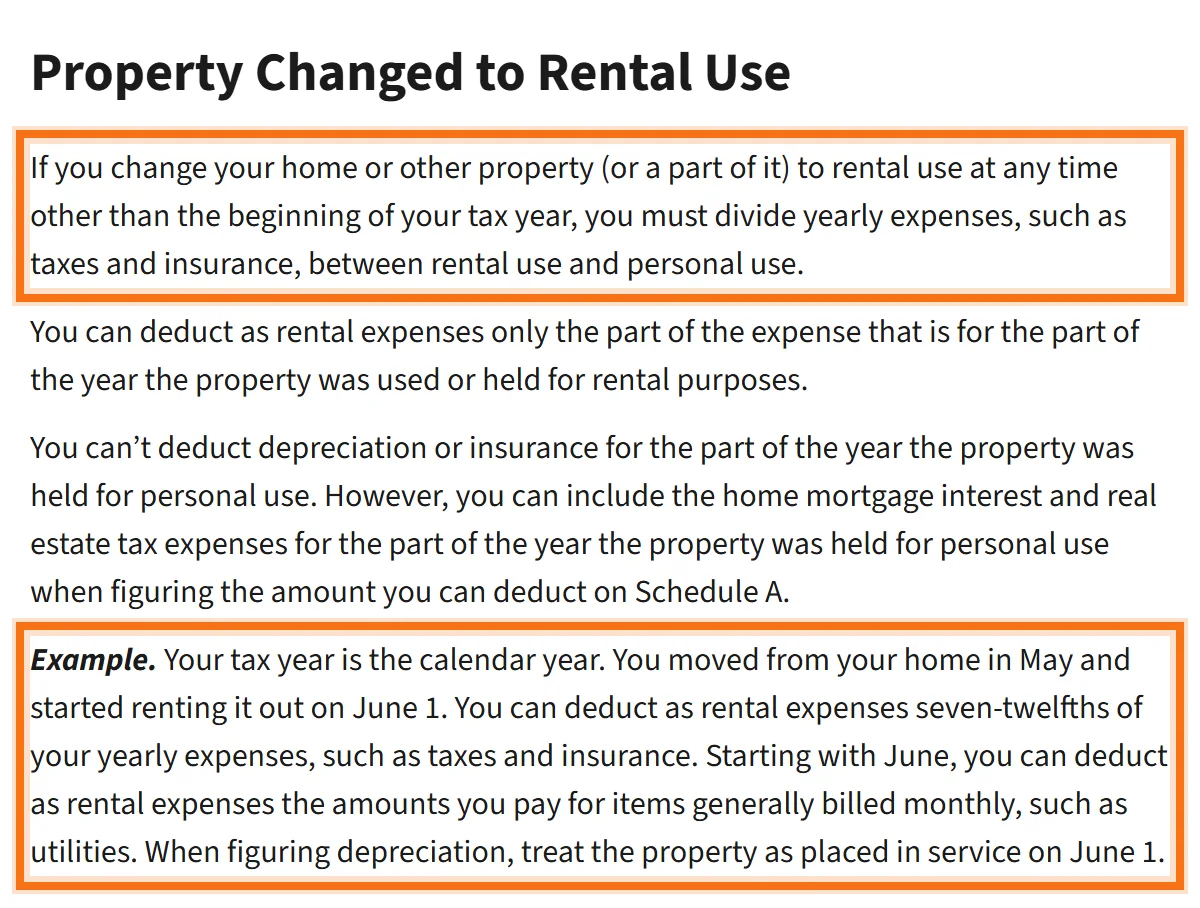
- The depreciation basis. Publication 527 sets the basis for depreciation of a former home at the lesser of its fair market value or your adjusted basis on the date of the change.
- The sale clock. Publication 523's home-sale exclusion uses ownership and residence of at least 24 months in the 5 years before the sale, and gain equal to depreciation allowed or allowable after May 6, 1997 cannot be excluded. If a sale is likely, ask your CPA before the lease is signed.
More in rental property taxes in Texas. This is general information, not legal, tax or insurance advice.
Self-manage or hire a manager?
Self-managing works for some owners: you live nearby, you are handy or have vendors, you are organized about paperwork and you can be reached. If that is you, the steps above are your checklist.
Hiring a manager makes sense when you live far away, your time is worth more than the fee, you do not want tenant calls, or the screening, notices, repairs and records realistically will not get done to a written standard. Compare honestly in self-managing vs. hiring a property manager and is property management worth it. Either way, start with your number: what the house should rent for.
If renting does not pencil out: the other doors
Not every accidental landlord should become one. If the rent would not cover the mortgage, taxes and insurance, or you need the equity in cash, renting is the wrong door. Our rent or sell page lays out the four we offer: lease it through Perpetual Property Management; list it on the MLS yourself through DirectList; a creative exit such as owner finance, subject-to or a wraparound; or a full-service listing through Perpetual Realty Group. When the home is worth less than the loan and there is a provable hardship, short sale assistance is a fifth. One discovery call with Justin Brown at 817-228-6817 covers your payoff, rate and equity.
Any sale that leaves the loan in place is a question for your lender and attorney first. For a house that will not sell, see house not selling? renting as a backup; for an inherited one, who can help you rent out an inherited house.
How Perpetual helps an accidental landlord
Perpetual Property Management is broker-owned, based in North Richland Hills, and manages homes in Keller, North Richland Hills, Fort Worth and nearby. What our site states:
- Who we work with. First-time and accidental landlords: owners who inherited a house, moved for work, or kept the old home as a rental. Many Keller landlords are owners who moved for work and kept the house.
- The rent. A free rental analysis: a rent range from leased comparables, demand notes, make-ready guidance and a written management quote, whether or not you hire us.
- The plans. Full Service 10%, Standard 9%, Investor Special 7% of monthly rent (portfolios of 5 or more units), with every fee on our price sheet and the final fee set after the rental analysis.
- Written promises. The Perpetual Promise: listed on every major rental platform within 5 business days of market-ready, payout by the 10th, and three more, each with a stated remedy, subject to the Guarantee Addendum.
Anything the site does not state, such as the agreement's term or the reserve we hold, is confirmed in writing before you sign. To talk it through, call 682-593-7033.
The takeaway: Check the loan, insurance, HOA, homestead and tax rules before the first lease, price from leased comparables, run the house to a written standard, and decide on management from your own numbers.
Questions owners ask
Do I need an LLC to rent out my house?
Not to rent it out. Whether an LLC makes sense is a liability, lending and tax question that depends on your equity, insurance limits and loan terms, so ask a Texas attorney and your CPA. An LLC does not replace insurance, a written lease or move-in records. Our guide to holding a Texas rental in an LLC covers the basics.
Can I rent it "as-is" and skip the make-ready?
You can, and the market will price it in lower rent, a longer vacancy and fewer applicants. Condition is the first filter on who applies. Our make-ready guide sorts the work into what usually pays back, what is a judgment call and what rarely pays, and a rental analysis tells you what your house would rent for as it is.
What if my old neighbors ask about the tenant?
Keep boundaries clean: neighbors aren't your property managers, and tenant privacy matters. Give trusted neighbors your contact for genuine emergencies (visible water, break-ins) and leave everyday matters to your systems.
When should an accidental landlord hire a property manager?
Common moments are a move out of the area, a first bad turnover, or a second property. Decide from your numbers rather than exhaustion: compare the fees on a written quote with your own time and distance. A free rental analysis gives you the rent and the quote in one step.
What does it mean to be an accidental landlord?
It means renting out a home you did not buy to rent: after a job move, an inheritance, a marriage, or a sale that stalled. The house was set up as a home, so the loan, insurance, homestead exemption and tax treatment were all written for an owner who lives there, and each has to be checked before a tenant moves in.
What insurance do accidental landlords need?
Ask your agent before the tenant moves in. The Texas Department of Insurance says most homeowners insurance won't cover damage to a rental property, or might limit what it pays, and that landlord insurance, mainly for traditional long-term leases, can give added protection. Ask about liability limits and the vacant period too. This is general information, not insurance advice.
How can accidental landlords set fair rent prices?
Use what similar homes nearby actually leased for, adjusted for condition, size and features, not your mortgage payment or listing asking prices. A rental analysis built from leased comparables gives a range; price inside it and adjust if inquiries are thin in the first two weeks.
Property management in Keller, North Richland Hills and Fort Worth. How full-service management works in Tarrant County →