Key takeaways
- Call the probate attorney first: until you know who has authority, nobody can safely sign a lease or a management agreement.
- Under Estates Code 357.001 an executor or administrator may rent estate property for one year or less without a court order; in a supervised administration a longer rental needs one (357.002).
- Letters testamentary or of administration are sufficient evidence of the executor's appointment (Estates Code 306.007): that is the document a manager asks to see.
- Tell the insurer early. The Texas Department of Insurance says most companies stop coverage when a house is vacant 60 days or more.
- Siblings who inherit together need one person authorized to decide, in writing, before the first repair bill.
If you inherited a house in Fort Worth, Keller or North Richland Hills and have never been a landlord, five kinds of help get you from keys to a signed lease: a probate attorney, the executor or administrator (who may be you), the title company, the insurer and CPA, and a property manager. The order matters, because the first call decides who is allowed to sign everything after it.
This guide takes each in turn, shows what Texas law says about renting estate property, and lists what a manager needs from you. Whether to rent or sell at all is a separate question; our rent or sell page covers that decision.
Who helps with an inherited house, in order
Here is who you call, what each one settles, and the paper that comes out of each step:
| Order | Who | What they settle | What you come away with |
|---|---|---|---|
| 1 | Probate attorney | How the house passes (will, no will, transfer on death deed) and who can sign a lease today | A plan: probate with an executor, muniment of title, heirship, or a recorded deed |
| 2 | Executor or administrator | Signs for the estate while it is open; may rent estate property under Estates Code ch. 357 | Letters testamentary or of administration from the court clerk |
| 3 | Title company | Whether the county records show a clear line from the owner who died to whoever signs now | A title search or commitment, if you order one |
| 4 | Insurer and CPA | Coverage for an empty house, then a landlord policy; the date-of-death value for tax basis | Written coverage terms; a value record such as an appraisal |
| 5 | Property manager | Pricing, make-ready, leasing and day-to-day management, signed by the person with authority | A written rental analysis, then a management agreement |
How to read this table: rows 1 and 2 decide who may sign rows 3 to 5. If the estate is still open, the person who signs the lease and the management agreement is usually the executor or administrator, not each heir. Rows 3 and 4 can run at the same time; row 5 can start with a rental analysis while the paperwork finishes.
First call: the probate attorney decides who can sign
A lease is a contract, and the person who signs as landlord has to have the authority to do it. After a death, that depends on how the house passes, and Texas has several routes. Under Estates Code 101.001, the estate vests immediately in the people named in the will, or in the heirs at law if there is no will, subject to the estate's debts. But once letters are issued, the executor or administrator has the right to possession of the estate (101.003).
Other routes skip an executor. A transfer on death deed passes the house to the named beneficiary if they survive the owner by 120 hours (Estates Code 114.103). A will probated as a muniment of title has, in the State Law Library's words, "no administration or executors." A small estate affidavit can transfer a homestead when it is the only real property in the estate (205.006).
Ask the attorney three things: who can sign a lease today, what document proves it, and whether anything in the will or the estate's debts affects renting. This is general information, not legal advice.
What an executor can sign: Estates Code chapter 357
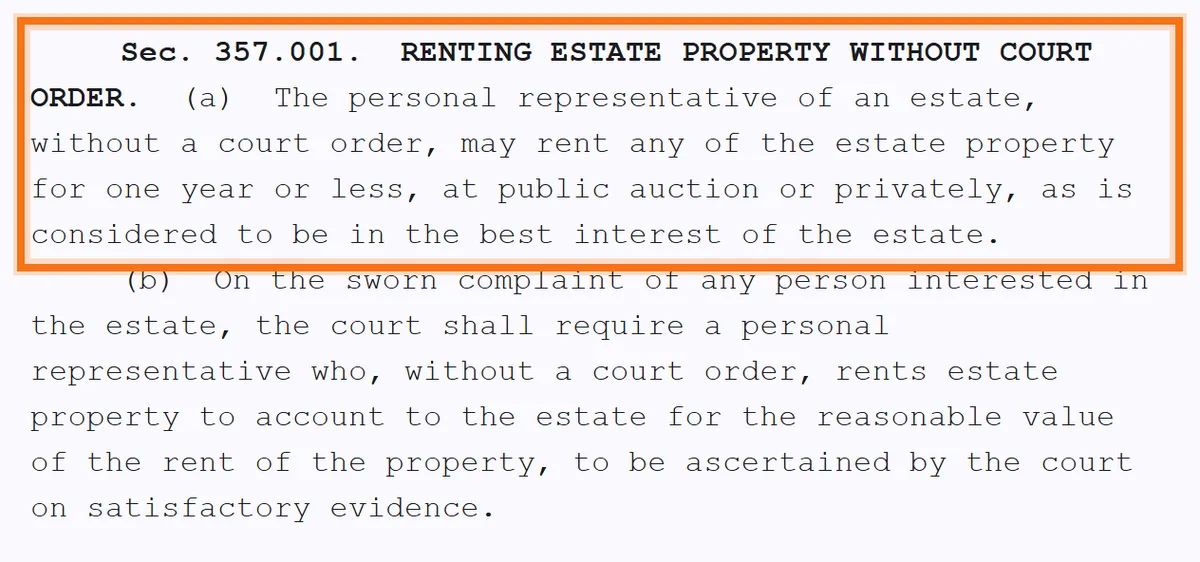
Texas law gives the personal representative of an estate (the executor or administrator) a specific power to rent estate property. Estates Code 357.001 allows it without a court order for one year or less, "at public auction or privately, as is considered to be in the best interest of the estate." In a court-supervised administration, a rental for more than one year requires a written application and a court order under 357.002.
Two more rules matter in practice. If the property's appraised value is $3,000 or more, the representative files a sworn report with the court within 30 days after renting it, stating the renter, the rent and the terms (357.051). And an independent executor may take, without a court order, any action a supervised representative could take with or without one (402.002); 402.054 names the authority "to enter into a lease." Which kind of administration you have is on the court's order. Your probate attorney confirms how these apply to your estate; this is general information, not legal advice.
The insurer: an empty house is a different risk
The policy on the house was written for the person who lived there. The Texas Department of Insurance's home insurance guide says a company may nonrenew if "your house is vacant for 60 days or more," that most companies stop coverage if a house is vacant that long, and that they usually do not stop liability coverage. Losses during a vacancy period set by the policy can also be excluded.
Call the carrier now, say who holds the interest, and ask in writing what is covered while the house is empty and what policy you need once a tenant moves in. A landlord (dwelling) policy is different from a homeowners policy; what landlord insurance you need before renting explains the switch. While the house is empty, keep the utilities on and have it checked; looking after an empty house covers what that involves. This is general information, not insurance advice.
The CPA: the date-of-death value
IRS Publication 551 says the basis of property inherited from a decedent is generally its fair market value at the date of death (or on the alternate valuation date if the estate's representative chooses it). That number sets your depreciation as a landlord and your gain if you sell, so the CPA will want a value close to the date of death.
Publication 527 lists inheritance among the ways you can acquire a rental and points to Publication 551 for the basis rules. Ask the CPA how the rent is reported while the estate is open and after the house is distributed, and how it is split if several heirs own it. Keep a separate bank account for the rental from the first month. This is general information, not tax advice.
The title company and the county records
A title company looks at the deed records and tells you whether the chain of ownership is clear. It also shows which document the county already holds.
The State Law Library describes an affidavit of heirship as a sworn list of heirs that is filed with the county clerk where the property is, and says "there is no law that requires third parties to accept" one, although real estate buyers and title companies commonly accept them. A muniment of title order, by contrast, is a court order filed with a copy of the will. Ask your attorney which one fits, and ask the title company what it would need to insure a later sale.
The property manager: what they need from you
Before a manager can sign a management agreement, they need to know they are dealing with the person who has authority. Expect to be asked for:
- Proof of authority. Letters testamentary or of administration, which Estates Code 306.007 makes "sufficient evidence" of the representative's appointment; or the recorded deed, muniment order or affidavit that put the house in your name.
- The heirs' agreement, if several of you own it and one is signing for all.
- The insurance in force on the house, and the mortgage details if one remains.
- Keys, codes and HOA contacts, and any warranties or repair records you find.
A manager then prices the house from leased comparables, scopes the make-ready, markets, screens, signs the lease and runs the house. If the estate is open, a 12-month lease stays within the one-year limit of 357.001; a longer term is a question for the attorney first. More on the move from family home to rental is in renting out a parent's home.
The belongings, before the make-ready
The hardest part is rarely the lease. It is the furniture, the papers, the garage and the attic. Clearing a house is personal, it can be tied to the estate, and it is the family's job, not the manager's. The executor decides what belongs to the estate before anything is sold or given away.
- Separate what the family keeps and move it out first.
- Choose between an estate sale company, a donation pickup and a hauler; many houses need all three, in that order.
- Once the house is empty, the make-ready list applies; hiring a manager before the house is rent-ready explains why that conversation can start early.
From keys in hand to a tenant moving in
As a planning sequence, not a promise, an inherited house moves through these stages. Several overlap.
- Authority: the attorney confirms the route and the documents.
- Insurance and tax: the carrier confirms coverage; the CPA lists the date-of-death value.
- Clear-out: set by the family; it can take a weekend or several months.
- Rental analysis: can happen during the clear-out, so the rent range and make-ready list are ready when the house is empty.
- Management agreement: signed by the person with authority, every fee in writing.
- Make-ready, then listing, showings and screening.
- Lease signed, move-in inspection documented, first rent collected.
If you inherited with brothers or sisters
Brothers and sisters who inherit together each own a share, but a rental needs one person to approve repairs, sign renewals and answer the manager. Put that authority in writing, with the help of the attorney, and agree among yourselves on a repair limit, how rent and costs are shared, and what happens if one of you wants to sell.
Sort it out before the first repair bill. A broken water heater with three heirs debating the invoice is a tenant without hot water. How a manager works with more than one owner is in co-owned rentals: how a manager works with two owners.
What to ask a manager on the first call
You do not need the vocabulary. Ask in plain words and expect plain answers:
- "What document do you need to see before we sign anything?"
- "What would the house rent for, and what would you fix first?"
- "What are all of your fees, in writing?"
- "How will I see the money and the invoices each month?"
- "If my brother and I both own it, who do you take instructions from?"
How Perpetual helps with an inherited house
Perpetual is a broker-owned management company in North Richland Hills, led by Broker/Owner Justin Brown, and our home market is Keller, North Richland Hills, Fort Worth and the Northeast Tarrant County communities around them. What our site states that helps with an inherited house:
- A free rental analysis: a rent range from leased comparables, demand notes, make-ready guidance on which improvements raise rent, and a written management quote, typically within one business day, whether or not you hire us.
- Every fee in writing on our price sheet; if a fee is not in the agreement, you do not pay it.
- The work after authority is settled: maintenance with vetted, insured vendors, the same written rental criteria for every applicant, the Texas lease, a 360-degree move-in inspection, and statements and invoices in the owner portal.

Which documents we accept for a particular estate, and how we take instructions when several heirs own the house, are confirmed in writing before you sign. To start, request a free rental analysis or call 682-593-7033.
The takeaway: Authority first, then insurance and tax, then the manager. Bring the manager the letters or recorded document that shows who can sign, agree among the heirs who decides, and let the rest of the work run from there.
Questions owners ask
I inherited a house and have never been a landlord. Who can help me rent it out?
Five kinds of help, in this order: a probate attorney to confirm who may sign, the executor or administrator if the estate is open, a title company to check the records, the insurer and a CPA, and then a property manager. The manager prices the house, scopes the make-ready, markets, screens, signs the lease and runs the house, but only after seeing the document that shows who has authority.
Can I rent out an inherited house before probate is finished?
Sometimes. Under Estates Code 357.001, the executor or administrator may rent estate property for one year or less without a court order, and in a court-supervised administration a longer rental needs a court order (357.002); independent executors have wider powers (402.002). An heir without letters or a recorded document usually is not the one who signs. Which applies depends on how the house passes, so ask your probate attorney first. This is general information, not legal advice.
Does a property manager clear out the belongings in an inherited house?
No. Clearing the house is the family's job and can be tied to the estate, so the executor decides what belongs to the estate before anything is sold or given away. Families usually use some mix of an estate sale company, a donation pickup and a hauler. A manager's work starts with the rental analysis and the make-ready once the house is empty.
What insurance do I need on an inherited house I plan to rent?
Call the carrier right away: the named insured has died and the house may be empty. The Texas Department of Insurance says most companies stop coverage if a house is vacant 60 days or more, though they usually keep liability coverage. Ask in writing what is covered while it is empty and what policy you need once a tenant moves in. This is general information, not insurance advice.
How long does it take to rent out an inherited house?
It depends mostly on the paperwork and the clear-out, both outside a manager's control. Confirming authority comes first; the clear-out can take a weekend or months. A rental analysis can be done during the clear-out so the make-ready list is ready when the house is empty. After that come make-ready, listing, showings, screening and the lease.
What document does a property manager need to rent out an inherited house?
Proof that the person signing has authority. If the estate is in probate, that is usually letters testamentary or of administration, which Estates Code 306.007 makes sufficient evidence of the executor's appointment. If the house passed another way, it is the recorded transfer on death deed, the muniment of title order or the affidavit. If several heirs own it, the manager also needs their written agreement on who decides.
Does an executor have to report renting out an estate house to the court?
Under Estates Code 357.051, a personal representative who rents estate property with an appraised value of $3,000 or more files a sworn report with the court within 30 days, stating the renter, the rent and the terms. Independent executors act without court orders in most matters (402.002), so ask your probate attorney which rules apply to your administration. This is general information, not legal advice.
Related services
Property management in Keller, North Richland Hills and Fort Worth. How full-service management works in Tarrant County →