
Key takeaways
- Title comes first: a will probated as a muniment of title, an executor with letters, a small estate affidavit or an heirship affidavit each leads to a different signer.
- IRS Publication 551: the basis of inherited property is generally its fair market value at the date of death, so a quick sale may show little gain.
- An empty house still costs taxes, insurance, utilities and yard care every month; in the illustrative example, $890.
- In the illustrative example, selling nets $282,000; renting nets $1,880 in year one and $12,330 in year two.
- Co-heirs should agree in writing on who signs, how money is split and what triggers a sale, before the first repair bill.
Should you sell or rent an inherited house? Decide in order: first how title passes and who can sign, then the tax basis, then what the house costs while you think, and only then the sale-versus-rent arithmetic. For a house in Tarrant County, in Fort Worth, Keller or North Richland Hills, selling fits heirs who need cash or cannot share an asset; renting fits a family where one person can run it and a year of rent clearly beats the carrying costs.
Below is a decision table, the Estates Code routes for title, the IRS basis rules, a carrying-cost worksheet and the rent-versus-sell numbers on an illustrative house.
Rent or sell an inherited house: the decision at a glance
Here are the questions that decide it, which way each answer points, and who can answer it:
| Question | Points toward selling | Points toward renting | Who answers it |
|---|---|---|---|
| Is title settled, and who can sign? | The heirs want one clean transfer through a sale | One person has authority and the heirs agree to run it | Probate attorney, title company |
| Do the heirs need cash? | Yes, soon, or they cannot share an asset | No, and the house can carry itself | The heirs |
| What does the house need before a tenant? | More work than a few years of rent would repay | A make-ready the rent repays | A walk-through and contractor quotes |
| What does it cost to hold while you decide? | Someone pays the carrying costs every month | A lease turns them into expenses the rent covers | Tax statement, insurer, utility bills |
| What is the tax basis? | A sale soon after death may show little gain over the date-of-death value | Renting starts depreciation from that same value | A CPA, IRS Publication 551 |
| Who will run it? | Nobody wants the job | One heir or a manager, with written authority | The heirs |
How to read this table: the first row comes before the others, because nobody can sign a listing or a lease without authority. After that, two or three answers pointing the same way usually settle it. A family that cannot agree on the last row should lean toward selling.
Title first: how the house passes under the Texas Estates Code
Under Estates Code 101.001, property devised by a will vests immediately in the devisees, and the estate of a person who dies without a will vests immediately in the heirs at law, both subject to the estate's debts. Vesting is not the same as being able to sign. Which document lets someone sell or lease depends on the route:
- Probate with an executor or administrator. Once letters are issued, the executor or administrator has the right to possession of the estate (101.003).
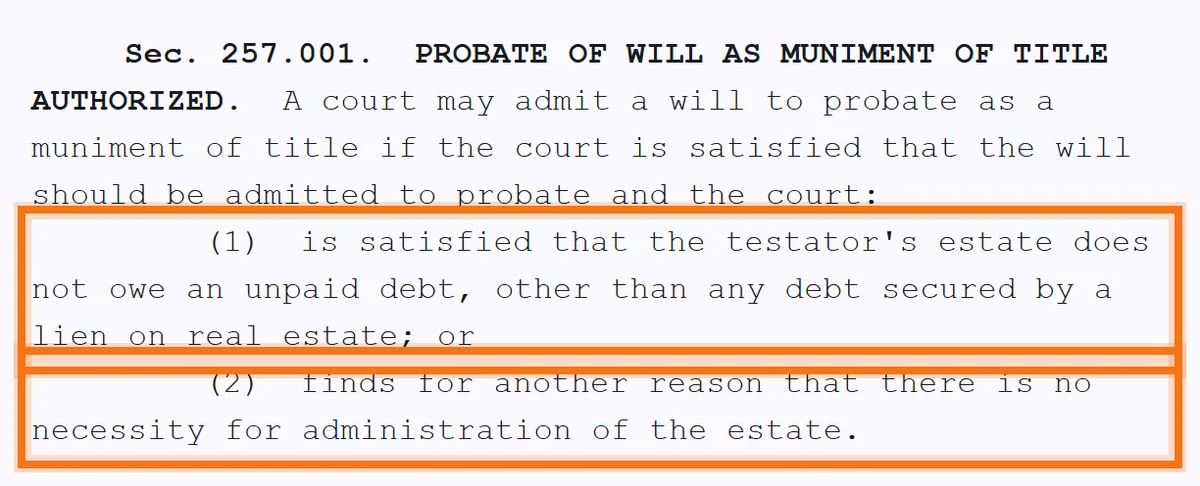
- A will probated as a muniment of title. A court may do this if the estate owes no unpaid debt other than debt secured by a lien on real estate, or for another reason no administration is needed (257.001). The proof required includes that four years have not elapsed since the death (257.054).
- A small estate affidavit, when there is no will: the estate assets, excluding homestead and exempt property, may not exceed $75,000, 30 days must have passed, and a judge must approve the affidavit (205.001). If the homestead is the only real property, title to it may pass under the affidavit, recorded in the deed records of the county where it sits (205.006).
- An affidavit of heirship. Once of record for five years or more, its statement of facts is prima facie evidence of heirship in a suit over title (203.001). The State Law Library notes there is no law that requires third parties to accept one, though title companies commonly do.
For a house in Tarrant County, the documents are filed with the county clerk, and a title company will tell you what it needs to insure a sale. Who may sign a lease while an estate is open, including the one-year limit in Estates Code 357.001, is covered in who can help you rent out an inherited house. This is general information, not legal advice; your probate attorney confirms the route.
The tax basis: the date-of-death value, as the IRS states it
IRS Publication 551 says the basis of property inherited from a decedent is generally its fair market value at the date of death, or on the alternate valuation date if the estate's personal representative chooses it. If the estate files a federal estate tax return, a beneficiary may receive a Schedule A (Form 8971) reporting the value to use. Publication 544 adds that if you inherit property, you are considered to have held it longer than one year, regardless of how long you actually held it.
That is why a sale soon after the death often shows little gain. Illustrative only: a date-of-death value of $275,000, a sale at $300,000 and $18,000 of selling costs give a gain of $300,000 - $18,000 - $275,000 = $7,000 (re-added: $275,000 + $7,000 + $18,000 = $300,000), treated as long-term under Publication 544.
Renting first changes the picture over time. Depreciation reduces your basis for figuring gain on a later sale (Publication 527), and IRS Topic 409 taxes the depreciation part of a real-property gain, unrecaptured section 1250 gain, at a maximum 25% rate; when to sell a rental property covers that side. Ask your CPA what record of the date-of-death value to keep, such as an appraisal. This is general information, not tax advice.
What the house costs while the family decides
Every month of deciding has a price. Secure the house (change the locks if you do not know who has keys), keep the utilities on so the air conditioning runs in summer and the pipes are protected in a freeze, and call the insurer. The Texas Department of Insurance's home insurance guide says most companies stop coverage if a house is vacant for 60 days or more, though they usually don't stop liability coverage. If there is a mortgage, keep paying it and call the servicer so it knows who to talk to.
Then write down the monthly carrying cost. Illustrative only: property tax $450, insurance $210, utilities $140 and lawn care $90 make $890 a month (re-added: $90 + $140 + $210 + $450 = $890). Six months of deciding is $5,340; a year of holding it empty is $10,680, with no income against it. Use your own tax statement and bills. Looking after an empty house covers checks and utilities, and what landlord insurance you need covers the policy switch if you rent.
What condition the house is really in
Inherited houses here are often older homes that were well loved and lightly updated. The owner lived with things a tenant will not: the original HVAC, a roof near the end of its life, old carpet, a water heater that has never been replaced, plumbing that has been patched rather than fixed.
Before you decide, get a walk-through and real quotes. They split the list into what must be done to rent safely, what should be done to rent at a good number, and what can wait, so the arithmetic below has real inputs. The make-ready guide explains what pays and what does not. In North Texas clay soil, a house that sat with the sprinklers off through a dry summer deserves a look at the foundation and drains; foundation and plumbing in North Texas rentals covers what to check.
Sell or rent: the arithmetic on an illustrative house
Illustrative only, not a quote and not market data. A paid-off inherited house in Fort Worth, three heirs. Sale at $300,000 with $18,000 of selling costs. Or rent at $2,000 a month after a $6,000 make-ready, with two months empty in year one. Management uses our published Full Service numbers as the example (10% a month, placement at 50% of one month's rent, renewal $150), charged here on the months rent comes in. Here is each line:
| Line | Sell now | Rent: year one | Rent: year two |
|---|---|---|---|
| Sale price or rent received | $300,000 | $20,000 (10 x $2,000) | $24,000 (12 x $2,000) |
| Selling costs or make-ready | -$18,000 | -$6,000 | $0 |
| Placement or renewal fee | -$1,000 | -$150 | |
| Monthly management (10%) | -$2,000 | -$2,400 | |
| Property tax ($450 a month) | -$5,400 | -$5,400 | |
| Landlord insurance ($210 a month) | -$2,520 | -$2,520 | |
| Repair reserve | -$1,200 | -$1,200 | |
| Result | $282,000 in cash | $1,880 | $12,330 |
| Per heir (three) | $94,000 | $626.67 | $4,110 |
How to read this table: year one carries the make-ready and the placement, so the real comparison is year two, $12,330 a year against $282,000 in hand, which is $12,330 / $282,000 = 4.4% before income tax and before any change in the house's value. Re-added: year-one costs are $6,000 + $1,000 + $2,000 + $5,400 + $2,520 + $1,200 = $18,120, and year-two costs are $150 + $2,400 + $5,400 + $2,520 + $1,200 = $11,670.
If that 4.4%, plus whatever you expect from the house's value, beats what each heir would do with $94,000, renting holds up. If not, or if the heirs simply need the cash, selling wins. Whether a management fee applies to an empty month, and the Standard plan's different numbers (9%, 75% placement, $200 renewal), are on the price sheet and in the written agreement. How to calculate rental return shows other ways to measure it.
When several heirs share the decision
Most inherited-house conflicts are not about money. They are about one person doing the work while the others have opinions. Agree in writing, with your attorney's help, on four things before anyone signs a lease or a listing:
- Who has authority to sign, and who the manager or buyer takes instructions from.
- A repair amount one person can approve without calling the others.
- How rent, costs and sale proceeds are split.
- What triggers a sale, and how one heir can buy out the others, for example at an appraised value.
If the house is rented, keep its money in its own account so distributions come from a statement rather than memory. Co-owned rentals: how a manager works with two owners covers the day-to-day side. This is general information, not legal or tax advice.
How to sell an inherited house in Fort Worth
Sell when the heirs need the money now, when the house needs more work than the rent would repay, or when the relationships cannot survive a shared asset. There is no shame in that last one: a clean sale and a clear split beat years of arguing over a lawn-care bill. To sell an inherited house in Fort Worth or elsewhere in Tarrant County, go in this order:
- Confirm the title route and the signer with your probate attorney.
- Ask a title company what it needs to insure the sale.
- Clear out the belongings; the executor decides what belongs to the estate.
- Decide between selling as-is and doing the must-fix items first, using real quotes.
- Choose how to list, and price from the sale side, not from what the house would rent for.
If the house needs more work than the family wants to take on, or the heirs want it closed in weeks rather than months, a local cash buyer such as Metroplex Home Buyers can make an as-is cash offer; compare it with what a listing would net before you accept.
A house that has not sold has more than one way out; our rent or sell page lays out four.
How Perpetual helps with an inherited house
Perpetual Property Management is broker-owned, with our office in North Richland Hills, and our affiliated brokerage, Perpetual Realty Group, handles sales. Our property management page names an inherited house among the first-time and accidental landlord situations we help with every week. For the decision itself, our site states:
- A free rental analysis: a rent range from leased comparables, make-ready guidance on which improvements raise rent, and a written management quote, typically within one business day, whether or not you hire us.
- A discovery call with Justin Brown, no fee and no obligation, covering what the house would rent for and what it would sell for today, and which of the four doors on our rent or sell page fits.
- If you rent: every fee on the price sheet, in writing, and monthly statements in the owner portal.

Which documents we accept for a particular estate, and how we take instructions when several heirs own the house, are confirmed in writing before you sign. To start, request a free rental analysis, read about selling investment property, or call 682-593-7033.
For the services, the fees on each plan and the north Fort Worth neighborhoods we serve from our North Richland Hills office, see our Fort Worth property management page.
The takeaway: Settle title, write down the date-of-death value, count the carrying costs, then put the sale proceeds next to a real year of rent, and let the heirs agree in writing before anyone signs a lease or a listing.
Questions owners ask
Can I rent out an inherited house before probate is finished?
Sometimes. Under Estates Code 357.001, the personal representative of an estate may rent estate property for one year or less without a court order. An heir without letters or a recorded document usually is not the one who signs, so do not sign a lease until your probate attorney confirms who has authority. The steps are in our guide to who can help you rent out an inherited house. This is general information, not legal advice.
Do I need to update the insurance on an inherited house?
Yes, right away. Tell the carrier the owner has died and who is now responsible. The Texas Department of Insurance says most companies stop coverage if a house is vacant for 60 days or more, though they usually don't stop liability coverage. Ask in writing what is covered while it is empty, and switch to a landlord policy before a tenant moves in. This is general information, not insurance advice.
How do heirs split rental income from an inherited house?
Through the arrangement the heirs agree in writing: who signs, how rent and costs are split, and what triggers a sale. Keep the house's money in its own account and split from the monthly statement. In the illustrative example, year-two rent nets $12,330, or $4,110 for each of three heirs. Confirm the arrangement and its tax treatment with an attorney and a CPA.
Is it better to sell an inherited house right away or rent it first?
It depends on cash needs, condition and whether the family can share an asset. In the illustrative example, selling nets $282,000 now; renting nets $1,880 in year one, after the make-ready and placement, and $12,330 in year two, about 4.4% of the sale proceeds before income tax. If the heirs need the money or cannot agree, selling is simpler.
How do I sell an inherited house in Fort Worth?
Confirm with a probate attorney how title passes and who can sign: an executor with letters, a will probated as a muniment of title, a small estate affidavit or an heirship affidavit. Ask a title company what it needs to insure the sale, clear out the belongings, decide what to fix using real quotes, then list. The documents are recorded with the clerk of the county where the house sits. This is general information, not legal advice.
What is the tax basis of an inherited house?
IRS Publication 551 says it is generally the fair market value at the date of death, or on the alternate valuation date if the estate's representative chooses it. Publication 544 says inherited property is considered held longer than one year. So a sale soon after the death is measured against the date-of-death value, not what the parent paid. Keep a record of that value and confirm it with a CPA; this is not tax advice.
Property management in Keller, North Richland Hills and Fort Worth. How full-service management works in Tarrant County →