Key takeaways
- Return on equity decides it: a year of cash flow divided by what you would walk away with today.
- Add up the capital bills ahead and divide by the yearly cash flow; more years than you plan to hold is a signal.
- Tiredness alone points to management, not a sale. Weak numbers plus tiredness is a fair reason to sell.
- Use after-tax proceeds: depreciation lowers your basis (IRS Pub 527) and unrecaptured section 1250 gain is taxed at up to 25% (Topic 409).
- Decide how you would sell, vacant or with the tenant, before you decide when.
When should I sell my rental property? When the equity inside it would earn more somewhere else, when a large capital bill is coming that the rent will not repay, or when owning it has become a habit rather than a decision. For owners of rental houses in Fort Worth, Keller and North Richland Hills, those signals, checked once a year against your own statements, beat any market headline. Most owners do the opposite: they sell after a bad month and hold through years of thin returns.
This guide gives a signals table, the arithmetic on an illustrative house, the tax points as the IRS states them, the false signals, and a one-hour annual review.
Sell or hold: the signals at a glance
Here are the signals worth checking, what to measure for each, and which way each one points:
| Signal | What to measure | Points toward selling | Points toward holding |
|---|---|---|---|
| Return on equity | A year of cash flow divided by the equity you would walk away with | Clearly below what the same money could earn elsewhere at a risk you accept | Comparable to or better than your alternative |
| Capital bills ahead | Quotes for the roof, HVAC, water heater, foundation or sewer work due in the next few years | They take more years of cash flow to repay than you plan to hold | Few are due, or the work lifts the rent |
| Your time and patience | Hours a year and when they land | Weak numbers and you are worn out | Sound numbers: hand off the work instead |
| The house's own record | Days vacant at the last turnover, renewals, rent against a current rental analysis | Longer vacancies and rent falling behind comparable leases | Quick re-leasing and renewals at market |
| Tax position | Depreciation taken, any years you lived there, the year you would sell | A home-sale exclusion window you would lose by waiting | A sale now would land in a year of unusually high income |
| Use of the proceeds | One written sentence on what you would do with the money | A specific, better use | Nothing better than another house like this one |
How to read this table: no single row decides it. Two or three rows pointing toward selling, checked on a calm day with your own statements, is a signal; one row is not. The tax row needs a CPA's numbers, not estimates.
Measure return on equity, not return on what you paid
The number most owners watch is cash flow against what they paid. That flatters a house that has gone up in value. The number that tells you whether to keep holding is return on equity: what the property earns you in a year, divided by what you would walk away with if you sold it today.
Illustrative only, not a quote or market data. A broker's opinion puts the sale price at $340,000. Your selling-cost quotes total $24,000 and the loan payoff is $110,000, so your equity is $340,000 - $24,000 - $110,000 = $206,000 (added back: $206,000 + $24,000 + $110,000 = $340,000). After every expense, a repair reserve, a vacancy allowance and the mortgage payment, the house clears $7,200 a year: $7,200 / $206,000 = 3.5%. Count the $4,100 of principal the rent paid down that year too, and it is $11,300 / $206,000 = 5.5%.
Compare that with what the equity could earn elsewhere at a risk you accept. If the alternative is clearly better, the rental is underperforming even though the monthly statement looks fine. Appreciation is not in the number; if you add your own expectation, write it down so you can check it next year.
Use the after-tax equity when you can get it. If your CPA estimates $18,000 of federal tax on the sale, the money you could actually move is $188,000, and the house's $11,300 is 6.0% of that. The guide to calculating rental return covers cap rate and cash-on-cash. Return on equity drifts down as the house appreciates and the loan pays off, which is why a great buy can become a mediocre hold without anything going wrong.
A big capital bill is coming that the rent will not repay
Roof, HVAC, water heater, foundation and sewer line each run on their own clock, and in North Texas a hail season can reset the roof clock without warning. When two or three come due in the same stretch, ask whether the rent after that spending still makes sense.
Work it as one division. Illustrative only, with placeholders where your contractor quotes go: a roof at $14,000, an HVAC system at $9,500 and a water heater at $1,800 add to $25,300 ($14,000 + $9,500 = $23,500, plus $1,800). Divided by the house's $7,200 yearly cash flow, that is about 3.5 years of cash flow for work the next owner will also enjoy. If you plan to hold for less than that, selling before the work, with the condition priced in, deserves a serious look.
Sometimes spending still wins: a strong location, or an upgrade that lifts the rent. IRS Publication 527 treats an expense that results in a betterment to the property or restores it as an improvement you capitalize and depreciate; the depreciation overview explains how. Build the list from inspection reports and real quotes.
Tired of it? That points to management, not a sale
Owners often decide to sell the week after a hard turnover or a run of late rent. That is fatigue, and it has a cheaper cure than a sale: if the numbers are sound and only your patience is wearing thin, hand the work to a manager and keep the asset.
Put a number on it first. How much time a manager would realistically save gives you an hours log to fill in, and whether it is cheaper to manage a rental yourself prices the year line by line. If the managed version of ownership sounds fine, you are not ready to sell; you are ready to stop self-managing. If the numbers are weak and you are also tired, that is two signals, and the sale conversation is a fair one.
Read your own house's record, not the headlines
You cannot time a market, but you can read your own house's record, which says more about your street than a regional headline does:
- Days vacant at the last turnover, compared with the one before.
- Whether good tenants renew, or leave at each lease end.
- The rent against a current rental analysis built from leased comparables, not asking prices.
- A broker's written opinion of the sale price, rather than a website estimate.
A house that re-leases quickly and renews at market is pulling its weight. A house whose vacancies are getting longer while its rent falls behind comparable leases is telling you something. Our free rental analysis gives the rent range from leased comparables, and a discovery call with Justin Brown covers what the house would rent for and what it would sell for today.
The tax points, as the IRS states them
Selling a rental is taxed differently from selling your own home, so the decision should use the after-tax number. Four points from IRS pages read for this guide:
- Depreciation lowers your basis. Publication 527: "Depreciation reduces your basis for figuring gain or loss on a later sale or exchange." Years of depreciation mean a larger taxable gain than the price change alone.
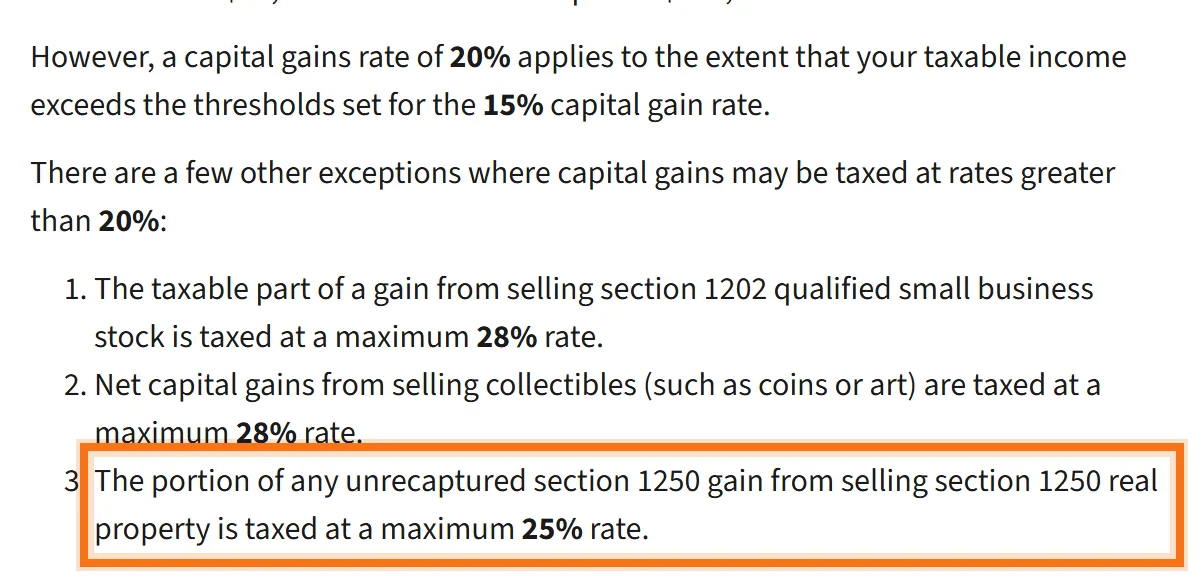
- Part of the gain can carry a higher rate. Tax Topic 409 says the portion of any unrecaptured section 1250 gain from selling section 1250 real property is taxed at a maximum 25% rate. Publication 544 describes that gain as, generally, the part of a long-term gain on real property that is due to depreciation.
- Long-term or short-term. Topic 409: held more than one year, a gain or loss is generally long-term; net short-term gains are taxed as ordinary income.
- If it was once your home. Publication 523 allows excluding up to $250,000 of gain ($500,000 for a married couple filing jointly) if you meet its Eligibility Test, which includes owning the home and living in it for at least 24 months of the 5 years before the sale. You cannot exclude the part of the gain equal to depreciation allowed or allowable after May 6, 1997.
Because the 24 months of residence must fall within the 5 years before the sale, a former home's exclusion window closes about three years after you move out. A 1031 exchange can defer the gain when you buy another investment property; the 1031 exchange overview covers the deadlines. Get the federal numbers from your CPA before you list. This is general information, not tax advice.
Things that feel like signals and are not
Some events push owners to sell when nothing about the investment has changed: one bad tenant (a screening and management problem, not a property problem), one vacant month (a normal cost of ownership), a neighbor's big sale price (it tells you what you could get, not what you would do with it), one large repair paid from reserves (two or three at once is a signal; one is not), and market headlines, which rarely describe your street.
The test for each: would you have sold if this event had not happened? If not, wait sixty days and look again with the return-on-equity math in front of you.
A once-a-year sell-or-hold review that takes an hour
Make this a habit so the decision is never made in a bad week. If the review falls a few months before a lease ends, compare whether to renew, raise rent or sell on the same numbers.
- Pull the year's owner statements and total the cash flow after all expenses, reserves, vacancy and the mortgage payment.
- Get a sale price from a broker's written opinion, not a website estimate, and subtract the loan payoff and your selling-cost quotes to find your equity.
- Divide cash flow by equity. Write down the return on equity, and ask your CPA for the after-tax version.
- List the capital items likely in the next few years, with real quotes.
- Note the lease end date, the tenant's payment record and whether the rent matches a current rental analysis.
- Write one sentence on what you would do with the proceeds if you sold.
If the return on equity is thin, the capital list is long and the sentence about the proceeds is specific, you have your answer. If the return is healthy and the only thing you would do with the money is buy another rental like this one, you already own it. Our owners have the statements, documents and inspection photo reports for this review in the owner portal.
If the answer is sell, decide how before you decide when
A rental can be sold vacant, with the tenant in place to an investor, or to the tenant. Vacant means an empty stretch and a make-ready but lets buyers who want to live there bid; with the tenant in place the rent keeps coming and buyers price on income; selling to the tenant skips marketing but still needs a fair value and clean paperwork.
Line the sale up with the lease, and read your management agreement for what it says about a sale. Selling a rental with a tenant in place covers the lease, the deposit and showings, and selling your rental: can you cancel management covers the agreement side. This is general information, not legal, tax or financial advice.
How Perpetual helps with a sell-or-hold decision
Perpetual Property Management is broker-owned, with our office in North Richland Hills, and our affiliated brokerage, Perpetual Realty Group, sells homes and rentals. For a rental in Keller, North Richland Hills or Fort Worth, our site states:
- The numbers for the review: monthly statements, documents and disbursement history in the owner portal, and inspections with photo reports.
- Both sides of the decision: a free rental analysis with a rent range from leased comparables, and for a sale, occupied or vacant, "the math for both, not a one-size answer."
- More than one way out: our rent or sell page lays out four doors: lease it with us, list it on the MLS yourself through DirectList, a creative exit such as owner finance, or a full-service listing with Perpetual Realty Group.
We give you the statements and the rent and sale numbers; your CPA gives you the after-tax figure. The terms of any listing are confirmed in writing before you sign. To start, request a free rental analysis, read about selling investment property, or call 682-593-7033.
The takeaway: Sell on the numbers, checked once a year with after-tax proceeds and real repair quotes, and never on the week you just had.
Questions owners ask
Is it better to sell a rental property vacant or with a tenant in it?
It depends on the house and the buyer. Vacant lets owner-occupant buyers bid but means an empty stretch; with a tenant in place the rent keeps coming and buyers are mostly investors. Our sale page puts it plainly: sometimes a paying tenant in place maximizes value to investor buyers, and sometimes a vacant, refreshed listing wins. The lease end date often decides which is practical.
How do I know if my rental is underperforming?
Divide a year of cash flow, after every expense, a reserve, a vacancy allowance and the mortgage payment, by the equity you would walk away with if you sold today. In the illustrative example that is $7,200 / $206,000 = 3.5%. If the same money could clearly earn more elsewhere at a risk you accept, the rental is underperforming even if the monthly statement looks healthy.
Should I sell my rental before a big repair like a roof or HVAC?
Sometimes. Divide the quotes for everything due in the next few years by the yearly cash flow: in the illustrative example, $25,300 against $7,200 a year is about 3.5 years. If that is longer than you plan to hold, selling before the work with the condition priced in can win. If the upgrade lifts the rent in a strong location, holding can still win.
What taxes do I pay when I sell a rental in Texas?
Federal tax is the main question. IRS Publication 527 says depreciation reduces your basis for figuring gain, and Tax Topic 409 says the portion of any unrecaptured section 1250 gain is taxed at a maximum 25% rate. A 1031 exchange can defer the gain if you buy another investment property. Get the numbers from a CPA before you list; this is general information, not tax advice.
Should I sell because I am tired of dealing with tenants?
Not on its own. If the numbers are sound, a property manager keeps the asset and removes the work; count your hours and price the managed year first. Weak numbers plus being worn out is a fair reason to sell.
When should I sell my investment property?
When two or three signals line up on a calm day: a return on equity clearly below what the money could earn elsewhere, capital bills that would take more years of cash flow to repay than you plan to hold, and a specific better use for the after-tax proceeds. One bad tenant or one empty month is not a signal. Run the check once a year with your own statements.
Can I still use the home-sale exclusion if I rented out my old house?
Possibly. IRS Publication 523 requires, among other tests, that you owned the home and lived in it for at least 24 months of the 5 years before the sale, and you cannot exclude gain equal to depreciation allowed or allowable after May 6, 1997. Because the 24 months must fall within those 5 years, the window closes about three years after you move out. Confirm your dates with a CPA; this is general information, not tax advice.
Property management in Keller, North Richland Hills and Fort Worth. How full-service management works in Tarrant County →