Key takeaways
- Compare the fee lines and your hours; repairs, insurance, taxes and the mortgage cost you the same either way.
- In the illustrative turnover year, management costs $2,260 more in cash and saves 52 hours: break-even at $43.46 an hour.
- In the illustrative quiet year, the break-even is $173.08 an hour, so self-managing usually wins on money.
- One mistake can outweigh the fee: the Property Code names $100 plus three times the deposit wrongfully withheld (92.109) and one month's rent plus $1,000 for an unlawful lockout (92.0081).
Is it cheaper to manage my rental myself? In cash, usually yes, because the management fee disappears; in total, only if your hours are worth less than the fee per hour saved and your year avoids a costly mistake. For a rental in Fort Worth, Keller or North Richland Hills, the honest answer is a ledger: each line, what you pay self-managed, what you pay managed, and your own numbers next to both.
Below is the ledger, a worked turnover year and a quiet year, the break-even value of an hour, and what the Texas Property Code says the most common self-manager mistakes cost.
The annual cost ledger: self-managed vs managed
Here is each cost line, what it means when you self-manage and when you hire a manager, with Perpetual's published numbers where a line is a management fee:
| Line | Self-managed: you pay | Managed: you pay | Perpetual price sheet (Investor Special / Standard / Full Service) |
|---|---|---|---|
| Monthly management | Nothing | A percentage of rent or a flat amount, per the written quote | 7% / 9% / 10% of monthly rent |
| Finding a tenant | Listing, photos, showings and the lease: your receipts and hours | A placement or leasing fee | 50% / 75% / 50% of one month's rent |
| Renewal | Your time and a renewal lease | A renewal fee, if any | $149 / $200 / $150 |
| Start-up | Your lease forms and move-in record | A setup or enrollment fee, if any | Enrollment inspection $125 / $49 / included |
| Repairs | Vendor invoices | The same vendor invoices plus any coordination charge | Coordination 3% to 5% (make-ready) / 4.9% / 5% of cost |
| Rekeying at turnover | You pay (Property Code 92.156) | Usually a turnover cost to you; the agreement decides how it is billed | Not a management fee |
| Eviction | Filing, service and your time, or an attorney | Per the agreement | Optional $7.95 a month / optional $7.95 a month / included |
| Your hours | All of them | Approvals, decisions and reading statements | Not a fee: your own estimate |
How to read this table: lines that cost the same either way, such as repairs, insurance, taxes and the mortgage, do not decide anything, so leave them out of the comparison. The fee lines and your hours decide it. Our plans are negotiable case by case and the final numbers are set after the rental analysis, so use the figures in your own written quote.
A worked year on one illustrative house
Illustrative only, not a quote. A house in Keller renting for $1,900 a month, with $2,400 of repairs in the year. The managed column uses our published Full Service numbers as the example: 10% a month, placement at 50% of one month's rent, renewal $150, coordination 5% of cost.
A turnover year (one tenant leaves, the house is empty one month). Managed: $190 a month on the 11 months rent comes in is $2,090, plus $950 placement and $120 coordination, for $3,160 (re-added: $120 + $950 + $2,090 = $3,160). If your agreement charges a fee for the empty month, add $190. Self-managed: $900 of your own direct costs from receipts, such as listing, photos, lease forms, software and mileage.
A quiet year (the tenant renews). Managed: $190 x 12 = $2,280, plus $150 renewal and $120 coordination, for $2,550. Self-managed: $300 of direct costs.
Here are the totals side by side, with your hours, which are your own estimates:
| Turnover year: self | Turnover year: managed | Quiet year: self | Quiet year: managed | |
|---|---|---|---|---|
| Cash for fees or direct costs | $900 | $3,160 | $300 | $2,550 |
| Extra cash if managed | $2,260 | $2,250 | ||
| Your hours (your estimate) | 60 | 8 | 18 | 5 |
| Hours saved by a manager | 52 | 13 | ||
| Break-even value of one hour | $2,260 / 52 = $43.46 | $2,250 / 13 = $173.08 |
How to read this table: if an hour of your time is worth more than the break-even figure to you, the managed year is cheaper in total; if it is worth less, self-managing is. In this example the turnover year tips toward management for many working owners, and the quiet year tips toward self-managing. All figures illustrative.
Vacancy is the line only you can estimate. Daily rent is $1,900 x 12 / 365 = $62.47. If you believe your self-managed listing would sit 10 days longer, that is $624.70, and the turnover-year break-even falls to ($2,260 - $624.70) / 52 = $31.45 an hour. If you would lease it just as fast, use zero. What a vacant month really costs shows the full per-day method.
What common mistakes cost, as the Texas Property Code states it
The ledger above assumes a clean year. One procedural mistake changes it. Here is what the Property Code says for five mistakes self-managers make, with an illustrative $1,900 rent:
| Mistake | Section | What the statute says | On $1,900 rent (illustrative) |
|---|---|---|---|
| Keeping a deposit in bad faith | 92.109(a) | $100, three times the portion of the deposit wrongfully withheld, and the tenant's reasonable attorney's fees | $600 withheld: $100 + $1,800 = $1,900, plus fees |
| No itemized list of deductions, in bad faith | 92.109(b) | The landlord forfeits the right to withhold any portion of the deposit or to sue the tenant for damages to the premises, and pays reasonable attorney's fees | Every deduction is lost, plus fees |
| Missing the 30-day deadline | 92.103(a), 92.109(d) | Refund or itemize on or before the 30th day after surrender; failing that, the landlord is presumed to have acted in bad faith | The burden shifts to you (92.109(c)) |
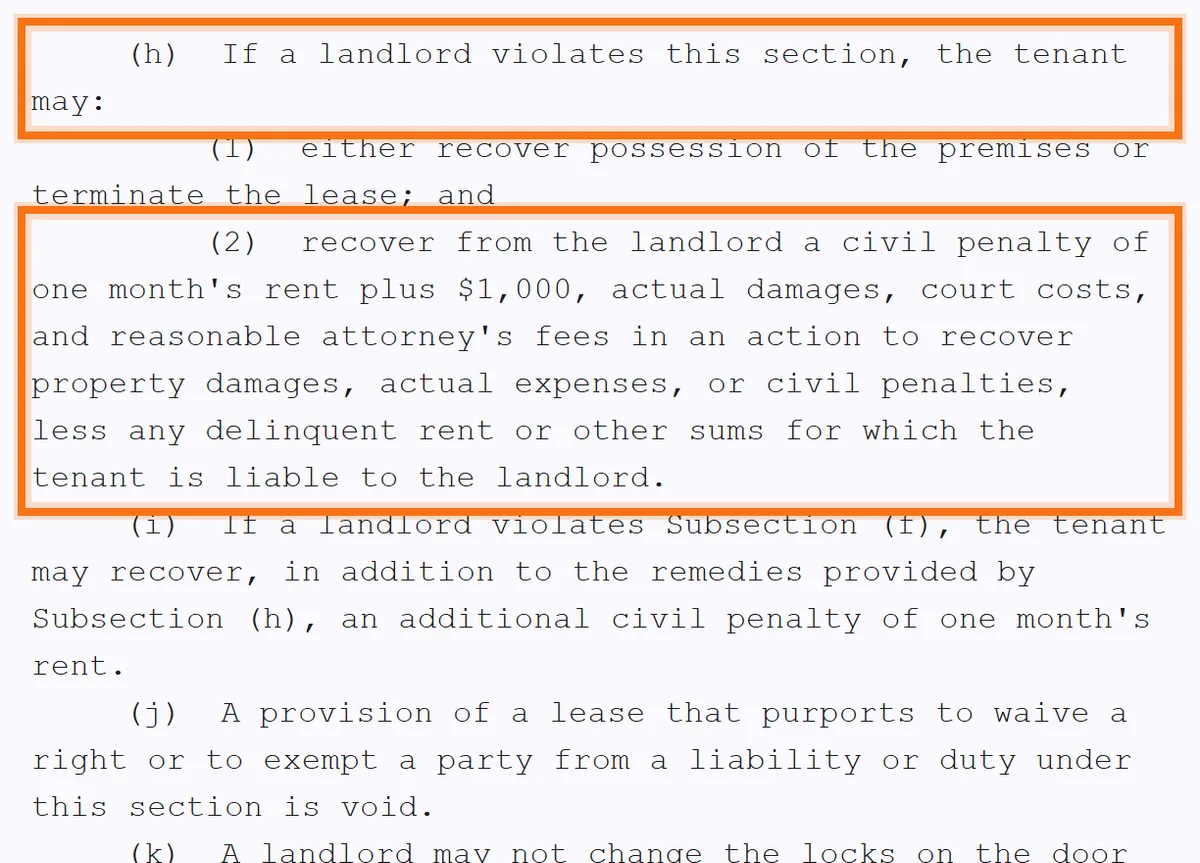
| A lockout that breaks 92.0081 | 92.0081(h) | Civil penalty of one month's rent plus $1,000, actual damages, court costs and reasonable attorney's fees, less delinquent rent | $1,900 + $1,000 = $2,900, plus damages and fees |
| A repair not made after proper notice | 92.0563(a) | Order to repair, rent reduction, civil penalty of one month's rent plus $500, actual damages, court costs and attorney's fees | $1,900 + $500 = $2,400, plus damages and fees |
How to read this table: these are the amounts the statute names; whether they apply is for a court, and each has conditions (the 92.0563 remedies follow the tenant's notices under 92.056, and the 92.107 forwarding-address rule affects the deposit clock). One of them in a year can match a year of management fees on this house. Our guides to Texas security deposit rules and landlord repair obligations cover the procedures.
This is general information, not legal advice.
Pricing your hours honestly
The hours line is the one owners leave blank. In a quiet year with a tenant in place, self-managing takes a few hours a month at most. In a turnover year it takes far more: the move-out inspection and deposit itemization on a legal deadline, make-ready, photos, showings on evenings and weekends, screening, the lease and the move-in record.
Price those hours at what you earn, or at what you would pay to get your Saturdays back. Owners who are retired or flexible, and who like the work, may fairly price them near zero. To fill in the number, use the month-by-month and event-by-event log in how much time a property manager would realistically save; this guide only prices the result.
The lines that move a year from cheap to expensive
Three lines do not appear every year but decide the comparison when they do. Vacancy: each empty day costs your daily rent. Placement: a tenant who stops paying in month four costs months of rent plus an eviction. Procedure: a deposit itemized late, a lockout done wrong or a repair ignored after notice carries the penalties in the table above.
If your year avoids all three, self-managing is cheaper. The honest question is how confident you are that it will, on your house, with your time. Is property management worth it works through the same risks on a $2,000 house.
When self-managing genuinely is cheaper
Self-managing comes out ahead when the conditions behind vacancy, bad placements and procedural mistakes are already handled: you live close, your tenant has renewed at least once, you use a current Texas lease and know the deposit and notice rules, you have vendors who answer your calls, and you have time to run a turnover properly when it comes.
Owners in that position are not paying for a problem they have. Keep self-managing, keep clean records, and reconsider when the tenant gives notice or your situation changes. If only the leasing part worries you, full-service management vs tenant placement only compares the two, and whether management is worth it for one rental covers the single-house case.
How to self-manage cheaply without self-managing badly
If you decide to do it yourself, the cheapest version is the careful one:
- Price from leased comparables, not asking prices.
- Use a current Texas lease and read it.
- Write your screening criteria down before the first application and apply them to everyone.
- Rekey within seven days after each tenant turnover, at your expense (Property Code 92.156(a)).
- Photograph the house at move-in and move-out.
- Calendar the deposit deadline: refund or itemize on or before the 30th day after the tenant surrenders the house (92.103(a)).
- Put every notice in writing and keep proof of delivery.
Done that way, self-managing is cheaper and safe. Done from memory and goodwill, it is cheaper until the year it is not. Either way, know what a manager would charge so your ledger compares against a real number; our pricing page lists every fee by plan.
How Perpetual fits into your ledger
Perpetual Property Management is broker-owned, with our office in North Richland Hills, managing rentals in Keller, North Richland Hills, Fort Worth and nearby. What our site states that fills the managed column of your ledger:
- Every fee in writing. The plans and fees are on our price sheet, the final fee is set after the rental analysis, and if a fee is not in the agreement, you do not pay it.
- Repairs. Maintenance coordination is a percentage of the vendor's invoice, and the original invoice is always in your portal.
- The lines that cause mistakes. Texas-compliant lease documents, security deposits handled per the Texas Property Code on the statutory timeline, and the same written criteria for every applicant.
- Vacancy. Your home is live on every major rental platform within 5 business days of being market-ready, or we waive the first month's management fee.
Whether a fee applies to a month with no rent is confirmed in writing before you sign. If the ledger says self-managing fits you, keep doing it. To fill in the managed column with real numbers, request a free rental analysis with a written quote, see what full-service management covers, or call 682-593-7033.
The takeaway: Fill in the ledger with your own receipts, hours and a written quote, divide the cash difference by the hours saved, and keep one line for the mistakes the Property Code prices for you.
Questions owners ask
How much does it cost to manage a rental property yourself?
The direct costs are listing and photos, lease forms, any software, mileage and rekeying between tenants, which come from your own receipts; in the illustrative example they are $900 in a turnover year and $300 in a quiet year. The larger costs are your hours and the risk of a longer vacancy or a procedural mistake. Put all of them in the ledger before comparing with a written management quote.
Can I self-manage a rental from another city?
You can, but distance raises the hours line. Showings, inspections, vendor visits and notice delivery all need someone at the house, and relying on a friend means relying on a favor with no process. Owners who self-manage from a distance often end up paying a local person informally. If you are more than a short drive away, price that help in the ledger.
What is the biggest mistake self-managing landlords make in Texas?
The expensive ones are procedural, because the Property Code prices them. Keeping a deposit in bad faith costs $100 plus three times the amount wrongfully withheld plus attorney's fees (92.109(a)); missing the 30-day deadline creates a presumption of bad faith (92.109(d)); a lockout that breaks 92.0081 carries one month's rent plus $1,000. Screening on instinct is the other costly one. This is general information, not legal advice.
Is it cheaper to manage one rental myself?
In cash, usually. In the illustrative example, management costs $2,260 more in a turnover year and $2,250 more in a quiet year. Divide that by the hours a manager would save you: $43.46 an hour in the turnover year and $173.08 in the quiet year. If your time is worth more than that to you, management is cheaper in total. Use your own receipts, hours and written quote.
Can I change the locks if my tenant does not pay rent in Texas?
Only as Property Code 92.0081 allows: among other conditions, the right must be in the lease, the tenant must be delinquent, and the written notice must be delivered by the deadlines in 92.0081(d). The landlord must provide a key to the new lock whether or not the tenant pays (92.0081(f)). A violation carries one month's rent plus $1,000, actual damages, costs and attorney's fees (92.0081(h)). This is general information, not legal advice.
Do I pay for rekeying if a property manager runs my rental?
Usually, but read the agreement. For security devices, Property Code 92.151 defines "landlord" to include the owner and a management company, and 92.156(a) requires rekeying at the landlord's expense not later than the seventh day after each tenant turnover date. Between you and the manager, the management agreement decides whose account pays the locksmith, so put the rekey in the ledger as a turnover cost either way.
Related services
Property management in Keller, North Richland Hills and Fort Worth. How full-service management works in Tarrant County →