Key takeaways
- Make the call before the tenant hears anything: Perpetual starts renewal conversations "well before lease end, typically 60–90 days."
- Renewing needs a written offer; raising the rent needs leased comps and a view of what a turnover would cost; selling needs a plan for the tenant and the deposit.
- On the illustrative numbers below, a 4% increase adds $873.60 a year if the tenant stays, and the year falls by $3,952.70 against a flat renewal if the tenant leaves.
- A Texas city may set rent control only after a disaster-based housing emergency and with the governor's approval (Local Government Code 214.902).
- Selling a rental: gain is figured from adjusted basis, which depreciation reduces, and the depreciation part of a long-term gain on real property can be taxed at up to 25% (IRS Publication 544, Topic 409).
Who can advise a North Richland Hills or Fort Worth owner on whether to renew, raise the rent or sell? A manager that prices from leased comps and a broker who can sell the house. Perpetual, based in North Richland Hills, runs a market check before every renewal and gives a recommendation with the turnover math shown, while the decision stays yours. Its affiliated brokerage, Perpetual Realty Group, can sell the rental occupied or vacant. Keller owners get the same.
Below: a calendar of when to decide, what each of the three choices needs, a fill-in comparison on illustrative numbers, and the tax points on a sale as the IRS states them.
The decision calendar before a lease ends
Count back from the lease end date. Each point below answers one question, and each leaves a record:
| Point before lease end | Question you answer | What you need in hand | What is put in writing |
|---|---|---|---|
| About 4 months | Is a sale on the table this year? | The lease (end date, renewal and notice clauses), a sale estimate, your payoff figure | Your own note of the options to price |
| About 3 months | Renew, raise or sell? | A rent check from current leased comps, the tenant's payment and repair record, a turnover estimate | Your instruction to the manager |
| 60 to 90 days | What does the tenant hear? | The decision, the new rent and term | A renewal offer, or notice under the lease that it will not be renewed |
| 30 to 60 days | Did the tenant accept? | The tenant's answer; if leaving, a move-out date | A signed renewal, or a move-out and marketing plan |
| Lease end | What happens on day one after? | Keys, the move-in condition record, the deposit ledger | Move-out inspection and deposit accounting, or the new lease term |
How to read this table: the first two rows are yours and happen before the tenant is told anything. The month counts are a planning guide, not law; the dates that bind you are in your lease. If the tenant is month to month, Property Code 91.001 sets the notice period unless both of you signed something different.
What each of the three choices needs
Renew at the same rent. A written renewal offer with the term and rent, and a signed renewal before the lease ends. Under a manager, a renewal usually carries a fee to the owner; Perpetual's price sheet lists a lease renewal at $149 (Investor Special), $200 (Standard) or $150 (Full Service).
Renew at a higher rent. The same offer with the new number, backed by current leased comparables, not asking prices. The current lease sets the rent for its term (read it for any change clause), so the increase normally lands in the renewal; mid-lease increases are covered in raising the rent during a lease. How the size of the increase is set is in how a manager decides the renewal increase.
Do not renew, then re-lease or sell. Notice as your lease requires it; for a month-to-month tenancy, section 91.001(b) ends it on the later of the date in the notice or one month after notice is given, unless the parties signed a different period (91.001(e)). Wording and delivery are in lease termination and non-renewal notices.
Sell. Either with the tenant in place, under the lease, or after move-out. Both are covered below.
A fill-in comparison: renew flat, raise and keep, raise and lose the tenant
Illustrative only, not a quote. Assumptions: a single house rented at $2,000 a month, the Standard plan as Perpetual's price sheet lists it (9% of monthly rent, $200 renewal, tenant placement at 75% of one month's rent, maintenance coordination 4.9% of cost, assumed here to apply to the make-ready; the rate for make-ready work is confirmed in writing), a 4% increase to $2,080, and, if the tenant leaves, one vacant month and a $1,500 make-ready quote. The fee is applied here only to the 11 rented months; whether any fee applies to a vacant month is confirmed in writing in the agreement. Your mortgage, tax and insurance are left out because they are the same in all three columns:
| Line (12 months) | Renew at $2,000 | Raise to $2,080, tenant stays | Raise to $2,080, tenant leaves |
|---|---|---|---|
| Rent received | 12 x $2,000 = $24,000 | 12 x $2,080 = $24,960 | 11 x $2,080 = $22,880 |
| Management fee at 9% | $2,160 | $2,246.40 | $2,059.20 |
| Renewal fee | $200 | $200 | $0 |
| Tenant placement (75% of $2,080) | $0 | $0 | $1,560 |
| Make-ready (your quote) | $0 | $0 | $1,500 |
| Coordination (4.9% of $1,500) | $0 | $0 | $73.50 |
| Left before your own costs | $21,640 | $22,513.60 | $17,687.30 |
How to read this table: the increase is worth $22,513.60 - $21,640 = $873.60 a year if the tenant stays. If the tenant leaves, the year is $21,640 - $17,687.30 = $3,952.70 lower than a flat renewal, about four and a half years of that increase. Re-added: $24,000 - $2,160 - $200 = $21,640; $24,960 - $2,246.40 - $200 = $22,513.60; $2,059.20 + $1,560 + $1,500 + $73.50 = $5,192.70, and $22,880 - $5,192.70 = $17,687.30. Put your own rent, quotes and plan in each line.
Raising the rent: what limits it in Texas
State law leaves little room for local caps. Under Local Government Code 214.902, a city's governing body may establish rent control only if it finds that a housing emergency exists due to a disaster and the governor approves the ordinance. Outside that, the limit on a renewal increase is the market and the tenant's choice to stay.
That is why the turnover line matters more than the percentage. Perpetual's renewals page puts it this way: "A turnover typically costs one to two months of rent once you count vacancy, make-ready, and leasing," and "Squeezing a good tenant with an aggressive increase and losing them is often the most expensive 'win' in landlording." The same page adds that "leaving rent flat for years quietly costs just as much."
The tenant's record belongs in the decision too: on-time payments, how the house looked at the last inspection, and how repair requests went. A strong record argues for a moderate increase; a weak one may argue for letting the lease end. Retention is covered in keeping good tenants longer. This is general information, not legal advice.
Selling at lease end: with the tenant in place or after move-out
Perpetual's selling page says it plainly: "Sometimes selling with a paying tenant in place maximizes value to investor buyers; sometimes a vacant, refreshed listing wins. You'll get the math for both, not a one-size answer."
- Tenant in place. Investor buyers see the lease and the rent record. Showings follow the lease's access terms. At closing, the new owner becomes liable for the security deposit from the date title is acquired and must give the tenant a signed statement with the exact dollar amount (Property Code 92.105(a), (b)). The seller stays liable until the new owner receives or assumes the deposit, unless a written contract between the parties says otherwise (92.105(b-1)).
- Vacant. Let the lease end, do the move-out inspection and deposit accounting, refresh the house and list it. The house earns no rent while it is listed.
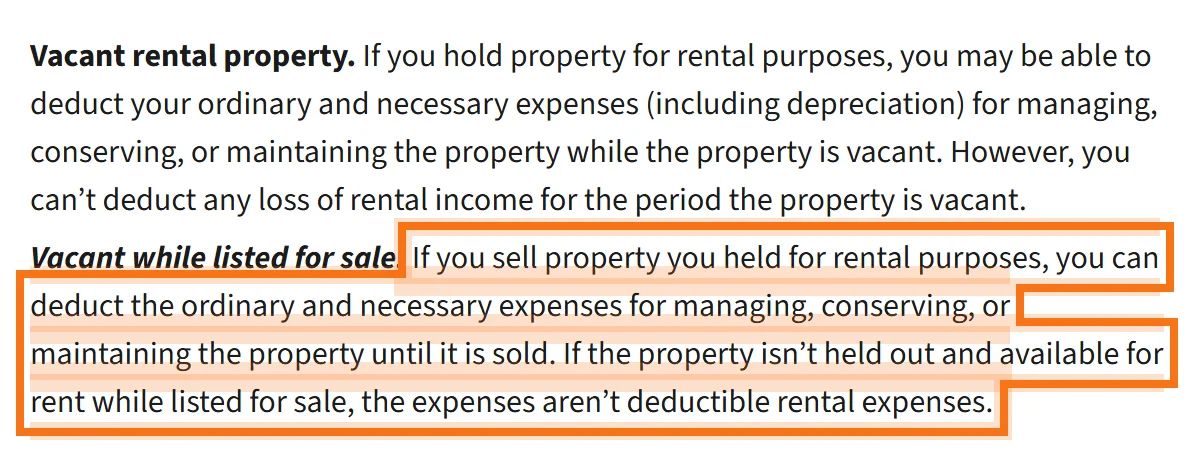
The full sale-with-a-tenant process is in selling a rental with a tenant in place.
The sale side on your own numbers, and the tax points
Illustrative only, not a quote and not tax advice. A rental bought for $250,000, with $10,000 of improvements and $30,000 of depreciation taken, sold for $330,000 with $20,000 of selling costs and a $180,000 loan payoff:
| Line | Where the number comes from | Illustrative |
|---|---|---|
| Sale price | A broker's pricing for the house | $330,000 |
| Selling costs | Your listing and closing quotes | - $20,000 |
| Loan payoff | Your lender's payoff statement | - $180,000 |
| Cash at closing, before tax | Sale price minus the two lines above | $130,000 |
| Adjusted basis | Cost + improvements - depreciation (Pub 544, Pub 527) | $250,000 + $10,000 - $30,000 = $230,000 |
| Gain | Amount realized ($330,000 - $20,000 = $310,000) minus adjusted basis | $310,000 - $230,000 = $80,000 |
How to read this table: the cash line is what you could put to work elsewhere; the gain line is what the IRS looks at. Re-added: $180,000 + $20,000 + $130,000 = $330,000, and $230,000 + $80,000 = $310,000. Weigh the $130,000 against the $21,640 a flat renewal leaves before your own costs; when to sell a rental property shows how to measure return on that equity.
The IRS points, as stated today: Publication 544 defines adjusted basis as cost "increased by certain additions and decreased by certain deductions," including depreciation. Publication 527 says you reduce basis by depreciation "you deducted or could have deducted." Topic 409 treats a gain as long-term if you held the asset more than one year, and "the portion of any unrecaptured section 1250 gain from selling section 1250 real property is taxed at a maximum 25% rate." A 1031 exchange is in the 1031 exchange overview. Ask your CPA before you list.
What changes the answer in North Richland Hills and Fort Worth
Perpetual's North Richland Hills page describes a long-term rental market: "NRH tenants often stay for years when the home is well-kept and rent moves reasonably, renewal strategy matters as much as placement." It also notes that much of the housing stock is 30 to 50 years old, with HVAC, water heaters and roofs needing planned attention, so an upcoming roof or system replacement is a fair input to the sell-or-hold question.
The Fort Worth page makes the same point from the owner's side: "Renewal pricing from current comparables, repairs handled before they become complaints and a tenant who can reach a real person keep a home occupied for years instead of turning over every twelve months." In newer growth-corridor areas, the page adds, a rental competes with brand-new build-to-rent supply, which is a reason to check leased comps rather than last year's rent before setting the increase.
If you are weighing the sale against keeping the house for the long run, the sell-or-rent decision table covers the first-time version of the same choice.
How Perpetual helps you decide at lease end
Perpetual Property Management is broker-owned and based on Rufe Snow Drive in North Richland Hills, managing homes in Keller, North Richland Hills, Fort Worth and nearby. What our site states about the lease-end decision:
- Market check before every renewal from current leased comps, and a recommendation (keep at market, adjust moderately, or let them go) with the turnover math shown, the decision always yours (renewals and turnovers).
- Early conversations: "well before lease end, typically 60–90 days," so marketing starts early if the tenant is leaving.
- Renewal fee per plan on the price sheet: $149, $200 or $150.
- A sale, if that is the answer: Perpetual Realty Group, our affiliated brokerage led by Broker/Owner Justin Brown, sells rentals occupied or vacant, and the rent or sell page lays out four ways out of a house.
Our site does not state a fixed day count for when you must decide, how sale commissions work, or whether management continues on a house listed with a tenant in place, so those are confirmed in writing before you sign. For a renewal or sale view on your house, start with a free rental analysis or call 682-593-7033.
The takeaway: Pick a decision date well before the renewal conversation, get a leased-comp rent check and a sale estimate on the same day, then compare a flat renewal, an increase and a sale on your own numbers before anyone tells the tenant.
Questions owners ask
Who can advise a North Richland Hills landlord on whether to renew, raise rent or sell?
A manager that prices renewals from leased comps and a broker who can sell the house. Perpetual, based in North Richland Hills, runs a market check before every renewal and recommends keeping the rent at market, adjusting moderately or letting the tenant go, with the turnover math shown; the decision is yours. Its affiliated brokerage, Perpetual Realty Group, can sell the house occupied or vacant.
Who can advise a Fort Worth owner whether to renew the lease, raise rent or sell?
The same two skills apply in Fort Worth: renewal pricing from current leased comparables and a broker's view of the sale. Perpetual manages Fort Worth rentals from its North Richland Hills office and prices renewals from current comps, and Perpetual Realty Group handles sales. Compare both choices on your own numbers before the tenant is told.
How early should I decide whether to renew my tenant's lease?
Before the renewal conversation, which Perpetual says typically starts 60 to 90 days before lease end. Give yourself about a month before that to get a leased-comp rent check and, if a sale is possible, a sale estimate. The binding dates are the notice terms in your lease.
Is there a limit on how much I can raise the rent in Texas?
State law lets a city adopt rent control only after finding a housing emergency due to a disaster, with the governor's approval (Local Government Code 214.902). Otherwise the practical limit is the market and whether the tenant stays. For a tenant under a lease, the lease's own terms decide when a new rent can start.
Can I sell my rental while the tenant is still living there?
Yes. The sale goes ahead under the lease, with showings on the lease's access terms. The new owner becomes liable for the security deposit from the date title is acquired and must give the tenant a signed statement with the exact amount (Property Code 92.105).
What tax do I pay when I sell a rental house?
It depends on your gain and your income. The IRS figures gain from adjusted basis, which depreciation reduces; a gain on an asset held more than one year is long-term, and the part of a long-term gain on real property due to depreciation can be taxed at up to 25% (Publication 544, Topic 409). Ask your CPA before you list.
Property management in Keller, North Richland Hills and Fort Worth. How full-service management works in Tarrant County →