Key takeaways
- New-lease comps show what the house would rent for after a turnover; renewal comps show what a sitting tenant is likely to accept.
- The cost of a turnover is the ceiling. On illustrative numbers, one turnover ($4,325) equals about 2.4 years of a $150 increase.
- The tenant's record moves the number: an on-time, careful tenant earns a smaller increase than market.
- Texas Local Government Code 214.902 lets a city adopt rent control only after a disaster housing emergency finding and the governor's approval.
- A guarantor on the original lease does not automatically cover a renewal at a higher rent (Property Code 92.021).
How does a property manager decide how much to raise the rent at renewal? By weighing five inputs: what similar homes leased for to new tenants, what similar tenants accepted when they renewed, what a turnover would cost, how this tenant has paid and kept the house, and when the offer goes out. For homes in Keller, North Richland Hills and Fort Worth, the recommendation closes most of the gap to market without making a good tenant's move-out likely, and the owner approves it.
This guide sets out the method, the arithmetic of the turnover ceiling, what Texas law says, and how the number reaches you and the tenant.
The renewal increase method: five inputs
Here are the five inputs a manager weighs before recommending a renewal rent, what each one does to the number, and where it comes from:
| Input | What is looked at | What it does to the number | Source |
|---|---|---|---|
| New-lease comps | Similar homes nearby that leased to new tenants in recent months, adjusted for condition | Sets what the house would rent for after a turnover | Leased records, not asking prices |
| Renewal comps | What tenants in similar homes recently accepted when they renewed | Shows what a sitting tenant is likely to accept | The manager's own renewals, or your past renewals |
| Cost of a turnover | Vacancy, the placement fee, make-ready, utilities while empty | The ceiling: how much risk an increase can afford | Your fee schedule and your own quotes |
| The tenant's record | Payment history, repair requests, inspection notes, lease compliance | A strong record argues for a smaller increase; a poor one for full market or no renewal | Ledger and inspection reports |
| Timing | When the lease ends and the lease's notice deadline | An early offer lowers the risk of a move-out; a late one raises it | The lease |
How to read this table: the first row says where the rent could go, and the next three say how far toward it this renewal should move. A house whose new-lease comps are well above the current rent, with a tenant who pays late, gets a different recommendation from the same house with a tenant who pays early and reports problems promptly. The last row decides how much room there is to talk.
New-lease comps vs renewal comps
The first input is new-lease comps: similar homes nearby that actually leased to new tenants in recent months, adjusted for condition. Asking prices are not evidence; a listing that has sat for weeks at a high figure says the figure is wrong. New-lease comps tell you what the house would rent for if the tenant left, before you count the cost of getting there. A house with original carpet sits at the low end of its comps; one with fresh paint and a newer system sits at the top.
The second input, renewal comps, is the one owners rarely see: the rents tenants in similar homes accepted when they renewed. A sitting tenant compares the offer with the cost and hassle of moving, not only with listings. A manager who handles many renewals can show what was accepted and what was turned down. Put the two side by side and you see the real range: from what a sitting tenant accepts to what a new tenant would pay. The pricing method itself is in how to price a rental in DFW.
The tenant's record moves the number
The third input is the ledger and the inspection history. A tenant who has paid on time every month, reported problems early and kept the house well is worth more than the rent difference, because the alternative is a turnover. A tenant who pays late, has had lease-compliance notices or has let the house slide is a different calculation: the increase may go to full market, or the recommendation may be not to renew.
Length of stay matters too. A tenant in a third or fourth year has absorbed several increases, and a steep one now may be the one that starts a search. A first-year tenant who signed near market needs only a small adjustment. This is not generosity; it is pricing the risk of an empty house.
The cost of a turnover is the ceiling
An increase only makes sense if it beats the alternative, so the cost of a turnover sets the ceiling. Here is an illustrative house: rent today $2,200, new-lease comps at $2,350. If the tenant leaves, assume one month empty at $2,350, a placement fee of 50% of one month's rent ($1,175) and an $800 make-ready quote. One turnover then costs $2,350 + $1,175 + $800 = $4,325. Here is how many years of each increase it takes to pay for that one turnover. Illustrative only, not a quote:
| Increase | New rent | Extra rent over 12 months | Years of the increase to equal one $4,325 turnover |
|---|---|---|---|
| $0 | $2,200 | $0 | Not applicable |
| $75 | $2,275 | 12 x $75 = $900 | About 4.8 ($4,325 / $900) |
| $110 | $2,310 | 12 x $110 = $1,320 | About 3.3 ($4,325 / $1,320) |
| $150 (full market) | $2,350 | 12 x $150 = $1,800 | About 2.4 ($4,325 / $1,800) |
How to read this table: the last column is how long the tenant must stay at the new rent for the extra income to cover one turnover. If an increase makes a move-out reasonably likely, it rarely pays in the first year. The empty month is rent not received, not a bill, and the figures leave out the monthly management fee. Our renewals page puts a typical turnover at one to two months of rent. For the chance-of-leaving version of this test, see whether to keep a good tenant at the same rent.
Timing of the offer, your costs and the market direction
The fifth input is timing. An offer that reaches the tenant well before the lease ends, with a reply date, gives a good tenant time to say yes before looking at listings, and gives you time to market the house if they say no. An offer sent a few days before the lease's notice deadline forces a rushed decision on both sides. Also check the month the new term would end: a twelve-month renewal ending in a month when your past listings took longer to lease may be better as an eleven- or thirteen-month term.
Two more things shape the number. Your own costs, such as property tax, insurance and HOA dues, move over time, and naming them in the offer helps a tenant accept part of an increase. And direction: if new-lease comps are rising, an increase slightly under today's market may be at market by mid-term; if they are flat, a smaller increase protects you from a vacancy that pays no more. How the renewal year fits around this is in how to keep good tenants longer.
How the number reaches you and the tenant
The recommendation should reach you as a short written summary: current rent, new-lease comps and the range, what similar tenants accepted at renewal, the tenant's record, the turnover arithmetic, and the proposed rent and term. You approve, adjust or decline; who decides what is set out in do owners approve lease renewals.
The tenant then receives the offer in writing with a reply date and a one-line reason. A tenant who sees that the new rent is still below what they would pay to move usually signs; one who receives a bare number often starts browsing that evening. The letter itself, part by part, and the notice timing are in raising the rent: how much and how to tell the tenant.
What Texas law says about renewal increases
Texas law leaves the number to the market and the lease, with a few rules worth knowing, as read in the statute text:
- No standing rent cap: Local Government Code 214.902 lets a city establish rent control by ordinance only if its governing body finds a housing emergency due to a disaster and the governor approves the ordinance.
- Timing: a fixed-term lease sets the rent until it ends unless the lease itself provides for a change, so the increase normally starts with the renewal term. For a monthly tenancy with no other notice period agreed in a signed instrument, Property Code 91.001(b) and (e) make termination effective on the later of the date in the notice or one month after it is given; plan any change on that horizon and check the lease.
- Retaliation: Property Code 92.331(b)(4) bars increasing the rent in retaliation within six months after a tenant's good-faith repair notice or similar action; 92.332(a)(1) excludes increases under an escalation clause in a written lease for utilities, taxes or insurance.
One more rule affects renewals with a co-signer. Under Property Code 92.021(a), a guarantor is liable only for the original lease term unless the original lease specifies otherwise as 92.021(b) allows, and even then only for a renewal that does not increase the guarantor's potential obligation for rent.
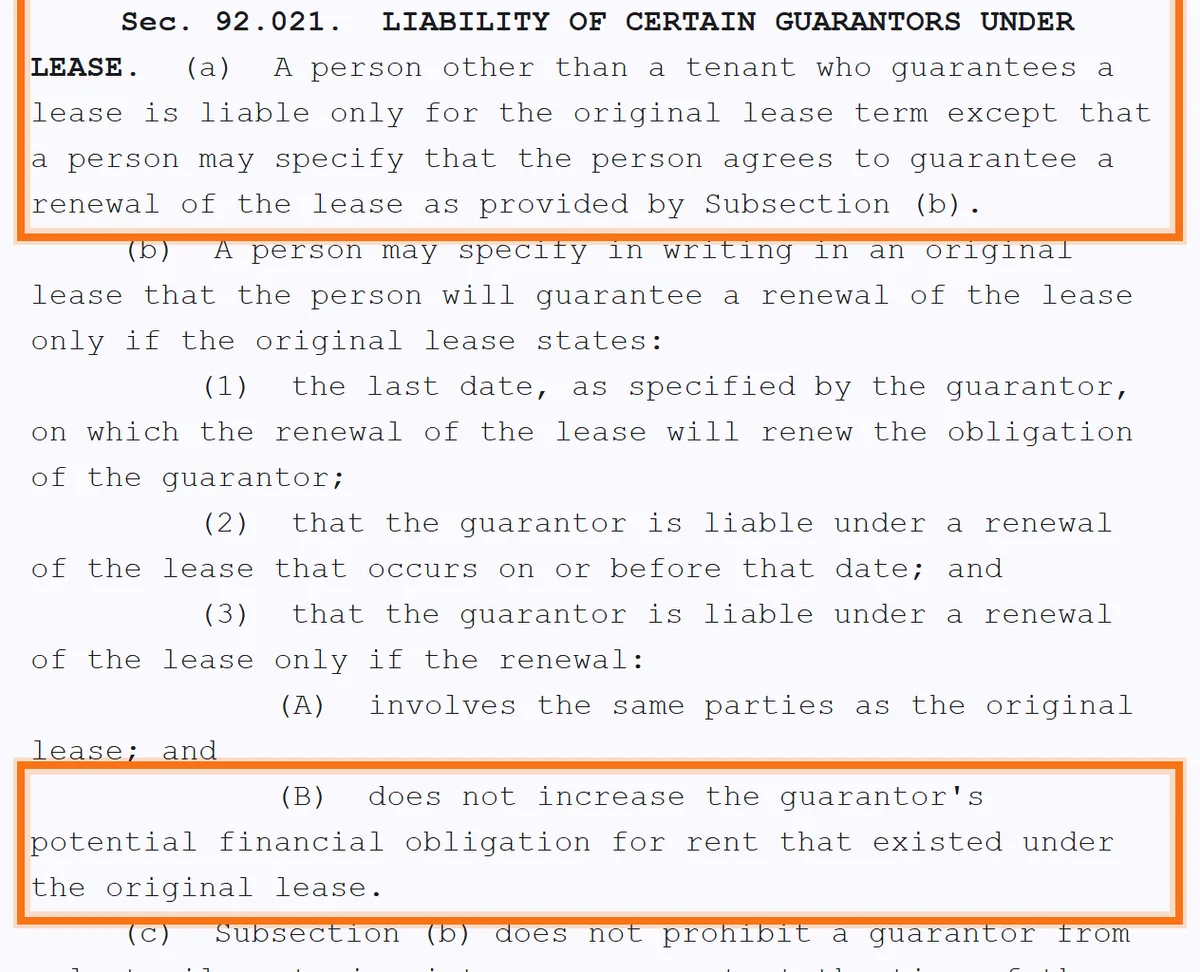
If a guarantor matters to you, ask for a new written guarantee with the renewal; more in should I accept a co-signer or guarantor. This is general information, not legal advice.
How Perpetual handles this
Here is what our site states about renewals:
- Market check before every renewal: current leased comps, the same discipline as initial pricing, so the offer reflects today's market, not last year's.
- A recommendation with reasoning: keep at market, adjust moderately, or let the tenant go, with the turnover math shown. The decision is always yours.
- Early conversations: renewals are negotiated well before lease end, typically 60 to 90 days, so if the tenant is leaving, marketing starts early.
- Raising rent every year: sometimes, depending on the market and the tenant; we show you the leased comps and the turnover math each time, and small regular adjustments usually beat rare painful ones.
- Fees: the management fee is 7%, 9% or 10% of monthly rent and the lease renewal fee is $149, $200 or $150 depending on the plan, as listed on our price sheet.
Anything our site does not list, such as how the renewal offer is worded and delivered, is confirmed in writing before you sign. The full service is on our lease renewals page. To see where your current rent sits against leased comps, request a free rental analysis or call 682-593-7033.
The takeaway: The renewal increase comes from new-lease comps, renewal comps, the cost of a turnover, the tenant's record and timing. The turnover cost is the ceiling: an increase that makes a move-out likely has to earn back vacancy, placement and make-ready before it pays.
Questions owners ask
Is there a limit on how much rent can be raised in Texas?
There is no statewide cap on a renewal increase for a private residential lease. Local Government Code 214.902 lets a city adopt rent control only if its governing body finds a housing emergency due to a disaster and the governor approves. The practical limits are the market and the lease: a fixed-term lease sets the rent until it ends. This is general information, not legal advice.
Should I raise the rent every year?
Not automatically. Small, regular increases that track the market are easier for a tenant to accept than one large correction after several flat years, but in a flat market holding the rent for a good tenant can be the better choice. Our renewals page puts it this way: sometimes, depending on the market and the tenant, with the leased comps and the turnover math shown each time.
What if the tenant pushes back on the increase?
The manager shares the comps and the reasoning, and a small concession often closes the gap: a slightly lower figure, a repair the tenant has wanted, or a longer term. You decide how far the offer can move. If the tenant still declines, the manager starts preparing to market the home so the gap between tenants is as short as possible.
Does a property manager profit from raising my rent?
Where the management fee is a percentage of rent, a higher rent means a slightly higher fee, so ask how the fee is calculated. On our price sheet it is 7%, 9% or 10% of monthly rent depending on the plan. Read the recommendation for its reasoning, not its percentage: it should show the comps and the turnover math, so you can check the number serves you.
What is the difference between renewal comps and new-lease comps?
New-lease comps are what similar homes rented for to new tenants, which is what your house would rent for after a turnover. Renewal comps are what tenants in similar homes accepted when they renewed. A sitting tenant weighs the offer against the cost of moving, so the two can differ. Seeing both shows the realistic range for a renewal offer.
Does a guarantor cover the higher rent after a renewal?
Not automatically. Under Texas Property Code 92.021, a guarantor is liable only for the original lease term unless the original lease specifies otherwise, and even then only for a renewal that does not increase the guarantor's potential obligation for rent. A guarantor may sign a new written guarantee for the higher rent (92.021(c)). This is general information, not legal advice.
Property management in Keller, North Richland Hills and Fort Worth. How full-service management works in Tarrant County →