
Key takeaways
- A guarantor adds a second source of money. Accept one for a money gap, never for a behavior gap such as an eviction or an unpaid landlord.
- Co-signer vs guarantor: a guarantor promises to pay but does not live there; a co-signer who moves in is a co-applicant under Property Code 92.351 and is screened like any tenant.
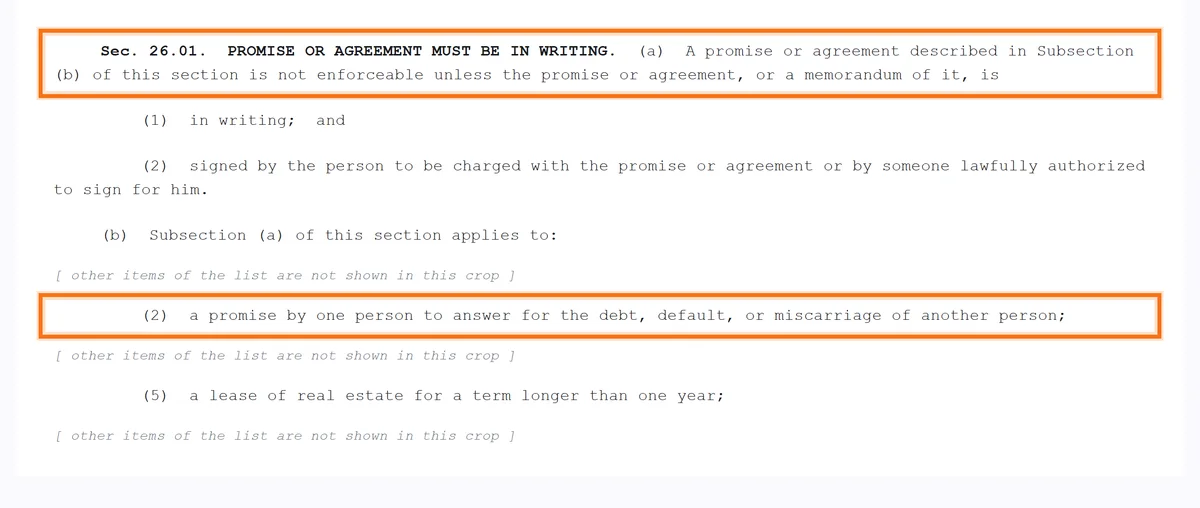
- A promise to answer for another person's debt is enforceable only in a signed writing (Business and Commerce Code 26.01).
- Requiring a co-signer or a larger deposit because of a screening report can be an adverse action that needs a notice under federal law.
- Whatever you decide, write it into the criteria before you list and apply it to every applicant.
Should you accept a co-signer or guarantor for a tenant? Yes, when the applicant's only shortfall is income or credit history, the guarantor is screened as carefully as a tenant, and a signed written guaranty covers the whole lease. No, when the problem is a prior eviction or money owed to a landlord. On a rental in Fort Worth, Keller or North Richland Hills, the rule should be in your written criteria before anyone applies.
This guide covers the difference between a co-signer and a guarantor, which applicants a guarantor actually helps, what the guaranty must say and the alternatives. Who counts as a tenant, an occupant or a guarantor on a lease in general is explained in roommates, co-signers and occupants.
When a guarantor fixes an application, and when it does not
Here is how common applicant situations line up against a guarantor, and what to ask for instead when a guarantor is the wrong tool:
| Applicant situation | Does a guarantor fix it? | What to ask for |
|---|---|---|
| Full-time student with little or no income | Often yes: the gap is money | A screened guarantor with a signed written guaranty |
| Starting a first job, offer letter in hand | Often yes, until pay stubs exist | The offer letter plus a guarantor, or a start date that allows pay stubs |
| Thin credit file, steady verified income | Often not needed | The full report and rental references; decide under your written credit rule |
| Income short of the rent standard, a roommate will live there | No: the roommate is a co-applicant | A separate application from every adult who will live in the house |
| Eviction by a previous landlord | No: the gap is behavior | Apply the written criteria as they are |
| Unpaid charges owed to a previous landlord | No: a guarantor pays after the loss, not instead of it | Apply the written criteria as they are |
How to read this table: the top rows are money gaps, where a second person who can pay changes the risk. The bottom rows are records of how the applicant behaved as a tenant, and a guarantor does not change behavior. If your written criteria list a record as a cause for rejection, a guarantor does not undo it.
Co-signer vs guarantor: the difference on a Texas lease
People use the two words for the same thing, but on a Texas rental they describe two different roles, and the difference decides what the person must sign and whether they are screened as a resident.
- Guarantor. Someone, often a parent, who promises to pay if the tenant does not, and who will not live in the house. Section 26.01 of the Business and Commerce Code says a promise by one person to answer for the debt, default or miscarriage of another is not enforceable unless the promise, or a memorandum of it, is in writing and signed by the person making it.
- Co-signer who moves in. Property Code 92.351 defines a co-applicant as a person who applies with other applicants and plans to live in the dwelling. That person is a tenant in all but name, is screened like one, and under section 92.352 a landlord's rejection of one co-applicant is a rejection of all co-applicants.
So the practical test is simple: will this person live in the house? If yes, they apply and sign the lease as a tenant. If no, they sign a separate written guaranty. This is general information, not legal advice.
A guarantor requirement can trigger a federal notice
Owners usually think of a guarantor as a favor to the applicant. Federal law can see it differently. The Consumer Financial Protection Bureau explains that under the Fair Credit Reporting Act, a landlord who rejects an application because of information in a tenant screening report must give an adverse action notice, and that adverse action can also include requiring a co-signer, or a larger deposit or higher rent than other applicants pay.
So if your approval says "yes, with a guarantor" because of what the screening report showed, treat it as an adverse action. The notice must name the company that provided the report, explain the applicant's right to a free copy if requested within 60 days, and explain the right to dispute inaccurate information. A guarantor rule written into the criteria, applied the same way to everyone, keeps that step routine rather than improvised.
Screen the guarantor like an applicant
A guarantor is worth something only if they can pay and can be found. So the guarantor goes through the same checks you would run on a tenant: identity, credit history, income and employment, and any eviction or court records, with their written consent. Decide the income standard in advance and write it down. Owners often set it higher than the tenant's, because the guarantor also pays for their own home.
Where the guarantor lives matters in practice. Collecting from someone across town is easier than from someone in another state, and much easier than from someone in another country. If you want a US or Texas address, put it in the written policy and apply it to every guarantor. The checks themselves, and what each one answers, are covered in background checks for Texas rental applicants.
What the guaranty should say
Section 26.01 sets the minimum: a signed writing. A guaranty that protects you in practice also states, in plain words:
- That the guarantor answers for all of the tenant's obligations under the lease, meaning rent, fees, damage and costs, not rent only.
- Whether you can pursue the guarantor without first collecting from the tenant.
- Whether the guaranty covers a renewal. Under Property Code 92.021, a guarantor who is not a tenant is liable only for the original lease term unless the original lease states the last date on which a renewal will renew the guarantor's obligation, and then only for a renewal with the same parties that does not increase the guarantor's potential obligation for rent.
- The guarantor's address for notices, and that the guarantor has received a copy of the lease.
- The guarantor's consent to the screening.
The renewal point causes the most trouble. Without that wording in the original lease, the guaranty does not follow the tenant into a second term, and owners often find that out only when rent stops. A guarantor may still agree to a higher rent at renewal in a separate written document (92.021(c)). At each renewal, either get a new signed guaranty or decide whether the tenant now qualifies alone. Have a Texas attorney review your guaranty form. This is general information, not legal advice.
What collecting from a guarantor looks like
Be realistic about collecting. If the tenant stops paying, the notices and any eviction proceed against the tenant; the guarantor is asked for the money separately, usually with a written demand first and a court claim only if that fails. A guarantor with a job, a home and a reachable address usually pays when the demand arrives. A guarantor who was never screened, or who has moved and cannot be found, is a signature on paper.
An illustrative example: your Keller tenant is a graduate student whose parent in Fort Worth signed the guaranty. The student falls behind in month nine. The tenant receives the notices the lease and Texas law require, the parent receives a demand under the guaranty, and the parent brings the account current. That good outcome depended on three things decided at the start: the parent was screened, local, and bound to the whole lease. What happens when money is still owed after a tenant leaves is in damage or unpaid rent beyond the deposit.
Alternatives to a guarantor, and writing the policy
When a guarantor is not available, or not the right tool, these are the realistic alternatives for a new tenant:
- A larger security deposit. Texas sets no statewide cap on the deposit amount, and cash in hand is stronger than a promise. If you require it because of a screening report, the adverse action notice above applies.
- A co-applicant. A roommate or partner who will live there applies, is screened and signs the lease. Under our published criteria, only the 2 highest earners count toward the income requirement.
- A different home. An applicant whose income is short for this rent may qualify for a lower one. Saying so plainly is better than stretching a rule.
- Rent paid in advance. Some applicants offer it. Section 92.102 treats an advance payment of rent as separate from a security deposit, so account for it separately, and get advice before relying on it.

Write the policy down before the house is listed: when a guarantor is accepted, what the guarantor must show, what the guaranty covers and which alternative applies instead. Fair housing law expects the same standard for every applicant, so a rule made up for one person is the weak point. The full framework is in tenant screening criteria in Texas.
How Perpetual handles this
Perpetual Property Management is broker-owned, with our office at 5755 Rufe Snow Dr in North Richland Hills, and we lease homes in Keller, North Richland Hills, Fort Worth and nearby. What our site states about applicants:
- Published criteria, the same for everyone. Our rental criteria require income of at least 3 times the rent, counting only the 2 highest earners, verified with pay stubs covering at least 6 weeks and 2 months of bank statements. All applicants are evaluated against the same written criteria.
- Every adult applies. Each applicant 18 or older completes a separate application, at $60 per applicant.
- Causes for rejection are listed, including eviction by a previous landlord and outstanding debt or unpaid charges to a previous landlord.
- No exceptions for "seems great." Our tenant screening page says it directly: the moment an owner or manager makes an exception for someone who seems great, they own both risks.
- Monthly statements in the owner portal, with income, expenses and documents in one place.
Our published criteria do not mention guarantors. Whether we accept a guarantor for your house, what the guarantor must show and which guaranty form is used are confirmed in writing before you sign. To set the rule before you list, call 682-593-7033 or request a free rental analysis.
The takeaway: Take a guarantor for a money gap, never for a behavior gap, get the guaranty in a signed writing, and apply the same written rule to every applicant.
Questions owners ask
Is a co-signer the same as a guarantor on a Texas lease?
Not quite, though people use the words loosely. A guarantor signs a separate written promise to pay if the tenant does not and does not live in the house. A co-signer who will live there is a co-applicant under Property Code 92.351: they apply, are screened and sign the lease as a tenant. For a parent who will not move in, a signed guaranty is the right document.
How much income should a guarantor have?
Texas law sets no number; it is your written policy. Decide it before you list and apply it to every guarantor. Owners often set it above the tenant standard because the guarantor also pays for their own home, and verify it the same way as any applicant's income. Our published criteria state 3 times the rent for applicants and do not state a guarantor standard.
Can a guarantor live in another state or country?
They can, but collecting from them gets harder with every border. If you want a US or Texas address, write that into the policy and apply it to every guarantor rather than deciding person by person.
Does a guarantor stay liable after the lease renews?
Usually not. Property Code 92.021 limits a guarantor who is not a tenant to the original lease term unless the original lease states the last date on which a renewal will renew the guarantor's obligation, for a renewal with the same parties and no higher potential rent obligation. If that wording is missing, do not assume the guaranty carries over: get a new signed guaranty at renewal or decide whether the tenant now qualifies alone. This is general information, not legal advice.
What does guarantor mean on a rental lease?
A guarantor is a person who promises the landlord to pay the tenant's rent and other lease obligations if the tenant does not. The guarantor does not live in the house and is not a tenant. In Texas that promise must be in writing and signed by the guarantor to be enforceable (Business and Commerce Code 26.01).
What are the alternatives to a guarantor for a new tenant?
The common ones are a larger security deposit, a co-applicant who will live in the house and be screened, a lower-rent home the applicant qualifies for alone, or rent paid in advance, accounted for separately from the deposit. If an alternative is required because of a screening report, federal law treats it as an adverse action that needs a notice.
Can I require a guarantor from some applicants but not others?
Only under a written rule that says exactly when a guarantor is required, applied the same way to everyone who falls under it, for example every applicant whose verified income is below your stated standard. A guarantor asked of one applicant and waived for another in the same situation is the kind of inconsistency fair housing complaints are built on.
Related services
Property management in Keller, North Richland Hills and Fort Worth. How full-service management works in Tarrant County →