
Key takeaways
- Screening starts before anyone applies: Texas requires printed notice of the selection criteria when the application is provided (Property Code 92.3515).
- Each check has a source and a blind spot; the table below lists both.
- A denial based even partly on a consumer report needs an adverse action notice (15 U.S.C. 1681m).
- A landlord who does not accept an applicant by the seventh day after a completed application has, by law, rejected it (92.352).
- Perpetual measures every applicant against the same written criteria: income at least 3x the rent, counting only the 2 highest earners.
Tenant screening works as a fixed order of steps: the written criteria come first, then a complete application from every adult, then the checks of identity, income, credit, rental history, employment and criminal background, and finally a decision with a notice. Each step answers one question and leaves others open. Whether the house is in Fort Worth, Keller or North Richland Hills, the order and the standard are the same for every applicant.
This guide follows one application through that process. What the written standard should contain is covered in tenant screening criteria for Texas rentals, and our own published standard is on the rental criteria page. This is general information, not legal advice; for anything beyond the text of a statute, ask a Texas attorney.
The tenant screening process, one application in order
Here is the order one application moves through, with where each piece of information comes from and the limit of what it proves:
| Check, in order | Where the information comes from | What it can show | What it cannot show |
|---|---|---|---|
| 1. Criteria made available | The landlord's printed tenant selection criteria, given with the application (92.3515(a)) | The applicant knows the standard before paying a fee | Whether the applicant will qualify |
| 2. Complete application from each adult | The applicant: a separate application from each applicant and co-applicant 18 or older | Who will live in the house and what they claim about income and history | Whether any claim is true |
| 3. Identity | A driver's license, passport or government-issued photo ID | That the documents name the person applying | Anything about payment history |
| 4. Income | Pay stubs and bank statements from the applicant (at Perpetual: minimum 6 weeks of stubs, 2 months of statements) | Whether documented income meets the stated multiple of rent | Whether the income will continue |
| 5. Credit | A consumer report, obtained for a permissible purpose | How obligations, collections and delinquencies have been handled | Why a past problem happened |
| 6. Rental history | Previous landlords and the residential history on the application | Payment record, notice given, money left owing | How the applicant will treat a different house |
| 7. Employment | The employer | That the job and pay on the documents exist | Job security next year |
| 8. Criminal background | A background search on each applicant | Records that the written criteria address | Anything the criteria do not address; it must not be used for anything else |
| 9. Decision and notice | The file measured against the written criteria | A decision traceable to a published standard | Nothing new: it only applies what steps 1 to 8 found |
How to read this table: read across each row before trusting a result. A strong credit file says nothing about whether income will continue, and a glowing reference says nothing about the next house, which is why no single check decides an application on its own. This is general information, not legal advice; for anything beyond the text of a statute, ask a Texas attorney.
The written criteria, before the application
The process starts before the first application. Under Property Code 92.3515(a), at the time an applicant is provided with a rental application, the landlord "shall make available to the applicant printed notice of the landlord's tenant selection criteria and the grounds for which the rental application may be denied," including criminal history, previous rental history, current income, credit history, or failure to provide accurate or complete information.
The applicant then signs an acknowledgment that the notice was made available (92.3515(b)). If the landlord rejects an applicant without having made the notice available, the landlord "shall return the application fee and any application deposit" (92.3515(e)). The practical effect: the standard is written, published and fixed before anyone is measured against it.
The application, identity and the consumer report
Every adult who will live in the house completes an application, because each one is screened. Why that matters for an owner is covered in does every adult in the house need to be screened. Identity comes first, from a government-issued photo ID, so that every later report is about the right person.
Credit comes from a consumer report. The FTC's guide for landlords, "Using Consumer Reports: What Landlords Need to Know," states that "You can only get a consumer report if you have a permissible purpose," and that "You may not use the consumer report for another purpose." When the file has been used, "you must securely dispose of the report and any information you gathered from it." A report shows how obligations have been handled. It does not explain why.
Income, measured against the rent
Income is compared with the rent using the multiple in the written criteria. The documents come from the applicant, so the check is whether they are complete, readable and consistent with each other: pay stubs that match deposits on bank statements, for example. Perpetual's criteria require pay stubs covering a minimum of 6 weeks and 2 months of bank statements, and state that screenshots of balances are not accepted.
Illustrative only, not a quote: at a rent of $1,950, 3x the rent is $5,850 a month (1,950 x 3 = 5,850; check: 5,850 / 3 = 1,950). Under our criteria that figure must come from no more than the two highest earners in the household. How each kind of income is checked is in how property managers verify income and employment.
Rental history and employment
Rental history comes from the residential history on the application and from previous landlords. Our criteria ask for 3 years of residential history and rental references, and our screening page says, "we speak to previous landlords." A reference can show whether rent was paid, whether notice was given and whether money was left owing. It cannot show how the applicant will treat a different house, which is why it is read alongside credit and income rather than instead of them.
Employment confirms that the job and pay on the documents exist; on our screening page, employment is "verified with the employer." Neither check predicts next year. Several of our published causes for rejection come from this step: "Eviction by a previous landlord," "Outstanding debt or unpaid charges to a previous landlord" and "Excessive late rent payments in the last 2 years."
The criminal background check and fair housing
Criminal history is one of the grounds 92.3515(a) expects a landlord's criteria to address, and our application includes a criminal background check on all applicants. The result is read only against what the written criteria say.
Every step sits inside fair housing law. The federal Fair Housing Act, 42 U.S.C. 3604(a), makes it unlawful to refuse to rent or "otherwise make unavailable or deny, a dwelling to any person because of race, color, religion, sex, familial status, or national origin," and 3604(f) covers handicap. The Texas Fair Housing Act says the same in Property Code 301.021. Which background checks are appropriate is the subject of legal background checks for Texas rental applicants.
The decision and the adverse action notice
The decision is the file measured against the written criteria, nothing more. If the answer is no, and a consumer report played any part, 15 U.S.C. 1681m(a) applies: the person taking the adverse action must give notice of it, the name, address and telephone number of the consumer reporting agency, a statement that the agency did not make the decision and cannot give the specific reasons, and notice of the right to a free copy of the report within 60 days and to dispute its accuracy.
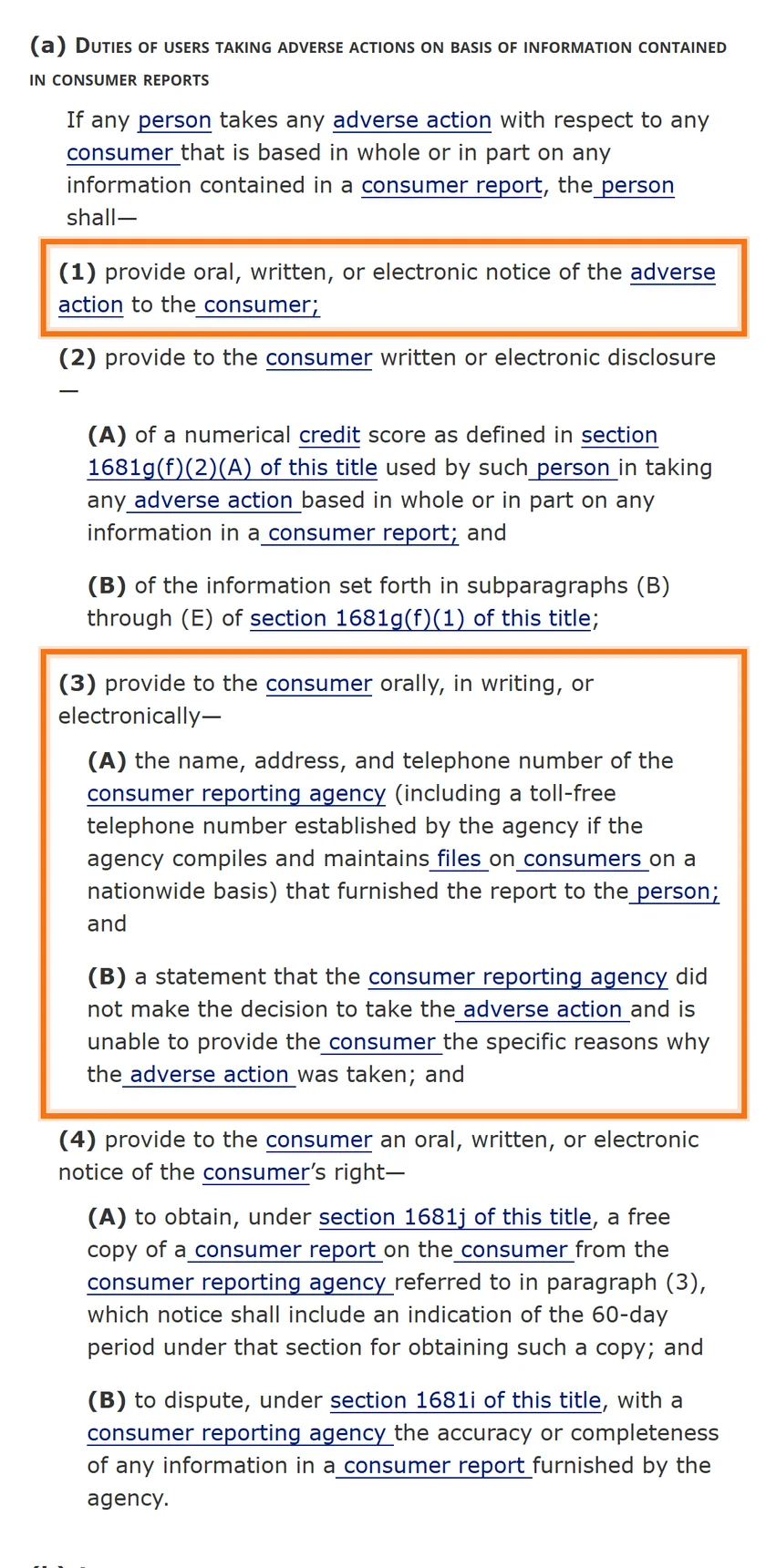
The FTC's landlord guide defines an adverse action as "any action by a landlord that is unfavorable to the interests of a rental applicant or tenant," and its examples include requiring a co-signer or a larger deposit than another applicant would need, not only a denial. The notice can be given "in writing, electronically, or orally"; the FTC recommends writing. This is general information, not legal advice; for anything beyond the text of a statute, ask a Texas attorney.
The Texas clock on a decision
Texas puts a clock on the decision. Under 92.352(a), the applicant "is deemed rejected by the landlord if the landlord does not give notice of acceptance of the applicant on or before the seventh day after" the completed application is submitted on the landlord's form. A rejection of one co-applicant counts as a rejection of all of them (92.352(b)).
Notice of acceptance or rejection is presumed given if it is by telephone to the applicant, a co-applicant or a person living with them on or before that date, or by U.S. mail postmarked by then (92.353(a)). If the date falls on a Saturday, Sunday or holiday, it moves to the end of the next day (92.353(c)). A landlord who in bad faith fails to refund an application fee or deposit in violation of the subchapter is liable for $100, three times the amount wrongfully retained and the applicant's reasonable attorney's fees (92.354). This is general information, not legal advice; for anything beyond the text of a statute, ask a Texas attorney.
What an owner should see from the process
An owner does not need the raw reports to know the process was followed. Ask the manager for:
- The criteria that were in force when the application came in, and the signed acknowledgment that they were made available.
- The date the completed application was submitted and the date of the decision, inside the seven-day window.
- Which criteria were met, in plain terms: income multiple, history, background.
- For a denial, confirmation that the notice went out, and which criterion was not met.
If a manager cannot show these, the screening may still have happened, but nobody can prove it was applied the same way to every applicant. How a manager chooses when several people qualify is covered in multiple rental applications.
How Perpetual runs this process
Perpetual Property Management is broker-owned, with an office at 5755 Rufe Snow Drive in North Richland Hills, and manages homes in Keller, North Richland Hills, Fort Worth and nearby. Our published rental criteria are the standard every application is measured against:
- A separate application from each applicant and co-applicant 18 or older; the fee is $60.00 per applicant.
- Identification: a driver's license, passport or government-issued photo ID.
- Income at least 3x the rent, with verifiable proof including pay stubs (minimum 6 weeks) and 2 months of bank statements; screenshots of balances are not accepted. Only the 2 highest earners count toward the 3x requirement.
- 3 years of residential history, rental references and monthly income details.
- The application includes a credit history evaluation, rental history verification, employment and income verification, and a criminal background check on all applicants.
Denied or canceled applications are non-refundable. "All applicants are evaluated against the same written criteria," as our criteria page says, and on our tenant screening page: "You set the standards with us; we apply them without exceptions." For owners, screening is part of tenant placement; the fee for it is on the price sheet and confirmed in writing in the management agreement. To talk through your house, call 682-593-7033.

The takeaway: Screening is a sequence, not a judgment call: criteria first, a complete application from every adult, each check read for what it can and cannot show, a decision within the Texas seven-day window, and a written notice when a consumer report played a part.
Questions owners ask
What rent-to-income ratio does tenant screening use?
The ratio is whatever the landlord's written criteria say; the application sections of the Property Code (92.351 to 92.355) require the criteria to be made available but do not set a number. Perpetual's published criteria require income of at least 3x the rent, counting only the 2 highest earners. Illustrative only: at $2,000 rent, the two highest earners together need $6,000 a month.
Does screening accept a co-signer?
Only if the landlord's written criteria say so, and the same way for everyone. Perpetual's published criteria do not mention co-signers or guarantors, so ask us before relying on one. Under the FTC's landlord guide, requiring a co-signer because of something in a consumer report is itself an adverse action that needs a notice. When a guarantor makes sense at all is covered in our guide on <a href="/resources/accept-co-signer-guarantor-tenant">accepting a co-signer or guarantor</a>.
How does screening treat an applicant with a past eviction?
It is read against the written criteria, the same way for every applicant. Perpetual's published causes for rejection include "Eviction by a previous landlord" and "Outstanding debt or unpaid charges to a previous landlord." The difference between an eviction filing and a judgment, and what a report may show, is in <a href="/resources/property-managers-evaluate-applicants-previous-evictions">how property managers evaluate applicants with previous evictions</a>.
Can I approve an applicant on a good feeling?
Not if you want a process you can defend. A decision that does not trace to the published criteria is the one that is hardest to explain later. On our tenant screening page we put it plainly: "You set the standards with us; we apply them without exceptions." If the vacancy is the pressure, change the price or the marketing, not the standard.
How do property managers screen tenants?
In a fixed order: the written selection criteria are made available with the application, as Property Code 92.3515 requires; every adult applies separately; identity is checked against a government ID; income documents are measured against the rent; a consumer report shows credit; previous landlords and the employer are contacted; a criminal background check is run; and the file is measured against the criteria. A denial based partly on a consumer report gets an adverse action notice under 15 U.S.C. 1681m. This is general information, not legal advice; for anything beyond the text of a statute, ask a Texas attorney.
How do they verify a rental applicant's income and employment?
From the applicant's documents, checked against each other and the source. Perpetual's criteria require pay stubs covering a minimum of 6 weeks and 2 months of bank statements, and do not accept screenshots of balances; employment is verified with the employer. The income must reach 3x the rent from no more than the two highest earners. "Insufficient or unverifiable income" is one of our published causes for rejection.
Do property managers actually call previous landlords?
A good one does. Our criteria ask applicants for 3 years of residential history and rental references, and our tenant screening page says, "we speak to previous landlords." The reference shows payment record, notice and money left owing; it cannot show how the applicant will treat a different house, so it is read with credit and income, not instead of them.
What background checks are appropriate and legal for Texas rental applicants?
Texas expects the criteria to address criminal history, rental history, income and credit (Property Code 92.3515(a)), and Perpetual's application includes credit, rental history, employment and income verification, and a criminal background check on all applicants. Every check must be applied without regard to race, color, religion, sex, handicap, familial status or national origin (42 U.S.C. 3604; Property Code 301.021). Reports are used only for the screening purpose and disposed of securely, as the FTC's landlord guide says. This is general information, not legal advice; for anything beyond the text of a statute, ask a Texas attorney.
Related services
Property management in Keller, North Richland Hills and Fort Worth. How full-service management works in Tarrant County →