
Key takeaways
- Two statutes apply: the federal Fair Housing Act (42 U.S.C. 3604) and the Texas Fair Housing Act (Property Code chapter 301).
- The protected grounds in 3604 are race, color, religion, sex, familial status, national origin and handicap; Texas uses the word disability.
- The rules reach every step: the ad, the showing, the application, the lease terms and services during the tenancy.
- The single-family exemption in 3603(b) never covers advertising, and its text requires renting without a broker or agent.
- Texas law also requires a landlord to make written tenant selection criteria available with the application (Property Code 92.3515).
Fair housing law for a Texas landlord comes from two statutes, the federal Fair Housing Act at 42 U.S.C. 3604 and the Texas Fair Housing Act in Property Code chapter 301. They make it unlawful to refuse to rent, to set different terms, to advertise a preference or to say a home is unavailable because of a protected characteristic. For an owner renting a house in Fort Worth, Keller or North Richland Hills, the checklist runs from the listing to the last repair.
Below: a subsection-by-subsection table, then who is protected, the listing, the application, accommodation and modification requests, the tenancy, the exemption, and where a complaint goes. Quotations are from the statute text.
The checklist: 42 U.S.C. 3604, subsection by subsection
Here is what each part of 42 U.S.C. 3604 prohibits, in the statute's own words where they matter, and where it shows up when you rent out one house:
| 3604 subsection | What it prohibits, as the text reads | Where it shows up for a house owner |
|---|---|---|
| (a) | Refusing to rent after "a bona fide offer," refusing to negotiate, or to "otherwise make unavailable or deny" a dwelling because of race, color, religion, sex, familial status or national origin | Answering one inquiry and not another, saying the house is taken, turning down an applicant |
| (b) | Discrimination in "the terms, conditions, or privileges" of rental, "or in the provision of services or facilities in connection therewith" | Rent, deposit, move-in date and lease terms; repair response and access to anything that comes with the house |
| (c) | Any "notice, statement, or advertisement" about a rental "that indicates any preference, limitation, or discrimination" (this subsection adds handicap to the list) | The listing text, sign, captions, texts and emails to prospects |
| (d) | Telling a person a dwelling "is not available for inspection, sale, or rental when such dwelling is in fact so available" | Who is offered a showing, and what a caller is told about availability |
| (e) | For profit, inducing a person to sell or rent by "representations regarding the entry or prospective entry into the neighborhood" of people of a particular group | Anything said about who lives in, or is moving into, the neighborhood to push a deal |
| (f)(1) and (f)(2) | The same refusals and different terms "because of a handicap" of the renter, a person who will live there, or "any person associated with" the renter | Application decisions, lease terms and services |
| (f)(3)(A) | Refusing "reasonable modifications" of the premises "at the expense of the handicapped person" when necessary for full enjoyment | A tenant's request to make a physical change to the house |
| (f)(3)(B) | Refusing "reasonable accommodations in rules, policies, practices, or services" when necessary for equal opportunity to use and enjoy a dwelling | A request to change a rule or a way of doing things |
How to read this table: the left column is your checklist, and the right column is where an owner of a single house meets it. Subsection (f)(3)(C), on accessible design, applies to "covered multifamily dwellings," which 3604(f)(7) defines as buildings of 4 or more units with an elevator and ground-floor units in other buildings of 4 or more units, so it is not a single-house item. This is general information, not legal advice.
Who is protected: the words the two Acts use
42 U.S.C. 3604(a) and (b) list race, color, religion, sex, familial status and national origin. Subsections (c), (d), (e) and (f) add handicap. Two definitions in 42 U.S.C. 3602 matter for a house owner:
- Familial status (3602(k)): one or more individuals under 18 living with a parent, a legal custodian, or that person's designee with written permission. The protection also applies to "any person who is pregnant or is in the process of securing legal custody" of a minor.
- Handicap (3602(h)): a physical or mental impairment that substantially limits one or more major life activities, a record of such an impairment, or being regarded as having one. It does not include "current, illegal use of or addiction to a controlled substance."
The Texas Fair Housing Act lists the same grounds and uses the word disability, defined in Property Code 301.003(6) in nearly the same terms. Section 301.004 defines familial status much as the federal text does. Section 301.0045 adds that discrimination because of race includes a person's "hair texture or protective hairstyle commonly or historically associated with race."
The listing: describe the house, never the household
Section 3604(c) makes it unlawful to publish any "notice, statement, or advertisement" about a rental that "indicates any preference, limitation, or discrimination" based on a protected ground, "or an intention to make any such preference." Texas Property Code 301.022 uses the same words. Both reach more than a printed ad: a yard sign, a listing caption, a text reply to an inquiry and a showing-day remark are all statements about the rental.
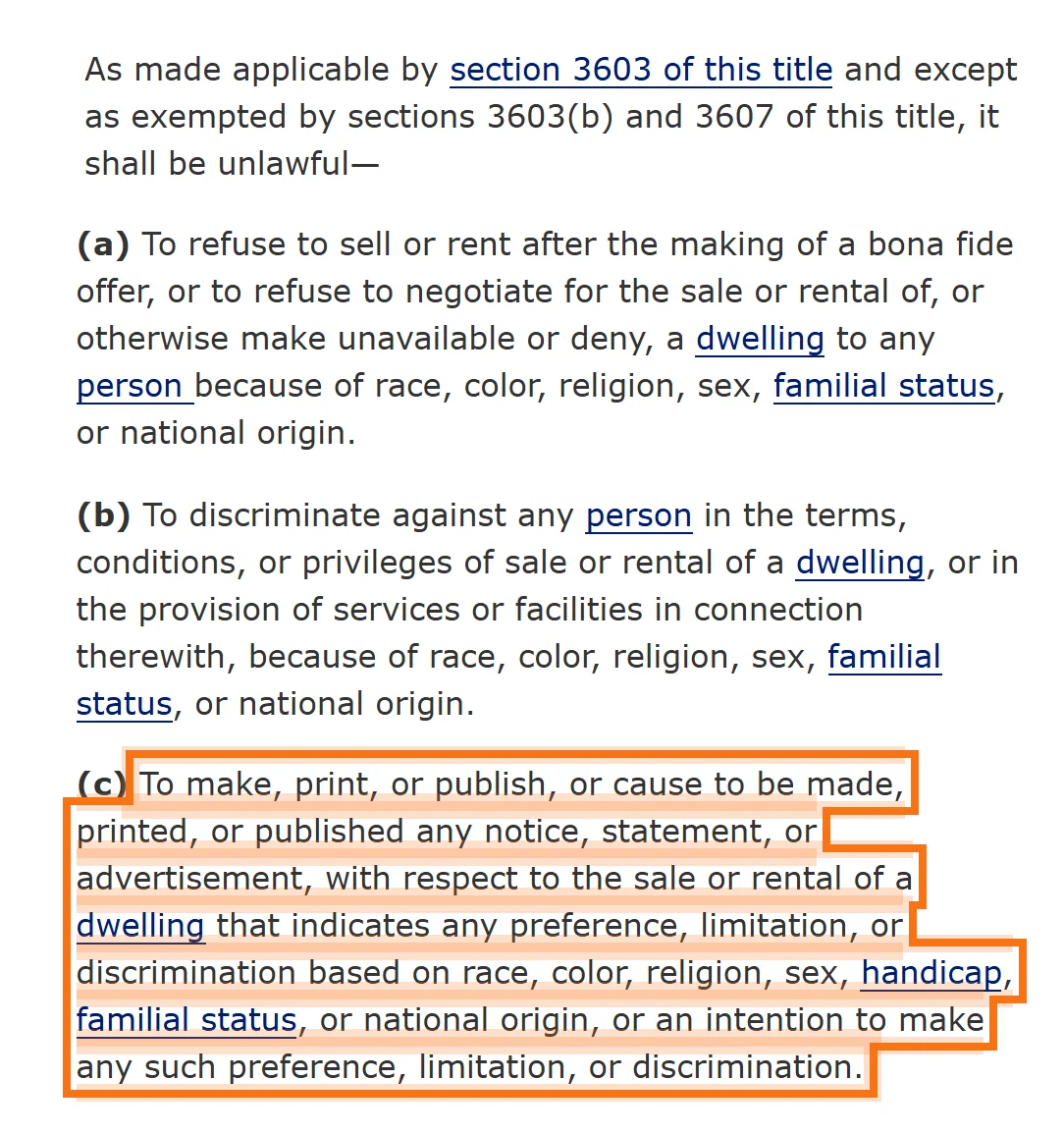
The practical test is simple: does the sentence describe the house or the household? "Three bedrooms, fenced yard, two-car garage, near the named park" describes the house. Phrases that name who should live there, such as a type of family, an age group, a faith, a language or a nationality, describe the household, which is what 3604(c) addresses. If a feature appeals to a particular group, state the feature and let every reader decide.
The same discipline applies to where the ad runs and how inquiries are answered. Every prospect gets the same listing, the same answer about availability under 3604(d), and the same way to book a showing. Our guide to protecting rental listings covers controlling where a listing appears.
The application: written criteria, the same for every applicant
The application is where a yes or no is given under 3604(a) and (b). The protection is a written standard, set before the house is listed and applied the same way to everyone. Texas law already requires part of it: under Property Code 92.3515(a), when an applicant is given a rental application, the landlord "shall make available to the applicant printed notice of the landlord's tenant selection criteria and the grounds for which the rental application may be denied," including criminal history, previous rental history, current income, credit history and failure to give accurate or complete information.
The applicant signs an acknowledgment (92.3515(b)). If the landlord rejects an applicant without having made the notice available, 92.3515(e) says the landlord "shall return the application fee and any application deposit." A written standard therefore does two jobs: it satisfies the notice rule, and it is the record of why each decision was made.
What goes into the standard, and how each item is verified, is covered in tenant screening criteria in Texas and how tenant screening works. The fair housing point is narrower: the same documents, income test and reasons for denial for every applicant.
Accommodation and modification requests, as 3604(f)(3) reads
Section 3604(f)(3) describes two kinds of request and makes refusing either a form of discrimination because of handicap.
- Modifications (3604(f)(3)(A)): refusing to permit, "at the expense of the handicapped person, reasonable modifications of existing premises" if they "may be necessary to afford such person full enjoyment of the premises." For a rental, "the landlord may where it is reasonable to do so condition permission for a modification on the renter agreeing to restore the interior of the premises to the condition that existed before the modification, reasonable wear and tear excepted."
- Accommodations (3604(f)(3)(B)): refusing "to make reasonable accommodations in rules, policies, practices, or services, when such accommodations may be necessary to afford such person equal opportunity to use and enjoy a dwelling."
Texas Property Code 301.025(c) uses the same two definitions. Both Acts add one limit, in 3604(f)(9) and 301.025(f): nothing requires a dwelling to be made available to an individual "whose tenancy would constitute a direct threat to the health or safety of other individuals or whose tenancy would result in substantial physical damage to the property of others."
For an owner, the working rule is procedural: answer every request in writing, decide it on its own facts, and keep the request, the response and the reason. Where a request is unclear or you think it may be unreasonable, ask a Texas attorney before saying no. This is general information, not legal advice.
During the tenancy: terms, repairs and services
Section 3604(b) does not stop at the lease signing. It covers "the terms, conditions, or privileges" of the rental and "the provision of services or facilities in connection therewith," and Property Code 301.021(b) does the same in Texas. For one house, that means:
- Repairs. Requests are handled by urgency and order received, with the same response for every tenant.
- Lease enforcement. A late-fee policy or a notice for a lease violation follows the lease, the same way each time.
- Renewals and rent changes. The offer is built from the market and the tenant's record under the lease, not from who the household is.
- Vendors. Anyone entering the house on your behalf represents you while they are there.
A written policy turns each decision into a check against something you set in advance. How a manager splits the Texas duties with you is in Texas landlord-tenant law basics.
The single-family exemption, and why it ends when you hire a manager
Owners of one house often ask whether the federal Act applies to them at all. The exemption is in 42 U.S.C. 3603(b)(1), and it opens: "Nothing in section 3604 of this title (other than subsection (c)) shall apply to" a single-family house rented by a private owner who owns no more than three such houses at a time. Advertising under 3604(c) is never exempt.
The same paragraph then sets conditions. The house must be rented "without the use in any manner of the sales or rental facilities or the sales or rental services of any real estate broker, agent, or salesman," and without publishing an advertisement in violation of 3604(c). An owner who hires a broker-owned management company to lease the house is using exactly those services.
Texas reads the same way. Property Code 301.041(a) exempts such a house from sections 301.021, 301.023, 301.024 and 301.025 only if it is rented without the services of a broker or agent "licensed under Chapter 1101, Occupations Code" and without an advertisement prohibited by 301.022. The publication rule in 301.022 is not on the exempted list. Whether the exemption fits your facts is a question for a Texas attorney; with a manager involved, plan on the rules applying in full.
Where a complaint goes, and the file that answers it
Property Code 301.0015 transfers the powers under the Texas Fair Housing Act to the Texas Workforce Commission, which "shall investigate complaints" (301.081(a)). Under 301.081(d), a complaint "must be filed on or before the first anniversary of the date the alleged discriminatory housing practice occurs or terminates, whichever is later." Under 301.151(a), an aggrieved person may also file a civil action in district court "not later than the second year" after the practice. If a court finds a violation, 301.153 lets it award "actual and punitive damages," reasonable attorney fees, court costs and an injunction.
The answer to a complaint is the file, so build it as you go:
- The listing as published and every change to it, with dates.
- The written criteria and each applicant's signed acknowledgment (92.3515).
- Each application, what was verified, the decision and the notice sent.
- Every accommodation or modification request, the response and the reason.
- Repair requests and how each was handled.
This guide is general information, not legal advice. For a decision about a specific applicant or request, ask a Texas attorney.
What Perpetual publishes on fair housing and screening
What our site states, and nothing beyond it:
- Our statement. The rental criteria page ends: "Perpetual Property Management supports and complies with the Fair Housing Act. All applicants are evaluated against the same written criteria." Our disclosures page says we support and comply with the Fair Housing Act and Equal Housing Opportunity requirements.
- The application. A separate application from each applicant and co-applicant 18 or older, at $60.00 per applicant; a driver's license, passport or government-issued photo ID; 3 years of residential history.
- Income. At least 3 times the rent, counting only the 2 highest earners, with verifiable proof including pay stubs (minimum 6 weeks) and 2 months of bank statements. Screenshots of balances are not accepted.
- Screening included. A credit history evaluation, rental history verification, employment and income verification, and a criminal background check on all applicants.
- Who decides. Our tenant screening page says: "You set the standards with us; we apply them without exceptions."
How a request for an accommodation or a modification at your house is handled, and what you approve, is confirmed in writing in the management agreement before you sign; ask us. To talk through the criteria for your house, call 682-593-7033.
The takeaway: Fair housing compliance for one Texas rental is a short list: describe the house, not the tenant; show and offer it to everyone the same way; apply written criteria identically; answer accommodation and modification requests; and keep the file.
Questions owners ask
Can a landlord in Texas refuse to rent to someone with children?
No. 42 U.S.C. 3604(a) and (b) and Texas Property Code 301.021 list familial status as a protected ground, and the federal definition covers individuals under 18 living with a parent or legal custodian, plus a person who is pregnant or securing custody. An occupancy limit is a different question: Property Code 301.044(a) says the Texas Act does not affect "a reasonable local or state restriction on the maximum number of occupants."
What is a reasonable accommodation or modification under the Fair Housing Act?
42 U.S.C. 3604(f)(3) treats two refusals as discrimination because of handicap: refusing reasonable modifications of the premises at the tenant's expense, and refusing reasonable accommodations in rules, policies, practices or services when necessary for equal opportunity to use and enjoy the home. For a modification, a landlord may, where reasonable, require the interior to be restored at move-out, reasonable wear and tear excepted.
What words should a landlord avoid in a rental listing?
Avoid any wording that describes who should live in the house rather than the house itself, because 42 U.S.C. 3604(c) and Property Code 301.022 bar any notice, statement or advertisement that indicates a preference, limitation or discrimination on a protected ground. Describe bedrooms, yard, parking, school district and nearby places by name, and let every reader decide whether the home suits them.
Do fair housing laws apply to a landlord with only one rental property?
Almost always, in practice. The exemption in 42 U.S.C. 3603(b)(1) excludes advertising under 3604(c) and applies only to an owner of no more than three single-family houses who rents without the services of any real estate broker or agent. Texas Property Code 301.041 has the same conditions. Hiring a broker-owned manager to lease the house uses exactly those services, so plan on the rules applying in full.
Is there a fair housing compliance checklist for Texas landlords?
Use 42 U.S.C. 3604 itself: no refusal or "otherwise make unavailable" on a protected ground (a), the same terms and services for everyone (b), no ad indicating a preference (c), honest availability for showings (d), and answers to accommodation and modification requests (f)(3). Add Texas Property Code 92.3515: written selection criteria made available with every application, with a signed acknowledgment.
Where is a fair housing complaint filed in Texas?
Complaints under the Texas Fair Housing Act go to the Texas Workforce Commission (Property Code 301.0015 and 301.081). Under Property Code 301.081(d), a complaint must be filed on or before the first anniversary of the date the practice occurred or ended, whichever is later. Under 301.151, an aggrieved person may also file a civil action in district court not later than the second year after the practice. Keep your listing, criteria and application file for that reason.
Related services
Property management in Keller, North Richland Hills and Fort Worth. How full-service management works in Tarrant County →