Key takeaways
- Most rules are in Property Code chapter 92, and several carry fixed penalties plus the tenant's attorney's fees.
- Deposits: refund or itemize within 30 days after surrender, once you have a written forwarding address (92.103, 92.107).
- Late fees: written lease, two full days late, and 12% of the rent or less (up to four units) to be presumed reasonable (92.019).
- No illegal lockouts, utility cutoffs or retaliation (92.0081, 92.008, 92.331).
- No statute sets an entry notice period. The lease decides.
What are the basic Texas landlord-tenant laws? For a house in Fort Worth, Keller or North Richland Hills, most are in chapter 92 of the Texas Property Code: repairs, security deposits, late fees, security devices, smoke alarms, lockouts and utility cutoffs, retaliation, and who the tenant can reach. Eviction notices are in chapter 24, which changed on January 1, 2026. Where the statute is silent, the written lease decides.
Below: each rule with its section number and what breaking it costs, what a landlord cannot do, and what the lease must add. General information, not legal advice.
Texas landlord-tenant law at a glance: 12 rules with section numbers
Here are the rules Texas rental owners run into most, the section where each one lives, and what breaking it can cost:
| Rule | Section | What it requires | If broken |
|---|---|---|---|
| Repairs | 92.052, 92.056 | Diligent effort to repair a condition materially affecting health or safety, after notice from a tenant current on rent; 7 days is a rebuttable presumption of reasonable time | Tenant may terminate, repair and deduct (92.0561) or sue |
| Deposit refund | 92.103, 92.107 | Refund or written itemized deductions by the 30th day after surrender, once the tenant gives a written forwarding address | Late is presumed bad faith (92.109(d)) |
| Deposit deductions | 92.104, 92.109 | No deduction for normal wear and tear; itemized list of all deductions | $100 + 3 times the amount wrongfully withheld + attorney's fees |
| Last month's rent | 92.108 | Tenant may not withhold it on the grounds that the deposit covers it | A bad-faith tenant owes 3 times the rent withheld + attorney's fees |
| Late fees | 92.019 | Notice in a written lease, reasonable, rent unpaid two full days after due; 12% (up to 4 units) or 10% (more than 4) is presumed reasonable | $100 + 3 times the fee collected + attorney's fees |
| Lockouts | 92.0081 | Only for delinquent rent, only if the lease allows it, with advance written notice and a key at any hour | One month's rent + $1,000 + damages + fees |
| Utilities | 92.008 | No interruption of a tenant-paid utility except for bona fide repairs, construction or an emergency | Tenant remedies in 92.008(f) |
| Security devices | 92.153, 92.156 | Window latches, door locks, keyless bolting device, door viewer, sliding-door pin lock and bar or latch; rekey within 7 days of each turnover | Tenant remedies in 92.164 |
| Smoke alarms | 92.255, 92.258 | One in each bedroom, plus corridor and each level as stated; tested at move-in; repaired on request | Tenant remedies in 92.260 |
| Retaliation | 92.331, 92.333 | No rent increase, eviction filing, reduced services or termination within 6 months of a protected tenant act | One month's rent + $500 + damages + fees |
| Who manages | 92.201 | Disclose the record owner and any off-site management company, for example in the lease | Tenant remedies in 92.205 |
| Notice to vacate | 24.005 | At least 3 days' written notice unless the lease says otherwise, delivered by a method in 24.005(f-3) | An eviction suit can fail on a defective notice |
How to read this table: the third column is the rule as the statute states it, shortened; the fourth is why it matters. Several penalties include the tenant's attorney's fees, so a small mistake on a deposit or a late fee can cost far more than the money involved. Under 92.006(a), the duties and remedies on deposits, security devices, ownership disclosure and utility cutoffs, and the duty to install smoke alarms, cannot be waived in the lease.
Repairs: the duty, the notice and the 7-day presumption
Under Property Code 92.052, a landlord must make a diligent effort to repair or remedy a condition that materially affects the physical health or safety of an ordinary tenant, or a failure to provide hot water of at least 120 degrees, once the tenant has given notice to the person or place where rent is normally paid and is not delinquent in rent. The notice must be in writing only if the written lease requires it. Conditions caused by the tenant, an occupant, family or guests are not the landlord's duty, unless the cause is normal wear and tear.
The landlord then has a reasonable time. Section 92.056 creates a rebuttable presumption that seven days is reasonable, weighed against the severity of the condition and the availability of materials, labor and utilities. If the landlord does not make a diligent effort after the required notices, the tenant may terminate the lease, go to court, or in the situations 92.0561 lists, repair and deduct up to one month's rent or $500, whichever is greater. A prompt, documented repair process protects the owner as much as the tenant. More detail is in Texas landlord repair obligations.
Security deposits: 30 days, an itemized list, no wear and tear
Texas does not cap the deposit amount, but it is strict at move-out. The landlord must refund the deposit by the 30th day after the tenant surrenders the premises (92.103), but need not refund or itemize until the tenant gives a written forwarding address (92.107). Deductions are limited to damages and charges the tenant is liable for, never normal wear and tear, with a written itemized list (92.104).
Keeping a deposit in bad faith costs $100, three times the amount wrongfully withheld and attorney's fees, and missing the 30 days is presumed bad faith (92.109). The tenant, for their part, may not skip the last month's rent on the grounds that the deposit covers it (92.108). The defense is a photo move-in inspection, the same checklist at move-out and invoices behind each deduction: Texas security deposit rules.
Entry: no Texas statute sets a notice period
No Texas statute sets a notice period before a landlord enters a rental, which surprises owners from other states. That does not mean entry at will: a lease that says nothing leaves the question to argument.
A good Texas lease states when the landlord may enter, for what purposes (repairs, inspections, showings near the end of the term, emergencies), and what notice will be given. With that in the lease, an inspection is a scheduled visit, not a confrontation. The details, including showings in an occupied home, are in landlord entry rights in Texas.
Security devices and smoke alarms
Under 92.153, at the landlord's expense and without the tenant asking, a house needs a latch on each exterior window; a doorknob lock or keyed deadbolt, a keyless bolting device and a door viewer on each exterior door; and a pin lock plus a handle latch or security bar on each sliding glass door. Under 92.156, keyed devices are rekeyed no later than the seventh day after each turnover.
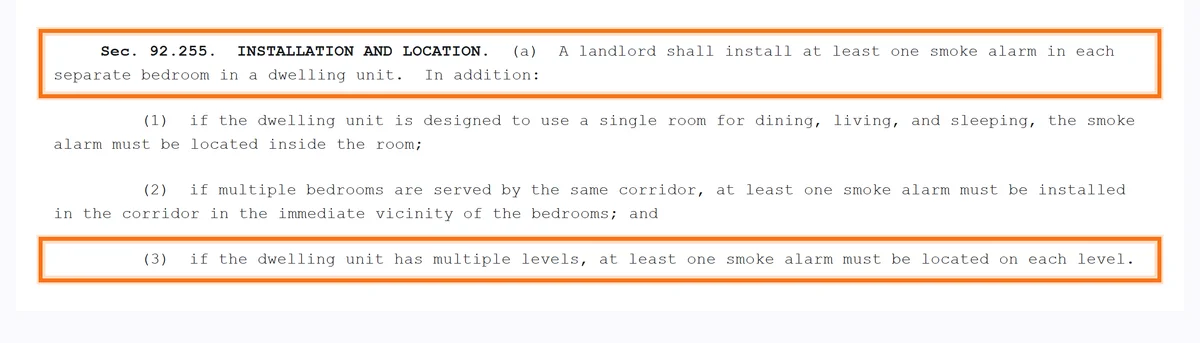
Under 92.255, at least one smoke alarm goes in each separate bedroom, plus the corridor serving several bedrooms and each level of a multi-level home; units occupied before September 1, 2011 may use battery alarms. Under 92.258, the landlord tests them at move-in and repairs them when the tenant reports a problem.
The checklist is in security devices and smoke alarms in Texas rentals.
Late fees and notices to vacate
How much late fee can a landlord charge in Texas? Under 92.019, only if notice of the fee is in a written lease, the fee is reasonable, and part of the rent has been unpaid two full days after the due date. A fee of no more than 12% of the month's rent (a building of four or fewer units) or 10% (more than four) is considered reasonable; an initial fee plus daily fees count as one fee. A violation costs $100, three times the fee and attorney's fees.
Notices to vacate are in chapter 24. Under 24.005, as amended effective January 1, 2026, a defaulting tenant gets at least three days' written notice unless the lease says otherwise; a tenant evicted only for nonpayment who was not late before that month gets a notice to pay rent or vacate. Delivery: mail, inside the premises in a conspicuous place, by hand to a tenant 16 or older, or electronically if agreed in writing. Next steps: late rent in Texas and the eviction timeline.
What a landlord cannot do in Texas
Each item as the Property Code states it:
- Change the locks except as 92.0081 allows. Only for delinquent rent, only if the lease gives that right, after written notice mailed at least 5 days ahead or hand-delivered or posted inside the main entry door at least 3 days ahead, and with a key available at any hour whether or not rent is paid.
- Remove doors, windows, locks or landlord-furnished appliances except for a bona fide repair or replacement, which must then be done promptly (92.0081(a)).
- Interrupt a utility the tenant pays for directly, except for bona fide repairs, construction or an emergency (92.008(a)).
- Retaliate. No rent increase, termination, eviction filing or service cut within six months after a protected tenant act (92.331).
- Keep a deposit for normal wear and tear (92.104(b)), or charge a late fee before rent has been unpaid two full days (92.019).
- Refuse a timely cash rent payment, unless the written lease requires payment by check, money order or another traceable instrument (92.011).
Tenant screening and leasing are also covered by fair housing law, which bars discrimination against applicants and tenants in protected classes.
Retaliation: the six-month window
Under 92.331, for six months after a tenant in good faith exercises a legal or lease right, gives a notice to repair, complains to a code-enforcement agency or joins a tenant organization, a landlord may not retaliate by filing an eviction, depriving the tenant of the premises, decreasing services, raising the rent or terminating the lease. The remedy (92.333) is one month's rent plus $500, actual damages, court costs and attorney's fees. Under 92.332, an eviction for delinquent rent, intentional damage, a material breach or a holdover after notice is not retaliation.
The practical rule: a renewal increase planned for every home is defensible; one that arrives two weeks after a complaint is not.
What the lease must add to the statute
The statute leaves most of the lease to the parties, but a few sections shape it. The landlord must disclose the record owner and any off-site management company, and the lease is one way to do it (92.201). Every landlord must give tenants a number for reporting emergencies (92.020). A lease requiring payment by check, money order or another traceable instrument lets you refuse cash (92.011). A guarantor is liable only for the original term unless the lease states the renewal terms (92.021). A lockout right exists only if the lease says so (92.0081).
Beyond that, cover rent, due date and late fee; the deposit; who maintains what; entry notice; pets; occupancy; HOA rules; early termination; and nonrenewal notice.
Where a property manager fits in
The trouble usually comes from not knowing a rule exists: the 30-day deposit clock, the two full days before a late fee, the 7-day rekey. A manager's value is a process that applies the same steps on every home. Statutes change (chapter 24 did on January 1, 2026), so read the current text on statutes.capitol.texas.gov before acting. This is general information, not legal advice; for your situation, ask a Texas attorney.
How Perpetual handles this
Perpetual Property Management is broker-owned, with our office in North Richland Hills, and we manage homes in Keller, North Richland Hills, Fort Worth and nearby. What our site states about the pieces of this law we handle:
- Leases. Our management covers Texas-compliant leases and move-in documentation.
- Repairs. Tenants report issues through their portal, emergencies follow a 24/7 process, and repairs under the spending limit you pre-approve get fixed fast; anything larger comes to you with a description, photos and a recommendation (maintenance coordination).
- Deposits. Every move-in and move-out gets a 360-degree condition inspection, and the move-out inspection is measured against the move-in baseline, with fair, documented deposit handling.
- Late rent. Late fees are applied per the lease, with escalation steps that are the same for every tenant, every time.
How we deliver notices, which lease form and addenda we use, and who handles a lockout question or a court filing are confirmed in writing before you sign. To talk through your rental, call 682-593-7033.
The takeaway: Texas landlord-tenant law is manageable once you know the dozen rules with penalties attached; a written lease that fills the gaps the statute leaves open does the rest.
Questions owners ask
How long does a landlord have to return a security deposit in Texas?
On or before the 30th day after the tenant surrenders the premises (92.103), but not until the tenant gives a written forwarding address (92.107). Deductions need a written itemized list (92.104), and missing the 30 days creates a presumption of bad faith (92.109).
Does a landlord have to give notice before entering a rental in Texas?
No Texas statute sets a notice period, so the lease governs. A well-drafted lease states the purposes for entry, the notice the tenant will receive, and what happens in an emergency. Put it in writing before the tenant moves in.
What repairs is a landlord required to make in Texas?
Under 92.052, a landlord must make a diligent effort to repair a condition that materially affects the physical health or safety of an ordinary tenant, or a lack of hot water of at least 120 degrees, after notice from a tenant who is current on rent. Section 92.056 presumes seven days is a reasonable time, subject to rebuttal. Conditions caused by the tenant or their guests are not covered, unless caused by normal wear and tear.
Can a landlord charge any late fee they want in Texas?
No. Under 92.019 the fee must be in a written lease, reasonable, and charged only after rent has been unpaid two full days. Up to 12% of the month's rent (four or fewer units) or 10% (more than four) is considered reasonable. An illegal fee costs $100, three times the fee and attorney's fees.
What Texas landlord rules should a property manager help me follow?
The twelve in the table at the top: repairs, the 30-day deposit deadline, rekeying and security devices, smoke alarms, late-fee limits, lockouts, utility cutoffs, retaliation and notices to vacate. Since no statute sets an entry notice period, the lease must supply one.
What can a landlord not do in Texas?
Lock a tenant out except as 92.0081 allows, cut off a tenant-paid utility except for repairs, construction or an emergency (92.008), retaliate within six months of a protected act (92.331), keep a deposit for normal wear and tear (92.104), or charge a late fee before rent is two full days late (92.019). General information, not legal advice.
Can a Texas landlord refuse to take cash rent?
Only if the written lease requires payment by check, money order or another traceable or negotiable instrument. Otherwise, under Property Code 92.011, the landlord must accept a timely cash payment, give a written receipt and record the payment date and amount in a record book.
Property management in Keller, North Richland Hills and Fort Worth. How full-service management works in Tarrant County →