
Key takeaways
- Pet rent and a pet deposit are both legal in Texas when the lease or pet addendum states them.
- A pet deposit is part of the security deposit: refundable, and itemized within 30 days of move-out like the rest.
- A pet fee is nonrefundable only when the lease clearly says so.
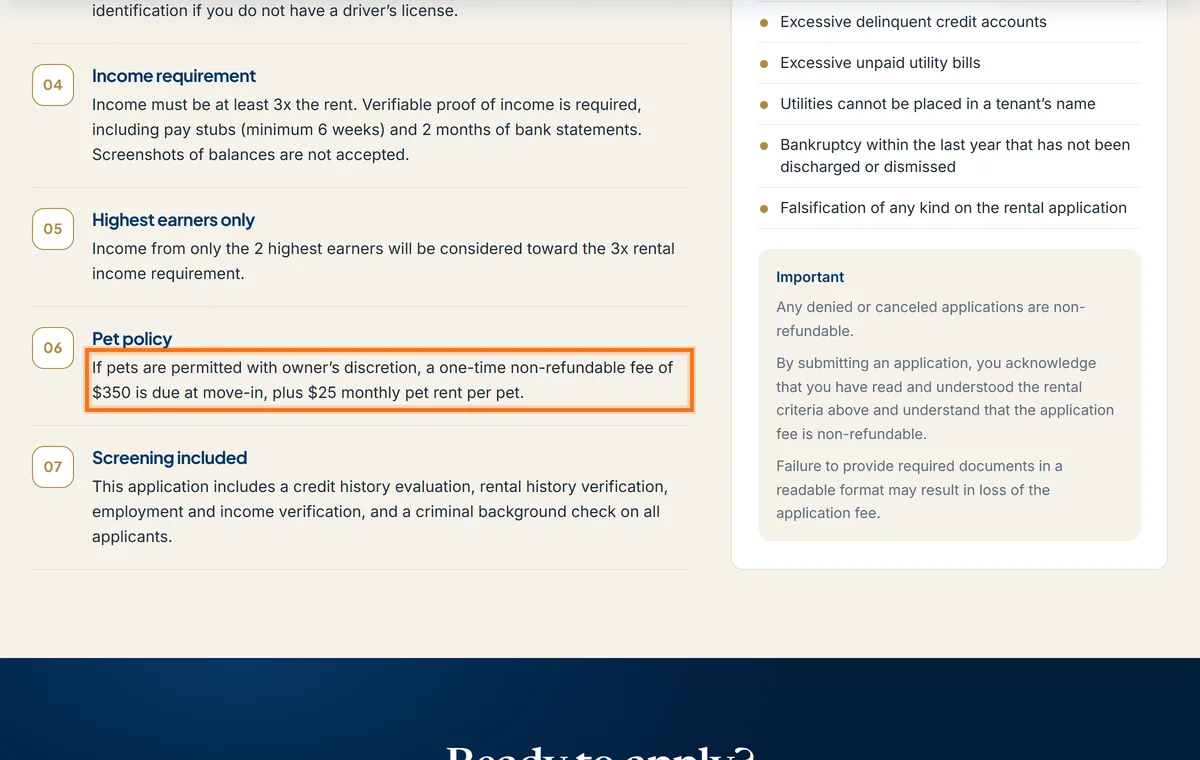
- Our published terms: a one-time nonrefundable $350 fee at move-in plus $25 monthly pet rent per pet, when the owner permits pets.
- Every applicant completes a PetScreening profile, with or without pets; a trained or equipped service dog carries no extra charge or deposit (Human Resources Code 121.003(h)), and other assistance animal requests are decided per request.
Yes, pet rent and a pet deposit are both legal in Texas when the lease or a pet addendum states them. A pet deposit is refundable as part of the security deposit; a pet fee is not. On the homes we manage in Fort Worth, Keller and North Richland Hills, when the owner permits pets, an approved pet means a one-time nonrefundable $350 fee at move-in plus $25 a month in pet rent per pet.
Allowing pets in a Keller, North Richland Hills or Fort Worth rental is usually the right call, provided the pet is screened as carefully as the person and the lease spells out who pays for what. Owners who ban pets outright turn away the applicants who disclose their pets, and a pet that appears anyway comes with no deposit and no addendum covering it.
This guide covers how we screen pets, how pet deposits, pet fees and pet rent fit under Texas law, why assistance animals are a separate category with different rules, and the practical steps that keep a pet-friendly home in good condition.
Why saying yes to pets usually pays
A no-pets listing rules out every applicant with a dog or a cat; a pet-friendly listing can consider them as well as everyone else.
The income side matters too. Pet rent and a pet deposit are allowed in Texas when the lease or pet addendum states them. You are paid for the extra wear, and you get to pick from a bigger pool of applicants. The risk you are managing is the pet that does real damage, and that risk is handled by screening and the lease, not by a blanket ban.
If you are not sure how a pet policy changes the rent you can ask for, a free rental analysis will show you where pet-friendly homes sit against the rest of the neighborhood.
How pet screening works
We screen every animal the way we screen every applicant: the same questions, the same documentation, the same decision rule. We use PetScreening, a third-party profile every applicant completes online, with or without pets, which also documents assistance-animal requests properly. It collects the animal's type, breed, age, weight, vaccination records, spay or neuter status, training and behavior history, along with photos.
From that profile and the conversation with the applicant, the checklist is short:
- Current rabies and core vaccinations, with a veterinarian's records.
- Any history of bites, aggression or complaints at a prior rental, confirmed with the prior landlord.
- Breed and weight against any limits set by the owner's insurance policy or the HOA, which are the usual sources of restrictions.
- Number of animals against the lease limit.
- Whether the pet is housebroken and, for dogs, how long it will be alone each day.
The prior landlord call is the most useful step. A dog that spent two years in a rental with no complaints and a clean move-out is a low-risk dog. Our tenant screening treats the pet profile as part of the application, so the decision on the animal and the decision on the people are made together and documented together.
Pet deposits, pet fees and pet rent under Texas law
Texas does not cap the security deposit a landlord may charge, and a pet deposit is generally treated as part of the security deposit. That means it follows the same rules at move-out: it is refundable, it can be applied to damage beyond normal wear, and it has to be accounted for in the same written itemization within the same deadline as the rest of the deposit.
A nonrefundable pet fee is a different animal, and the lease has to say clearly that it is nonrefundable. Pet rent is a monthly charge on top of the base rent, and it pays the owner every month the animal lives in the home. A refundable deposit and monthly pet rent can be combined.
Whichever structure you choose, it must be in the lease or a pet addendum, and it has to be the same for every tenant with a comparable pet. The rules for how deposits are returned are covered in Texas security deposit rules.
Pet deposit vs. pet fee vs. pet rent
The charges side by side, with what the tenant gets back:
| Charge | When it is paid | Refundable? | What it is for |
|---|---|---|---|
| Pet deposit | At move-in, with the security deposit | Yes, as part of the security deposit | Damage beyond normal wear, itemized within 30 days after move-out |
| Pet fee | Once, at move-in | No, when the lease says it is nonrefundable | The added cost of a pet at turnover; ours is $350 |
| Pet rent | Every month, with the rent | No | Ongoing wear while the animal lives in the home; ours is $25 per pet |
| Pet screening profile | Online, with the application | Not a deposit | Documents each animal, or no animal, and any assistance-animal request |
| Service dog (Texas definition: specially trained or equipped) | Nothing extra | Not applicable | Human Resources Code 121.003(h): no extra compensation or deposit for the animal; the tenant is liable for damage beyond reasonable wear and tear |
| Other animal requested as a disability accommodation | Decided per request, in writing | Decided per request | Not a pet decision; the fair housing texts do not address pet fees, so get an attorney's view before any charge |
How to read this table: only the deposit can come back to the tenant, and only what is left after itemized damage. The fee and the pet rent are income to the owner, and none of the three may be required for a service dog as Texas law defines it; other assistance animal requests are decided separately.
Assistance animals: a separate request, not a pet decision
A tenant with a disability who asks to keep an animal is asking for a reasonable accommodation, not a pet approval. 42 U.S.C. 3604(f)(3)(B) and Texas Property Code 301.025(c)(2) make it discrimination to refuse "reasonable accommodations in rules, policies, practices, or services" that may be necessary for equal opportunity to use and enjoy a home. HUD's regulation, 24 CFR 100.204, gives a seeing eye dog in a no-pets building as its own example of a violation.
On money, Texas Human Resources Code 121.003(h) says a person with a service animal, which 121.002(1) defines as a dog specially trained or equipped to help a person with a disability, "may not be required to pay extra compensation or make a deposit for the animal," but is liable for damage beyond reasonable wear and tear. For any other animal, the statute and regulation texts do not address pet fees, so the decision is made per request, in writing, with an attorney's view before any charge. On questions, 24 CFR 100.202(c) bars asking whether an applicant has a disability or about its nature or severity.
Keep each request out of the pet process and decide it in writing. Fair housing for Texas landlords covers the broader statute, and the assistance animals guide sets out what you may ask, charge or refuse, law by law. This is general information, not legal advice.
What the pet addendum should cover
The lease addendum is where the policy becomes enforceable. A good one lists each approved animal by name, type, breed, weight and photo, so that an approved beagle cannot become two unapproved shepherds a year later. It also sets out:
- The deposit, fee and pet rent, and whether each is refundable.
- Waste cleanup, leash rules, and where the animal may be kept.
- Flea and pest treatment responsibilities, including at move-out.
- Carpet cleaning or deodorizing at move-out, and who pays.
- What happens if an unapproved animal is found: the fee, the cure period, and the right to require removal.
- A requirement to keep vaccinations current and to notify the owner of any bite or complaint.
Our leasing service uses a pet addendum written for Texas and reviewed with the lease, so every pet-friendly home we manage starts from the same document.
Protecting the home during the lease
A pet-friendly home holds up fine with a few choices made in advance. Hard-surface flooring in main areas outlasts carpet and is easier to clean at turnover. A fenced yard with a working gate latch prevents most escape problems, and a quick check of fence boards during make-ready costs little. Window blinds take abuse from dogs that watch the street, so inexpensive replacements are a normal turnover item.
During the lease, periodic inspections are where pet issues get caught early: scratched doors, a yard that is not being picked up, a litter box in a bad spot. We photograph the condition and address it with the tenant while it is still small. Our inspection service documents that for the owner, and the written record is what makes a deposit deduction hold up later.
At move-out, the pet addendum does its work. Flea treatment, odor and stains beyond normal wear, and damaged doors, trim or landscaping are documented, priced from actual invoices, and itemized against the deposit.
Where owners get it wrong
- Banning pets to avoid risk, then discovering a dog on an inspection with no addendum and no deposit.
- Running an assistance animal request through the pet policy: charging a service dog the pet fee, or asking about a diagnosis (24 CFR 100.202(c)).
- Approving a pet by text with no addendum, which leaves nothing to enforce at move-out.
- Setting breed limits that the owner's insurance policy does not actually require, which shrinks the pool for no reason.
- Forgetting to check the HOA's pet rules, which can limit number or size and can fine the owner.
A pet policy is a business decision that should be made once, in writing, and then applied the same way to every applicant. Done that way, it adds income and widens the applicant pool. Done ad hoc, it adds disputes. This is general information, not legal advice; confirm your lease and pet addendum with an attorney who practices Texas landlord-tenant law.
The takeaway: Allow pets, screen them like applicants, put every term in a signed addendum, and decide any assistance animal request separately, in writing, under fair housing law.
Questions owners ask
Can a landlord charge pet rent in Texas?
Yes. Monthly pet rent is common and generally lawful in Texas when it is stated in the lease or a pet addendum. For a trained or equipped service dog, Texas Human Resources Code 121.003(h) bars extra compensation and deposits; any other assistance animal request is decided separately, in writing.
Is a pet deposit refundable in Texas?
A pet deposit is generally treated as part of the security deposit, so it is refundable and must be itemized under the same rules and deadline as the rest of the deposit. A nonrefundable pet fee is different and must be clearly labeled as nonrefundable in the lease.
Can I say no to an emotional support animal?
It is not a pet decision. Refusing a reasonable accommodation that may be necessary for a tenant with a disability is discrimination under 42 U.S.C. 3604(f)(3)(B) and Texas Property Code 301.025(c)(2). The refusal ground the statute spells out, 3604(f)(9), is a tenancy that would be a direct threat to others' health or safety or cause substantial physical damage to others' property. Decide each request in writing, and talk to a Texas attorney before any refusal.
What if the tenant gets a pet without permission?
The lease and pet addendum should set out the consequence: a fee, a short period to either remove the animal or complete screening and sign an addendum, and the owner's right to treat continued violation as a lease default. Consistent enforcement matters more than the size of the fee.
Should I allow pets to attract more tenants?
Usually, yes. A no-pets listing rules out every applicant with a dog or a cat, while a pet-friendly listing can consider them as well, so you choose from a larger pool. Pet rent and a pet deposit are allowed in Texas when the lease or pet addendum states them, so you are paid for the extra wear. Perpetual screens every animal as part of the application and puts the terms in a signed pet addendum, so saying yes is a controlled decision rather than a gamble.
How can I protect my rental from pet damage?
Screen the animal as carefully as the applicant, then put the terms in writing. Check vaccination records, any bite or complaint history with the prior landlord, and breed and weight against your insurer's and HOA's actual limits. A signed pet addendum lists each approved animal by name and photo, sets the refundable deposit and monthly pet rent, and assigns flea treatment, carpet cleaning and waste cleanup to the tenant. Hard-surface flooring in main areas, a working gate latch and periodic inspections that photograph the condition catch problems while they are small. Perpetual documents pet-related wear at every inspection and itemizes damage beyond normal wear against the deposit from actual invoices.
How does pet rent work in Texas?
Pet rent is a monthly charge added to the rent for each approved pet and written into the pet addendum of the lease. Texas law does not cap it; the amount is set by the owner and manager from what comparable rentals charge. It is income to the owner, separate from a refundable pet deposit or a one-time pet fee.
Is it legal to charge pet rent and a pet deposit in Texas?
Yes. Texas law allows both, and does not cap either, as long as each is written into the lease or a pet addendum and applied the same way to every tenant with a comparable pet. Neither can be required for a service dog as Texas Human Resources Code 121.003 defines it; other assistance animal requests are decided separately, in writing.
How much is pet rent on the homes Perpetual manages?
When the owner permits pets, our published rental criteria set a one-time nonrefundable $350 fee due at move-in plus $25 a month in pet rent per pet. Every applicant also completes a PetScreening profile, with or without pets.
Related services
Property management in Keller, North Richland Hills and Fort Worth. How full-service management works in Tarrant County →