Key takeaways
- An animal requested by a tenant with a disability is a request for a reasonable accommodation: refusing a reasonable, necessary one is discrimination under 42 U.S.C. 3604(f)(3)(B) and Texas Property Code 301.025(c)(2).
- HUD's own regulation, 24 CFR 100.204, uses a no-pets building and a seeing eye dog as its example of a violation.
- 24 CFR 100.202(c) bars asking whether an applicant has a disability, or its nature or severity. What supporting information an owner may request is not spelled out in the text.
- For a service animal as Texas defines it (a specially trained or equipped dog), Human Resources Code 121.003(h) bars extra charges and deposits; the tenant still pays for damage beyond reasonable wear and tear.
- For other animals, documentation, fees and any refusal are decided per request, in writing, with a Texas attorney before a refusal or a charge.
A Texas landlord may ask an applicant with an animal the questions every applicant is asked, but may not ask whether the applicant has a disability or about its nature or severity (24 CFR 100.202(c)). A no-pets rule can be a rule the law requires you to change. A trained or equipped service dog carries no extra charge or deposit. Everything else is decided per request, in writing, on rentals in Fort Worth, Keller and North Richland Hills.
Below: what each law says, and what the texts leave open (documentation, fees for other animals, online letters, refusals).
The laws that decide a Texas assistance animal request, and what each one says
Each law that applies to an animal request on a Texas rental house, read from the official text on November 13, 2026:
| Law | What the text says | What it settles for a rental house | What it leaves to each request |
|---|---|---|---|
| 42 U.S.C. 3604(f)(3)(B), Fair Housing Act | Refusing "reasonable accommodations in rules, policies, practices, or services" that "may be necessary" for equal opportunity to use and enjoy a dwelling is discrimination. | A no-pets rule is a rule or policy that an accommodation can change. | Whether this animal is reasonable and may be necessary for this tenant. |
| 42 U.S.C. 3602(h) | "Handicap": an impairment that substantially limits a major life activity, a record of one, or being regarded as having one. | Who the law protects. | Whether a tenant meets it, without asking about nature or severity. |
| 24 CFR 100.204, HUD's regulation | The same duty, with Example (1): refusing a blind applicant's seeing eye dog in a no-pets building is a violation. | A no-pets policy does not end the conversation. | Animals and facts the example does not describe. |
| 24 CFR 100.202(c) | Unlawful to inquire whether an applicant has a handicap, or about "the nature or severity" of one, except listed inquiries made of all applicants. | No questions about a diagnosis or how severe a condition is. | What supporting information, if any, to request when a need is not obvious. |
| 42 U.S.C. 3604(f)(9); 24 CFR 100.202(d); Property Code 301.025(f) | No duty to rent where a tenancy "would constitute a direct threat" to the health or safety of others or would cause "substantial physical damage" to the property of others. | The refusal ground the text spells out. | How it applies to a particular animal and its conduct. |
| Texas Property Code 301.025(c)(2), 301.041 | Same accommodation duty under state law; the 301.041(a)(1) owner exemption requires renting without a licensed broker's services. | Renting through a licensed broker does not meet that exemption condition. | Any other exemption question. |
| Texas Human Resources Code 121.002(1), 121.003(h) | Both terms mean a dog "specially trained or equipped" to help a person with a disability, who "may not be required to pay extra compensation or make a deposit for the animal." | No pet fee, pet rent or pet deposit for such a dog; the tenant pays for damage. | Fees for any other animal. |
How to read this table: the third column is what the text decides for you; the fourth is what it does not. Everything in the fourth column is decided per request, in writing, with a Texas attorney before any refusal or charge.
Service animal, assistance animal, pet: the same words mean different things in different laws
Three laws use the same words differently. Texas Human Resources Code 121.002(1) says "assistance animal" and "service animal" both mean "a canine that is specially trained or equipped to help a person with a disability and that is used by a person with a disability." Chapter 121 mostly governs public facilities, but 121.003(g) and (h) also reach "housing accommodations offered for rent."
The federal ADA rule for businesses open to the public, 28 CFR 36.104 (part 36 governs public accommodations and commercial facilities), defines a service animal as "any dog that is individually trained to do work or perform tasks" for a person with a disability. It says other species are not service animals for that definition and that "the provision of emotional support" is not work or tasks. It decides who may bring a dog into a store, not who may keep an animal in a rented house.
The Fair Housing Act text and HUD's regulation define neither term. They ask whether an accommodation in a rule or policy "may be necessary" for equal opportunity to use and enjoy a dwelling. Nothing in 3604(f)(3)(B) or 24 CFR 100.204 limits that question to dogs or to trained animals. In this guide, "assistance animal" means any animal a tenant asks to keep as a disability-related accommodation, and a pet is every other animal. The side-by-side comparison is in the difference between a pet and an assistance animal.
What you can ask, and the question HUD's regulation forbids
The clearest line is a prohibition. 24 CFR 100.202(c) makes it unlawful "to make an inquiry to determine whether an applicant for a dwelling ... has a handicap or to make inquiry as to the nature or severity of a handicap of such a person." Asking for a diagnosis, for medical records or how severe a condition is falls on the wrong side of that sentence.
The same paragraph lists inquiries that remain allowed "provided these inquiries are made of all applicants, whether or not they have handicaps," starting with an inquiry "into an applicant's ability to meet the requirements of ownership or tenancy." Screening against the written criteria stays the same for every applicant. Fair, written screening criteria covers that standard.
What the texts do not say is what an owner may request when a tenant asks for an animal and the disability, or the need for the animal, is not obvious. The Fair Housing Act, HUD's regulation and Texas chapter 301 are silent on documentation, so it is a case-by-case question. Put any request for information in writing, keep diagnosis and severity out of it, and have a Texas attorney look at it first if you are unsure.
HUD's own regulation uses a no-pets building as its example
Owners often ask whether a "no pets" line in the lease settles the matter. HUD's fair housing regulation answers that with its own example. Section 100.204(a) repeats the statute's duty to make reasonable accommodations in "rules, policies, practices, or services," and paragraph (b) illustrates it: a blind applicant wants to live with a seeing eye dog, the building has a no pets policy, and refusing the dog is a violation "because, without the seeing eye dog, the blind person will not have an equal opportunity to use and enjoy a dwelling."
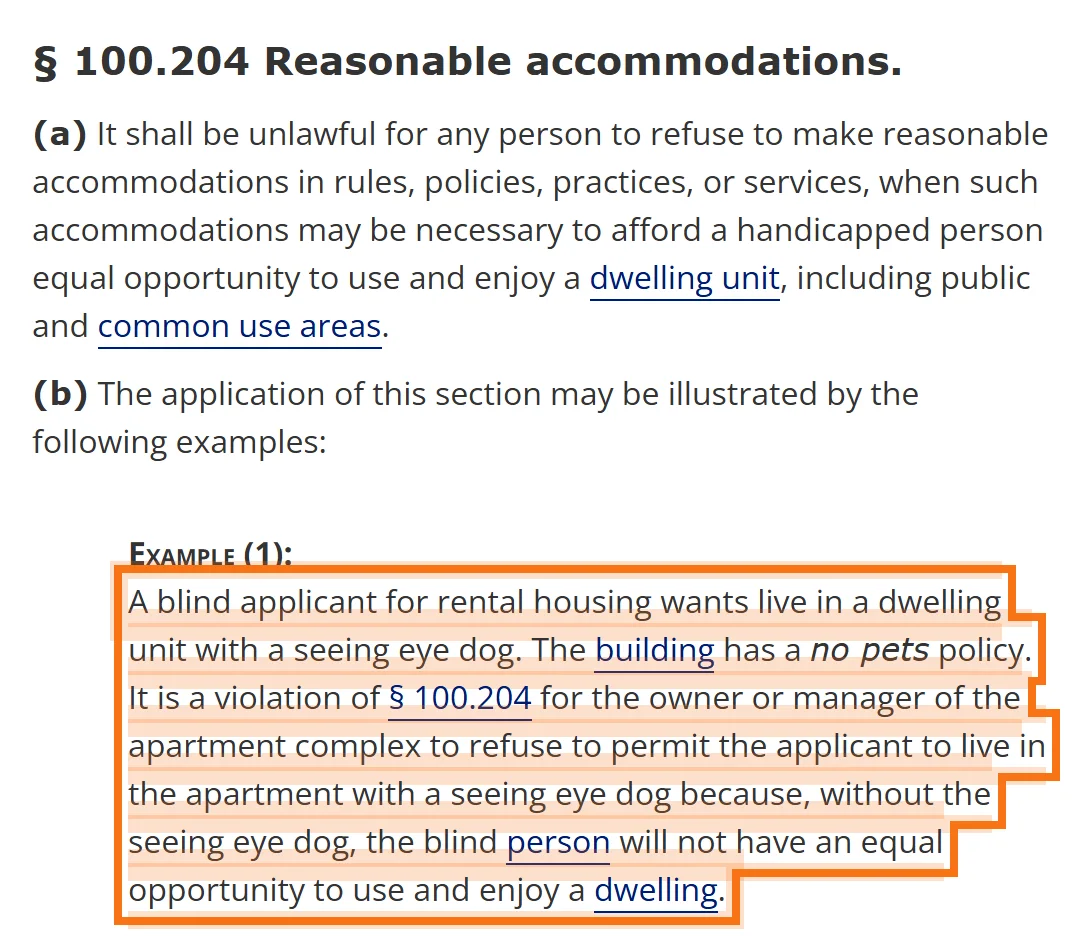
The example describes a trained guide dog and an obvious disability. The regulation gives no example for other animals or for a need that is not apparent, so those requests are weighed on their own facts. The text read here is the regulation itself, current on the official eCFR to November 10, 2026, not a HUD guidance document.
Pet fees, deposits and damage: what Texas law says and what it leaves open
A trained or equipped service dog. Texas Human Resources Code 121.003(h) is the one statute read for this guide that names money. A person with a disability "who has or obtains a service animal is entitled to full and equal access to all housing accommodations ... and may not be required to pay extra compensation or make a deposit for the animal but is liable for damages done to the premises by the animal except for reasonable wear and tear." For a dog that meets the 121.002(1) definition, a pet fee, pet rent or pet deposit is off the table.
Any other animal. The Fair Housing Act text, HUD's 24 CFR 100.204 and Texas chapter 301 do not mention pet fees, pet rent or deposits. Whether charging one for an approved accommodation animal is discrimination in the "terms, conditions, or privileges" of a rental (3604(f)(2), 301.025(b)) is not answered in the text. Do not apply your pet fee automatically: decide it per request, in writing, after a Texas attorney's view.
Damage. The tenant's responsibility does not go away. Section 121.003(h) keeps the person liable for damage the animal does, apart from reasonable wear and tear. For every tenant, Property Code 92.104(a) lets you deduct "damages and charges for which the tenant is legally liable under the lease," and 92.104(b) bars keeping any part of the deposit for normal wear and tear. See Texas security deposit rules.
Online letters, certificates and registries
None of the laws covered in this guide mention letters bought online, certificates, vests or registries, and none creates an official registry for assistance animals. The texts neither tell you to accept a certificate nor to reject one. It is a document submitted with a request, and the request is decided like any other: per request, in writing.
Texas does have a criminal statute on false claims. Human Resources Code 121.006(a) makes it an offense to "intentionally or knowingly" represent "that an animal is an assistance animal or a service animal when the animal is not specially trained or equipped to help a person with a disability," a misdemeanor punishable by a fine of up to $1,000 and 30 hours of community service. It uses chapter 121's meaning, a trained or equipped dog, and it is a matter for prosecutors, not a screening tool. If a document worries you, ask an attorney before you answer.
When a request can be refused: the narrow text
The refusal ground written into the law is short. 42 U.S.C. 3604(f)(9), repeated in 24 CFR 100.202(d) and Texas Property Code 301.025(f), says the law does not require a dwelling to be made available to "an individual whose tenancy would constitute a direct threat to the health or safety of other individuals or whose tenancy would result in substantial physical damage to the property of others." The text speaks of a tenancy and its effects. It does not mention breeds, weights or species, and it does not say what evidence is enough.
The duty is also limited by its own words: the accommodation must be "reasonable" and one that "may be necessary." The statute defines neither word, so applying them is a judgment on the facts of each request.
The stakes are written into the statutes too. Property Code 301.151 lets an aggrieved person sue in district court within two years after the practice occurs or ends, and Human Resources Code 121.004 makes a violation of 121.003 a misdemeanor and lets the person sue with a conclusive presumption of at least $300 in damages. Never refuse in passing by phone or text; talk to a Texas attorney, then put the decision and its reason in writing. Fair housing for Texas landlords covers the rest of the statute.
A written, per-request process for owners
Because the texts leave several questions to judgment, handle every request the same way and keep the record:
- Record the request the day it arrives, in whatever form it came.
- If the disability and the need are apparent, there is nothing to ask about them; never ask about diagnosis or severity (24 CFR 100.202(c)).
- If you need information, ask in writing, with an attorney reviewing the wording if you are unsure.
- Decide in writing. An approval names the animal and is recorded with the application and lease; the conduct and damage terms that bind every tenant still apply.
- Settle money separately. No extra charge or deposit for a trained or equipped service dog (121.003(h)); anything else only after legal advice.
- Refuse only after an attorney's review, in writing, with the reason.
- Keep the file for the life of the tenancy and after it.
The same request, the same steps, every time.
How Perpetual handles an assistance animal request
Perpetual Property Management is a broker-owned local company in North Richland Hills managing rental homes across Tarrant County, including Fort Worth, Keller and North Richland Hills. Here is what our own pages say on this subject today, quoted exactly:
- Rental criteria: "If there are occupants under 18, pets, or service animals in the household, that information must be included on the application and lease."
- Tenant screening: "every applicant completes a PetScreening profile (with or without pets), which also documents assistance-animal requests properly."
- Pet policy: "If pets are permitted with owner's discretion, a one-time non-refundable fee of $350 is due at move-in, plus $25 monthly pet rent per pet."
- "Perpetual Property Management supports and complies with the Fair Housing Act. All applicants are evaluated against the same written criteria."
Our pages do not state how an approved accommodation animal is charged, who signs the decision or how quickly it is made. That is confirmed in writing before you sign the management agreement. For a disputed request or any refusal, the right adviser is a Texas attorney who handles fair housing. To talk through how requests are handled on your rental, call 682-593-7033.
This guide describes what the statute and regulation texts say. It is general information, not legal advice.
The takeaway: Read the request as an accommodation request, not a pet negotiation; keep every question away from the diagnosis; charge nothing extra for a trained or equipped service dog; and decide everything the texts leave open per request, in writing, with an attorney before any refusal or charge.
Questions owners ask
Can a landlord charge a pet deposit for an emotional support animal in Texas?
Texas Human Resources Code 121.003(h) bars extra compensation or a deposit for a service animal, which chapter 121 defines as a dog specially trained or equipped to help a person with a disability. An emotional support animal without that training is outside that definition, and the Fair Housing Act text, 24 CFR 100.204 and Property Code chapter 301 do not mention pet deposits. It is decided per request, in writing; ask a Texas attorney before charging one.
Can a landlord ask for proof of a service animal in Texas?
24 CFR 100.202(c) makes it unlawful to ask whether an applicant has a disability or about its nature or severity, apart from listed questions asked of every applicant. The texts do not list what supporting information an owner may request when a need is not obvious, so any request for information is decided case by case, in writing, and never asks for a diagnosis or medical records.
Can a landlord deny an emotional support animal because of breed?
No law read for this guide mentions breed. The refusal ground in 42 U.S.C. 3604(f)(9) and Texas Property Code 301.025(f) is a tenancy that "would constitute a direct threat to the health or safety of other individuals" or "would result in substantial physical damage to the property of others." Applying it to a specific animal is a question for a Texas attorney.
Are online ESA letters valid in Texas?
None of the laws covered here mention online letters, certificates or registries, and none creates an official registry. A letter is a document submitted with a request, and the request is decided per request, in writing.
Does a no-pets lease apply to assistance animals?
Not automatically. HUD's regulation, 24 CFR 100.204, gives a no-pets building and a blind applicant's seeing eye dog as its own example: refusing the dog is a violation. For other animals, whether the no-pets rule gives way is decided per request under 42 U.S.C. 3604(f)(3)(B) and Texas Property Code 301.025(c)(2).
How is a service animal defined in Texas law compared with the ADA?
Texas Human Resources Code 121.002(1) defines both "assistance animal" and "service animal" as a canine specially trained or equipped to help a person with a disability. The ADA rule for public accommodations, 28 CFR 36.104, covers any dog individually trained to do work or perform tasks and excludes emotional support. Neither decides a housing accommodation request.
Does the Texas Fair Housing Act apply if I rent my house through a property manager?
Texas Property Code 301.041(a)(1) exempts some single-family houses rented by their owner, but only if, among other conditions, the house is rented without the services of a broker or agent licensed under Occupations Code chapter 1101. Renting through a licensed broker does not meet that condition. Any other exemption question belongs with an attorney.
Property management in Keller, North Richland Hills and Fort Worth. How full-service management works in Tarrant County →