Key takeaways
- A pet is your decision under the lease: allow it or not, with your pet fee, pet rent and limits.
- An assistance animal is a request for a reasonable accommodation from a tenant with a disability; the question is whether it "may be necessary" for equal opportunity to use and enjoy the home (42 U.S.C. 3604(f)(3)(B)).
- For a service animal as Texas defines it, a specially trained or equipped dog, Human Resources Code 121.003(h) bars any extra charge or deposit.
- For other accommodation animals, the statute texts do not address fees; decide per request, in writing, with an attorney's view before charging.
- Damage stays with the tenant in every case.
A pet is an animal your lease allows on your terms. An assistance animal is one a tenant with a disability asks to keep as a reasonable accommodation, so the request runs under fair housing law, not your pet policy. For a trained or equipped service dog, Texas law bars extra charges and deposits. For other animals, owners in Fort Worth, Keller and North Richland Hills decide fees and documentation per request, in writing. The tenant pays for damage either way.
Below: a side-by-side table, why the line depends on the tenant's need rather than the animal, the one Texas statute that names deposits, and what changes in the lease paperwork.
Pet, service dog or assistance animal: what changes, side by side
The same questions answered for a pet, for a service animal as Texas law defines it (a specially trained or equipped dog), and for any other animal a tenant asks to keep as a disability-related accommodation:
| Question | Pet | Service animal (Texas definition) | Other animal requested as an accommodation |
|---|---|---|---|
| What decides it | Your lease and pet policy. | Fair housing law (42 U.S.C. 3604(f)(3)(B), Property Code 301.025(c)(2)) and Human Resources Code 121.003(g)-(h). | Fair housing law, decided per request. |
| Does a no-pets rule apply? | Yes. Allowing pets is your choice. | 121.003(h) gives the tenant "full and equal access" to housing with the dog; 24 CFR 100.204 Example (1) calls refusing a seeing eye dog under a no pets policy a violation. | The duty reaches "rules, policies, practices, or services"; whether the rule gives way is decided per request. |
| Pet fee, pet rent, pet deposit | As your lease states. | "May not be required to pay extra compensation or make a deposit for the animal" (121.003(h)). | Not addressed in the statute or regulation text; decided per request, with an attorney's view before charging. |
| Damage | The tenant is liable under the lease; deposit deductions under 92.104. | Liable for damage "except for reasonable wear and tear" (121.003(h)). | The tenant is liable under the lease like any tenant (92.104(a)). |
| Breed, size and number limits | As your policy sets them. | Not mentioned in these texts. | Not mentioned in these texts; refusal grounds are in 3604(f)(9). |
| Questions you may ask | Your normal pet screening questions. | Never whether the tenant has a disability or its nature or severity (24 CFR 100.202(c)). | Same rule; what supporting information to request for a need that is not obvious is decided per request. |
| Where it is written down | The pet addendum. | The written decision, with the application and lease. | The written decision, with the application and lease. |
How to read this table: read across a row to see what changes. The middle column is the only one where a Texas statute settles money; the right-hand column marks what the texts leave open, which you decide per request, in writing. The full rules on asking, charging and refusing are in what Texas landlords can ask, charge or refuse.
Why the line depends on the tenant's need, not on the animal
It is tempting to sort animals by species or training: dogs with vests on one side, everything else on the other. The fair housing text does not work that way. 42 U.S.C. 3604(f)(3)(B) asks whether an accommodation in a rule or policy "may be necessary to afford such person equal opportunity to use and enjoy a dwelling." That is a question about the tenant's disability-related need, and nothing in the statute or in HUD's 24 CFR 100.204 limits it to dogs or to trained animals.
Training matters under a different law. Texas Human Resources Code 121.002(1) defines both "assistance animal" and "service animal" as "a canine that is specially trained or equipped to help a person with a disability." The ADA rule for businesses open to the public, 28 CFR 36.104, covers "any dog that is individually trained to do work or perform tasks" and says emotional support is not work or tasks. Those definitions decide access to stores and restaurants, and in Texas they also trigger the housing fee rule below.
So the same dog can be a pet in one rental and an accommodation in another, depending on the person who asks. That is why the request, not the animal, decides which column of the table applies. Fair housing for Texas landlords covers the statute as a whole.
The one Texas statute that names deposits for an animal in housing
Most of the confusion about money comes from a statute few owners have read. Texas Human Resources Code chapter 121 is mostly about public facilities, but subsection 121.003(g) gives persons with disabilities "full and equal access" to "all housing accommodations offered for rent, lease, or compensation," and subsection (h) adds the rule on animals:
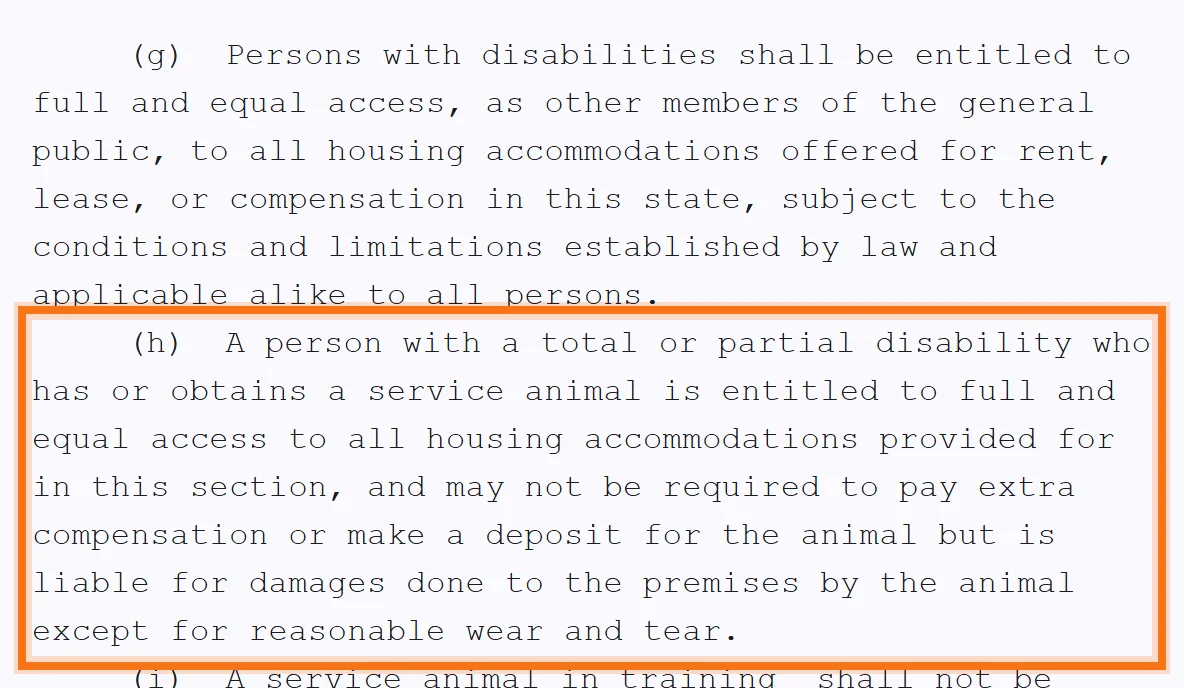
Section 121.002(3) defines "housing accommodations" broadly, as property used or intended as a home or residence, except a single-family residence that rents out only one room. So for a dog that is specially trained or equipped to help the tenant, the pet fee, the monthly pet rent and a pet deposit are all off the table, and the tenant still pays for damage beyond reasonable wear and tear.
What the statute does not cover is just as important. It speaks only of a "service animal," which chapter 121 defines as a trained or equipped dog. It says nothing about an untrained dog, a cat or any other animal requested as an accommodation. No federal or Texas text read for this guide fills that gap, so fees on those animals are decided per request, in writing, after an attorney's view.
What changes in the lease paperwork
A pet goes on a pet addendum: each approved animal, the fee, the pet rent, the deposit and the conduct rules. Those terms are yours to set and apply the same way to every comparable pet. Pet rent, pet deposits and pet screening in Texas covers that side, and protecting your rental from pet damage covers records and recovery.
An assistance animal goes on a written decision instead: the request, the date, what was asked and received, the decision and any terms. Two kinds of terms stay the same for everyone. Damage is the tenant's responsibility (121.003(h) for a service animal, the lease and 92.104(a) for every tenant), and the conduct rules in your lease apply to every tenant. Human Resources Code 121.003(g) itself grants housing access "subject to the conditions and limitations established by law and applicable alike to all persons."
What should not carry over from the pet addendum is anything the texts make questionable for this animal: a pet fee on a service dog, or a limit applied as a blanket rule without a per-request decision.
When the request comes mid-lease, or after an inspection finds an animal
Requests do not only arrive with the application. None of the texts read for this guide limits an accommodation request to the application stage, so a tenant can ask in the middle of a lease, including after an inspection turns up an animal that is not on the pet addendum.
Treat those as two separate questions. Decide the accommodation request first, in writing, by the same steps you use at application. Then deal with any lease issue that remains, such as an unapproved second animal or damage, under the lease. If the two overlap, for example a pet-violation charge on an animal that is now the subject of a request, ask an attorney before charging anything.
Inspections help either way. Dated photos of floors, doors, trim and the yard are what make a damage charge hold up at move-out, whatever the animal's status. See damage or a pet found mid-lease.
The owner's usual questions, answered from the text
"If I cannot charge a pet deposit, who pays for damage?" The tenant. Human Resources Code 121.003(h) makes the tenant with a service animal liable for damage beyond reasonable wear and tear, and Property Code 92.104(a) lets you deduct from the security deposit the damages and charges the tenant is legally liable for under the lease. Section 92.104(b) bars keeping any of it for normal wear and tear.
"Can I refuse because of the breed or size?" No text read for this guide mentions breed or size. The refusal ground the statute spells out, 3604(f)(9) and Property Code 301.025(f), is a tenancy that would be "a direct threat to the health or safety of other individuals" or cause "substantial physical damage to the property of others." Applying that to one animal is an attorney question.
"What about my insurance policy or HOA?" This guide states no insurance or HOA rule. Ask your insurance agent how your policy treats the animal, and ask an attorney before relying on either to refuse a request.
How Perpetual handles pets and assistance animals
Perpetual Property Management is a broker-owned local company in North Richland Hills managing rental homes across Tarrant County, including Fort Worth, Keller and North Richland Hills. What our pages say today, quoted:
- Pets: "If pets are permitted with owner's discretion, a one-time non-refundable fee of $350 is due at move-in, plus $25 monthly pet rent per pet." (rental criteria)
- Service animals: "If there are occupants under 18, pets, or service animals in the household, that information must be included on the application and lease."
- Screening: "every applicant completes a PetScreening profile (with or without pets), which also documents assistance-animal requests properly." (tenant screening)
- Leases: our leasing service uses lease documents "with the addenda your property actually needs (HOA rules, pool, pets, smart devices)."
Our pages do not state whether the $350 fee or the $25 pet rent is charged for an assistance animal that is not a trained or equipped service dog. That is confirmed in writing before you sign the management agreement. For a disputed request, talk to a Texas attorney. To see how your lease handles animals today, call 682-593-7033.
This guide describes what the statute and regulation texts say. It is general information, not legal advice.
The takeaway: A pet lives under your pet policy; an assistance animal lives under fair housing law and, for a trained or equipped service dog, Human Resources Code 121.003(h). Decide every request in writing, and the tenant pays for damage either way.
Questions owners ask
Can a landlord charge a pet deposit for an emotional support animal in Texas?
For a service animal, which Texas Human Resources Code 121.002(1) defines as a dog specially trained or equipped to help a person with a disability, no: 121.003(h) says the tenant "may not be required to pay extra compensation or make a deposit for the animal." For an emotional support animal without that training, the statute texts do not address deposits, so it is decided per request, in writing, after an attorney's view.
Can a landlord ask for proof that an animal is an assistance animal?
24 CFR 100.202(c) makes it unlawful to ask whether an applicant has a disability or about its nature or severity, apart from listed questions asked of every applicant. The texts do not list what supporting information an owner may request when the need for an animal is not obvious, so that is decided per request, in writing, without asking for a diagnosis.
Can I refuse an assistance animal because of its breed or size?
No text read for this guide mentions breed or size. The refusal ground the statute spells out, 42 U.S.C. 3604(f)(9) and Texas Property Code 301.025(f), is a tenancy that would be a direct threat to others' health or safety or would cause substantial physical damage to others' property. Applying that to one animal is a question for a Texas attorney before any refusal.
Does a tenant with an assistance animal have to follow the lease rules?
The terms that apply to every tenant still apply. Texas Human Resources Code 121.003(g) grants housing access "subject to the conditions and limitations established by law and applicable alike to all persons," and 121.003(h) keeps a tenant with a service animal liable for damage beyond reasonable wear and tear. What changes is the pet policy, decided per request.
Can a tenant ask for an assistance animal after signing the lease?
Yes. None of the texts read for this guide limits an accommodation request to the application stage. Decide the request in writing by the same steps you use at application, then handle any separate lease issue, such as damage, under the lease. Ask an attorney before charging a pet-violation fee on an animal that is the subject of a pending request.
Does Perpetual charge its $350 pet fee for an assistance animal?
Our published pet policy is a one-time non-refundable $350 fee plus $25 monthly pet rent per pet, when the owner permits pets. Our pages do not state how an assistance animal is charged; that is confirmed in writing before you sign. For a trained or equipped service dog, Texas Human Resources Code 121.003(h) bars extra compensation and deposits.
Related services
Property management in Keller, North Richland Hills and Fort Worth. How full-service management works in Tarrant County →