
Key takeaways
- A finding is the start of a paper trail, not a confrontation: dated photos, the lease clause, a written notice with a cure date, a follow-up visit.
- The lease does the work. Occupants, pets, alterations, access and damage charges all need a clause before move-in.
- Texas sets no cure period for a non-rent lease violation that we could find; the lease sets it.
- Tenant-caused damage can be billed under the lease now or deducted from the deposit at move-out, with an itemized list (Property Code 92.104).
- If the tenant does not cure, a written notice to vacate comes first: at least three days unless the lease says otherwise, delivered as 24.005(f-3) allows.
When an inspection on a rental in Fort Worth, Keller or North Richland Hills finds damage, an extra occupant or a pet that is not on the lease, what happens next is a sequence: document it against the move-in record, send a written notice that names the lease clause and a cure date, check again, and decide. Many findings end at the notice. A few go on to a repair bill, a deposit deduction or a notice to vacate.
This guide covers the steps after the finding. How the finding is made in the first place is in can inspections catch unauthorized occupants, pets or changes and how often a manager physically inspects a rental.
Five common findings and the usual next step
Here are the findings an interior inspection most often turns up, with the evidence to keep, the clause that makes it enforceable and the usual cure:
| Finding | Evidence to keep | Lease clause it relies on | Usual cure asked | If not cured |
|---|---|---|---|---|
| Damage beyond normal wear and tear | Dated photos next to the move-in photo of the same spot; a vendor's note on the cause | Tenant pays for damage caused by the tenant, occupants or guests | Repair at the tenant's cost, by the owner's vendor or as the lease allows | Charge stays on the ledger; deducted at move-out (92.104) |
| An adult living there who is not on the lease | Photos of a made bed, belongings, a car seen on several visits; dates | Named occupants; guest limit; written consent for anyone new | Apply and be screened, then added in writing, or leave by a date | Lease default: notice to vacate is possible (24.005) |
| A pet that is not on the lease | Photos of bowls, crate, litter, pet damage; dates | Pet clause; no animal without a signed pet addendum | Remove the pet, or sign a pet addendum if the owner allows one | Lease default; pet damage charged under the lease |
| An alteration: paint, mounted fixtures, a changed lock | Photos against the move-in report | No alterations without written approval; restore at move-out | Restore, or get written approval for what stays | Restoration cost charged under the lease |
| Refused or blocked access for the inspection | Copy of the notice sent, the date, the tenant's reply | Access clause with the notice period the lease sets | A new date with the notice the lease requires | Lease default; never force entry |
How to read this table: the third column is the one to check today, before you need it. Every cure in the fourth column depends on a clause the tenant signed, and a finding with no clause behind it can only be discussed, not enforced. The last column is the outer edge, not the plan: many tenants cure once they see a clear written notice.
Step 1: the evidence that holds up later
Everything after a finding rests on the record made that day. A note that says "pet observed" is an opinion. A dated photo of a chewed door frame next to the move-in photo of the same frame, undamaged, is evidence.
- Date every photo and take the same spot that appears in the move-in report, from the same angle, so the before and after line up.
- Write what was seen, not what was assumed: "a second made bed and men's clothing in bedroom three on two visits", not "boyfriend moved in".
- Name the clause the finding concerns, so the notice can quote it.
- Keep the vendor's word on cause. If a plumber writes that a drain was blocked by grease, or a door was kicked rather than worn, that line decides who pays.
- Stay inside the lease. Photograph the condition of the house, not the tenant's papers, mail or private belongings.
The move-in record matters as much as the new photos, because the move-out comparison uses it too; see the move-out inspection and how deposits get itemized.
Step 2: the lease clauses that make a finding enforceable
A notice can only enforce what the lease says. These are the clauses an owner should confirm are in the lease before the next inspection, not after it:
- Occupants. The lease names everyone who may live there, sets a guest limit and requires written consent for anyone new. Texas also sets an outer limit: Property Code 92.010(a) caps occupancy at three adults times the number of bedrooms. The clause, not the statute, is what you enforce day to day.
- Pets. No animal without a signed pet addendum, the deposit, fee or pet rent that applies, and the tenant's responsibility for pet damage.
- Alterations. No painting, mounting, lock changes or structural changes without written approval, and restoration at move-out.
- Access. No Texas statute sets a notice period for a landlord's entry, so the lease sets it, and a refused inspection is then a lease default.
- Damage charges. The tenant pays for damage caused by the tenant, occupants, family or guests, and the lease says when that charge is due.
The full clause list is in what a Texas residential lease must cover, and who belongs on the lease is in roommates, co-signers and occupants.
Step 3: the written notice and the cure period
The notice is short and factual. It states what was found and when, quotes the lease clause, says exactly what the tenant must do, and gives a date. It attaches or describes the photos, and it does not argue or accuse.
How long to give is a lease question. We found no section in Property Code chapter 24 or 92 that sets a cure period for a lease violation other than rent, so the cure period is whatever the lease provides, or a reasonable date if it is silent. Typical cures:
- Extra occupant: the person applies and is screened like any applicant, then is added in writing, or leaves by the date.
- Pet: the pet leaves, or, if you choose to allow it, a pet addendum is signed with the fee and pet rent your lease uses. Our guide to pets in your rental covers the addendum.
- Alteration: restore it, or approve in writing what may stay.
- Damage: repair at the tenant's cost, as the next section explains.
At the cure date, someone looks again and records the result with dated photos. A finding without a second look is a loose end that weakens every later step.
Step 4: bill the repair now, or deduct it at move-out?
Texas gives an owner the choice. Under Property Code 92.052(b), unless the condition was caused by normal wear and tear, the landlord has no duty during the lease term to repair a condition caused by the tenant, a lawful occupant, a family member or a guest. So the owner can repair it now and bill the tenant under the lease, or record it and settle it from the deposit when the tenant leaves.
Repair now when the damage will spread or affects safety: a leak, a broken exterior door, a damaged smoke alarm. Waiting turns a small invoice into a large one. Record and wait when the damage is stable, such as a scratched floor or a stained carpet, and the tenant is otherwise paying and caring for the house.
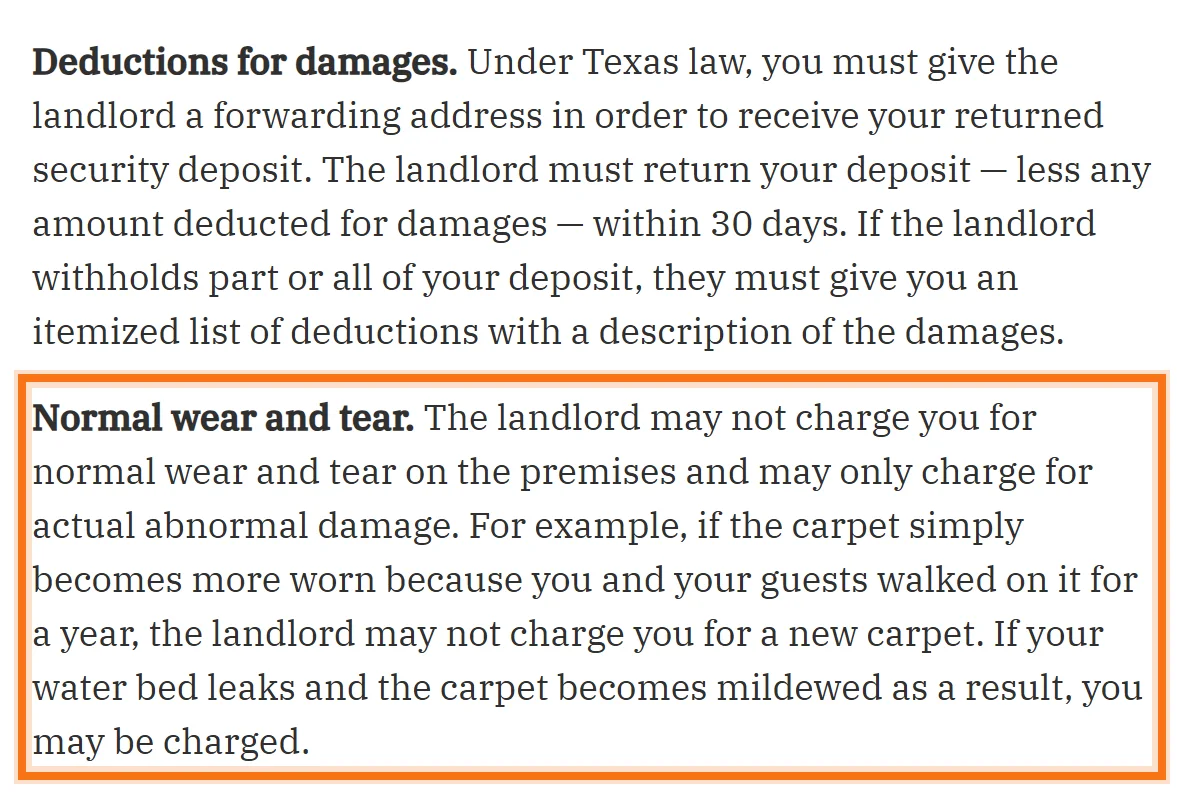
At move-out, Property Code 92.104(a) lets the landlord deduct damages and charges the tenant is legally liable for under the lease, but not normal wear and tear (92.104(b)), and any deduction needs a written description and itemized list (92.104(c)). The refund or accounting is due by the 30th day after the tenant surrenders the house (92.103(a)). Missing that date creates a presumption of bad faith (92.109(d)), and bad-faith retention can cost $100 plus three times the amount withheld and attorney's fees (92.109(a)).
Illustrative only, not a quote: a $2,000 deposit and a $450 door and drywall repair caused by an unapproved dog. If the tenant pays the $450 when billed, the deposit is untouched. If not, $2,000 - $450 = $1,550 is refunded at move-out with the itemized list, before any other lawful deduction. How cause is decided is in how a manager decides a repair is the tenant's responsibility, and damage larger than the deposit is in when damage exceeds the deposit. This is general information, not legal advice.
Step 5: when the tenant does not cure, the notice to vacate as Texas law reads in 2026
A tenant who keeps an unapproved occupant or pet, refuses access or will not pay for damage after notice is in default under the lease. Ending the tenancy for it starts with a written notice to vacate, and Texas changed the delivery rules on January 1, 2026 (Senate Bill 38). As the current text of Property Code 24.005 reads:
- Notice period. At least three days' written notice to vacate before the landlord files the eviction suit, unless the lease sets a shorter or longer period (24.005(a)). The special notice to pay rent or vacate applies to nonpayment cases, not to a pet or occupant default.
- Delivery. By mail (first class, registered, certified or a delivery service), by delivery inside the premises in a conspicuous place, by hand to a tenant 16 or older, or electronically if the parties agreed to that in writing (24.005(f-3)). Those rules do not apply if the tenant actually receives the notice (24.005(f-4)). Posting on the outside of the door is no longer listed.
Whether to go that far is the owner's decision, and for a stable tenant paying on time a pet addendum or an added occupant is often the better result. The notice is covered in the Texas notice to vacate explained and the court steps in the Texas eviction process. This is general information, not legal advice; ask a Texas attorney before you file.
How Perpetual handles this
On the homes we manage in Keller, North Richland Hills and Fort Worth, here is what our site states about inspections and what follows them:
- Inspections. Every plan includes an annual property inspection (price sheet). Our inspection program schedules interior inspections during the tenancy with proper notice, with the in-tenancy schedule set in your management agreement, and extra inspections can be arranged when something warrants a look.
- Reports. You receive a photo report in your Owner Portal with condition notes and any recommended actions, such as maintenance items or lease-violation follow-ups. Anything found feeds into maintenance coordination or tenant communication with a recommendation.
- The baseline. Every move-in and move-out gets a 360-degree condition inspection under the Perpetual Promise, subject to the Guarantee Addendum, and the move-out inspection is measured against the move-in baseline.
- Occupants and pets. Each resident over 18 submits a separate application ($60 per applicant). Pets are at the owner's discretion; if permitted, a one-time non-refundable fee of $350 is due at move-in plus $25 monthly pet rent per pet.
- Notices and evictions. We use Texas-compliant leases, and when a tenancy fails we send the notice Texas procedure requires and document it. We are not a law firm and coordinate with a landlord-tenant attorney where appropriate. Eviction service is included on Full Service and optional at $7.95 a month on Standard and Investor Special.
The cure periods and violation steps in our lease are confirmed in writing before you sign. If an inspection on your rental has turned something up, or you have not seen inside in a year, call 682-593-7033.
The takeaway: Treat every mid-lease finding the same way: photos against the move-in record, a written notice citing the clause, a cure date, a second look. Bill or deduct only what the lease and Property Code 92.104 allow, and send a notice to vacate only as 24.005 reads today.
Questions owners ask
How will I know if a tenant is damaging the house between move-in and move-out?
Through scheduled interior inspections with dated photos, and through what vendors and neighbors report between visits. Each report should reach you with photos and a note of any lease concern. How findings are made is in our guide to what inspections catch; this one covers what happens after: the notice, the cure date, the second look and, if needed, a bill or a deposit deduction.
Can inspections catch unauthorized occupants, pets, or changes to the property?
Usually yes: pets leave bowls, crates and scratches, extra occupants leave beds and belongings, and alterations are visible on sight. A finding is not proof of a lease violation on its own, so it is written up with dated photos, compared with the move-in record and sent to the tenant as a notice that names the clause and gives a cure date.
How often can a landlord inspect a rental property in Texas?
No Texas statute sets how often a landlord may inspect or how much notice to give before entry, so the lease controls both. Set a schedule and a notice period in the lease and follow them. Our plans include an annual property inspection, with the in-tenancy schedule set in the management agreement and extra inspections arranged when something warrants a look.
What if the tenant refuses to allow an inspection?
If the lease grants access for inspections with notice, a refusal is a lease default. Document the refusal, send a written notice citing the clause and set a new date with the notice the lease requires. Repeated refusals can support a notice to vacate under Property Code 24.005, but forcing entry or changing the locks is not the answer. Ask a Texas attorney before taking that step.
Can I evict a tenant for an unauthorized pet in Texas?
If the lease prohibits pets without a signed addendum, an unapproved pet is a lease default. After a written notice and a chance to cure, a tenant who keeps the animal can be given a written notice to vacate under Property Code 24.005: at least three days unless the lease sets another period. Many owners prefer to sign a pet addendum with a fee and pet rent if the tenant is otherwise good.
Can I charge a tenant for damage before they move out?
Usually, if the lease makes the tenant responsible for damage caused by the tenant, occupants or guests and says when the charge is due. Property Code 92.052(b) removes the landlord's duty to repair tenant-caused conditions during the lease, other than normal wear and tear. An unpaid charge can later be deducted from the deposit with an itemized list (92.104). This is general information, not legal advice.
How much notice to vacate does Texas require for a lease violation?
Property Code 24.005(a) requires at least three days' written notice to vacate before an eviction suit is filed, unless the lease sets a shorter or longer period. Since January 1, 2026, the notice goes by mail or a delivery service, inside the premises in a conspicuous place, by hand to a tenant 16 or older, or electronically if agreed in writing (24.005(f-3)).
Related services
Property management in Keller, North Richland Hills and Fort Worth. How full-service management works in Tarrant County →