Key takeaways
- Several landlord rights in Texas exist only if the lease says so: late fees (92.019), lockouts for unpaid rent (92.0081), requiring rent by check or money order (92.011).
- Some clauses count only if underlined or in bold, such as advance notice of move-out as a condition for the deposit refund (92.103(b)).
- Without the statement in 92.016(f) and 92.017(g), a tenant who leaves under those sections is released from rent already owed.
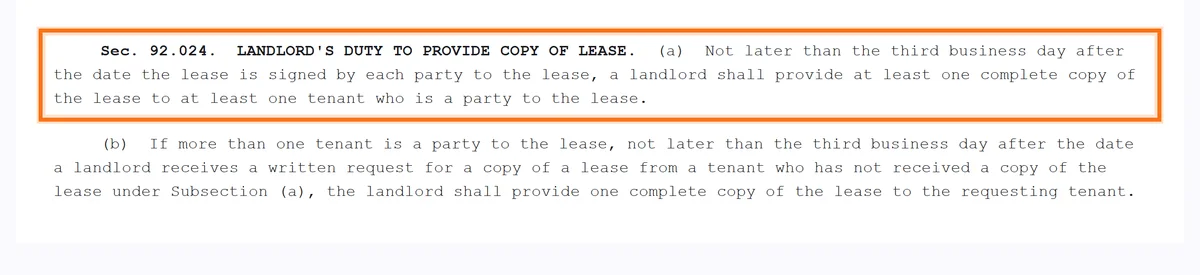
- Give the tenant a complete copy of the signed lease by the third business day (92.024).
- Some rights cannot be waived by any lease, including deposit and security-device rules and the military and family-violence rights.
What must a Texas residential lease contain? For a rental house in Fort Worth, Keller or North Richland Hills: the parties, the property, the term and the rent, plus the specific wording Property Code chapter 92 requires before certain rights work. A late fee, a lockout for unpaid rent and several deposit and security-device rules depend on what the lease says, and some only count if underlined or in bold.
Below: a table of the required wording with its section, then each part of the lease in order. This is general information, not legal advice; for your lease, ask a Texas attorney.
The lease wording Texas law requires, clause by clause
Here is each lease clause the Texas Property Code ties to a specific right or format, the section, and what happens when it is missing:
| Clause | Section | What the statute requires | Without it |
|---|---|---|---|
| Early termination statement | 92.016(f), 92.017(g) | Language substantially equivalent to: "Tenants may have special statutory rights to terminate the lease early in certain situations involving family violence or a military deployment or transfer." | A tenant who terminates under 92.016 or 92.017 is released from delinquent rent owed on the termination date |
| Sexual offense or stalking statement | 92.0161(g) | The same kind of statement for "certain sexual offenses or stalking" | The same release under 92.0161 |
| Late fee | 92.019 | Notice of the fee in a written lease; the fee reasonable; rent unpaid two full days after the due date | No late fee may be collected |
| Lockout for unpaid rent | 92.0081(d) | The right to change the locks must be placed in the lease; the advance notice must state, in underlined or bold print, the tenant's right to a key at any hour | No lockout; a violation costs one month's rent plus $1,000, damages and fees |
| Repair remedies notice | 92.056(g) | Underlined or bold language telling the tenant the remedies in 92.056 and 92.0561 | The lease falls short of the statute |
| Advance notice of move-out | 92.103(b) | A requirement to give advance notice as a condition of the deposit refund must be underlined or in conspicuous bold print | The requirement is not effective |
| Rekeying cost after a breach | 92.156(e) | An underlined or boldface provision authorizing the deduction | No deduction from the deposit |
| Security-device requests in writing | 92.159 | The written-request requirement must be underlined or in bold | Oral requests count |
| Smoke alarm tampering | 92.2611(d) | An underlined or bold notice that the tenant must not disconnect an alarm or remove its battery | The landlord's remedies in 92.2611(e) are not available |
| Rent by check or money order only | 92.011 | A written lease requiring a check, money order or other traceable instrument | You must accept timely cash, give a receipt and log it |
| Floodplain notice | 92.0135 | The statutory notice in the lease, an addendum or a separate signed document at or before signing | After a substantial flood loss the tenant may terminate |
How to read this table: the third column is the condition the statute sets, shortened; the fourth is what you lose if the lease misses it. Several rows are about formatting, not substance: a clause that is present but not underlined or bold where the statute demands it does not do its job. This is the first thing to check on any lease form you inherit or download.
Start from a current Texas form, not a download
Our leasing page puts it plainly: a proper Texas lease and a photo-documented move-in report turn arguments into paperwork checks, while a downloaded PDF lease and no condition report turn them into your word against theirs. A form written for another state misses the Texas-specific wording in the table above, and you find out in a dispute.
The law on forms is in the Occupations Code. Under 1101.654(b), a licensed broker who completes a lease form incidental to acting as a broker is not practicing law if the form was adopted by the Texas Real Estate Commission for that kind of transaction, prepared by a Texas attorney and approved for it, or prepared by the owner or an attorney and required by the owner. A self-managing owner can have an attorney prepare or review a lease. The statutes the lease has to live inside are summarized in Texas landlord-tenant law basics.
The core terms: parties, property, term, rent, occupancy
The foundation has to be exact. Name every adult who will live there as a tenant and have each one sign. Identify the property by full address and state any areas the tenant may not use. Give a start date and an end date, and say what happens at the end: month-to-month, renewal or move-out. State the rent, the due date, how it is paid and to whom; a written lease that requires a check, money order or other traceable instrument lets you refuse cash (92.011).
Under 92.010, the most adults a landlord may allow to occupy a dwelling is three times the number of bedrooms, with narrow exceptions. A guarantor is liable only for the original term unless the lease includes the renewal terms 92.021(b) lists. After signing, give a tenant a complete copy by the third business day (92.024).
Late fees and the security deposit
Under 92.019, a late fee can be collected only if notice of it is in a written lease, the fee is reasonable, and rent has stayed unpaid two full days after the due date. A fee of no more than 12% of the month's rent (a building with four or fewer units) or 10% (more than four) is considered reasonable, and an initial fee plus daily fees count as one fee. Write the amounts in numbers. A lease clause that tries to waive 92.019 is void. More in late rent in Texas.
For the deposit, state the amount and the conditions for deductions. The refund or itemized list is due within 30 days after surrender (92.103), once the tenant gives a written forwarding address (92.107), and the tenant may not withhold the last month's rent against the deposit (92.108). See Texas security deposit rules.
Repairs: what the lease can and cannot shift
Under 92.052, a landlord must make a diligent effort to repair a condition that materially affects the physical health or safety of an ordinary tenant once a tenant who is current on rent gives notice. That notice must be in writing only if the lease is written and requires it (92.052(d)), so a clause requiring written requests through one channel gives you a record of every request.
Section 92.006 says the repair duty cannot be waived except as it allows. A tenant may agree to pay for certain damage, such as wastewater stoppages caused by improper objects, doors, windows and screens, or windows left open, but only in a written lease with the agreement underlined or in bold (or in a separate addendum), specific, clear, knowing and for consideration (92.006(e), (f)). Everything else, such as filters, lawn and irrigation, the lease can allocate. More in Texas landlord repair obligations.
Access, use and the rules tenants break
No Texas statute sets a notice period for a landlord's entry, so the lease must say when you may enter for repairs, inspections and showings, what notice you give, and what happens in an emergency. Write it in.
Use clauses need to be specific:
- Who may live in the home, how long a guest may stay, and that any new adult applies first.
- Subletting: under 91.005 a tenant may not sublet without the landlord's prior consent; say so, and add short-term rental listings by name.
- Vehicles, parking and no inoperable vehicles.
- Smoking, inside and out.
- Alterations such as painting or mounting a dish, only with written consent.
Two limits: a lease may not prohibit a tenant from lawfully possessing a firearm in the rental unit (92.026), and a lease clause that waives a tenant's right to summon police or emergency help is void (92.015). See smoking, subletting and Airbnb clauses.
Ending the lease: early termination, holdover, lockouts
Four clauses decide most end-of-lease disputes. The notice clause sets how far ahead a tenant must say they are leaving and how you give notice of nonrenewal. The early termination clause says whether a tenant may leave early, on what notice and at what cost. The holdover clause sets the rent if the tenant stays past the end date. The default clause defines a breach and your remedies.
The statute adds rights the lease cannot remove. A tenant may end a lease early, on the conditions each section sets, after family violence (92.016), certain sexual offenses or stalking (92.0161), or qualifying military orders (92.017); 92.006(g) bars waiving the first and third except as those sections allow. Include the statements in the table. A lockout for unpaid rent is legal only under 92.0081, starting with that right placed in the lease. For a tenant who leaves early, see when a tenant breaks a lease in Texas.
Disclosures the owner must make
Several disclosures can sit in the lease or its attachments:
- Owner and manager. The record owner's name and address, and the name and street address of an off-site management company; the lease is one way to give it (92.201).
- Emergency number. A landlord without an on-site office must give the tenant a phone number for reporting emergencies (92.020(d)).
- Floodplain. The statutory notice of whether you know the dwelling is in a 100-year floodplain, and whether it has flooded in the last five years, signed at or before lease signing (92.0135).
- Lead paint. For housing built before 1978, the lease must include the federal disclosure elements in 40 CFR 745.113(b), and the tenant receives the federally approved pamphlet.
The parking-rules notice in 92.0131 applies only to a multiunit complex, not to a single-family house. Selection criteria under 92.3515 belong with the application, before the lease.
What owners most often leave out
Gaps that cost owners money later, each a short paragraph to fix:
- Lawn and landscape. Who mows, waters, trims and runs the irrigation.
- HOA rules. Attached and binding on the tenant, so fines are not just the owner's.
- Renters insurance. If you require it, say so and when proof is due. The Texas Department of Insurance says a renters policy covers the tenant's belongings and does not pay to fix the house; see requiring tenants to carry renters insurance.
- Utilities. Which accounts the tenant must open in their own name by move-in.
- Keys. How many were issued and the charge for unreturned ones.
- The end date. A month you would want to re-lease in.
Where addenda fit
The base lease is written for every home; addenda fit it to yours. A pet addendum, an HOA addendum with the rules attached, a pool addendum, a lead-based paint disclosure for older homes, the floodplain notice and a move-in condition form cover most houses. Each is signed, becomes part of the lease, and must not contradict it. Lease addenda every Texas landlord should consider walks through each one, and who prepares and signs the lease covers the signing.
How Perpetual handles this
Perpetual Property Management is broker-owned, with our office in North Richland Hills, and we manage homes in Keller, North Richland Hills, Fort Worth and nearby. What our site states about the lease on a home we manage:
- The documents. Current Texas-compliant lease documentation with the addenda your property actually needs (HOA rules, pool, pets, smart devices), not a generic template. You receive a copy of everything through the Owner Portal.
- The move-in file. A photo-documented move-in condition report, room by room, timestamped and acknowledged by the tenant.
- Deposits. Held, accounted for and returned or properly itemized on the statutory timeline under the Texas Property Code.
- Repair requests. Tenants report issues through their portal, which creates a documented record.
Which lease form and addenda your home gets, and how we deliver notices, are confirmed in writing before you sign. To see how this works for your house, read about leasing and move-in or call 682-593-7033.
The takeaway: Start from a current Texas form, check that every clause in the table is present and formatted as the statute requires, attach the addenda the house needs, and give the tenant a complete copy within three business days.
Questions owners ask
Can I use a generic lease form for a rental house in Texas?
You can, but a form written for another state misses the Texas wording that makes certain rights work: notice of the late fee (92.019), the lockout right (92.0081), the early-termination statement (92.016, 92.017) and the clauses that only count if underlined or in bold, such as 92.103(b). Start from a current Texas form or have a Texas attorney prepare one.
Does a Texas lease have to allow the landlord to enter the property?
No Texas statute sets a notice period for a landlord's entry, so the lease is where the right to enter for repairs, inspections and showings, and the notice you will give, gets written down. Put it in before the tenant moves in.
What disclosures must a Texas landlord give a tenant?
The owner's name and address and any off-site management company (92.201), an emergency phone number (92.020), the floodplain notice (92.0135), and for housing built before 1978 the federal lead-based paint disclosure and pamphlet (40 CFR 745.113). The early-termination statement in 92.016 and 92.017 also belongs in the lease. Confirm the specifics with a Texas attorney.
Should the lease require renters insurance?
If you want it, the lease must say so and state when proof is due. The Texas Department of Insurance says a renters policy covers the tenant's own belongings and does not pay to fix the house; your landlord policy does that.
What is the most common thing missing from an owner's lease?
Often the formatting. Several clauses only work if underlined or in bold, such as advance notice of move-out as a condition of the deposit refund (92.103(b)) or a written-request rule for security devices (92.159). Close behind: no statement under 92.016 and 92.017, no lawn allocation and no HOA rules attached.
How do I know the lease actually protects me as the owner?
Check it against the table in this guide: the late-fee notice in plain numbers, the lockout right if you want one, the 92.016 and 92.017 statement, the bold or underlined clauses, a written repair-request rule, an access clause, occupancy and guest limits, subletting, early termination, holdover and default. Then confirm you can give the tenant a complete copy within three business days. Perpetual uses current Texas-compliant lease documentation with property-specific addenda, and you receive a copy through the Owner Portal.
Can my lease address smoking, subletting, and unauthorized Airbnb rentals?
Yes, and it should. Under Property Code 91.005 a tenant may not sublet without the landlord's prior consent, and the lease can name short-term rental listings, set a guest limit and state the smoking policy inside and out. A short-term rental addendum closes the gap when a tenant stays in the home and rents out a bedroom by the night.
Does a Texas lease have to say anything about military tenants?
Yes, in effect. If the lease lacks language substantially equivalent to "Tenants may have special statutory rights to terminate the lease early in certain situations involving family violence or a military deployment or transfer," a tenant who terminates under 92.016 or 92.017 is released from delinquent rent owed on the termination date. Under 92.006(g), those rights cannot be waived except as the sections allow.
Property management in Keller, North Richland Hills and Fort Worth. How full-service management works in Tarrant County →