Key takeaways
- Decide before listing which pets the house can handle, and put the limits in the listing and the lease.
- A pet addendum names the animal and sets the rules on waste, the yard, supervision and damage responsibility.
- Dated move-in photos of floors, doors, trim, blinds and the yard are what turn a pet charge into a paperwork check.
- Texas lets a landlord deduct damages from the deposit, never normal wear and tear, with a written itemized list (Property Code 92.104).
- A bite or injury claim is an insurance matter, not a deposit matter: ask your agent what your landlord policy covers.
How can you protect your rental from pet damage? For a rental house in Fort Worth, Keller or North Richland Hills, prevent it before move-in and keep the record that lets you recover it afterward. Prevention is the house, the pet limits and a specific pet addendum. Recovery is dated move-in photos, checks during the lease and an itemized deposit accounting that separates pet damage from normal wear and tear.
This guide walks through those stages in order. Whether to allow pets at all is answered in should I allow pets to attract more tenants, and the law on pet deposits, fees and pet rent in pets in your rental in Texas.
Prevent and recover: the stages in order
Here is each stage, what you do, what it protects against, and where it is written down:
| Stage | What you do | What it protects against | Where it is written |
|---|---|---|---|
| Before listing | Decide which pets the house suits: number, size, kind | A pet the floors, yard or fence cannot handle | The listing and the lease |
| Approval | Name each pet on the application and the lease | A second or replacement animal later | Application and pet addendum |
| Pet addendum | Rules on waste, the yard, supervision, damage and move-out cleaning | Arguments over what was allowed | Pet addendum |
| Move-in | Dated photos of floors, doors, trim, blinds, screens and the yard | "It was already like that" | Move-in condition report |
| During the lease | Inspect, and put any problem in writing | Small damage growing into a large one | Inspection report and notice |
| Move-out | Itemize damage, not normal wear and tear | A deposit dispute | Itemized list (Property Code 92.104) |
| Beyond the deposit | Bill the balance, then decide on court | Damage larger than the deposit | Demand letter, court filing |
| Injury or bite | Ask your agent what your policy covers | A liability claim the deposit cannot touch | Your insurance policies |
How to read this table: the first four rows are prevention and happen before the tenant has keys; the last four are recovery, and every one of them depends on the move-in record. Skip the photos and each later stage turns into your word against the tenant's.
Before you say yes: house fit and pet limits
Prevention starts with the house. A fenced yard with a latching gate, hard floors and solid doors suits a dog; a house with new carpet throughout and no fence does not suit one as well. Decide what your house can handle before you list, and write it as limits rather than case-by-case exceptions:
- How many pets, and which kinds.
- Any size or weight limit you choose for the house.
- Whether pets are allowed in every room or kept off carpeted areas.
- What happens if a pet is added during the lease: written approval first.
Put the limits in the listing so applicants see them before they apply, and apply them the same way to every applicant. Each approved pet should be named on the application and the lease, with a description and a photo, so a second animal that appears later is a lease question, not an argument. A pet found mid-lease without approval is covered in damage, extra occupants or a pet found mid-lease.
The pet addendum, and what each charge is
The pet addendum attaches to the lease, names each animal and sets the rules. The rules that prevent damage are the practical ones:
- The named pet only; no additional or replacement animals without written approval.
- Waste picked up from the yard, and litter disposed of properly.
- No pets left outside unattended for long periods, and no tethering.
- Flea treatment and professional carpet cleaning at move-out where the house has carpet.
- The tenant is responsible for damage caused by the pet, beyond the deposit if needed.
The addendum should also say exactly what each pet charge is. Property Code 92.102 defines a security deposit as money, other than a rental application deposit or an advance payment of rent, intended primarily to secure performance under the lease. A one-time fee or monthly pet rent is described differently, so the lease should name each one plainly and say whether any of it is refundable. How deposits, fees and pet rent differ is in pets in your rental in Texas, and who keeps pet fees in who keeps late fees and pet fees.
Make the house hard to damage
The cheapest protection is a house that pets cannot hurt much. When you prepare a house for rent, choose surfaces with pets in mind:
- Vinyl plank or tile instead of carpet in the main rooms.
- Scrubbable paint on lower walls.
- Solid or solid-core doors where a dog waits, and a kick plate on the back door.
- A fence in good repair with a self-latching gate.
- Sturdy blinds rather than ones a cat will shred.
None of this is a pet-only expense; every item also survives ordinary tenants better. If the house keeps its carpet, limit pets accordingly and state the move-out carpet cleaning in the addendum. Flooring for rentals, room by room compares what survives tenants and pets.
The move-in record and checks during the lease
A pet charge is only as good as the evidence that the damage is new. The move-in condition report, with dated photos of floors, baseboards, doors, blinds, window screens, sills and the yard, is what lets you charge for a scratched door at move-out. Without it, the tenant says the scratch was there.
Checks during the lease then catch problems while they are small: a yard being dug up, an odor that means accidents indoors, a door that is starting to be scratched. Raise it with the tenant in writing, describe what has to change, and follow up. A problem documented mid-lease and again at move-out holds up; one first noticed at move-out, with no earlier record, becomes a negotiation. How often a manager inspects and what you receive is in rental property inspections.
Recovering the cost at move-out, and beyond the deposit
At move-out, Property Code 92.104 sets the rules. The landlord may deduct damages and charges the tenant is legally liable for under the lease or for breaching it (92.104(a)), may not keep any part of the deposit to cover normal wear and tear (92.104(b)), and gives the tenant the balance with a written description and itemized list of all deductions (92.104(c)). The refund is due on or before the 30th day after the tenant surrenders the premises, except as Section 92.107 provides (92.103(a)).
Pet damage falls on the damage side of that line when it comes from negligence, carelessness, accident or abuse rather than intended use, which is how 92.001(4) defines what normal wear and tear excludes. Scratched-through doors, chewed trim, soiled carpet and dug-up yard areas are typical items to compare against the move-in photos.
Illustrative only, not prices or a quote: a $2,000 deposit, and three items that the move-in photos show were not there before: a scratched back door replaced for $600, a soiled bedroom carpet replaced for $1,900, and dug yard areas filled and re-sodded for $250. Deductions: $600 + $1,900 + $250 = $2,750. The deposit covers $2,000; the balance of $750 ($2,750 minus $2,000) is owed beyond it. Each item counts only if it is damage, not wear.
What to do about that balance, from the demand letter to justice court, is in when damage exceeds the deposit in Texas. A dispute over the deductions is covered in who handles a security deposit dispute. This is general information, not legal advice.
Insurance: the risk the deposit cannot cover
The deposit covers chewed trim. It does not cover an injury claim from a visitor or a neighbor. Texas's Office of Public Insurance Counsel explains the difference on its residential property insurance page: a homeowners policy usually covers liability claims for accidents caused by you, your property, family or pets, while a dwelling policy does not cover those claims and does not pay for someone else's injuries. A renters policy usually covers the tenant's liability for accidents caused by the tenant, family or pets. OPIC also lists extra liability coverage that helps pay for accidents involving a pet.
Ask your agent three questions: what liability coverage your landlord policy includes, whether it excludes any animals, and whether your lease's pet terms match the policy. How a renters insurance requirement is written into a lease is in requiring renters insurance. This is general information, not insurance advice.
How Perpetual handles this
Perpetual Property Management manages rentals in Fort Worth, Keller and North Richland Hills. What our published pages say about pets and the record behind a pet charge:
- Pets are your decision. Under our rental criteria, pets are permitted at the owner's discretion; if they are, a one-time non-refundable fee of $350 is due at move-in, plus $25 monthly pet rent per pet. Our FAQ says pets are screened separately through our PetScreening process.
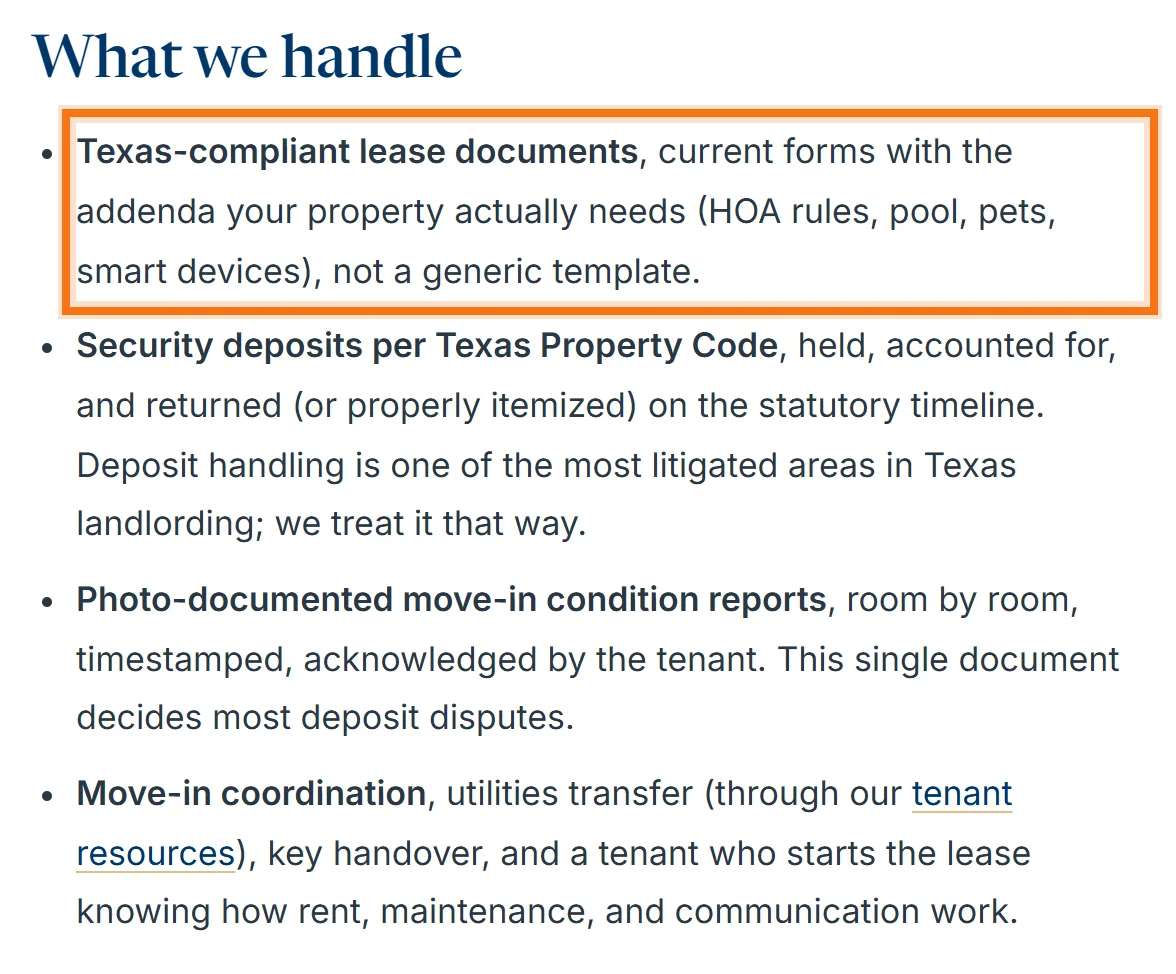
- The lease: Texas-compliant lease documents with the addenda the property needs, pets included.
- The move-in record: photo-documented move-in condition reports, room by room, timestamped and acknowledged by the tenant, and a 360-degree condition inspection at every move-in and move-out (subject to the Guarantee Addendum).
- During the lease: an annual property inspection on every plan; our inspections page notes that inspections catch lease violations such as unauthorized pets early, with photo reports in your portal.
- The deposit: held, accounted for and returned, or properly itemized, on the statutory timeline under the Texas Property Code.
Because our criteria call the $350 a non-refundable fee, plan on the security deposit and the lease's damage terms, not the fee, to cover damage. How any charge beyond the deposit is pursued is confirmed in writing in the management agreement before you sign. See tenant placement and leasing, or call 682-593-7033.
The takeaway: Prevent pet damage with the right house, clear limits and a specific pet addendum; recover it with dated move-in photos, checks during the lease and an itemized deposit accounting that never charges for normal wear.
Questions owners ask
Can I deduct pet damage from the security deposit in Texas?
Yes, for damage the tenant is legally liable for under the lease, but never for normal wear and tear (Property Code 92.104(a) and (b)). Give the tenant the balance with a written description and itemized list of deductions (92.104(c)), on or before the 30th day after the tenant surrenders the premises (92.103(a)). Dated move-in photos are what make a pet deduction hold up.
Is a non-refundable pet fee the same as a pet deposit?
No. Property Code 92.102 defines a security deposit as money intended primarily to secure performance under a lease, and the lease should name every pet charge plainly: deposit, one-time fee or monthly pet rent, and whether any of it is refundable. Our criteria call our $350 charge a one-time non-refundable fee. Ask a Texas attorney before relying on a fee to cover damage.
What should a pet addendum include?
It should name each animal with a description and photo, limit the household to those animals unless you approve another in writing, set rules on waste, the yard, supervision and tethering, state each pet charge and whether it is refundable, make the tenant responsible for pet damage, and list move-out requirements such as professional carpet cleaning and flea treatment where the house has carpet.
What if the tenant gets a pet without permission?
Treat it as a lease question. Document it, notify the tenant in writing, and either bring the animal onto the lease through the same approval and pet addendum as any other pet, or require it to be removed, as the lease allows. Inspections during the lease are how unapproved pets are usually found.
What if the pet damage costs more than the deposit?
Deduct what the deposit covers with an itemized list, then bill the tenant for the balance in writing. If it is not paid, the options run from a demand letter to justice court, explained in our guide on damage that exceeds the deposit in Texas. Your move-in photos and the itemized list are the evidence either way.
Does insurance cover a dog bite at my rental?
It depends on the policies. Texas's Office of Public Insurance Counsel says a dwelling policy does not pay for someone else's injuries, while homeowners and renters policies usually cover liability claims for accidents caused by family or pets. Ask your agent what your landlord policy covers and whether it excludes any animals.
Related services
Property management in Keller, North Richland Hills and Fort Worth. How full-service management works in Tarrant County →