
Key takeaways
- Choose rental flooring room by room: vinyl plank for living areas, halls and bedrooms, tile or sheet vinyl where water sits, carpet only where replacing it is acceptable.
- Compare floors on your own quotes over several tenancies: a floor that is cleaned at each turnover can beat a cheaper one that is replaced.
- Texas law lets a landlord deduct damages from a deposit but not normal wear and tear (Property Code 92.104), so dated move-in photos of every floor matter.
- IRS Publication 527 puts carpeting used in a residential rental in the 5-year class; an improvement to the building takes the building's recovery period.
- Keep the product name, color and spare cartons on file so a later repair matches.
What flooring should go in a rental house? For most homes in Fort Worth, Keller and North Richland Hills, vinyl plank in the living areas, halls and bedrooms, tile or sheet vinyl in bathrooms and laundry, and carpet only where you are willing to replace it. The right floor is the one that is cleaned, not replaced, at the next turnover, judged on your own quotes across several tenancies rather than on the install price alone.
This guide gives the choice room by room in one table, explains what Texas treats as wear or damage on a floor at move-out, shows a worksheet for comparing quotes over time, and summarizes what IRS Publication 527 says about carpet.
The floor-by-room decision for a rental house
Here is the usual choice for each room of a single-family rental, why, and the question a move-out raises on that floor:
| Room | Floor most owners choose | Why | At move-out, ask |
|---|---|---|---|
| Living, dining, halls | Vinyl plank, one continuous color | Cleaned at turnover; a single damaged plank can be replaced | Is it scuffing from walking, or a gouge from dragging furniture? |
| Kitchen | Vinyl plank or tile | Water at the sink, dishwasher and refrigerator line | Is it dulling in the traffic path, or a burn or deep cut? |
| Bathrooms, laundry | Tile, or sheet vinyl or water-rated plank in a small room | Standing water; sheet vinyl has few or no seams | Is the grout cracked with age, or a tile chipped by a dropped object? |
| Bedrooms | Vinyl plank continued, or carpet if you accept replacing it | Quieter and warmer with carpet; plank lasts through more turnovers | Is it a traffic lane, or a stain, burn or tear? |
| Stairs | Carpet, or plank with proper stair nosing | Grip and noise | Is the nap worn on the treads, or the carpet torn? |
How to read this table: the third column is why the floor suits the room; the last column is the question the move-out inspection has to answer, because only damage, not normal wear, can come out of a deposit. Whatever you choose, the cleanest result is one material and one color through the connected rooms, so a later repair matches. Paint and other finishes follow the same logic in paint and finishes for rentals.
Judge a rental floor on four things, in this order
The question is not which floor is nicest. It is which floor costs the least over the next several tenants while keeping the house competitive. Four tests settle it:
- Turnover treatment. At move-out, is the floor cleaned, patched or replaced? A floor that is usually cleaned wins.
- Water tolerance. Dishwashers leak, tubs overflow and water heaters fail. Read the product's water rating in the maker's specification, not the sales sheet's headline.
- Repairability. Can one damaged section be fixed without redoing the room? Planks and tile usually can if you kept spares; carpet and sheet goods usually cannot be patched invisibly.
- How it shows. A floor that photographs clean and matches from room to room helps the listing.
Price comes after those four, and it is a price over time: the worksheet further down shows how to compare.
Vinyl plank: the default for most rental rooms
Vinyl plank, often called luxury vinyl plank or LVP, is a common rental choice for living areas, halls and bedrooms because it can pass the four tests: products are sold as waterproof or water-resistant, it is cleaned rather than replaced at turnover, a gouged plank can be swapped, and it reads as wood in photos.
What to compare between products, using each maker's specification sheet and warranty:
- Wear layer thickness: the layer that resists scratches from pet nails and furniture.
- Core and installation: click-together floating floors are quick to repair; glue-down is another option for large open areas. Ask the installer which suits your slab.
- Subfloor prep: ask whether the quote includes leveling, because an uneven slab shows through as lifted seams.
- Color: a mid-tone hides dust and scuffs better than very dark or very light planks.
If you searched for the best vinyl plank flooring in North Richland Hills, there is no single brand answer: the best one for a rental is the product whose specification and warranty fit your house and budget, installed by someone who prepares the slab first.
Tile and sheet vinyl: the wet rooms
Tile does not care about water, is cleaned at turnover, and a neutral tile floor can carry many tenancies, which makes it a natural choice for bathrooms, laundry rooms, entries and many kitchens. Its trade-offs: it is hard and cold underfoot in a bedroom, slow and costly to replace, and grout needs sealing; a darker grout hides staining. Tile and grout can crack if the slab moves; the soil and slab questions are in foundation and plumbing in North Texas rentals.
Sheet vinyl is the budget option for a small bathroom or laundry room: it goes down in one piece with few or no seams, so water has fewer places to get under it. It cannot be patched invisibly, so treat it like carpet: a surface you replace when it is damaged. Either way, keep a labeled box of spare tiles or an offcut in the garage and note it on the inventory.
Carpet: where it still makes sense
Carpet is the floor most likely to be replaced at turnover, which is the argument against it in a rental: it holds stains and odors and cannot be patched invisibly. In living areas, halls and rooms off a kitchen or bath, most owners choose a hard surface instead.
It still has a place. Bedrooms and upstairs rooms are quieter and warmer with carpet, and carpeted stairs give grip. If carpet stays, choose a mid-tone with a pattern or fleck that hides traffic lanes, over a good pad, and compare the product warranties.
Treat carpet as a consumable, not a finish. Put its replacement into your plan across tenancies, using the worksheet below. A pet policy affects how often that happens; see protecting a rental from pet damage.
Existing hardwood: keep it, protect it, document it
If the house already has solid hardwood, keep it where it is sound, but plan for its weaknesses: water buckles it, and a dragged sofa or pet nails can mark it. The repair for wide damage is usually a sand-and-refinish of the room with the house empty, not a plank swap, and engineered hardwood allows fewer refinishes.
Protect it in the lease with felt pads and rugs in high-traffic areas, and photograph it closely at move-in. Do not extend hardwood into a kitchen or bath. When existing hardwood is badly damaged, get two quotes, a refinish and a hard-surface replacement, and compare them with the worksheet below, counting the days the house sits empty for each.
North Texas conditions to plan for
Three local conditions are worth planning for. Slab movement: a floor installed without proper expansion gaps or on an unleveled slab shows any slab movement as gaps and lifted seams. Sun: rooms with large west-facing windows fade floors and carpet, so blinds or shades in those rooms help. Water events: frozen pipes, aging water heaters and supply-line failures are common ways water reaches a floor in any room with plumbing.
The water side is covered in water leaks and mold in Texas rentals, including how a small leak becomes a flooring claim. Checking the water heater, supply lines and drains protects the floors around them.
Cost over several tenancies: a worksheet for your quotes
Compare two floors over the tenancies you expect, using your own quotes. Fill in this worksheet for one room or the whole house:
| Line | Carpet | Vinyl plank |
|---|---|---|
| A. Install quote today | Your quote | Your quote |
| B. Turnovers in the period | Your estimate | Same number |
| C. What happens at each turnover | Replace (or clean, if it survives) | Professional clean |
| D. Cost of C, times B | Your quote x B | Your quote x B |
| Total over the period | A + D | A + D |
How to read this table: the totals are what you pay out of pocket; the extra days of vacancy while a floor is ordered and installed are lost rent, which is income you do not receive, so weigh them separately rather than adding them into the cash total.
Illustrative only, not a quote or a market price. Say a carpet quote is $2,000 and a vinyl plank quote is $4,000 for the same rooms, you expect three tenancies (two turnovers), the carpet is replaced at each turnover and the plank gets a $150 professional clean. Carpet: $2,000 + $2,000 + $2,000 = $6,000. Plank: $4,000 + $150 + $150 = $4,300. After the first turnover alone, carpet is $4,000 and plank $4,150, so carpet is still $150 ahead; after the second, plank is $1,700 lower ($6,000 minus $4,300). Change any assumption, such as carpet surviving one turnover, and run it again with your quotes.
Wear or damage? How Texas treats a floor at move-out
Property Code 92.104 sets the deposit rules for floors as for everything else. Before returning a deposit, the landlord may deduct damages and charges the tenant is legally liable for under the lease or for breaching it (92.104(a)). The landlord may not keep any part of the deposit to cover normal wear and tear (92.104(b)), and any deduction comes with a written description and itemized list (92.104(c)).
The test is the definition in 92.001(4): normal wear and tear is deterioration that results from the intended use of a dwelling, and it does not include deterioration from negligence, carelessness, accident or abuse by the tenant, a household member or a guest. The statute names no floors, so apply that test to the facts. A traffic path worn by walking points to intended use; a burn, a deep gouge or a tear points to an accident or carelessness. Your dated move-in photos decide which story holds up.
The general rule is in what is normal wear and tear and what can be charged, and the itemizing in the move-out inspection in Texas. This is general information, not legal advice.
Carpet vs other floors in IRS Publication 527
Flooring also changes your tax records, and IRS Publication 527 (for 2025 returns) treats carpet and the building differently:
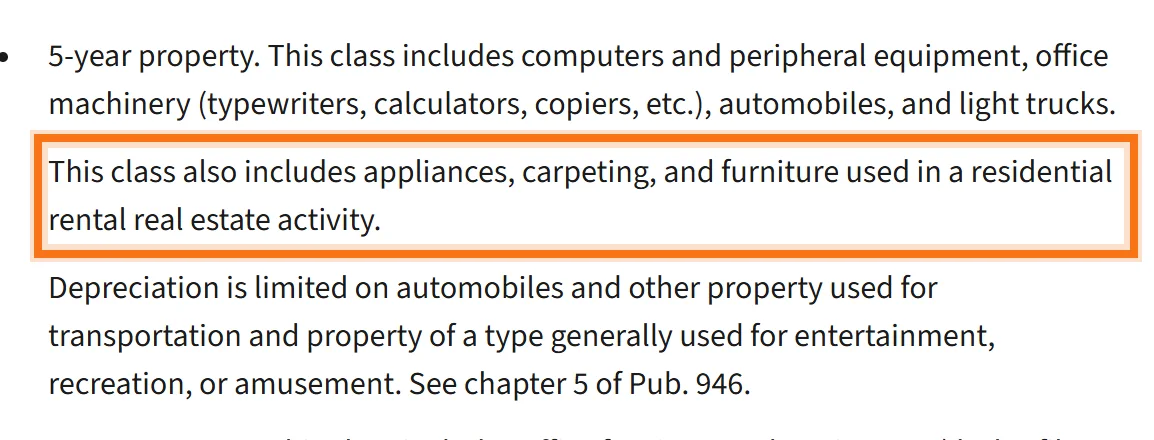
- Carpet: the 5-year property class "also includes appliances, carpeting, and furniture used in a residential rental real estate activity." Table 2-1 lists carpets at 5 years under the General Depreciation System and 9 years under the Alternative Depreciation System.
- The building: residential rental property and its structural components are 27.5 years under the General Depreciation System.
- Improvements: additions and improvements take the same recovery period as the property they are made to. Publication 527's list of improvement examples includes both "Flooring" and "Wall-to-wall carpeting."
Publication 527 does not give vinyl plank or tile a line of its own, and whether a floor job is a repair or an improvement depends on the facts. Ask your CPA how to classify your floor before you file. The basics are in depreciation for rental owners. This is general information, not tax advice.
Clean, repair or replace at make-ready
When the house is empty and a floor is in question, the decision is short. Clean it if it is sound and the stain or wear comes out. Repair it if the damage is in one area and you have matching material. Replace it if it fails both, and when replacing, choose by the four tests rather than by matching what was there.
Order material before the tenant leaves whenever a replacement is foreseeable, so the floor does not add days to the vacancy. Photograph the new floor for the move-in record, note the product, color and installer in the file, and keep spare cartons. The full scope of work before listing is in the make-ready guide.
How Perpetual handles flooring decisions
What our published pages say: our free rental analysis includes make-ready guidance on which improvements raise rent and which just cost money, so you can decide whether a new floor is worth it before you spend. Every plan includes an annual property inspection, and our inspection program sends photo reports to your portal, with anything found feeding into maintenance coordination or tenant communication with a recommendation. Every move-in and move-out gets a 360-degree condition inspection (subject to the Guarantee Addendum), which is the record a floor deduction rests on.
Repairs under your pre-approved spending limit go ahead; larger jobs such as a floor replacement come to you with a description, photos and a recommendation. Maintenance coordination is 5% of cost on Full Service and 4.9% on Standard, and make-ready coordination is 3% to 5% of cost on Investor Special, charged on the vendor's invoice; the original invoice is always in your portal. Our maintenance page says we can usually coordinate with your own vendor if they are insured and reliable. How a specific flooring project is scoped and billed is confirmed in writing before you sign. See maintenance coordination, or call 682-593-7033.
The takeaway: Pick each room's floor by what happens at the next turnover, compare quotes over several tenancies, photograph every floor at move-in, and keep the product details and spares on file.
Questions owners ask
What is the best flooring for a rental property?
For most rental houses, vinyl plank in living areas, halls and bedrooms with tile or sheet vinyl in bathrooms and laundry rooms holds up to tenants, tolerates water and photographs well. Carpet fits where you accept replacing it, such as bedrooms or stairs, and existing hardwood stays only where it is sound and protected in the lease. Compare products on their specifications and warranties.
Is luxury vinyl plank good for rentals?
Usually, yes. Vinyl plank is cleaned rather than replaced at turnover, a damaged plank can be swapped if you kept spares, and products are sold as waterproof or water-resistant. Compare wear layer thickness and warranties on the maker's specification sheet, and make sure the quote includes leveling the slab before installation.
Should I put carpet in a rental?
Only where you accept replacing it, typically bedrooms or stairs. In living areas, halls and rooms off a kitchen or bath, carpet holds stains and odors and cannot be patched invisibly, so it is the floor most likely to add days and cost at a turnover. Run the worksheet in this guide on your own quotes before deciding.
Can I charge a tenant for flooring damage in Texas?
You can deduct damages the tenant is legally liable for under the lease, but not normal wear and tear (Property Code 92.104(a) and (b)), with a written description and itemized list (92.104(c)). Normal wear and tear is deterioration from intended use, not from negligence, carelessness, accident or abuse (92.001(4)). Dated move-in photos of each floor are what make a deduction hold up.
Does new flooring increase rent?
Not by itself. A floor upgrade pays only if it raises the rent, shortens the vacancy or cuts what you replace at turnovers. Compare your house with leased homes that do and do not have hard floors; our free rental analysis includes make-ready guidance on which improvements raise rent and which just cost money.
How is carpet in a rental depreciated?
IRS Publication 527 says the 5-year property class also includes carpeting used in a residential rental real estate activity, and Table 2-1 lists carpets at 5 years under the General Depreciation System and 9 years under the Alternative Depreciation System. Improvements to the building take the building's recovery period. Ask your CPA how your floor job is classified.
Property management in Keller, North Richland Hills and Fort Worth. How full-service management works in Tarrant County →