Key takeaways
- The landlord in Property Code chapter 92 is the owner; a manager is not, unless it presents itself as the owner in the lease (92.001(2)).
- The refund or itemized list is due by the 30th day after surrender, but not until the tenant gives a written forwarding address (92.103, 92.107).
- Missing the 30th day creates a presumption of bad faith, and in a tenant's suit the landlord must prove the deductions were reasonable (92.109(c), (d)).
- A tenant can sue in justice court as a small claims case up to $20,000 (Rule 500.1(a)).
- In that case an individual owner appears in person or through an attorney; the manager's job is the file (Rule 500.3).
When a tenant disputes a deposit deduction, the property manager usually handles the back-and-forth: the objection, the evidence and a recommendation to you. You own the outcome. For a rental in Fort Worth, Keller or North Richland Hills, Texas law places the deposit duties on the landlord, meaning the owner, and if the tenant files a small claims case, you are the party the court hears.
This guide follows a dispute from the forwarding address to the courtroom: the rule at each step, who acts, and what the manager can and cannot do for you.
The deposit dispute path in Texas, step by step
Here is the path a disputed deposit follows, the rule that applies at each step as the Property Code and the Texas Rules of Civil Procedure read, and who usually acts when a manager is involved:
| Step | What happens | The rule, as it reads | Who acts |
|---|---|---|---|
| 1. Move-out | The tenant surrenders the house and gives a written forwarding address | No obligation to refund or itemize until the written forwarding address arrives; the tenant does not forfeit the deposit by not giving one (92.107) | Manager inspects and collects the address |
| 2. Refund or itemized list | Balance plus a written description and itemized list of deductions | On or before the 30th day after surrender (92.103(a)); itemized list required when anything is kept (92.104(c)) | Manager prepares; owner approves what is kept |
| 3. Objection | The tenant disputes one or more items | No statute sets this step; the lease and the evidence decide it | Manager answers with the file, on the owner's decision |
| 4. Bad faith | The question a court asks if the refund or list was late or a deduction unsupported | Late refund or list: presumed bad faith (92.109(d)); landlord must prove deductions reasonable (92.109(c)); bad-faith retention: $100 + three times the amount wrongfully withheld + attorney's fees (92.109(a)) | The landlord, which is the owner |
| 5. Suit | The tenant files a small claims case in justice court | Up to $20,000, excluding statutory interest and court costs (Rule 500.1(a)); venue under Rule 502.4 | Owner is the defendant |
| 6. Hearing | The judge hears both sides | An individual: self or an attorney; an entity: employee, owner, officer, partner or attorney (Rule 500.3) | Owner or attorney; the manager supplies the file |
How to read this table: steps 1 and 2 are where most disputes are won or lost, because the timing and the itemized list set up everything after. Steps 4 to 6 are why the owner, not the manager, carries the risk. This is general information, not legal advice.
Why the deposit is the owner's legal duty, even under management
Property Code chapter 92 puts the deposit duties on the "landlord", and section 92.001(2) defines the landlord as the owner, lessor or sublessor of a dwelling. A manager or agent is not the landlord unless it purports to be the owner, lessor or sublessor in the lease. So the refund deadline, the itemized list, the record-keeping duty in 92.106 and the penalties in 92.109 all point at you, even when a manager did every step.
That shapes the working relationship. A good manager does the inspection, assembles the evidence and drafts the itemized list, but you decide what is kept, because the risk of a bad call is yours. Whether the manager or you holds the deposit money, and how it moves at move-out, should be written in your management agreement. The general rules are in Texas security deposit rules.
When the tenant objects: answering with the file
Most disputes start with an email or letter after the itemized list arrives: the carpet was already stained, the cleaning charge is too high, the wall damage was there at move-in. Some tenants send a formal demand citing the Property Code.
The answer should be in writing, prompt and calm, and it should take the items one at a time: the move-in photo, the move-out photo of the same spot, the invoice or estimate, and the lease clause that makes the tenant responsible. A tenant who sees a dated before-and-after of a stained carpet usually drops that item. A tenant who sees only a dollar figure keeps going.
Keep the reply factual. It may become an exhibit, so it should say nothing you would not want a judge to read. How the itemized list should have been built is in the move-out inspection guide.
The review: which deductions to keep
Before answering, re-read the file the way a judge would, because in a tenant's suit the landlord has the burden of proving that keeping any part of the deposit was reasonable (92.109(c)). For each item, ask:
- Is there a before-and-after comparison of the same thing?
- Is it damage, or normal wear and tear, which cannot be deducted (92.104(b))?
- Is the tenant legally liable for it under the lease (92.104(a))?
- Is the amount the actual cost, on an invoice or estimate?
Holding a well-supported item costs little. Holding a weak one invites a bad-faith finding, which under 92.109(a) means $100 plus three times the portion wrongfully withheld plus the tenant's reasonable attorney's fees. Illustrative only: on a $300 deduction found to be kept in bad faith, that is $100 + $900 = $1,000 before attorney's fees (checked: three times $300 is $900). Dropping a borderline item is usually cheaper than defending it. What counts as wear and tear: normal wear and tear vs. damage.
If the tenant files in justice court
A tenant who is not satisfied can file a small claims case in justice court. Rule 500.1(a) of the Texas Rules of Civil Procedure describes a small claims case as a suit for money damages, civil penalties or other relief allowed by law, for no more than $20,000 excluding statutory interest and court costs but including attorney fees. Under Rule 502.4(b), a defendant is generally entitled to be sued in the county and precinct where the defendant lives, where the events happened, or where the contract was to be performed. Filing fees: confirm with the justice court.
Who answers for you is set by Rule 500.3:
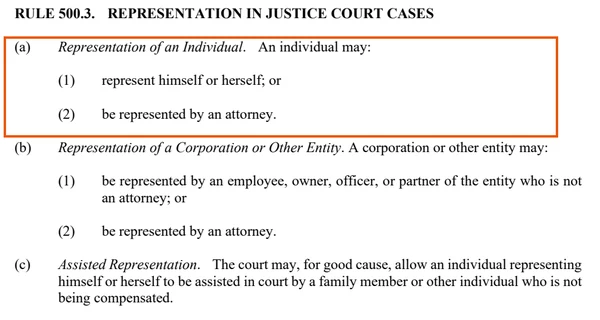
So an individual owner appears in person or through an attorney, and an owner's LLC through its own employee, owner, officer or partner, or an attorney. The rules for eviction cases are different and do allow a property manager (Rule 510.3), which is why owners are sometimes surprised; see would I need to go to eviction court myself. The manager's part in a deposit case is the organized file, and the person who did the inspections can be a witness. For a large claim, or a tenant with a lawyer, talk to a Texas attorney. This is general information, not legal advice.
When the dispute runs the other way
Sometimes the dispute runs the other way: the damage or unpaid rent is more than the deposit. The itemized list matters even more then. Under 92.109(b), a landlord who in bad faith does not provide the written description and itemized list forfeits the right to withhold any part of the deposit and the right to sue the tenant for damages to the premises. A late or missing list can cost you the claim, not just the deposit.
With a timely list showing a balance owed, the next steps are a written demand and, if needed, your own small claims case. Collecting a judgment is often harder than winning one, so weigh the amount against the effort. The full path is in when damage or unpaid rent exceeds the deposit.
How most deposit disputes are prevented
Deposit disputes are mostly a documentation problem, and the documentation starts at move-in. The practices that prevent most of them:
- A dated move-in condition report with photos of every room, acknowledged by the tenant.
- Documented inspections during the lease, so damage is dated and raised when it appears.
- A clear move-out reminder of what the lease expects, giving the tenant a chance to clean or fix first.
- The refund or itemized list sent well inside 30 days, with photos and invoices, not just amounts. Timing details: how quickly a deposit must be returned in Texas.
- Deductions limited to what the lease supports and what the work actually cost.
A tenant who saw the standard at move-in, was reminded of it before move-out and received the evidence with the list rarely files anything.
How Perpetual handles this
Perpetual Property Management is broker-owned and manages homes in Keller, North Richland Hills, Fort Worth and nearby. What our site states about deposits and the records behind them:
- Deposits. Security deposits are handled per the Texas Property Code: held, accounted for, and returned or properly itemized on the statutory timeline (our leasing and move-in page).
- The move-in record. A photo-documented move-in condition report, room by room, timestamped and acknowledged by the tenant.
- Move-in and move-out. A 360-degree condition inspection at every move-in and move-out, under the Perpetual Promise, subject to the Guarantee Addendum; the move-out inspection is measured against the move-in baseline.
- Your records. Statements, documents and disbursement history in the AppFolio owner portal.
Who answers a tenant's objection, how you approve the deductions, where the deposit is held and what we do if a case is filed are confirmed in writing in the management agreement before you sign. To talk about a deposit question, call 682-593-7033.
The takeaway: The manager builds and answers with the file; the owner approves what is kept and answers to the court. A deposit dispute is decided by the itemized list and the evidence behind it, so approve only the deductions the file supports.
Questions owners ask
Can a tenant sue a landlord over a security deposit in Texas?
Yes. A tenant who believes deductions were improper can file a small claims case in justice court, for up to $20,000 under Rule 500.1(a). If the court finds the deposit was kept in bad faith, Property Code 92.109(a) makes the landlord liable for $100, three times the portion wrongfully withheld and the tenant's reasonable attorney's fees. A timely itemized list with photos and invoices is the defense. This is general information, not legal advice.
Does the property manager or the owner hold the security deposit?
It depends on the management agreement, which should say where the deposit is held and how it is accounted for at move-out. Either way, Property Code 92.001(2) makes the owner the landlord, so the refund and itemization duties stay with the owner. Ask any manager in writing where deposits are held.
What if the tenant never gave a forwarding address?
Under Property Code 92.107(a), the landlord is not obligated to return the deposit or send the itemized list until the tenant gives a written statement of a forwarding address. Under 92.107(b), the tenant does not lose the right to the refund just by not giving one. Keep the list ready and send it as soon as the address arrives.
Can I deduct for cleaning if the tenant disputes it?
Only for cleaning beyond normal wear and tear that the tenant is liable for under the lease (92.104), and only for the actual cost. In a tenant's suit, the landlord has to prove the deduction was reasonable (92.109(c)), so move-in and move-out photos of the same areas and the cleaning invoice are what make the charge hold.
Can my property manager represent me in small claims court over a deposit?
Rule 500.3 of the Texas Rules of Civil Procedure says an individual may represent himself or herself or be represented by an attorney; an entity may be represented by its employee, owner, officer or partner, or by an attorney. A property manager is not listed there, unlike the eviction rule (510.3). The manager can supply the file and the inspection evidence. This is general information, not legal advice.
What happens if the deposit refund or itemized list is late?
Under Property Code 92.109(d), a landlord who does not return the deposit or provide the written itemization on or before the 30th day after the tenant surrenders possession is presumed to have acted in bad faith. The landlord is not obligated to refund or itemize until the tenant gives a written forwarding address (92.107), so keep the address request in the move-out steps and send the list early. This is general information, not legal advice.
Property management in Keller, North Richland Hills and Fort Worth. How full-service management works in Tarrant County →