Key takeaways
- Most turnover overspending comes from scope, not prices: lists that grow, replacing what could be repaired, and trades making several trips.
- Test every item twice: repair or replace, and wear or damage. Texas does not let a landlord keep any part of a deposit for normal wear and tear (Property Code 92.104(b)).
- Damage the tenant is liable for under the lease can come out of the deposit, with a written description and itemized list (92.104(a), (c)).
- IRS Publication 527 deducts repairs but capitalizes improvements, and says to keep the two costs separate in your records.
- Set a written approval limit so small items move and large ones get a second look.
How do you avoid spending too much on repairs between tenants? Decide each item on two tests before anyone is booked: can it be repaired instead of replaced, and is it normal wear (your cost) or damage the tenant is liable for (a deposit deduction)? On a rental in Fort Worth, Keller or North Richland Hills, write that list once at move-out, group the work by trade, and keep the invoices sorted for your tax records.
This guide gives the item-by-item table, the Texas wear-and-tear rule as the statute words it, an illustrative scope added up two ways, the IRS repair-versus-improvement line, and what our published pages say we do.
Turnover items: repair or replace, tenant charge or owner cost
Here is the usual turnover list for a single-family rental, the test that keeps each item from turning into a replacement, and how the Texas deposit rule sorts the cost:
| Turnover item | Repair or replace test | Tenant charge or owner cost |
|---|---|---|
| Interior paint | Touch up if marks are in a few places and you have the matching paint on file; repaint a room only where touch-ups will show | Fading and light scuffs from living there are wear (owner); large holes or damage from carelessness are chargeable if the lease makes the tenant liable |
| Carpet | Clean first; replace only the room that fails cleaning, in a matching product | A traffic path from walking is wear; burns, tears and pet stains point to damage |
| Vinyl plank or tile | Replace the damaged planks or tiles from spares, not the room | Dulling in the walkway is wear; gouges and cracked tiles from impact point to damage |
| Doors, trim, blinds, hardware | Tighten, re-hang, fill and paint; replace only the broken part | A loose hinge from use is wear; a door broken by force is damage |
| Appliances | Compare the repair quote with the unit's age and a replacement quote | Failure from use or age is the owner's; damage from misuse may be chargeable under the lease |
| Water heater, HVAC, roof | Repair while sensible; plan the replacement before it fails | Owner cost; IRS Table 1-1 lists a water heater, central air and a new roof as improvement examples |
| Cleaning and trash-out | One cleaning after the trades are done, not before | What the lease requires the tenant to leave clean decides the charge |
| Yard | Mow, edge and clear rather than re-landscape | The lease decides who maintained it during the tenancy |
How to read this table: the middle column keeps the owner's own spending down; the right-hand column decides who pays. The words "wear" and "damage" follow the statute's definition, and the move-in photos decide which one a given mark is. Anything charged to the deposit goes on the itemized list with the invoice behind it.
Write the scope once, on move-out day
The expensive turnover is the one where the list keeps growing. The handyman notices a loose railing, the painter suggests the ceilings, the cleaner mentions the grout, and each addition is small until they add up to a renovation. Write the scope at the move-out walkthrough, in one pass, and make anything added later explain itself.
Give the scope two columns: items the tenant is liable for under the lease, which go to the deposit accounting, and items you pay because they are wear, age or your own choice. Looking at your column on its own makes it easy to ask of each line: does this help the house rent, or does it just look nicer? A worksheet for the whole turnover, including the vacant days, is in rental turnover: what it costs and how long it takes.
Rent-ready is the standard, not renovated
Rent-ready means clean, safe, everything working, and finishes in presentable condition. It does not mean new. A kitchen with sound cabinets in a dated color can still rent; replacing it between tenants is a project, not a turnover, and it should be judged on whether it changes the rent.
An illustrative comparison, not a quote: a replace-first scope of whole-house carpet $3,000, a full repaint $2,400 and new blinds $300 totals $5,700 ($3,000 + $2,400 = $5,400; + $300 = $5,700). A repair-first scope of carpet in the one damaged bedroom $700, touch-ups plus two rooms painted $900 and replacement slats $60 totals $1,660 ($700 + $900 = $1,600; + $60 = $1,660). The difference is $4,040; checked the other way, $1,660 + $4,040 = $5,700. Run it with your own quotes; which items pay back in rent is in the make-ready guide.
Wear or damage: what Texas lets you charge
Texas draws the line in two places. Property Code 92.001(4) defines normal wear and tear as "deterioration that results from the intended use of a dwelling", and says it does not include deterioration from "negligence, carelessness, accident, or abuse" of the premises by the tenant, a household member or a guest. Then 92.104 sets the deposit rule: the landlord may deduct "damages and charges for which the tenant is legally liable under the lease or as a result of breaching the lease" (a), may not keep any portion "to cover normal wear and tear" (b), and must give a written description and itemized list of all deductions (c).
For your spending, that means two things. Wear is a cost of owning a rental, so the repair-first habit is where the savings are. Damage is chargeable only when the record shows it: dated move-in photos, the move-out inspection and the invoice for the actual repair. Charging a deposit for a full replacement of something that only needed a repair invites a dispute. The general rule, with examples, is in normal wear and tear vs tenant damage in Texas. This is general information, not legal advice.
Bundle the work so each trade comes once
Trip charges and minimums are where small turnovers get expensive. A plumber called for the kitchen faucet on Monday and a bathroom drain on Thursday may bill two trips. A handyman asked to patch walls and then, after the painter has left, to hang a towel bar bills again, and the painter comes back to touch up.
Group every item by trade before anyone is booked, and book the trades in an order that does not undo work: repairs, then paint, then flooring, then cleaning. In an illustrative case with a $95 trip charge, the second plumber visit above costs $95 that one combined visit would not. A manager who coordinates turnovers should sequence this way; an owner doing it alone should write the trade list down before the first call. How to check that the prices themselves are reasonable is in how to tell if rental repair prices are reasonable.
Set an approval limit and use it
Two habits cost money: approving nothing until you have seen everything, which stretches the vacancy while rent is lost, and approving everything by reflex, which lets the scope creep. The fix is a spending limit written into the management agreement. Items under it proceed as part of the make-ready; items over it come to you with photos, a price and a recommendation.
When a large item reaches you, ask three questions: is it needed to rent the house safely, will it raise the rent or cut future repairs, and could it wait until the next turnover? A water heater at the end of its life usually cannot wait. A fence the old one could outlast for another year often can.
Repair or improvement: the IRS line and your records
Turnover invoices also sort into two tax buckets. IRS Publication 527 says an expense for repairing or maintaining your rental may generally be deducted if you are not required to capitalize it, while you must capitalize an improvement: an expense that "results in a betterment to your property, restores your property, or adapts your property to a new or different use." Its Table 1-1 lists improvement examples that show up at turnovers, including flooring, wall-to-wall carpeting, a water heater and kitchen modernization.
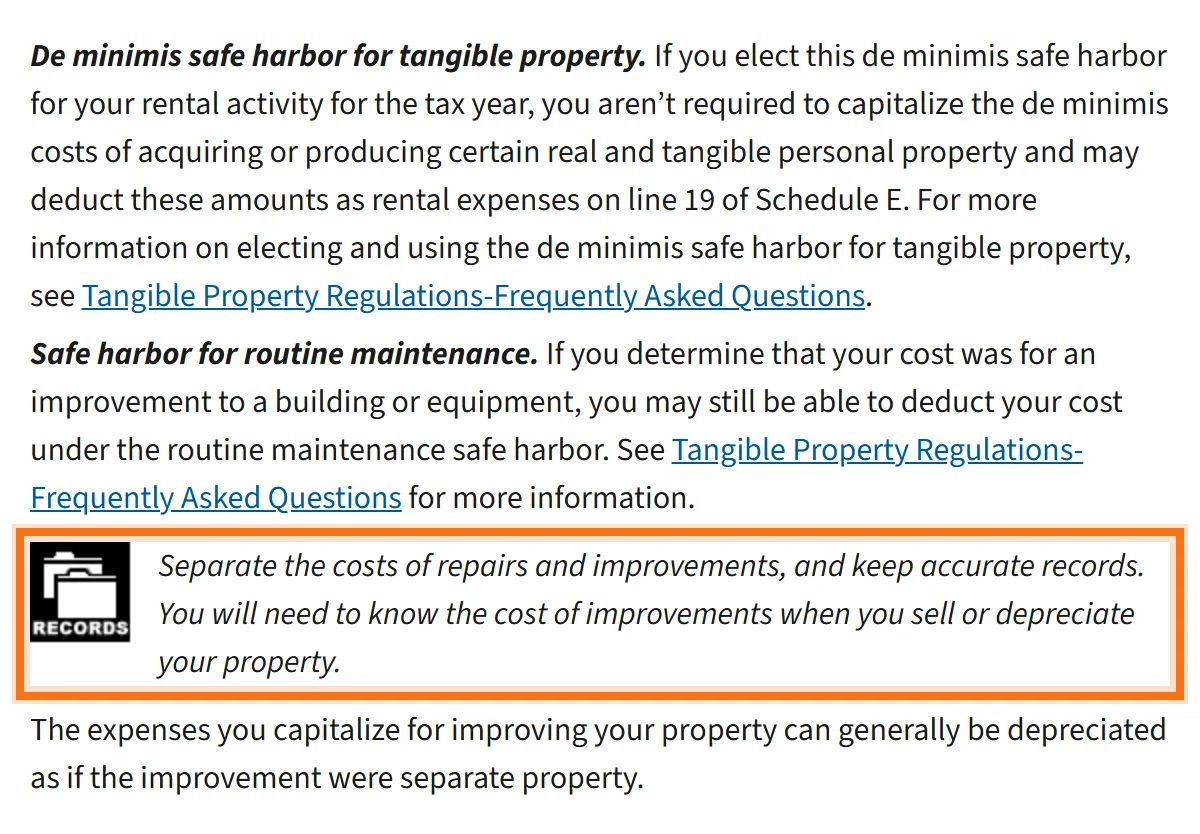
The same page describes a de minimis safe harbor and a safe harbor for routine maintenance that may let some costs be deducted, and points to the IRS Tangible Property Regulations FAQ for the details. Whether a given job is a repair or an improvement depends on the facts, so ask your CPA, and keep itemized invoices with labor and materials per item. This is general information, not tax advice.
How Perpetual handles turnover repairs
What our published pages say about turnovers:
- The sequence. Our renewals and turnovers page describes a move-out inspection against the move-in baseline with documented deposit handling, make-ready coordination ("paint, clean, repair, refresh, sequenced tightly") and marketing that starts before the work finishes.
- Approvals. Repairs under your pre-approved spending limit go ahead; anything larger comes to you with a description, photos and a recommendation. We can usually work with your own vendor if they are insured and reliable.
- Billing. Maintenance coordination is 5% of cost on Full Service and 4.9% on Standard, and make-ready coordination is 3% to 5% of cost on Investor Special, as a percentage of the vendor's invoice; the original invoice is always in your portal, and every completed repair over $500 gets photo or video proof (Guarantee Addendum).
- Before you spend. Our free rental analysis includes make-ready guidance on which improvements raise rent and which just cost money.
Your spending limit, and how make-ready work is billed on your plan, are confirmed in writing in the management agreement before you sign. See our pricing, or call 682-593-7033.
The takeaway: Write the turnover scope once, test each item for repair before replace and for wear versus damage, bundle trades, and file repair and improvement invoices separately.
Questions owners ask
What is a reasonable make-ready budget between tenants?
It depends on the home and how long the tenant stayed, so a fixed number is misleading. Track your own turnovers: cleaning, paint, small repairs and yard for a routine one, with flooring or an appliance in the years those come due. Over a few turnovers you will know your house's normal, and anything well above it deserves a question.
Should I replace carpet with hard flooring between tenants?
Often, when the carpet is at the end of its life anyway. Hard flooring costs more up front but is usually cleaned rather than replaced at turnover, and damaged planks can be swapped if you kept spares. Replacing carpet that still has years left is rarely worth it. IRS Publication 527 lists flooring and wall-to-wall carpeting as improvement examples, so keep that invoice separate.
Can I use my own handyman for turnover work under management?
Many managers allow it if the person is insured and does good work, with the arrangement written into the management agreement. Our maintenance page says we can usually coordinate with your own vendor if they are insured and reliable. The trade-off is scheduling: one late arrival can push back the painter and the cleaner.
Is it cheaper to do the turnover myself?
Sometimes on labor, rarely on the whole turnover. Owners doing their own paint and repairs often take longer, and the extra vacant days are rent you do not receive. If you have the time, the skills and the house is nearby, it can work; otherwise the vacant days usually outweigh the labor saved.
Can I charge the tenant for a full repaint or new carpet?
Only for damage the tenant is legally liable for under the lease, not for normal wear and tear (Property Code 92.104(a) and (b)). Normal wear is deterioration from the intended use of the home, not from negligence, carelessness, accident or abuse (92.001(4)). Charge the actual cost of fixing the damage, list it on the written itemization, and keep the invoice and photos.
Are turnover repairs tax deductible?
Repairs and maintenance generally are, if you are not required to capitalize them; improvements that better, restore or adapt the property are capitalized and depreciated, according to IRS Publication 527. The publication also describes de minimis and routine maintenance safe harbors. Keep repair and improvement invoices separate and ask your CPA.
Related services
Property management in Keller, North Richland Hills and Fort Worth. How full-service management works in Tarrant County →