
Key takeaways
- The first month is mostly hand-overs: keys, records, decisions and money.
- Decide your repair approval limit and reserve before you sign, not after the first repair.
- Every step should leave a record you can open in the portal or hold in your hand.
- If a tenant is in place, agree who tells the tenant, and when, before anyone calls them.
- Check the first statement line by line against the agreement.
Your first 30 days with a property manager are a series of hand-overs. You give the manager keys, records and a few decisions; the manager gives you back a signed agreement, a dated condition record, a rent range, either a tenant who knows where to pay or a new signed lease, and a first statement. Whether your house is in Fort Worth, Keller or North Richland Hills, the month went well if you can point to each of those records on day 30.
This guide is the owner's checklist: what to have ready, what to decide, and what to ask for when a record is missing. How quickly a takeover can start is covered in how quickly a property manager can take over your rental.
The first 30 days, week by week: what you hand over and what you get back
Here is a reasonable order for the first month with any property manager, with what you hand over at each step and the record you should get back. The dates in your own agreement govern; use this to check them:
| When | What the manager does | What you hand over or decide | The record you get |
|---|---|---|---|
| Before you sign | Prepares a rental analysis and a written quote | The address, the rent you hope for, your questions | A rent range from leased comparables and a quote with every fee |
| The day you sign | Sends the agreement and opens your owner account | Your repair approval limit, the reserve, your bank details for payouts | A signed copy of the agreement and your portal login |
| Week 1 | Requests what it needs to run the house | Keys, remotes and codes; HOA contacts and rules; insurance declarations page; warranties; the lease, deposit records and tenant ledger if occupied | A written list of what was received and what is still missing |
| Weeks 1 to 2 | Tells the tenant where to pay and how to ask for repairs; inspects the house | Agree who tells the tenant first, and when | A copy of the tenant notice and a dated condition record with photos |
| Weeks 2 to 3, if vacant | Prices the make-ready, then lists the house once it is market-ready | Approve or decline each make-ready item; confirm the rent and pet decision | Approved estimates, the date the listing went live, a weekly activity report |
| Weeks 3 to 4 | Screens, signs the lease, documents move-in; or collects the first rent from the tenant in place | Nothing new if the criteria and terms were set in writing earlier | The signed lease, the move-in condition report, the deposit receipt |
| First statement | Disburses rent less the fees in the agreement | Check each line against the agreement | A statement with rent, fees, invoices and the payout |
How to read this table: the third column is your job and the fourth is your proof. If a row's record is missing on day 30, ask for it in writing; a gap in the first month rarely closes by itself later. The same steps from the manager's side, vacant house versus tenant in place, are in what happens in the first 30 days after you sign.
Before you sign: the three decisions the manager will ask for
Three numbers belong in the agreement before onboarding starts, because the manager will need them within days. First, your repair approval limit: the dollar amount a repair can reach before the manager must ask you. Second, the reserve: the amount kept back from rent for small repairs. Third, how and where you are paid. If you leave these blank, the first repair call becomes a negotiation.
Read the agreement for term, termination, every fee and who holds the tenant's deposit before you sign; our guide to what to look for in a management agreement walks through each clause. Ask for a signed copy for your own files. If you have not started yet, the steps before signing are in how to get started with a property management company.
Week one: the hand-over box
The first week is about giving the manager what it needs to run the house without calling you. Put these in one box or one shared folder:
- Access: every key, garage remote, gate code and mailbox key, labeled.
- HOA: the association's contact details and its rules, including any leasing rules.
- Insurance: your declarations page. Ask your own agent whether your policy fits a rented house; the differences are in landlord insurance vs. homeowners.
- Systems: warranty papers, the age of the HVAC and water heater if you know it, and any vendor you trust.
- Utilities: which accounts are in your name now, and who will hold them while the house is vacant.
- Tenancy, if occupied: the lease and every addendum, the deposit amount and where it is held, and the tenant's payment ledger.
Ask the manager for a written list of what arrived and what is still missing. The full document list is in documents to give a new property manager.
Weeks one and two: the condition record and the rent check
Early in the month the manager should walk the house and record its condition with dated photos: rooms, systems, exterior and yard. That record is what later inspections and the move-out are compared against, so ask where it will be stored and when you can see it. What a first inspection covers, and what you fix first, is in the inspection when your house first comes under management.
The rent check comes from the same visit. For a vacant house it sets the asking rent and the make-ready list. For a house with a tenant it tells you where the current rent sits, which matters at the next renewal. Ask for a range with the leased comparables behind it, not one number; what a rental analysis should include explains what to look for.
If the house is vacant: make-ready, listing and the lease
For a vacant house, the make-ready comes before the listing. The manager prices each item and you approve or decline it in writing, so the invoices later match what you agreed. Our make-ready guide sorts the work into what pays back and what rarely does.
Once the house is ready, the listing goes live and the reporting starts. Ask how often you will hear about inquiries, showings and feedback, and in what form. Decide the rent, the pet policy and the move-in date range before the first showing, so applications are judged against terms set in advance rather than argued case by case. When an applicant is approved, the lease is signed, the deposit and first rent are collected, and the move-in condition report is made with photos. The order of move-in day is in our move-in checklist.
If a tenant is in place: who tells the tenant, and what moves
With a tenant in place, the first decision is who tells the tenant and when. A tenant who hears it from you first, in a short note that names the new manager, is less likely to suspect a scam when a new payment link arrives. Agree on the wording with the manager and keep a copy of the notice that is sent.
Texas law also requires the landlord to disclose to a tenant the name and address of the holder of record title and, if an off-site company is primarily responsible for managing the dwelling, the management company's name and street address (Property Code 92.201(a)). Among the methods 92.201(b) allows: in writing on or before the seventh day after the tenant's request, or in a copy of the lease or written rules given before the tenant asks. What changes for the tenant is covered in who tells tenants that the manager is changing, and the lease, deposit and ledger hand-over in taking over a house with a tenant in place.
Day 30: checking the first statement
The first statement is where the month's hand-overs turn into numbers. Check these lines against the agreement:
- Rent received matches the lease, and any prorated rent is explained.
- The management fee is the percentage in the agreement, applied the way the agreement says.
- Any placement, enrollment inspection or setup charge appears once, at the amount agreed.
- Each repair has the vendor's invoice behind it.
- The reserve equals the amount you agreed.
- The payout equals rent minus those items, on the date the agreement sets.
For a licensed broker holding your money, TREC rule 22 TAC 535.146(c)(6) requires a documentary record of each trust account deposit or withdrawal and an accounting to each beneficiary at least monthly when there has been activity. How to read each line is in how to read your monthly owner statement.
Gaps that should worry you on day 30
A few gaps on day 30 are worth a direct, written question before they become the pattern:
- No condition record, or one with a handful of photos and no dates.
- A rent figure with no comparables behind it.
- Make-ready invoices for work you never approved in writing.
- Leasing activity you had to ask about rather than being told.
- A first statement that is late, or arrives without invoices.
- A tenant who still calls you because nobody told them who manages the house.
One gap is a question; three is a sign. What to do about a manager whose problems continue is in red flags in the manager you already have. What the rest of the first year brings is in your first year as a landlord.
How Perpetual runs the first month
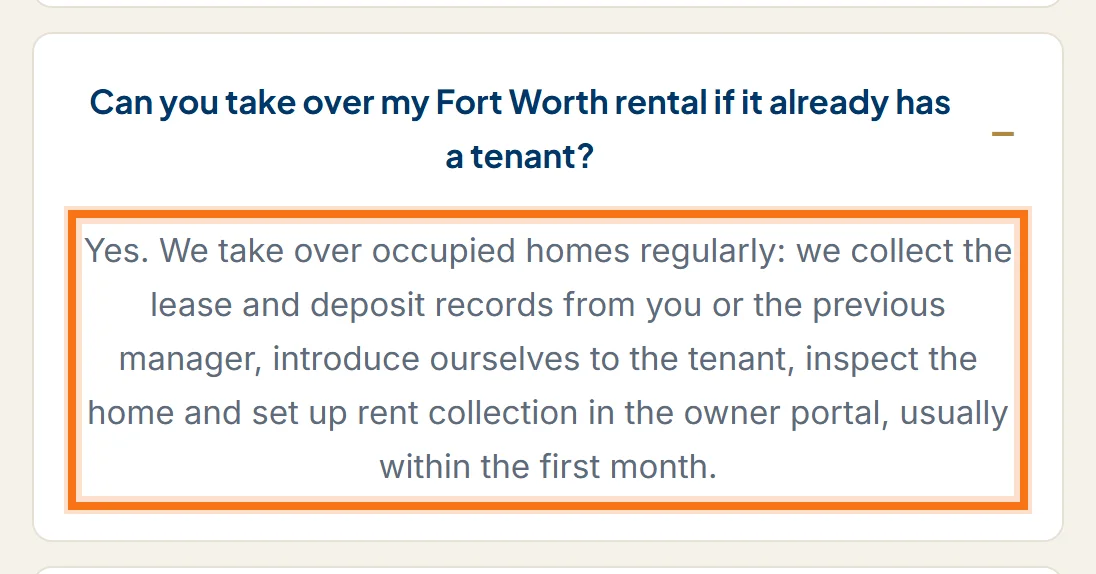
Our page on switching managers sets out the order we follow when we take over a house: review the current agreement and its notice terms, you give notice, then we request the lease and related documents, the security deposit, keys, the tenant ledger, property records and open work orders. Tenants receive instructions on where to pay rent and how to submit maintenance requests. The enrollment inspection establishes a condition record as we begin, and your first monthly statement is the checkpoint for transferred balances and charges. Our Fort Worth and Keller pages say an occupied takeover is usually done within the first month.
Before any of that, the free rental analysis gives you a rent range from leased comparables and a written quote, typically within one business day. Our full-service management page lists everything one agreement covers. The enrollment inspection is included on Full Service, $49 on Standard and $125 on Investor Special, as our price sheet lists.
Under the Perpetual Promise, subject to its Guarantee Addendum, we answer calls and emails within one business day, send a written activity report every week while the home is vacant, list a market-ready home on every major rental platform within 5 business days, and disburse rent we collect by the 10th of each month. Anything the price sheet does not state, such as the exact handover date for your house, is confirmed in writing before you sign. Call 682-593-7033.
The takeaway: On day 30 you should hold a signed agreement, a dated condition record, a rent range, a copy of the tenant notice or a new signed lease, and a first statement that matches the agreement. If one is missing, ask for it in writing now.
Questions owners ask
What does a property manager need from me to get started?
Keys, remotes and codes; HOA contacts and rules; your insurance declarations page; warranty papers; utility account details; and, if the house is occupied, the lease with every addendum, the deposit records and the tenant's payment ledger. Decide your repair approval limit, the reserve and how you want to be paid before you sign, so the manager is not waiting on you in week one.
How long does it take a property manager to find a tenant?
It depends on condition, price and how quickly the make-ready is finished, and no honest manager can promise a number of days. What you can ask for is a clear start: the date the house is market-ready, the date the listing goes live, and a regular report of inquiries, showings and feedback so any price change is made on evidence.
When do I get my first owner statement?
On the disbursement date your agreement sets, for the first month in which rent is collected. For a vacant house that may be the month after move-in; for a tenant in place it is usually the first full rent cycle under the new manager. Perpetual disburses rent we collect by the 10th of each month under our written guarantee, subject to its Guarantee Addendum.
Should I meet the tenant when a property manager takes over?
It helps if you send the tenant a short note first, naming the new manager, so the change does not look like a scam. After that, the manager should be the tenant's only contact for rent and repairs. Meeting the tenant in person is your choice, but agree on what you will and will not discuss so the tenant is not getting two sets of answers.
How do I get started with a property management company?
Start with a rental analysis and a written quote, then read the management agreement for term, termination, every fee, your repair approval limit and who holds the deposit. Once signed, hand over keys, HOA rules, your insurance declarations page and any existing lease and ledger. Perpetual starts with a free rental analysis that includes a written management quote, with no obligation.
What happens in the first 30 days after I sign with a property manager?
The manager collects keys, records and your decisions, records the house's condition with dated photos, checks the rent against leased comparables and either takes over the existing tenant or prepares, lists and leases a vacant house. Day 30 brings the first statement, which should match the agreement line by line with invoices behind every repair. The week-by-week checklist is at the top of this guide.
What records should I have from my property manager by day 30?
A signed copy of the management agreement, a dated condition record with photos, a rent range with the comparables behind it, a copy of the notice sent to the tenant or a new signed lease and move-in report, approved make-ready estimates if the house was vacant, and a first statement with invoices attached. If one is missing, ask for it in writing and note how long the answer takes.
Does Texas law require the tenant to be told who manages the house?
Property Code 92.201 requires a landlord to disclose to a tenant the name and address of the record title holder and, if an off-site company is primarily responsible for managing the dwelling, the management company's name and street address. Among the allowed methods, it can be given in writing by the seventh day after the tenant's request or included in the lease or written rules. This is general information, not legal advice.
Related services
Property management in Keller, North Richland Hills and Fort Worth. How full-service management works in Tarrant County →