Key takeaways
- Month one has four jobs: records and access, a dated condition record, getting rent flowing (a listing or a tenant handover), and your first statement.
- A vacant house and an occupied house follow different tracks after the inspection; know which one you are on.
- Only some steps run on a clock. Written guarantees and two Texas Property Code sections set the dated ones; the rest depends on the house.
- Every repair decision in month one should fit the spending limit you set in the agreement.
- Judge the first statement line by line against the fees in your agreement: it is the template for every month after.
What happens in the first 30 days after you sign with a property manager? Records and keys change hands, the house gets a dated condition record, and then one of two things happens: a vacant house is prepared, priced and listed, or a house with a tenant moves from you or the old manager to the new one. For an owner in Fort Worth, Keller or North Richland Hills, the month ends with portal access and a first statement you can check against the agreement.
This guide lays out the order of events for both tracks, the clocks that really run in month one, what to look for on the first statement and the signs that should worry you. The full guide to the first 30 days covers keys, utilities, insurance and the HOA in more detail.
The first 30 days at a glance
Here is the order of events in month one, for a vacant house and for a house with a tenant, and what you should hold after each step:
| Step | House is vacant | Tenant already in place | What you should have afterwards |
|---|---|---|---|
| 1. Signing | Agreement with every fee in writing; a rent range from the rental analysis | The same, plus the lease, deposit amount and ledger ready to hand over | A signed agreement you can read fee by fee |
| 2. Records and access | Keys, codes, HOA and utility details, insurance, bank details for payouts, a tax form | Plus the lease, deposit and tenant ledger, from you or the previous manager | Portal access with your statements and documents |
| 3. Condition record | An inspection with photos and a list of make-ready items | An inspection scheduled with the tenant under the lease's access terms | A dated record of the condition of the house |
| 4. Rent starts flowing | Make-ready, a rent decision, the listing, showings and screening | The tenant gets written instructions for paying rent and requesting repairs | A live listing, or a tenant paying the new manager |
| 5. First statement | May show only expenses until a tenant moves in | Rent received, fees, repairs and the amount paid out to you | A statement you can match to the agreement line by line |
How to read this table: steps 1 to 3 are the same whatever the house; step 4 is where the tracks split. A manager that skips step 3 has nothing to measure the next move-out against, and that cost shows up at the first deposit dispute.
Records, access and the condition record
The month starts with paperwork. You sign the management agreement, with every fee listed, and the manager asks for what it needs to act for you: proof of ownership, your bank details for payouts, a tax form, your insurance details, keys and codes, HOA contacts and, if there is a tenant, the lease, the deposit amount and the payment ledger.
Then the manager makes a condition record. For a vacant house that visit also produces a make-ready list, ideally split into what the law requires, what renters in your area expect and what is optional. For an occupied house it is an inspection scheduled with the tenant under the access terms of the lease; Texas has no statute setting a notice period for entry, so the lease governs.
Your decisions at this stage: the repair spending limit that goes in the agreement, which owner receives statements and approvals if there are two of you, and which make-ready items are in or out. Log in to the owner portal as soon as you have access and check that the house and, if there is one, the lease are set up.
If the house is vacant: make-ready, price and listing
If the house is empty, the rest of the month is about getting it rented. You approve a rent figure based on leased comparables, the make-ready work you approved is done and checked, and marketing begins: photos, a written listing, syndication to the rental sites and showings. Applicants are screened against written criteria that apply to every applicant.
Do not expect a signed lease by day 30 on a house that needed work. A listing may only have been live for a week or two by then. What you should have is activity: inquiries, showings and feedback, and a view on whether the price or the condition is holding the house back. How the first two weeks of a listing are run is described on our marketing and showings page, and what an empty month costs is in what vacancy really costs.
If a tenant is in place: the handover
If a tenant is in place, the job is moving the tenancy from you, or from the old manager, to the new manager without a missed payment. The lease, the security deposit, the keys, the tenant ledger, the property records and any open work orders are transferred. The tenant receives written instructions for paying rent and requesting repairs, and a number for reporting emergencies.
The lease does not change because management changed; it continues on its existing terms. The new manager should read it and tell you what it would change at renewal. If the lease ends soon, the renewal conversation starts now. The details, including what to do when the lease or the deposit record is missing, are in how a manager takes over a house with a tenant in place and the handover timeline for owners who self-managed.
The first rent and the first statement
For an occupied house, the month closes with rent: it arrives at the manager on the due date, anyone who has not paid gets the lease's late process, and your payout goes out on the schedule in the agreement. For a vacant house, the first rent and the deposit arrive at move-in, with the signed lease and the move-in condition report.
Then comes the first owner statement. It should show rent received, the management fee and any leasing fee as separate lines, every repair with the vendor named, the deposit held, any reserve, and the amount paid to you. Read it against the agreement fee by fee. It is the template for every statement after it, and anything unclear now stays unclear. The guide to reading your owner statement walks through each line.
What going well looks like, and what should worry you
Owners often cannot tell in month one whether they chose well. These are the signals:
- Going well: every request for a document or an approval came with a reason, the inspection report had photos, the rent recommendation came with the comparable houses behind it, and the statement matched the fees you were quoted.
- Going well: you heard from the manager before you had to ask, including in weeks when nothing happened.
- Worrying: the house was listed without an inspection, the deposit does not appear on the records, repairs above your limit were done without asking, or the first statement has a line you cannot match to the agreement.
- Worrying: the tenant called you because no one at the manager answered.
A single slip in month one is not a reason to leave; a pattern is. Raise it in writing and give the manager the chance to fix it.
The clocks that actually run in month one
Most of the first month has no fixed timetable: how long make-ready takes, when the house leases and how fast a previous manager hands over records depend on the house and the people. A few things are dated. Here are the ones our site and the Texas Property Code put in writing:
| Clock | Where it comes from | What it means for you |
|---|---|---|
| Rental analysis within one business day of your request | Our rental analysis page | You see a rent range and a written quote before you sign |
| Listed on every major rental platform within 5 business days of being market-ready | The Perpetual Promise; first month's management fee waived if missed | Once make-ready is done, the listing has a deadline |
| Calls and emails answered within one business day, and a written activity report every week while vacant | The Perpetual Promise; that month's fee credited if missed | You should not have to chase updates in month one |
| Rent we collect disbursed to you by the 10th of each month | The Perpetual Promise; that month's fee waived if missed | The first payout has a date, not just a schedule |
| Name and street address of an off-site management company, within 7 days of a tenant's request | Property Code 92.201 | The tenant must be able to learn who manages the house |
| A phone number for reporting emergencies | Property Code 92.020(d) | The tenant needs the new manager's emergency number from the first day |
How to read this table: the first four rows are our written promises, each with a stated remedy, subject to the Guarantee Addendum; the last two are Texas law and apply to any landlord. Everything else in month one runs on the house's own timeline, which is why updates matter more than speed.
How Perpetual handles this
Perpetual Property Management is broker-owned, with our office at 5755 Rufe Snow Dr in North Richland Hills, and we manage homes in Keller, North Richland Hills, Fort Worth and nearby. What our site states about the start of management:
- Before you sign: the free rental analysis gives a rent range from leased comparables, make-ready guidance and a written management quote with every fee in plain English.
- Taking over a home: we request the lease, deposit, keys, tenant ledger, property records and open work orders, and tenants get new payment and maintenance instructions. We design the handover so rent never misses a beat.
- Condition record: the enrollment inspection is included on Full Service, $49 on Standard and $125 on Investor Special, as our pricing page lists.
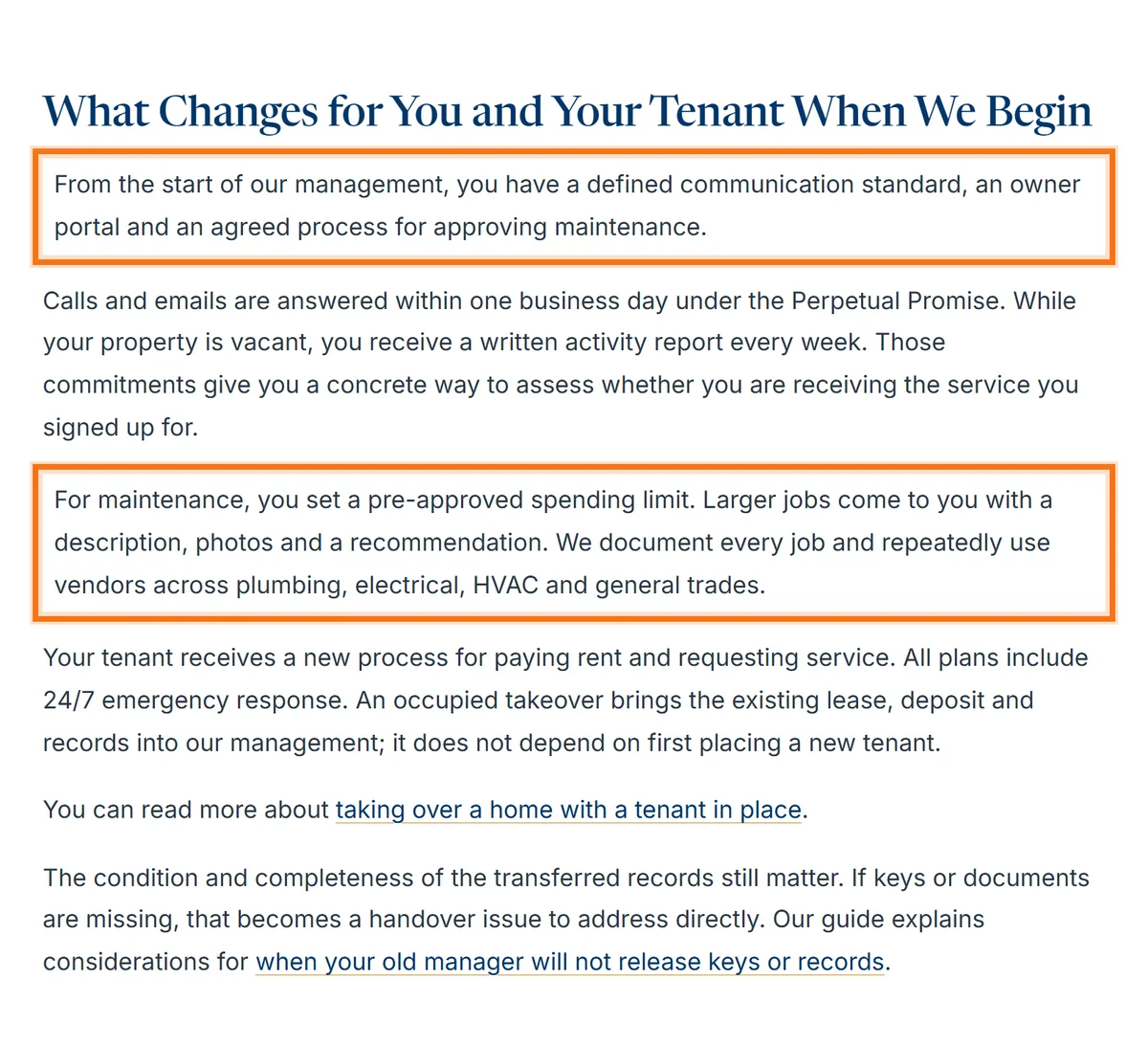
- From the first day: a defined communication standard, the owner portal and an agreed process for approving maintenance.
The site does not publish an onboarding checklist, the order of our first-week tasks or whether any charge applies before the first rent arrives, so those are confirmed in writing before you sign.
If you are about to sign with a manager, or just did, and want to know what month one should look like for your house, call 682-593-7033.
The takeaway: Expect records and access first, a dated condition record next, then a listing or a tenant handover, and a first statement at the end; judge the month by whether each step left you with something in writing.
Questions owners ask
How much contact should I expect from a property manager in the first month?
More than in any later month. Expect requests for documents and approvals at the start, the inspection report soon after, then either the rent recommendation and listing activity (vacant) or handover updates (tenant in place). After the first statement, contact usually settles into monthly reporting plus anything that needs a decision. A quiet first month is worth a phone call.
Do I have to pay anything before the house is rented?
It depends on the agreement, and the written quote should list every charge that can occur before the first rent arrives. Common examples are an enrollment or onboarding inspection fee, any make-ready work you approve, and a reserve some managers ask for to pay the first vendor. Whether the management fee is charged on collected rent or during vacancy is one of the first questions to ask.
What if the house is not rented within the first 30 days?
For a house that needed make-ready work, that is normal: the listing may only have been live for a week or two. What matters is that the manager can show you inquiries, showings and feedback, and has a view on whether the price or the presentation needs adjusting. A manager who cannot show that activity, or proposes a price cut without evidence, is the concern, not the calendar.
Can I change my repair approval limit after the first month?
Usually, by a written amendment to the agreement; check how yours says changes are made. Many owners set the limit conservatively at first and raise it once they have seen a few invoices. Emergency repairs that protect the house or the tenant are usually handled under a separate provision, so check what the agreement says about those.
When do I get my first rent payment after signing with a property manager?
After the manager has collected a month's rent and the payout date in your agreement arrives. For a house with a tenant, that can be the first payout cycle after the handover; for a vacant house, it follows the first rent at move-in. Our written guarantee is that rent we collect is disbursed to you by the 10th of each month, or that month's management fee is waived.
Does my tenant have to be told about the new property manager?
In practice, yes: the tenant needs to know where to pay rent and how to report repairs and emergencies. Texas Property Code 92.020 requires a landlord to give tenants a phone number for reporting emergencies, and 92.201 requires disclosure of an off-site management company's name and street address, within 7 days of a tenant's request or in the lease. This is general information, not legal advice.
Related services
Property management in Keller, North Richland Hills and Fort Worth. How full-service management works in Tarrant County →